
ISO 14001 – Tutorial (about 60 minutes)
- View
ISO 14001 is the international standard that sets out the requirements for an environmental management system (EMS): an organised, repeatable way for an organisation to understand how its work affects the environment, keep within the law, and improve its environmental performance over time. Factories, hospitals, software companies, logistics firms, public bodies and service providers of every size use it, and many obtain an independent certificate that customers, investors and regulators recognise. After this tutorial you will be able to explain how the standard is built, identify environmental aspects and decide which are significant, plan and run an EMS, understand how certification audits work, and avoid the mistakes that turn many systems into paperwork.
Course overview
Edition and status: The current edition is ISO 14001:2026, Environmental management systems — Requirements with guidance for use, the fourth edition, prepared by ISO technical committee ISO/TC 207, subcommittee SC 1 (Environmental management systems), and published in April 2026. It replaces ISO 14001:2015 (now withdrawn) together with its Amendment 1:2024 (the climate-change amendment), whose content has been incorporated into the new text. Certification bodies such as DNV describe the revision as moderate: it keeps the harmonized clause structure and the Plan-Do-Check-Act logic, clarifies existing requirements and adds a few new ones. A transition period of about three years applies; accreditation-body notices put the end of validity for 2015-edition certificates around April–May 2029, so check the exact date with your certification body. Verified 2026-10-29 against the transition notice of the Irish National Accreditation Board (INAB NF50, June 2026) and the publication notes of DNV and DQS (April 2026); the ISO catalogue page could not be retrieved automatically, so confirm the details there if you need the official record. Where this tutorial mentions a change introduced in 2026, it says so; everything else applies to both editions.
Who this is for: engineers, operations and facilities staff, production and site managers, quality, health-and-safety and compliance professionals, procurement and sustainability teams, and anyone who has been told "we are going for ISO 14001" and wants to understand what that means for their daily work. It is also useful for people who will be interviewed by an auditor and want to know what the auditor is looking for.
Prerequisites: none. A general idea of how an organisation runs (processes, managers, suppliers, permits) helps, but every environmental and management-system term is explained when it first appears. You do not need a background in environmental science.
By the end of this tutorial:
- You will be able to explain the purpose of ISO 14001 and why it is a management-system standard rather than a list of environmental limits.
- You will be able to define the core vocabulary, including environmental aspect, environmental impact, compliance obligation and life cycle perspective.
- You will be able to describe the clause 4 to 10 structure and connect it to the Plan-Do-Check-Act cycle.
- You will be able to identify environmental aspects, apply significance criteria and link the results to controls and objectives.
- You will be able to outline how certification works, from stage 1 and stage 2 audits to surveillance, recertification and the 2026 transition.
- You will be able to apply the standard to a realistic organisation and recognise common pitfalls in scope, aspects and evidence.
- You will be able to compare ISO 14001 with related schemes such as EMAS, ISO 9001, ISO 45001 and ISO 50001.
Lesson 1 – Origins, purpose and scope
Why manage the environment as a system?
Almost every organisation already does something for the environment. A plant has a wastewater permit, an office recycles paper, a fleet manager watches fuel use, and someone fills in waste transfer notes. The problem is that these efforts are usually scattered. Nobody can say whether they cover the activities that matter most, whether the organisation is actually meeting every legal duty, who is responsible when a process changes, or whether performance is getting better or worse. Environmental work becomes a reaction to the latest inspection, complaint or incident.
ISO 14001 answers this by treating the environment as something to be managed, in the same way an organisation manages quality, money or safety. It does not tell you what your emissions limit should be or which technology to buy. Instead it requires you to understand your situation, find out how your activities interact with the environment, decide which of those interactions are significant, put controls and objectives in place, check that they work, and keep improving. The organised set of policies, processes, roles, plans and records that does this is the environmental management system, or EMS.
A short history
Environmental management standards grew out of the quality-management movement of the 1980s and the growing public concern about pollution and resource use. The British standard BS 7750, published in 1992, was one of the first national EMS standards. The same year, the Rio Earth Summit encouraged business to take a more systematic approach to sustainable development, and in 1993 ISO set up technical committee ISO/TC 207 to develop international environmental management standards. The first edition of ISO 14001 appeared in 1996. A second edition in 2004 clarified the text and improved compatibility with ISO 9001.
The third edition, ISO 14001:2015, was a major rewrite. It adopted the common high-level structure that ISO uses for all management-system standards, so that environment, quality and safety systems could share the same skeleton. It also raised the bar: more emphasis on top management leadership, on the organisation's context, on protecting the environment rather than only preventing pollution, on thinking across the life cycle of products and services, and on communication. In 2024 an amendment asked organisations to consider whether climate change is a relevant issue for their EMS.
The fourth edition, ISO 14001:2026, builds on 2015 rather than replacing its logic. It aligns with the updated harmonized structure that ISO published for all management-system standards, folds in the climate-change amendment, widens the attention given to environmental conditions such as biodiversity, pollution levels and the availability of natural resources, and adds explicit requirements for managing changes to the EMS. You will meet these points in Lessons 3 and 4.
What the standard covers – and what it does not
ISO 14001 applies to any organisation, of any size and type, that wants to manage its environmental responsibilities systematically. It covers the environmental aspects of the organisation's activities, products and services that the organisation can either control directly or influence, taking a life cycle perspective into account. The organisation decides the boundaries of the EMS, as long as the decision is honest and documented.
Three things are deliberately outside its scope. First, it sets no absolute environmental performance levels: two certified companies in the same sector may have very different emissions. What it requires is commitment to fulfil legal and other obligations, to protect the environment (including preventing pollution), and to improve continually. Second, it is not a law: compliance with environmental legislation remains a separate, mandatory duty, and the EMS is the tool for meeting it reliably. Third, it is not a product label or an eco-claim; holding a certificate says that the management system conforms, not that every product is "green".
Why organisations adopt it
- Legal confidence. A systematic register of obligations, plus periodic checks of compliance, reduces the risk of fines, permit breaches and prosecutions.
- Cost and resource efficiency. Looking closely at energy, water, materials and waste often reveals savings.
- Customer and tender requirements. Many large buyers and public bodies ask suppliers for an EMS or certificate.
- Resilience. Thinking about environmental conditions such as flooding, heat, water scarcity or resource prices makes the business better prepared.
- Trust and reporting. An EMS produces reliable data that supports sustainability and climate reporting and gives stakeholders confidence.
Lesson 2 – Key concepts and vocabulary
ISO 14001 contains its own terms and definitions in clause 3. The wording below is a plain-language paraphrase, not the official text, but it captures what each term means in practice.
- Environment – the surroundings in which an organisation operates: air, water, land, natural resources, plants and animals, people, and the way they interact. It can extend from the immediate site to the global climate.
- Environmental management system (EMS) – the part of the organisation's overall management system used to manage environmental aspects, fulfil compliance obligations and address risks and opportunities.
- Environmental aspect – an element of an activity, product or service that interacts, or can interact, with the environment. Burning gas in a boiler, discharging rinse water, using packaging or running a data centre are aspects.
- Environmental impact – a change to the environment, harmful or beneficial, that results wholly or partly from an aspect. The aspect is the cause; the impact is the effect. Gas combustion (aspect) contributes to climate change and local air pollution (impacts).
- Significant environmental aspect – an aspect that has, or can have, one or more significant impacts, judged against criteria the organisation sets. Significant aspects drive most of the EMS: controls, objectives, training and monitoring.
- Environmental condition – the state or characteristic of the environment at a point in time, such as air quality, river flow, biodiversity on a site, or the regional climate. Conditions can affect the organisation just as the organisation affects them.
- Compliance obligations – legal requirements the organisation must meet (laws, permits, licences, regulations) and other requirements it has chosen to adopt (customer contract clauses, industry codes, voluntary commitments). Once adopted, voluntary requirements are treated like legal ones inside the EMS.
- Life cycle perspective – looking at the consecutive stages of a product or service, from raw material acquisition through design, production, transport, use, end-of-life treatment and final disposal, and asking where the organisation can control or influence impacts. It is not the same as a full quantitative life cycle assessment.
- Environmental performance – measurable results related to the management of environmental aspects, for example kilograms of waste per unit produced or number of permit exceedances.
- Prevention of pollution – using processes, practices, materials, products, substitution or treatment to avoid, reduce or control pollution, in order to lessen adverse impacts.
- Interested party – a person or organisation that can affect, be affected by, or believe itself to be affected by the organisation's decisions: regulators, neighbours, customers, employees, investors, insurers, local communities, NGOs.
- Risks and opportunities – potential adverse effects (threats) and potential beneficial effects (opportunities). ISO 14001 links them to environmental aspects, compliance obligations and the organisation's context.
- Documented information – information the organisation must control and maintain, and the medium that contains it. "Maintain" usually means a living document such as a procedure; "retain" means a record kept as evidence.
- Nonconformity and corrective action – a nonconformity is a failure to meet a requirement (of the standard, the law or the organisation's own EMS). Corrective action removes its cause so that it does not happen again.
- Continual improvement – an ongoing, repeated effort to make performance better. It does not have to happen everywhere at once or at a fixed rate.
Aspects and impacts: the heart of the standard
If you remember one idea from this lesson, make it the aspect–impact relationship. An organisation cannot directly "manage climate change" or "manage river quality". It can manage the things it does that affect them: how much fuel it burns, what it discharges, which materials it buys, how its products are designed and disposed of. By describing activities in terms of aspects, ISO 14001 turns broad environmental concerns into specific, controllable points in daily work.
Aspects should be considered under several operating situations. Normal conditions are routine operation. Abnormal conditions include start-up, shutdown, maintenance and cleaning, when emissions or waste can differ from normal. Emergency situations are foreseeable accidents such as a chemical spill, a fire with contaminated firefighting water, or a refrigerant leak. The 2026 edition makes it more explicit that these situations are considered when aspects are determined and evaluated.
Control and influence
An organisation has direct control over its own processes: it can change a machine setting, a procedure or a purchase decision. It has influence over others: it can set requirements in supplier contracts, design products that use less energy in use, or give customers disposal instructions. ISO 14001 expects both to be considered. A software company may have small on-site impacts but considerable influence through the energy efficiency of its cloud workloads and the hardware it buys.
Lesson 3 – Structure of the standard
ISO 14001 follows the harmonized structure (earlier called the high-level structure or Annex SL) that ISO uses for all its management-system standards. The same clause numbers and titles appear in ISO 9001 (quality), ISO 45001 (occupational health and safety), ISO/IEC 27001 (information security) and ISO 50001 (energy). This makes it much easier to run an integrated management system.
Clauses 1 to 3 are introductory: scope, normative references (ISO 14001 has none) and terms and definitions. The requirements an auditor checks are in clauses 4 to 10. Annex A gives informative guidance on using the requirements; it explains intent and gives examples, but it does not add requirements. The 2026 edition expands that guidance noticeably.
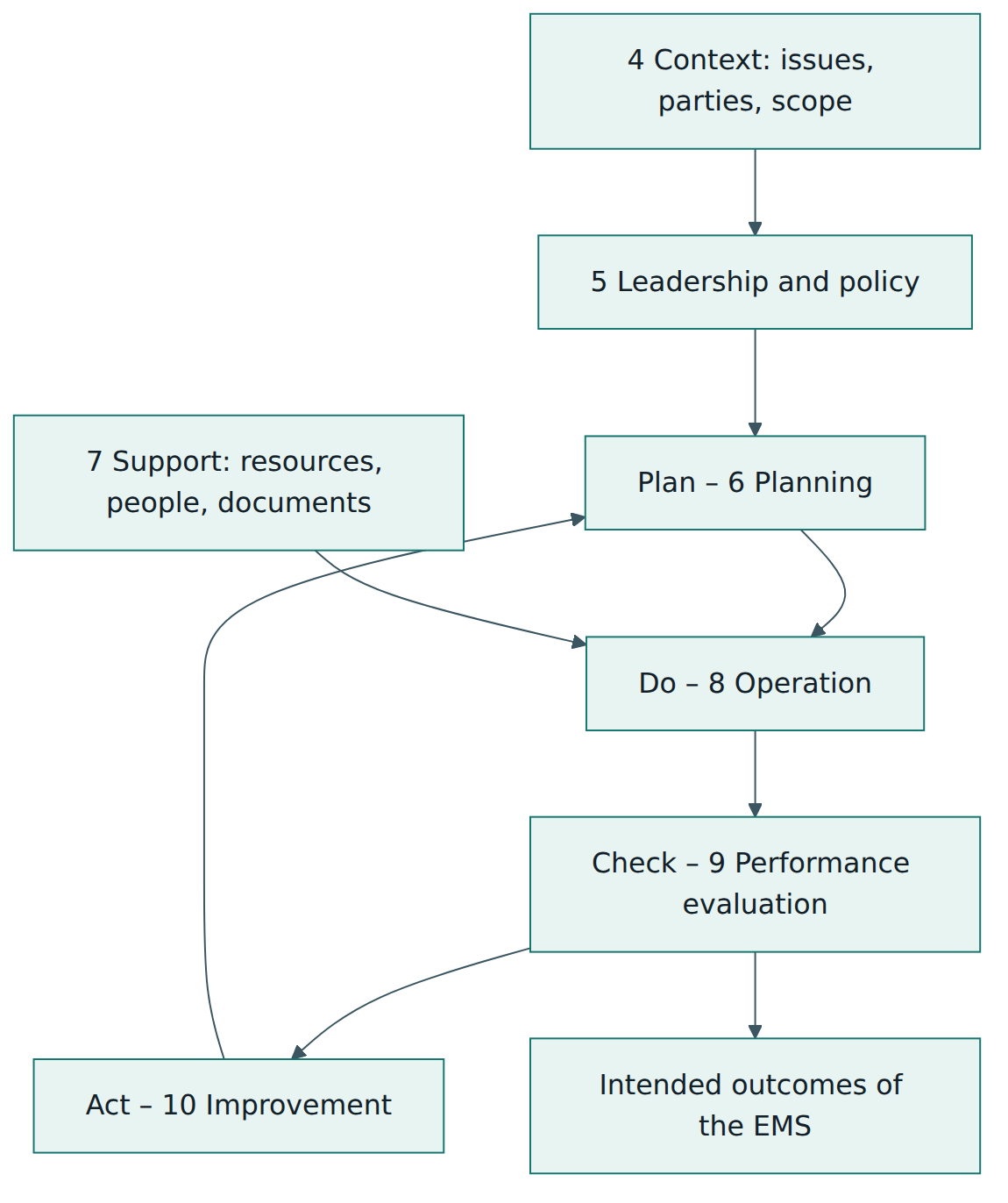
Clause 4 – Context of the organization
Before designing anything, the organisation must understand its situation. It identifies the external and internal issues relevant to its purpose that affect its ability to achieve the intended outcomes of the EMS. Since the 2024 amendment, climate change must be considered as a possible issue, and the 2026 edition widens this to environmental conditions more generally, such as biodiversity and ecosystem health, pollution levels and the availability of natural resources. The organisation also identifies interested parties, works out which of their needs and expectations are relevant, and decides which of those become compliance obligations. Finally it defines and documents the scope of the EMS (which sites, activities, products and services are covered) and commits to establishing, implementing, maintaining and continually improving the system.
Clause 5 – Leadership
Top management (the people who direct the organisation at the highest level) must take accountability for the EMS's effectiveness, make sure the environmental policy and objectives fit the strategy, integrate EMS requirements into business processes, provide resources, and support the people who make the system work. The 2026 edition stresses that this support extends to relevant roles throughout the organisation, not only to managers. Clause 5 also requires an environmental policy that includes commitments to protect the environment (including preventing pollution), to fulfil compliance obligations and to continually improve the EMS to enhance environmental performance. Roles, responsibilities and authorities must be assigned and communicated.
Clause 6 – Planning
This is where the specific content of the EMS is decided. In the 2015 edition it contained four sub-clauses under actions to address risks and opportunities: general, environmental aspects, compliance obligations and planning action. The 2026 edition reorganises the material: the determination of environmental aspects and compliance obligations remains, risks and opportunities now have a dedicated sub-clause (6.1.4) that draws on the context work of clauses 4.1 and 4.2 as well as on aspects and obligations, and planning of actions follows. Clause 6.2 covers environmental objectives and the plans to achieve them: what will be done, what resources are needed, who is responsible, when it will be completed and how results will be evaluated. A new clause 6.3, planning of changes, requires the organisation to carry out changes to the EMS in a planned and controlled way.
Clause 7 – Support
Clause 7 provides what the system needs to function: resources; competence of people whose work affects environmental performance or compliance; awareness of the policy, the significant aspects relevant to each person's work, their contribution to the EMS and the consequences of not following requirements; communication; and documented information. Communication receives more attention in ISO 14001 than in many other management-system standards. The organisation must decide what, when, with whom and how to communicate internally and externally, consider its compliance obligations when doing so, and make sure environmental information it communicates is reliable and consistent with the data generated by the EMS.
Clause 8 – Operation
Clause 8.1 requires operational planning and control: setting criteria for processes, applying controls according to those criteria, and keeping enough information to be confident that processes run as planned. It also asks the organisation to consider the life cycle perspective, for example by addressing environmental requirements in design and in the purchase of products and services, communicating relevant requirements to external providers, and providing information about significant impacts during transport, use and end-of-life of products. In the 2026 edition the old focus on "outsourced processes" is widened to externally provided processes, products and services, which strengthens supply-chain control. Clause 8.2 covers emergency preparedness and response: planning responses to foreseeable emergencies, taking action to prevent or reduce consequences, testing the planned responses where practicable, and reviewing them after incidents or tests.
Clause 9 – Performance evaluation
The organisation decides what needs to be monitored and measured, how, when, and how results are analysed and evaluated, using calibrated or verified equipment where relevant. A distinctive ISO 14001 requirement is the periodic evaluation of compliance: checking, at a planned frequency, whether every compliance obligation is actually being met, acting when it is not, and keeping evidence of the results. Clause 9 also requires an internal audit programme (the 2026 edition adds that each audit must have defined objectives, alongside its criteria and scope) and a management review in which top management considers inputs such as performance trends, compliance status, audit results, changes in context and opportunities for improvement, and records decisions.
Clause 10 – Improvement
When a nonconformity occurs, the organisation reacts to control and correct it and deal with consequences, including mitigating adverse environmental impacts; it then evaluates the cause and takes corrective action proportionate to the significance of the effects. It must also continually improve the suitability, adequacy and effectiveness of the EMS to enhance environmental performance.
Lesson 4 – How it works in practice
Knowing the clauses is not the same as running an EMS. This lesson walks through a typical implementation sequence and the main working tools. Real projects overlap these steps, but the order below reflects the dependencies between them.
Step 1 – Commitment and a project team
An EMS that lives only in the environmental or quality department does not survive. Top management needs to understand why the organisation is doing this, approve the scope, appoint someone to coordinate the work (often called the EMS manager or environmental coordinator, although the standard does not require a specific title) and give that person access to operations, maintenance, procurement, design, facilities and finance. Many organisations begin with a gap analysis: a structured comparison of current practice with each clause.
Step 2 – Context, interested parties and scope
Short workshops with managers usually work better than long documents. A useful output is a one-page list of external issues (regulation, climate risks, water availability, customer demands, local community concerns) and internal issues (age of equipment, skills, culture, finances), plus a table of interested parties and their relevant requirements. The scope statement then names the sites, activities, products and services covered. Excluding a dirty process or a troublesome site to make certification easier undermines credibility and will be challenged by auditors.
Step 3 – Aspects and impacts register
The aspects register is the central working tool. Teams walk through each activity, product and service and ask: what goes in (energy, water, materials, chemicals), what comes out (emissions, discharges, waste, noise, heat, products), and what could go wrong? Each aspect is linked to its impacts and to the operating situation (normal, abnormal, emergency). Then the organisation applies its significance criteria.
Significance criteria are the organisation's own choice, but they should be documented and applied consistently. Common criteria include the scale or quantity, the severity of the potential impact, how likely it is, how long it lasts, the sensitivity of the receiving environment (for example a nearby river or protected habitat), whether a legal requirement applies, and the concerns of interested parties. Many organisations use a simple scoring matrix. Whatever method is used, the result is a list of significant aspects that flows into the rest of the system.
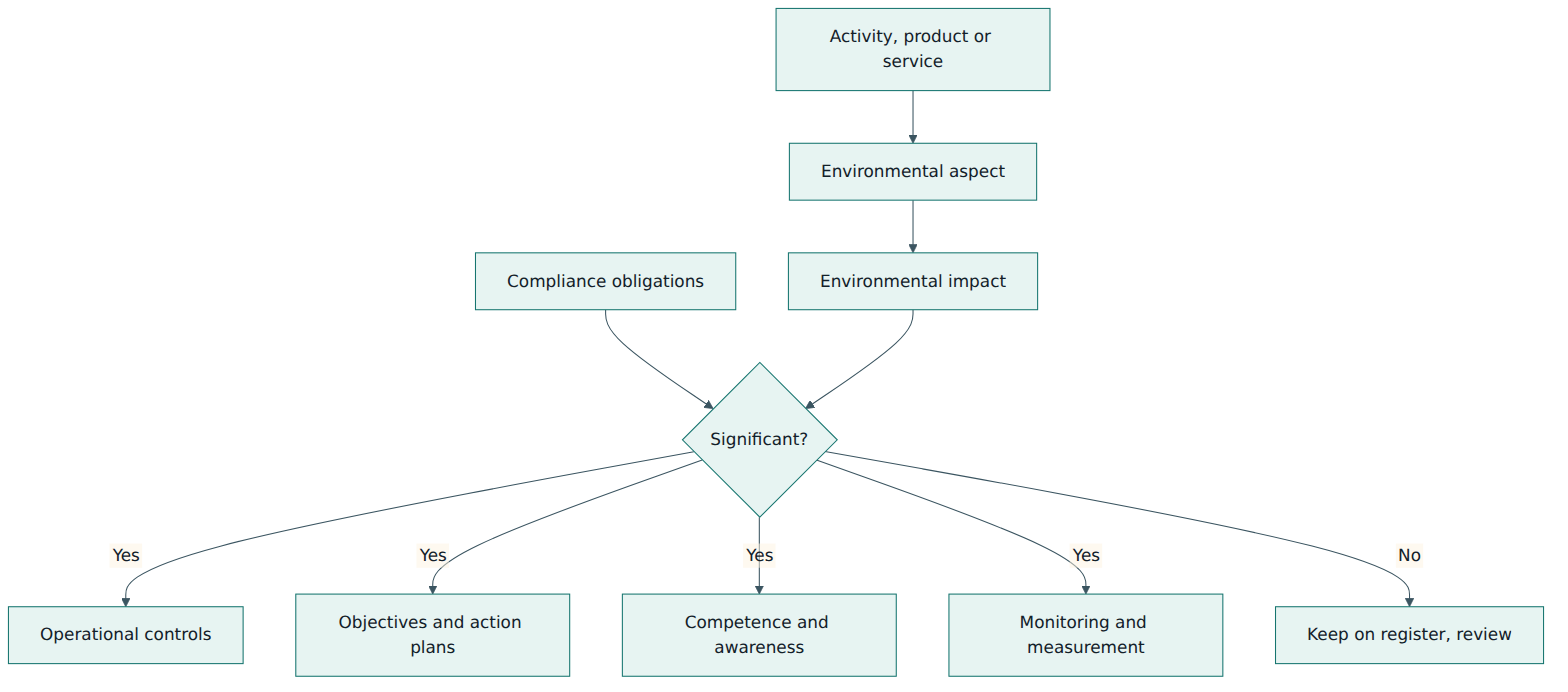
Step 4 – Compliance obligations register
Alongside the aspects register sits a register of compliance obligations: environmental laws and regulations, permit conditions, local by-laws, waste and packaging rules, customer contract clauses and voluntary commitments. For each obligation the organisation records which activity it applies to, what has to be done and who is responsible. Legal-update services or specialist advisers help keep the register current. The register is not an end in itself; it feeds operational controls, training, monitoring and the evaluation of compliance.
Step 5 – Risks, opportunities and objectives
Next, the organisation brings together what it has learned from context, interested parties, aspects and obligations, and decides which risks and opportunities need action. A risk might be a permit renewal that will impose stricter limits, a supplier located in a flood zone, or reputational damage from a poorly managed waste stream. An opportunity might be a lower-carbon process, a circular-economy partnership that turns waste into a product, or a customer demand for verified environmental data.
Environmental objectives translate priorities into results. Good objectives are consistent with the policy, measurable where practicable, monitored, communicated and updated. Each needs an action plan: what, resources, owner, deadline and how success will be evaluated. "Reduce natural gas use per tonne of product by 8 % within two years by recovering heat from the curing ovens" is far more useful than "use less energy".
Step 6 – Operational control along the life cycle
Operational controls are the everyday arrangements that keep significant aspects under control: work instructions for chemical handling, maintenance schedules for abatement equipment, segregation rules for waste, checks on wastewater before discharge, energy settings for equipment, and environmental criteria in purchasing and design. The life cycle perspective reminds the organisation to look upstream and downstream, not only at its own fence line.
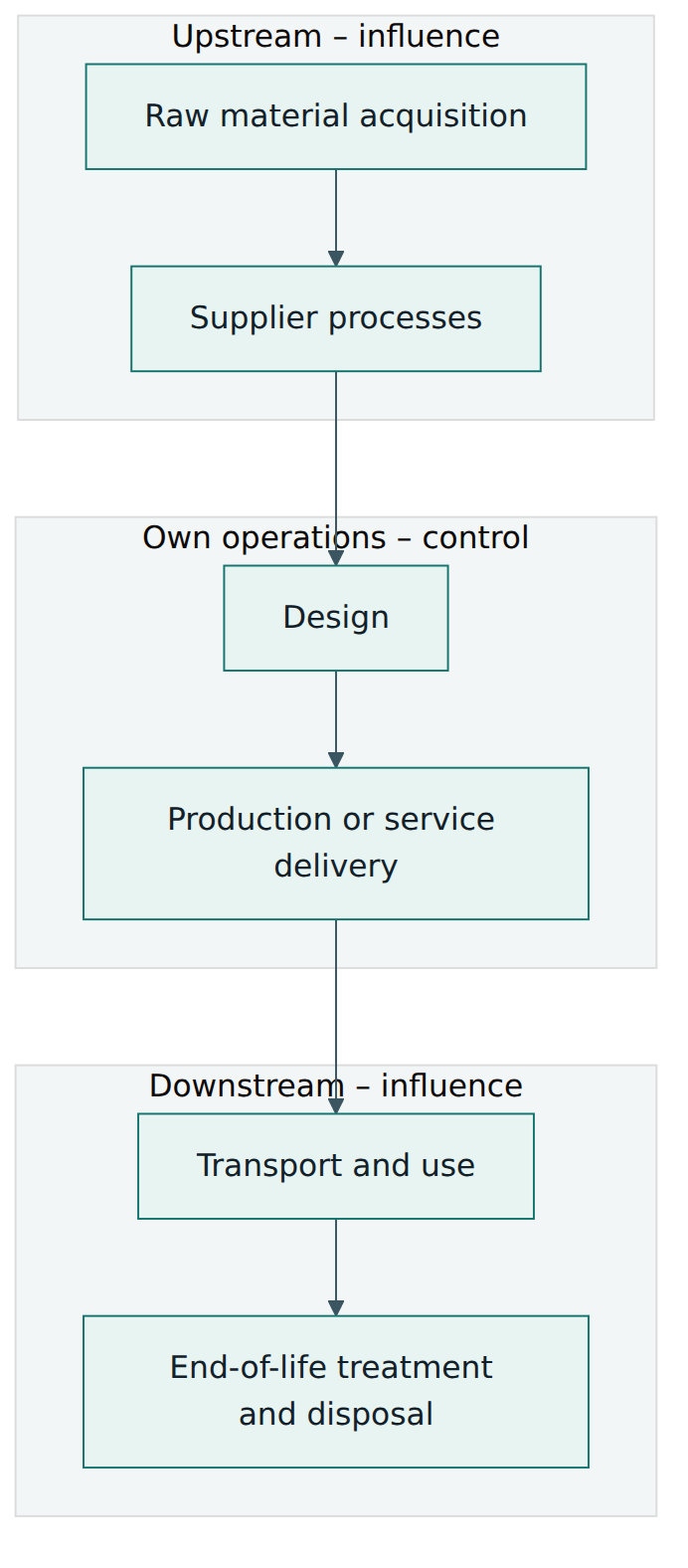
The life cycle perspective does not require a formal life cycle assessment. It asks for sensible questions at each stage. Could a design change make a product easier to repair or recycle? Can a purchasing specification exclude a hazardous substance? Do customers need instructions to dispose of a product safely? Should a transport contract favour lower-emission vehicles?
Step 7 – Emergency preparedness
Foreseeable emergencies identified in the aspects register get a planned response: spill kits and drain covers, containment for firefighting water, procedures for gas or refrigerant leaks, contacts for regulators and neighbours. Responses are tested where practicable, for example with a spill drill, and reviewed after tests and real incidents.
Step 8 – Managing change
Changes such as a new product line, a new chemical, a move to a new building, a reorganisation or a new outsourced service can create new aspects or obligations. The 2026 edition's clause on planning of changes makes it explicit that changes to the EMS must be planned: consider the purpose and possible consequences, the integrity of the EMS, resources and responsibilities. In practice, the simplest way to meet this is to add an environmental check to existing change-approval processes such as capital project reviews, engineering change requests and supplier onboarding.
Step 9 – Monitoring, compliance evaluation, audit and review
The organisation monitors its key environmental indicators (energy, water, waste, emissions, incidents, complaints), evaluates compliance at planned intervals, runs internal audits across the scope and holds management reviews. These activities generate the evidence that the system works and the information that drives improvement. Internal auditors should be objective and impartial, which usually means they do not audit their own work; ISO 19011 gives guidance on auditing management systems.
Roles and documented information
ISO 14001 does not prescribe an organisation chart. Typical roles are top management (accountability, policy, resources, review), an EMS coordinator (day-to-day running), process owners (controls in their areas), internal auditors and every employee (awareness and following controls). The standard requires certain documented information, including the scope, policy, significant aspects and the criteria used to determine them, compliance obligations, objectives, evidence of competence, monitoring results, compliance evaluation results, the audit programme and results, management review results, and nonconformities with corrective actions. Beyond that, the organisation decides how much documentation it needs. A thick manual is not required; many effective systems run on a handful of registers, a few procedures and records generated by normal tools.
Lesson 5 – Assessment, certification and compliance
Ways to demonstrate conformity
ISO 14001 can be used without any certificate. An organisation can make a self-declaration of conformity, seek confirmation from parties with an interest in it such as customers, ask an external party to confirm its self-declaration, or seek certification by an external organisation. Third-party certification is the best-known route and the one customers and tenders most often ask for.
Who certifies
ISO writes standards; it does not certify organisations. Certificates are issued by certification bodies, which are ideally accredited by a national accreditation body such as UKAS in the United Kingdom, ANAB in the United States, DAkkS in Germany or NABCB in India. Accreditation bodies check that certification bodies are competent and impartial, applying ISO/IEC 17021-1 (requirements for bodies auditing management systems) and ISO/IEC 17021-2 (competence requirements for EMS auditing and certification). Accreditation bodies that have signed the International Accreditation Forum (IAF) Multilateral Recognition Arrangement (MLA) recognise each other's accredited certificates. Certificates from unaccredited bodies are often not accepted by large customers and public buyers.
The certification cycle
Initial certification is a two-stage audit. The stage 1 audit reviews readiness: the scope, documented information, the aspects and obligations registers, the site and its processes, and whether internal audit and management review have taken place. It identifies concerns that could lead to nonconformities. The stage 2 audit evaluates implementation and effectiveness on site: auditors interview people, observe operations, sample records and follow significant aspects from the register to the controls on the shop floor.
Audit findings are typically graded. A major nonconformity is a failure that affects the EMS's ability to achieve its intended outcomes, such as a significant aspect with no controls or no evaluation of compliance at all; certification cannot be granted until it is corrected and verified. A minor nonconformity is a lapse that does not undermine the system; the organisation submits a corrective action plan. Auditors may also record opportunities for improvement.
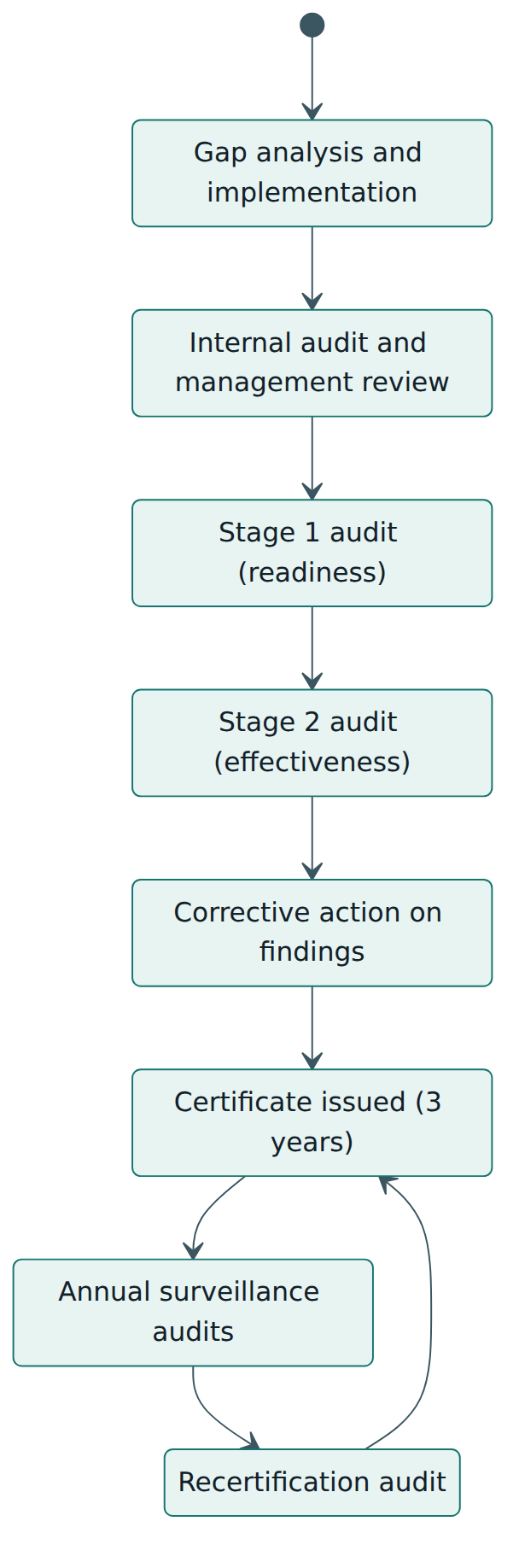
Certificates are normally valid for three years. Surveillance audits take place at least once a year in the intervening years and sample parts of the system; a recertification audit before expiry starts the next cycle. Audit duration depends on the number of people, the complexity of the environmental aspects and the number of sites, following IAF rules. Multi-site organisations can sometimes be certified with sampling of sites if they meet specific conditions.
What auditors look for
- A credible scope that does not hide significant activities.
- Aspects identified across normal, abnormal and emergency situations, with consistent significance criteria and a life cycle view.
- A current compliance obligations register and evidence that compliance has been evaluated and gaps acted upon.
- Controls in operation that match the documents, and people who know the significant aspects relevant to their work.
- Objectives with measurable progress, and management reviews that lead to decisions.
- Corrective actions that address root causes, not only symptoms.
Certification is not legal compliance
A certificate does not prove that an organisation complies with every law. It shows that the organisation has a system to identify its obligations, evaluate compliance and act on gaps. Auditors sample; regulators inspect. An organisation can still receive a regulatory notice while certified, and how it responds through its EMS is what matters to the certification body.
The 2026 transition
Organisations certified to ISO 14001:2015 must move to the 2026 edition within the transition period, which accreditation and certification bodies put at three years from publication, ending around April–May 2029. Typical steps are a gap analysis against the new requirements, updates to the context analysis (environmental conditions, biodiversity, resource availability), a revised approach to risks and opportunities, a documented way of planning changes, broader controls over externally provided processes, products and services, audit objectives for each internal audit, internal audits and a management review covering the changes, and then a transition audit, often combined with a surveillance or recertification visit.
Lesson 6 – Worked example: Riverbend Coatings
Riverbend Coatings (a fictional company) employs 140 people at one site beside a small river. It cleans, pre-treats and powder-coats metal parts for furniture and appliance manufacturers. Two of its biggest customers have told it that suppliers without a certified EMS will not be considered for new contracts after next year. The managing director appoints the facilities engineer, Amara, as EMS coordinator and gives her half her time for a year.
Context and scope
In two workshops the management team lists external issues: a wastewater permit due for renewal with tighter metal limits, rising gas prices, more frequent heavy rainfall that has twice flooded the yard, and customer requests for product carbon data. Internal issues include ageing curing ovens and limited environmental knowledge among shift leaders. Interested parties include the environmental regulator, the water utility that receives the effluent, neighbours who have complained about odour, customers, employees and the company's bank. Following the 2026 edition, the team also considers the river's condition: it is a habitat for protected fish, so any discharge is sensitive. The scope covers the entire site, all coating lines, the warehouse and the delivery vehicles.
Aspects and significance
Amara walks each process with its operators. The register lists, among others: gas combustion in the curing ovens; electricity for compressors and extraction; rinse water containing metals from the pre-treatment line; sludge from wastewater treatment (hazardous waste); solvent-based cleaning at the masking station (volatile organic compound emissions and odour); powder overspray; packaging waste; diesel use by the vans; and emergency aspects such as a spill of acid from the pre-treatment tanks or contaminated firefighting water reaching the river.
The team scores each aspect for severity, likelihood, quantity, sensitivity of the receiving environment, legal relevance and stakeholder concern. Significant aspects: metal-bearing wastewater, hazardous sludge, oven gas use, solvent emissions and the acid spill scenario. Packaging waste scores low and stays on the register for annual review.
Obligations, risks and objectives
The compliance obligations register lists the discharge permit conditions, hazardous waste rules, solvent emission regulations, fuel storage rules, and two customer contract clauses requiring restricted-substance declarations. Risks include the permit renewal and flooding of the chemical store; opportunities include heat recovery from the ovens and a customer interest in low-carbon coated parts.
Objectives for the first two years: no permit exceedances; a 10 % reduction in gas use per square metre coated through oven heat recovery and better scheduling; replacing the solvent cleaner with a water-based product; and moving the chemical store above the flood level. Each has an owner, budget, deadline and indicator.
Controls and support
Operational controls include daily pH and metals checks on the treated effluent before discharge, a maintenance schedule for the treatment plant, labelled and bunded chemical storage, waste segregation rules with records for every sludge collection, and an environmental question in the purchasing checklist for new chemicals. Shift leaders receive training on the significant aspects in their area and on what to do if an effluent check fails. A short induction module covers awareness for all staff and contractors. The emergency plan for acid spills is tested by a drill in which a team closes the drain valve and deploys absorbent within the target time; the drill reveals that the night shift does not know where the valve key is kept, which becomes a corrective action.
A change and a nonconformity
Midway through the year, sales wins a contract that requires a new zinc-phosphate pre-treatment step. Under the planning-of-changes process the project review asks Amara to assess the change: it adds a new chemical, a new sludge composition and possibly a new permit condition. The aspects and obligations registers are updated, the regulator is consulted before commissioning, and operators are trained before the line starts.
In month nine, an internal audit finds that the effluent checks were skipped for three days during staff holidays. Riverbend records a nonconformity, confirms from the treatment plant data that no limit was exceeded, and investigates the cause: only one person was trained for the check. The corrective action trains two more operators per shift and adds an automatic alarm when a daily check is missing. A later audit verifies the fix.
Review and certification
At the management review the directors see gas use down 6 % so far, the solvent replacement complete, no permit exceedances, one nonconformity closed and the chemical store relocation scheduled. They approve funding for heat recovery and add a supplier engagement objective on packaging. The stage 1 audit raises a concern that significance criteria were applied inconsistently to two aspects; Amara corrects this before stage 2. The stage 2 audit finds one minor nonconformity (calibration records for the pH meter were incomplete), which is fixed with a corrective action plan, and the certificate is issued. The first surveillance audit a year later will sample the new pre-treatment line and the heat-recovery project.
Notice how every element connects: the context identified the sensitive river, which raised the significance of the wastewater aspect, which drove the controls, training, monitoring and objectives that the auditors then followed through the system.
Lesson 7 – Relationship to other standards and frameworks
ISO 14001 sits in a family of environmental standards produced by ISO/TC 207 and alongside other management-system standards that share its structure. Understanding the neighbours helps you avoid duplication and choose the right tool for each question.
- ISO 14004 gives general guidelines for implementing an EMS; it is guidance, not certifiable.
- ISO 14031 gives guidance on environmental performance evaluation and indicators.
- ISO 14040 and ISO 14044 describe the principles and requirements of life cycle assessment, the formal quantitative method behind many product footprints.
- ISO 14064-1 specifies how to quantify and report greenhouse gas emissions at organisation level; it complements the EMS when climate reporting is required.
- ISO 14006 gives guidance on incorporating ecodesign into a management system.
| Standard or scheme | Focus | Certifiable? | How it relates to ISO 14001 |
|---|---|---|---|
| ISO 9001 | Quality management: meeting customer and regulatory requirements consistently | Yes, by accredited certification bodies | Same harmonized structure; many organisations run an integrated quality and environment system with shared audit and review processes |
| ISO 45001 | Occupational health and safety management | Yes | Same structure; chemical handling, emergencies and contractor control often overlap with environmental controls |
| ISO 50001 | Energy management and energy performance improvement | Yes | Goes deeper on energy baselines and indicators; often used where energy use is a significant aspect |
| EMAS (EU Eco-Management and Audit Scheme) | Environmental management with public reporting, under EU regulation | Registration after validation by an accredited environmental verifier | Incorporates the ISO 14001 EMS requirements and adds an environmental review, a validated public environmental statement and registration with a competent body |
| ISO 14064-1 | Greenhouse gas inventories at organisation level | Verification of GHG statements (under ISO 14064-3 and ISO 14065) | Provides the method to quantify emissions that the EMS identifies as an aspect and may set objectives for |
ISO 14001 is also commonly used as the operational backbone for wider sustainability and reporting frameworks. A reporting framework tells an organisation what to disclose; an EMS provides the processes and data to manage and evidence what is disclosed. An organisation with a working EMS usually finds it easier to answer customer questionnaires and regulatory reporting requirements, but the EMS does not replace them.
Common pitfalls and best practices
Pitfalls
- Paper system. Buying a template set, filling in the blanks and filing it. The registers do not match what happens on site, and the first stage 2 audit exposes the gap.
- Narrow aspects review. Listing only routine waste and energy, ignoring abnormal conditions, emergencies, products in use and suppliers.
- Unclear significance. Changing scores to get a convenient answer, or using criteria nobody can explain, so significant aspects end up uncontrolled.
- Treating the certificate as legal compliance. Assuming that certification means every legal obligation is met, and letting the obligations register go stale.
- EMS isolated in one department. Environmental work that operations, procurement and design never see, and a management review that is a formality.
- Vague objectives. Statements like "be greener" with no indicator, owner or deadline, so progress cannot be shown.
- Ignoring change. New processes, chemicals or suppliers introduced without updating aspects and obligations.
Best practices
- Start from operations. Build the aspects register by walking processes with the people who run them, then keep it in a tool they can use.
- Integrate. Put environmental checks into existing processes: change control, purchasing, design reviews, maintenance planning and shift handovers.
- Measure a few things well. Choose a small set of indicators linked to significant aspects and review trends regularly.
- Keep obligations current. Use a legal-update service or adviser, assign owners for each obligation and evaluate compliance on a planned schedule.
- Test emergency plans. Run drills, involve all shifts and contractors, and fix what the drill reveals.
- Make management review decisive. Bring data and proposals, record decisions and resources, and follow them up.
- Use internal audits as learning. Spread audits across the year, follow aspects from register to shop floor, and treat findings as improvement input rather than blame.
Summary and key takeaways
- ISO 14001 sets requirements for an environmental management system; it defines how to manage, not absolute limits to achieve.
- The current edition is ISO 14001:2026, which replaced the 2015 edition and its 2024 climate amendment, with a transition period of about three years.
- Clauses 4 to 10 follow the harmonized structure shared with ISO 9001, ISO 45001 and ISO 50001 and map onto Plan-Do-Check-Act.
- Environmental aspects are the causes, impacts are the effects; significant aspects drive controls, objectives, training and monitoring.
- Compliance obligations include legal and voluntary requirements, and the organisation must evaluate compliance periodically.
- The life cycle perspective asks the organisation to consider what it controls and what it influences, upstream and downstream.
- Certification is done by accredited certification bodies through stage 1 and stage 2 audits, yearly surveillance and three-yearly recertification; it is not proof of legal compliance.
- Effective systems are integrated into daily operations, keep registers current and use audits and reviews to improve.
Reflection questions
- Think of an organisation you know. Which three environmental aspects would you expect to be significant, and what criteria would you use to justify that?
- Which of that organisation's environmental impacts happen outside its own site, and what influence does it realistically have over them?
- How would you design an evaluation of compliance so that it catches problems early rather than once a year before the audit?
- Which existing business processes (purchasing, change approval, design, maintenance) would you use to embed EMS requirements, and how?
- If your organisation already has ISO 9001 or ISO 45001, which parts of the management system could be shared with an EMS, and which must stay specific to the environment?
Further reading and official sources
- ISO 14001:2026 – Environmental management systems – Requirements with guidance for use – ISO
- ISO 14000 family – Environmental management – ISO
- ISO 14001:2026 transition guide: key changes, timeline and audit focus – DQS
- NF50 Transition Requirements for ISO 14001:2026 – Irish National Accreditation Board
- ISO 14001:2026 published: what has changed – DNV
- Eco-Management and Audit Scheme (EMAS) – European Commission
Original tutorial by xOps School (DevOpsSchool Private Limited), written from public sources about ISO 14001. Not affiliated with or endorsed by the standard's owner; standard names are trademarks of their owners. Buy the official standard from its publisher for the authoritative text.