
ISO 50001 – Tutorial (about 60 minutes)
- View
ISO 50001 is the international standard that sets out the requirements for an energy management system (EnMS): a structured, repeatable way for an organisation to understand where its energy goes, decide what matters most, act on it, and prove with data that its energy performance is getting better. Manufacturers, hospitals, universities, data-centre operators, retailers, water utilities and public bodies use it, and many obtain an independent certificate. After this tutorial you will be able to explain how the standard is organised, carry out the logic of an energy review, build energy performance indicators and baselines that survive changes in production or weather, understand how certification works, and recognise the mistakes that make many energy programmes fade after the first year.
Course overview
Edition and status: The current edition is ISO 50001:2018, Energy management systems — Requirements with guidance for use, the second edition, published by ISO in August 2018 and maintained by technical committee ISO/TC 301 (Energy management and energy savings). It replaced the first edition, ISO 50001:2011, which is withdrawn. In February 2024 ISO published Amendment 1 (ISO 50001:2018/Amd 1:2024, "Climate action changes"), which adds climate change to the context analysis in the same way as for other ISO management-system standards. The 2018 edition, read together with that amendment, is the current version: no new edition and no draft revision had been published when this tutorial was verified on 2026-10-29 (sources: the ISO catalogue entries for ISO 50001:2018 and its 2024 amendment, and national standards catalogues that list ISO 50001:2018+A1:2024 as current). Unlike ISO 9001 and ISO 14001, which received new editions in 2026, ISO 50001 was not under a published revision at that date; check the ISO catalogue before you rely on this, because standards are reviewed regularly.
Who this is for: engineers, facilities and maintenance staff, production and site managers, energy and sustainability specialists, quality, environmental and compliance professionals, procurement teams and anyone who has been asked to "get us ISO 50001 certified" and wants to know what that really involves. It is also useful for data and IT people who will build the metering, dashboards and analysis that an energy management system depends on.
Prerequisites: none. A rough idea of how an organisation runs (processes, managers, suppliers, maintenance) helps, and you should be comfortable with simple arithmetic and the idea of a trend line. Every energy and management-system term is explained the first time it appears; no engineering degree is needed.
By the end of this tutorial:
- You will be able to explain what ISO 50001 is for and why it is a management-system standard rather than a list of efficiency limits or technologies.
- You will be able to define the core vocabulary, including energy performance, significant energy use, relevant variable, energy performance indicator and energy baseline.
- You will be able to describe the clause 4 to 10 structure and connect it to the Plan-Do-Check-Act cycle.
- You will be able to carry out the logic of an energy review and turn its results into objectives, energy targets and action plans.
- You will be able to explain why energy performance must be normalised, and calculate a simple normalised saving.
- You will be able to outline how certification works under ISO 50003, and which alternatives exist when certification is not the goal.
- You will be able to compare ISO 50001 with related standards such as ISO 14001, ISO 50002-1, ISO 50006 and ISO 50015.
Lesson 1 – Origins, purpose and scope
Why manage energy as a system?
Most organisations already do something about energy. Someone replaces old lighting with LEDs, a maintenance technician fixes a steam leak, a facilities manager negotiates a better tariff, and a project engineer specifies a more efficient motor. Each action helps, but the effort is usually scattered and short-lived. Nobody can say whether the work targets the equipment that actually uses the most energy, whether savings last after the project team moves on, or whether the site is really performing better or simply had a mild winter and a quiet production year.
Practitioners who follow energy-saving projects over several years describe a familiar pattern: savings appear after a project, then drift away as settings are changed back, maintenance slips and new equipment is bought on purchase price alone. The problem is rarely a lack of technology. It is a lack of management: clear responsibility, reliable data, agreed priorities, controls on how equipment is run, and a routine for checking results and acting on them.
ISO 50001 addresses that gap. It treats energy as something to be managed in the same way an organisation manages quality, money or safety. It does not tell you what your energy intensity must be, which boiler to buy or how many solar panels to install. Instead it asks you to understand how you use energy, identify the uses that matter most, set objectives and targets, control the way significant equipment is operated, maintained, designed and purchased, measure the results with indicators that account for changing conditions, and keep improving. The organised set of policies, processes, roles, plans, data and records that does all this is the energy management system, or EnMS.
A short history
Before ISO 50001, several countries and regions had their own energy management standards, including national standards in the United States, China, Denmark, Ireland and others, and the European standard EN 16001:2009. Recognising that energy management was becoming a global concern linked to cost, energy security and climate change, ISO set up a project committee in 2008 to write one international standard. Experts from dozens of countries took part, and ISO 50001 was first published in June 2011. The European standard was withdrawn the following year once the international one was available.
The second edition, published in 2018, made two major changes. First, it adopted the common clause structure that ISO uses for all its management-system standards (today called the Harmonized Structure), so that ISO 50001 can be integrated with ISO 9001, ISO 14001 and ISO 45001. Second, it sharpened the language about energy performance: concepts such as normalisation, significant energy use and the energy review were clarified, and the requirement to demonstrate continual energy performance improvement became more explicit. The edition was also written to be more accessible to small and medium-sized organisations. In 2024 a short amendment added a requirement to consider whether climate change is a relevant issue for the organisation and a note that interested parties may have climate-related requirements.
What ISO 50001 covers and what it does not
ISO 50001 applies to any organisation, of any size and in any sector, and to all types of energy: electricity, natural gas, fuel oil, steam, compressed air bought from a neighbour, district heating and cooling, renewable energy produced on site, and so on. The organisation decides which sites, activities and energy types are included, as long as the choice is honest and documented.
What ISO 50001 does not do is just as important:
- It sets no numeric performance level. Two certified organisations in the same industry may have very different energy intensities; each must show that its own performance is improving.
- It does not prescribe technologies. Insulation, heat recovery, variable-speed drives or a behaviour campaign are all choices the organisation makes from its own analysis.
- It is not a greenhouse-gas accounting standard. Energy data feeds carbon reporting, but carbon inventories are covered by other standards such as ISO 14064-1 and the GHG Protocol.
- It is not a product label or a building rating. It certifies a management system, not an appliance or a building.
Lesson 2 – Key concepts and vocabulary
ISO 50001 has a precise vocabulary, and many disagreements during implementation and audits come from people using everyday words such as "efficiency" or "consumption" loosely. The definitions below are explained in plain words; the standard itself contains the formal wording.
- Energy management system (EnMS) – the policies, objectives, energy targets, action plans, processes, roles and records an organisation uses to improve its energy performance. It is a way of working, not a software product.
- Energy – in ISO 50001 terms, any form of energy the organisation uses: electricity, fuels, steam, heat, compressed air and similar, whether purchased, stored, treated or generated.
- Energy consumption – the quantity of energy used, for example 1.2 GWh of electricity in a year.
- Energy use – the application of energy, meaning what it is used for: ventilation, lighting, process heating, refrigeration, transport. "Energy use" answers "for what?"; "energy consumption" answers "how much?".
- Energy efficiency – a ratio or other relationship between an output (of performance, service, goods or energy) and the energy input, such as litres of water pumped per kWh.
- Energy performance – measurable results related to energy efficiency, energy use and energy consumption. It is the broad idea that the EnMS must improve.
- Energy review – the organisation's analysis of its energy efficiency, use and consumption, based on data, used to find significant energy uses and improvement opportunities.
- Significant energy use (SEU) – an energy use that accounts for substantial consumption and/or offers considerable potential for improvement, according to criteria the organisation sets itself.
- Relevant variable – a quantifiable factor that changes routinely and significantly affects energy performance: production volume, outdoor temperature (often expressed as degree days), occupancy, operating hours.
- Static factor – a factor that affects energy performance but does not change routinely: the size of a building, the design of a production line, the number of shifts. A major change to a static factor may require the baseline to be updated.
- Normalisation – adjusting energy data so that performance can be compared fairly under equivalent conditions, for example correcting for a colder winter or higher production.
- Energy performance indicator (EnPI) – the measure or unit of energy performance the organisation defines, from a simple metered value to a ratio or a statistical model.
- Energy baseline (EnB) – a quantitative reference, taken from a defined period, that provides the basis for comparing energy performance.
- Energy target – a quantifiable improvement in energy performance that the organisation sets out to achieve, usually linked to a broader objective.
- Energy management team – the person or people top management makes responsible for implementing the EnMS and achieving energy performance improvement.
- Boundaries – the physical or organisational limits (a site, a building, a process line) within which the EnMS applies; the scope describes which activities, facilities and decisions are covered within those boundaries.
Use versus consumption: why the distinction matters
Imagine a hospital that consumed 14 GWh last year. That number alone tells you nothing about what to do. Breaking it into energy uses — ventilation and air handling, chillers, steam for sterilisation, lighting, IT, kitchens — shows where the energy goes, and that is where management attention can be aimed. The energy review in Lesson 4 is essentially the discipline of moving from "how much" to "for what", then to "which uses matter most", then to "what drives them".
Why ratios can mislead
Many organisations start with a simple ratio such as kWh per tonne of product. Ratios are easy to communicate, but they hide a trap. Most equipment has a fixed part of its consumption (lights, ventilation, keeping ovens hot, compressors idling) that does not depend on output. When production rises, the fixed part is spread across more tonnes and the ratio improves even if nothing was done. When production falls, the ratio worsens even if the team worked hard. ISO 50001 therefore expects the organisation to understand its relevant variables and to normalise where they significantly affect performance. Lesson 6 shows this with numbers.
Lesson 3 – Structure of the standard
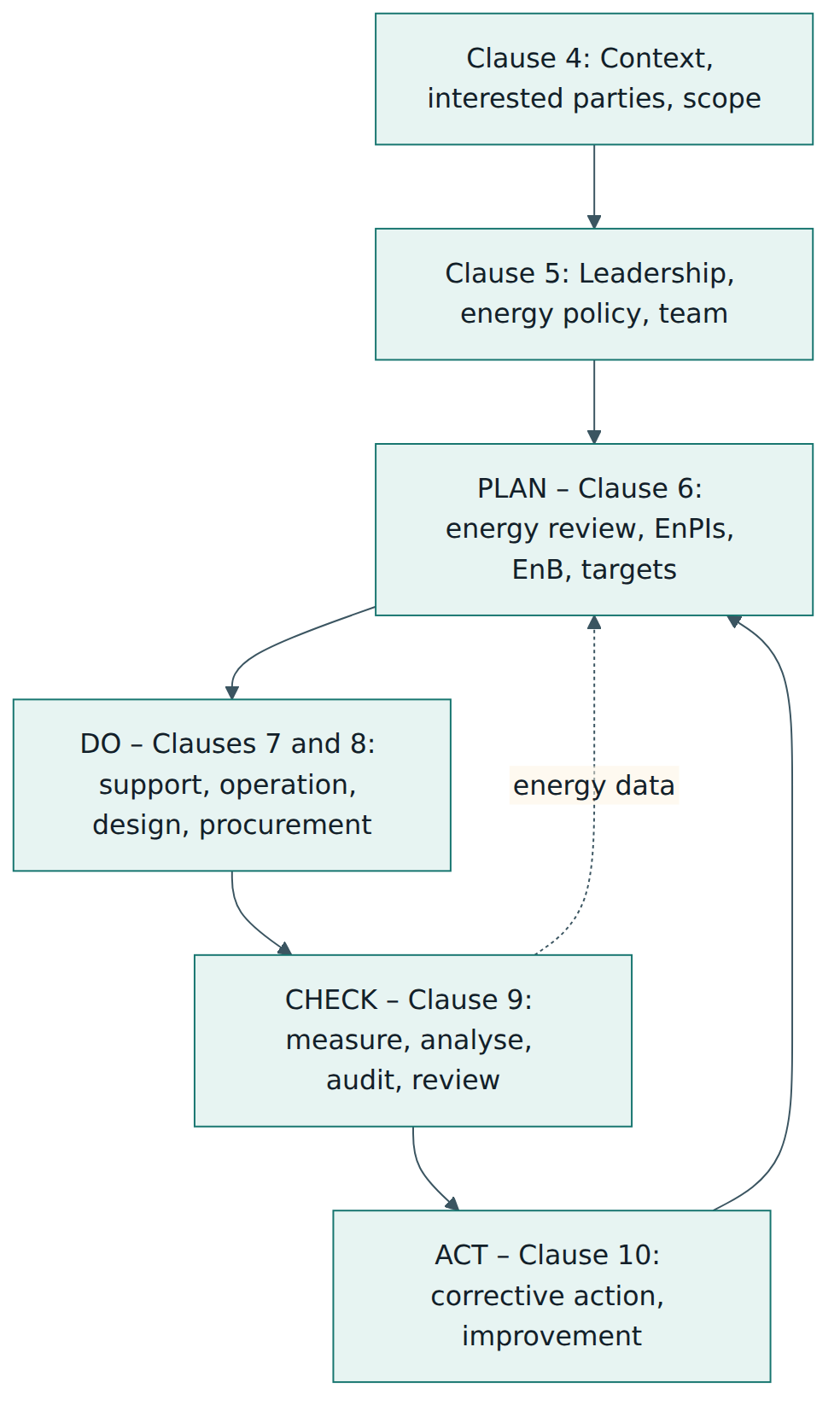
ISO 50001:2018 follows the Harmonized Structure that ISO uses for management-system standards. Clauses 0 to 3 are introductory: an introduction, the scope, normative references (there are none) and terms and definitions. The requirements are in clauses 4 to 10, and an informative Annex A gives guidance on how to read them. The table below paraphrases what each clause asks for.
| Clause | Title | What it asks the organisation to do (paraphrased) |
|---|---|---|
| 4 | Context of the organization | Understand internal and external issues that affect energy performance (since 2024 including whether climate change is relevant), the needs of interested parties such as regulators, customers and owners, and legal and other requirements; define the EnMS boundaries and scope. |
| 5 | Leadership | Top management shows commitment, establishes an energy policy, appoints an energy management team and makes sure resources, roles and authorities are in place. |
| 6 | Planning | Address risks and opportunities; set objectives, energy targets and action plans; carry out the energy review; define EnPIs and energy baselines; plan how energy data will be collected. |
| 7 | Support | Provide resources, competence for people who affect SEUs or the EnMS, awareness, communication (including a way for staff to suggest improvements) and controlled documented information. |
| 8 | Operation | Plan and control operations and maintenance of SEUs; consider energy performance in the design of new or changed facilities, equipment and processes; use energy performance as a criterion when procuring energy-using items and services. |
| 9 | Performance evaluation | Monitor, measure, analyse and evaluate energy performance and the EnMS; evaluate compliance with legal and other requirements; carry out internal audits and management reviews. |
| 10 | Improvement | Deal with nonconformities through correction and corrective action, and continually improve both the EnMS and energy performance. |
Plan-Do-Check-Act
Like other management-system standards, ISO 50001 is built on the Plan-Do-Check-Act (PDCA) cycle. Plan covers understanding context, leadership direction and the energy planning in clause 6. Do covers support and operation. Check covers monitoring, analysis, audits and review. Act covers corrective action and continual improvement, which then feed the next round of planning. Figure 1 shows how the clauses map onto the cycle.
What makes ISO 50001 different from other management-system standards
Because it shares the Harmonized Structure, about half of ISO 50001 reads like ISO 9001 or ISO 14001: context, policy, roles, competence, documented information, internal audit and management review look very familiar. The distinctive content sits mainly in clauses 6, 8 and 9:
- The energy review (6.3) is the analytical heart of the system. It is updated at planned intervals and when there are major changes to facilities, equipment, systems or energy-using processes.
- EnPIs and energy baselines (6.4 and 6.5) make energy performance measurable. When relevant variables significantly affect performance, values must be normalised, and the organisation must define when a baseline will be revised.
- Planning for collection of energy data (6.6) requires the organisation to decide which characteristics it will measure, at what frequency, and how the data's accuracy and repeatability are ensured. At a minimum this covers the relevant variables of SEUs, the energy consumption linked to SEUs and to the whole organisation, operational criteria for SEUs, static factors where applicable, and data from action plans.
- Design (8.2) and procurement (8.3) push energy thinking upstream. Decisions about a new building, a new line or a new chiller lock in energy consumption for decades, so the standard asks for energy performance to be considered at those moments, not only after installation.
- Demonstrated energy performance improvement is the outcome the standard is explicit about. A beautifully documented system with flat or worsening normalised performance does not meet the intent.
Documented information
ISO 50001 does not demand a manual. It requires certain information to be kept as documented information (for example the scope and boundaries, the energy policy, objectives and targets, the energy review method and results, EnPI and baseline methods and values, the data collection plan, monitoring results, competence evidence, audit and review results, and nonconformities and corrective actions) and leaves the rest to the organisation's judgement.
Lesson 4 – How it works in practice
This lesson walks through the life of an EnMS, from the first decision to the routine that keeps it running. The order below is typical, but in practice several steps overlap.
Step 1: Leadership commitment, scope and team
The EnMS starts with top management. They decide why the organisation is doing this (cost, carbon commitments, customer requirements, regulation), approve the scope and boundaries, appoint the energy management team, and provide budget and time. A common arrangement is an energy manager or coordinator who leads a cross-functional team of people from operations, maintenance, engineering, finance, procurement and facilities. Small organisations may have a single person with clear authority.
Top management also establishes the energy policy. In ISO 50001 the policy is a short statement of intent and direction that commits to continual improvement in energy performance, to making information and resources available to achieve objectives and targets, to meeting applicable legal and other requirements related to energy, and to supporting both the purchase of energy-efficient products and services and design work that considers energy performance. The policy has to be communicated inside the organisation and kept current.
Step 2: Context and compliance obligations
The team looks at internal and external issues that affect the organisation's ability to improve energy performance: energy prices and supply risks, ageing equipment, planned expansions, the maturity of metering, and, since the 2024 amendment, whether climate change is a relevant issue. It lists interested parties and their requirements, and compiles the legal and other requirements related to energy: mandatory energy audits, efficiency regulations for equipment, building energy codes, reporting schemes, and voluntary commitments such as a corporate climate target or a customer's supplier code.
Step 3: The energy review
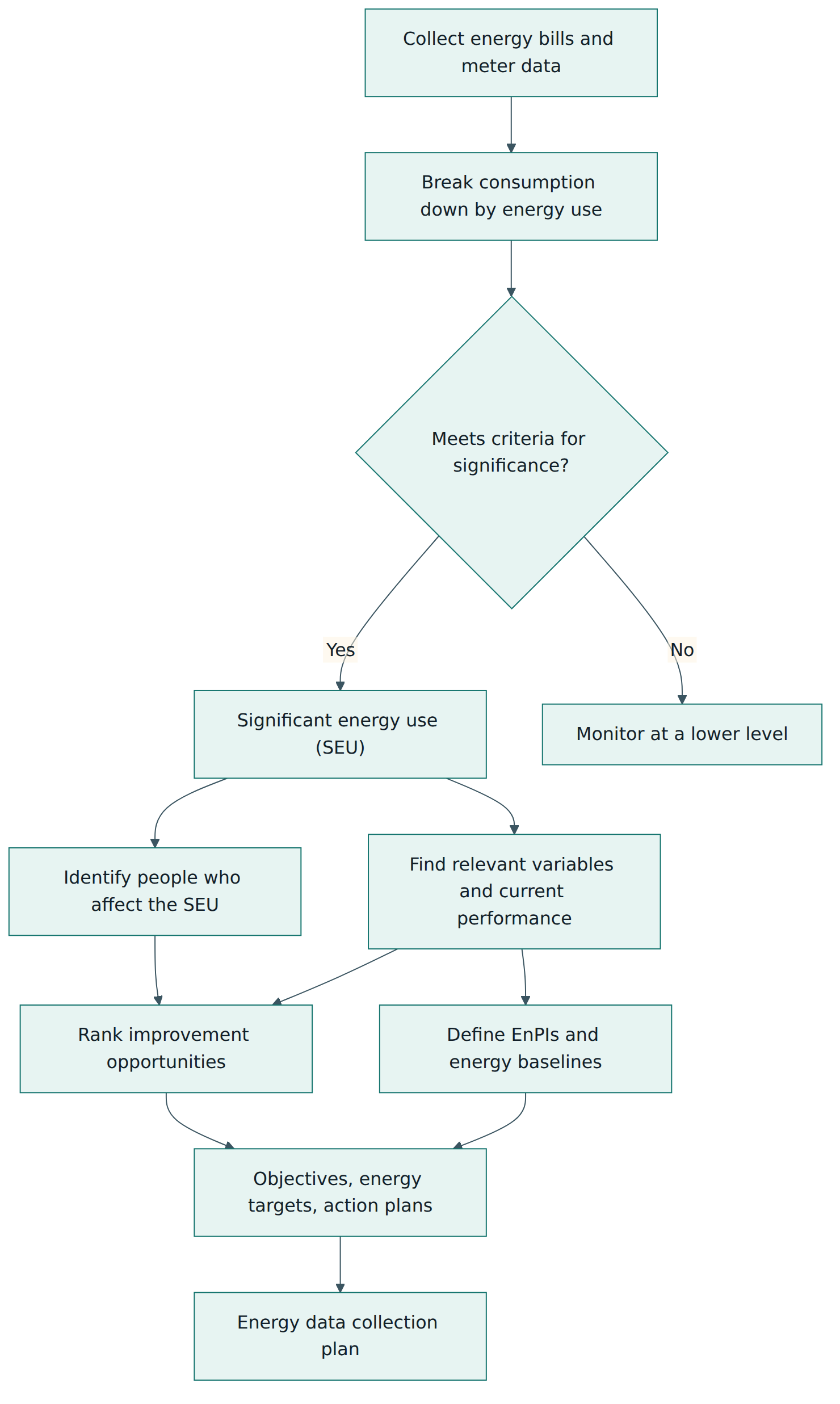
The energy review is the most important analytical step. It typically proceeds as follows:
- Collect and analyse consumption. Gather bills and meter readings for every energy type for at least the last year, ideally longer, and analyse past and present use and consumption.
- Break consumption down by use. Use sub-meters, equipment ratings and running hours, temporary loggers or engineering estimates to show where energy goes.
- Identify significant energy uses. Apply the organisation's own criteria, such as "any use above 10 % of site consumption" or "any use with large improvement potential". The criteria must be written down so the decision can be repeated and audited.
- Characterise each SEU. Determine its relevant variables, its current energy performance, and the people who work for or on behalf of the organisation and affect it — operators, maintenance contractors, schedulers.
- Find and rank improvement opportunities. Opportunities may be operational (switching off idle equipment, optimising set points), maintenance-related (fixing leaks, cleaning heat exchangers), capital projects, or changes in design and procurement.
- Estimate future energy use and consumption, so planned changes such as a new production line are taken into account.
Step 4: EnPIs, baselines and the data collection plan
For the organisation as a whole and for each SEU, the team defines EnPIs that actually reflect energy performance. Options range from a metered value (total kWh, suitable only when conditions are stable), to a ratio (kWh per unit produced), to a regression model that predicts consumption from relevant variables such as production and degree days. ISO 50006 gives detailed guidance on choosing and validating these indicators.
Each EnPI is compared against an energy baseline taken from a defined period, often a recent full year so that seasonal effects are included. If relevant variables significantly affect performance, the comparison must be normalised. The organisation also writes down when it will revise a baseline: for example when an EnPI no longer reflects performance, when there has been a major change to static factors such as the closure of a building or a new production line, or according to a method decided in advance.
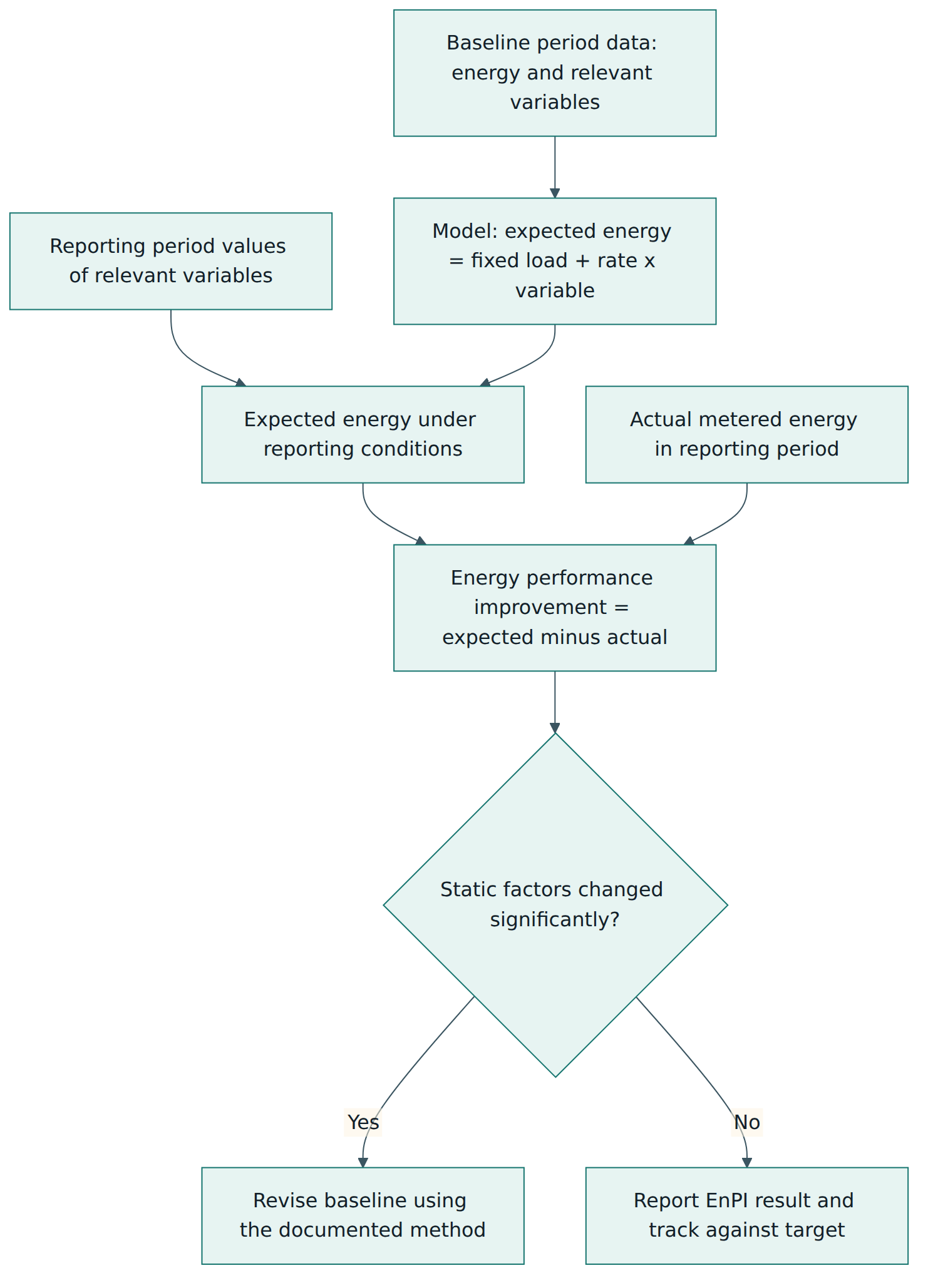
Finally, the energy data collection plan sets out what is measured, how often, with which meter or method, who is responsible, and how accuracy is maintained (calibration, verification, checking against bills). Without this plan, EnPIs quickly become unreliable.
Step 5: Objectives, targets and action plans
Objectives are the broad results the organisation wants ("reduce energy intensity of baking operations"); energy targets put a number and date on them ("5 % normalised reduction in oven gas consumption by the end of next year"). Action plans state what will be done, who is responsible, what resources are needed, when it will be finished, and how the result — including the energy performance improvement — will be verified. Verification of the improvement is not optional: a project counts when the data shows it worked, not when the invoice is paid.
Step 6: Operation — control, design and procurement
Operational control means setting criteria for how SEUs are operated and maintained so they do not drift into poor performance: set points, start-up and shut-down routines, cleaning intervals, leak inspections, and what to do when something deviates. These criteria must be communicated to the people who affect the SEUs, including contractors.
Design means that when new, modified or renovated facilities, equipment, systems or energy-using processes could significantly affect energy performance, the organisation considers improvement opportunities and operational control in the design work and records the results.
Procurement means that when buying energy-using products, equipment and services that are expected to significantly affect energy performance, the organisation tells suppliers that energy performance is part of the evaluation, and sets criteria for judging energy performance over the planned or expected operating life — not only purchase price. Where relevant, the organisation can also define specifications for the energy it buys.
Step 7: Support
People who affect SEUs need the right competence, which may come from training, experience or education. Everyone working under the organisation's control needs awareness of the energy policy, how their work affects energy performance, and the consequences of not following the EnMS. The organisation decides what to communicate internally and externally, and must give people working for it a way to comment or suggest improvements, an often underused source of cheap savings.
Step 8: Check and act
At planned intervals, the organisation evaluates EnPIs against baselines and targets, checks whether action plans delivered, investigates significant deviations in energy performance, evaluates compliance with legal and other requirements, and carries out internal audits of the EnMS. Top management then holds a management review that looks at energy performance, the status of targets, audit results, changes in context and the adequacy of resources, and decides on improvements. Nonconformities are corrected and their causes removed. Then the cycle starts again, usually with an updated energy review.
Lesson 5 – Assessment, certification and compliance
Ways to show conformity
An organisation can use ISO 50001 in several ways, and certification is only one of them:
- Use it as guidance without any external claim, simply to run a better energy programme.
- Self-declare conformity, possibly backed by confirmation from a customer or another external party.
- Seek third-party certification from a certification body, which is the most widely recognised option and the one most often required by customers, regulators or incentive schemes.
ISO itself writes standards; it does not certify organisations and does not issue certificates. Certification is performed by independent certification bodies. In most countries these bodies are accredited by a national accreditation body, which checks that they are competent and impartial. Accredited certificates carry more weight than unaccredited ones because the certification body itself has been assessed.
ISO 50003: the rules for certification bodies
Certification bodies that certify energy management systems follow two documents: ISO/IEC 17021-1, the general requirements for bodies auditing and certifying any management system, and ISO 50003 (current edition 2021), which adds energy-specific rules. ISO 50003 covers the competence auditors need, how audit time is calculated, how multi-site organisations can be sampled, and what evidence of energy performance improvement is needed. Audit time depends on the complexity of the EnMS — for example the organisation's annual energy consumption, the number of energy types and the number of SEUs — as well as on the number of people whose work affects energy performance.
A defining feature of ISO 50001 certification is that a working management system is not enough on its own: the certification body must also see evidence that energy performance has improved, and at recertification that improvement continues. Exactly what evidence is needed at which stage is set out in ISO 50003, so an organisation planning certification should agree the details with its certification body early.
The certification cycle
Figure 4 shows the usual three-year cycle. Before the formal audit, many organisations run a gap analysis or a pre-assessment (optional). The stage 1 audit reviews the documented EnMS, scope, energy review, EnPIs, baselines and readiness, often on site. The stage 2 audit evaluates implementation and effectiveness: auditors interview operators, check control of SEUs, test the data behind EnPIs, look at action plans and their verified results, and examine internal audit and management review records. Findings are classified as major nonconformities (a requirement not met in a way that threatens the system's ability to achieve its results), minor nonconformities, and opportunities for improvement. Major nonconformities must be resolved before a certificate is issued.
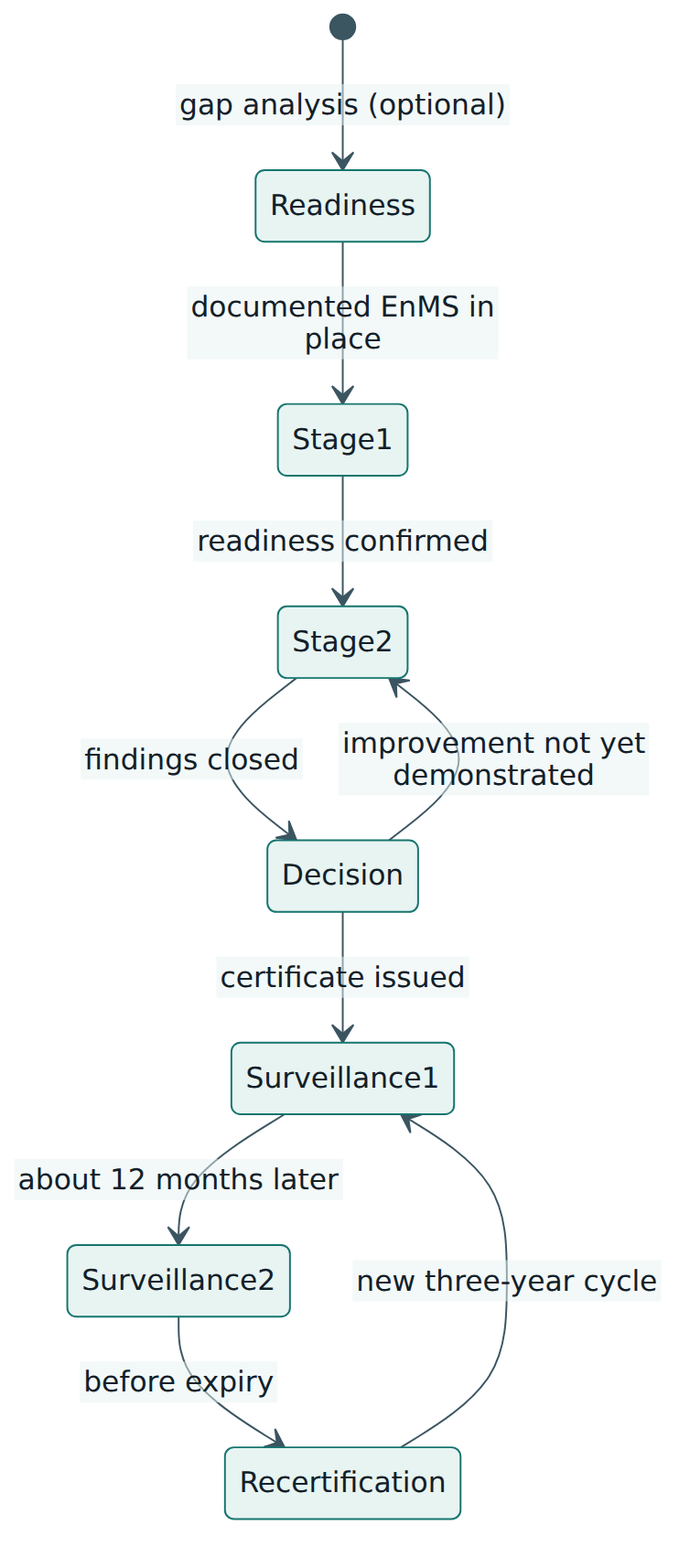
A certificate is normally valid for three years, with surveillance audits at least once a year in between. Surveillance audits sample parts of the system and check that actions to improve energy performance are being implemented; the stricter test of demonstrated improvement applies at the initial certification decision and again at recertification. Recertification near the end of the cycle reviews the whole system again.
Regulatory and programme links
ISO 50001 is voluntary as a standard, but laws and programmes frequently refer to it. In the European Union, the Energy Efficiency Directive (recast in 2023) makes an energy management system mandatory for the largest energy consumers and requires other enterprises above a consumption threshold to carry out regular energy audits unless they run an energy management system; in both cases an EnMS certified by an independent body against the relevant standard, typically ISO 50001, is the recognised route. Several countries tie tax relief, levy reductions or incentive schemes to an ISO 50001 certificate, and some utilities and governments fund implementation programmes. In the United States, the Department of Energy runs the 50001 Ready programme, a free, self-paced recognition for facilities that implement an ISO 50001-based system and attest to it, without an external audit or certificate, supported by an online step-by-step navigator. Rules differ between jurisdictions and change over time, so always check the current text of any scheme that matters to you.
What auditors look for
Experienced ISO 50001 auditors tend to focus on a few questions that reveal whether the system is real:
- Do the SEUs actually account for most consumption, and do the criteria for significance make sense?
- Are EnPIs normalised where they should be, and can the energy team explain the model and its statistical quality?
- Is the metering in the data collection plan installed, calibrated and checked against bills?
- Do operators of SEUs know the operating criteria, and does practice on the shop floor match them?
- Are procurement and design decisions taking energy performance into account, with evidence?
- Has energy performance improved, and is the improvement attributable to the EnMS rather than to luck?
Lesson 6 – Worked example
This example follows a fictional organisation, Northfield Bakeries, a single-site industrial bakery with about 250 employees that makes bread and rolls for supermarkets. It uses about 9 GWh of energy per year: natural gas for tunnel ovens and space heating, and electricity for refrigeration and freezing, compressed air, mixers, conveyors and lighting. A large supermarket customer has asked its main suppliers to show a credible energy and carbon programme, and energy prices have risen sharply. The managing director decides to implement ISO 50001 and seek certification within about eighteen months.
Leadership, scope and policy
The managing director appoints the engineering manager as energy management team leader, supported by the production manager, a maintenance supervisor, the finance controller, the purchasing lead and a data analyst. The scope covers all activities at the bakery site and all energy types; the delivery fleet, operated by a logistics partner, is outside the boundaries but noted as a future opportunity. A one-page energy policy is approved, posted on notice boards and included in induction training.
Context and compliance
The team notes key issues: volatile gas prices, ageing refrigeration plant, a planned new production line in two years, limited sub-metering, and — under the 2024 amendment — climate change as a relevant issue, because the customer's carbon expectations and hotter summers affect refrigeration load. The legal register lists the national mandatory energy-audit regulation, refrigerant rules, and the customer's supplier code as an "other requirement" the bakery has chosen to adopt.
Energy review
Using twelve months of bills, the main meters and two months of temporary loggers, the team breaks down consumption roughly as follows: tunnel ovens about 4.2 GWh of gas, refrigeration and freezing about 1.9 GWh of electricity, compressed air about 0.8 GWh, space heating about 0.8 GWh of gas, and other uses (mixers, conveyors, lighting, offices) about 1.3 GWh in total, none of which reaches the threshold individually. Their documented criterion for significance is "any use above 8 % of site consumption, or any use the team judges to have large improvement potential". Ovens, refrigeration, compressed air and space heating qualify as SEUs.
For each SEU the team identifies relevant variables and the people who affect it. Oven gas depends mainly on tonnes baked; refrigeration electricity depends on production and on outdoor temperature; compressed-air electricity depends on production hours and on leaks; space heating depends on heating degree days. Oven operators, shift leaders, the refrigeration maintenance contractor and the production planner are identified as people whose actions affect SEUs.
The opportunity list includes reducing oven idle time between production runs, tuning burners, recovering heat from oven exhaust for washing water, a compressed-air leak programme, lowering compressor pressure, raising refrigeration suction pressure, and replacing the oldest chiller. Opportunities are ranked by savings, cost, risk and ease.
EnPIs and the baseline
The team first tries a simple ratio for the ovens: about 4,215 MWh of gas for 21,000 tonnes in the baseline year, or roughly 200.7 kWh per tonne. The data analyst then fits a regression on monthly data and finds that oven gas is well described by a fixed load of about 80 MWh per month (ovens kept hot, burners on standby) plus about 0.155 MWh per tonne baked. Over twelve months that model gives 960 MWh of fixed load plus 3,255 MWh variable load, matching the 4,215 MWh measured. The regression model becomes the oven EnPI, with the baseline year as the energy baseline. The team documents that the baseline will be revised if the new production line is installed or if the model stops fitting the data.
A data collection plan follows: permanent gas sub-meters on the oven bank, electricity sub-meters on the refrigeration plant and compressor house, production tonnes from the planning system, degree days from a recognised weather source, monthly reconciliation of sub-meters with utility bills, and calibration intervals for the new meters.
Objectives, targets and actions
Top management approves objectives and energy targets, including "reduce normalised oven gas consumption by at least 8 % within twelve months" and "reduce compressed-air electricity per production hour by 15 %". Action plans name owners and verification methods: an oven idle-time procedure with shift-leader checks, burner tuning by the oven supplier, monthly ultrasonic leak surveys, and a lower compressor set point after testing what the machines truly need.
Operation, design and procurement
Operating criteria for the ovens are set: maximum idle time at full temperature, a reduced standby temperature during short breaks, and a start-up sequence. They go into the shift checklist and the oven operators' training. The refrigeration contractor's contract is updated with condenser cleaning intervals and set-point limits. For the new production line, the design brief now includes an energy section: heat recovery, insulation, metering and variable-speed drives are evaluated, and the decisions are recorded. Purchasing adds life-cycle energy cost to the evaluation for the chiller replacement and asks bidders for efficiency data at the bakery's typical load and temperatures.
Measuring the result
After twelve months, the reporting-year data shows 23,000 tonnes baked and 4,050 MWh of oven gas actually metered. Three ways of reading this give very different answers:
- Raw consumption: 4,050 versus 4,215 MWh, a drop of 165 MWh or about 3.9 %. This understates the improvement, because production rose.
- Simple ratio: 4,050 MWh divided by 23,000 tonnes is about 176.1 kWh per tonne, roughly 12.3 % better than 200.7. This overstates the improvement, because part of the gain comes from spreading the fixed load over more tonnes.
- Normalised with the baseline model: expected consumption at 23,000 tonnes is 960 + 0.155 × 23,000 = 4,525 MWh. Actual was 4,050 MWh, so the normalised saving is 475 MWh, about 10.5 %.
The normalised figure is the one the energy team reports: the oven target of 8 % has been met, and the improvement can be attributed to the actions rather than to the production increase. The compressed-air target is only partly met: leaks were fixed but reappeared, because the leak survey was done only when someone remembered.
Check, act and certification
An internal audit, carried out by a trained quality engineer who does not work in energy, finds that the night shift does not follow the oven idle procedure and that one refrigeration sub-meter had not been reconciled with bills for three months. Corrective actions include adding the idle check to the night-shift leader's handover and assigning a named owner for monthly reconciliation. At management review the directors look at EnPI results, the audit findings, the customer's expectations and the budget for heat recovery, and decide to fund it. The leak survey becomes a scheduled maintenance task in the computerised maintenance system.
The stage 1 audit raises a concern that the significance criteria were not written down clearly for space heating; the team fixes the document. At stage 2 the auditor interviews oven operators, checks the regression model and its data, samples action plans and verifies the normalised oven saving. One minor nonconformity is raised about calibration records for a temporary meter. With improvement demonstrated and the finding addressed, the certificate is issued. In the following years the bakery adds the delivery fleet to the scope once the logistics contract is renegotiated.
Lesson 7 – Relationship to other standards and frameworks
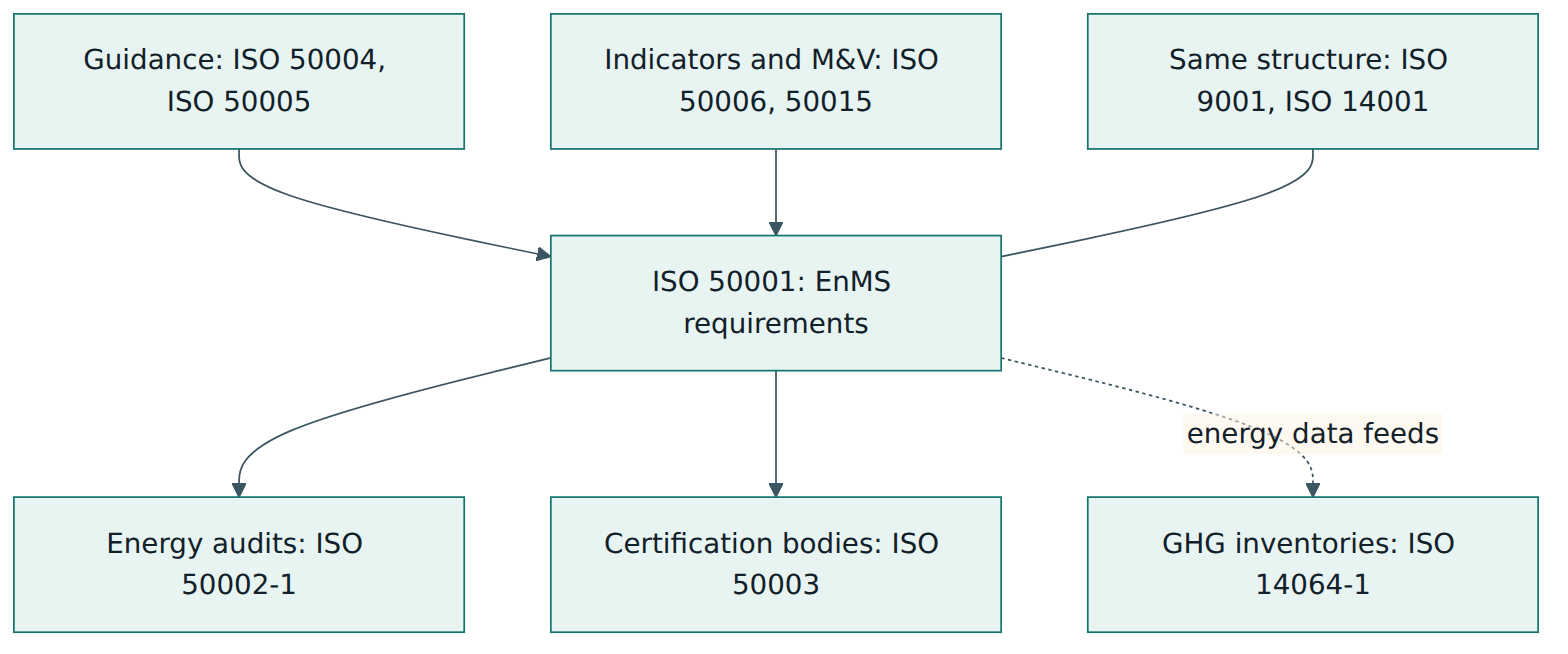
ISO 50001 sits at the centre of a family of energy-management standards (often called the ISO 50000 family) and alongside other management-system standards that share its structure. Knowing the neighbours helps you avoid duplicating effort and choose the right tool for each job.
| Standard or framework | What it is | How it relates to ISO 50001 |
|---|---|---|
| ISO 14001 | Environmental management system requirements | Same Harmonized Structure, so the two are often integrated. Energy use is usually one of many environmental aspects in ISO 14001; ISO 50001 goes much deeper on energy data, indicators, baselines and demonstrated improvement. |
| ISO 9001 | Quality management system requirements | Shares the structure and many common processes (document control, internal audit, management review, corrective action), which can serve both systems. |
| ISO 50002-1 | Energy audits: general requirements (2025; replaced ISO 50002:2014, with parts 2 and 3 for buildings and processes) | An energy audit is a detailed, often one-off study of a site or system. Its results feed the energy review and the opportunity list, but an audit alone is not a management system. |
| ISO 50003 | Requirements for bodies that audit and certify EnMSs | Applies to certification bodies, not to the organisation. It explains audit time, auditor competence and the evidence of improvement needed for certification. |
| ISO 50004 | Guidance for implementing, maintaining and improving an EnMS | Practical guidance that helps organisations apply ISO 50001; it adds no requirements. |
| ISO 50006 | Evaluating energy performance using EnPIs and energy baselines | Detailed method for choosing indicators, relevant variables, normalisation and baseline adjustments — the technical companion to clauses 6.4 and 6.5. |
| ISO 50015 | Measurement and verification of energy performance of organisations | Principles for planning and reporting how savings are measured and verified; useful for verifying action plans and projects. |
| ISO 50005 | Guidelines for a phased implementation of an EnMS | Helps smaller or less mature organisations implement step by step, using maturity levels, before aiming for full conformity. |
| ISO 14064-1 and the GHG Protocol | Greenhouse-gas inventories at organisation level | Energy data from the EnMS is a major input to emissions inventories; ISO 50001 manages energy performance, while these standards account for emissions. |
Integration in practice
Organisations that already hold ISO 14001 or ISO 9001 certificates usually find that roughly half of the ISO 50001 requirements can be met by extending existing processes: the same internal audit programme, document control, management review and corrective-action system. The new work is in the energy-specific parts: the energy review, SEUs, EnPIs and baselines, the data collection plan, and energy criteria in operation, design and procurement. Many certification bodies offer combined audits for integrated systems, which can reduce audit days and disruption.
Energy audits versus energy management
A frequent source of confusion is the difference between an energy audit and an EnMS. An audit is like a medical examination: a qualified person examines the site in depth and produces a list of findings and recommendations. An EnMS is like a lifestyle: the routine that makes sure the recommendations are implemented, their results are measured, gains are maintained and new opportunities keep being found. Regulations that accept either route generally recognise that a functioning, verified EnMS delivers the benefits of periodic audits and more.
Common pitfalls and best practices
Common pitfalls
- Paper system, flat performance. Policies and procedures are written for the certificate, but normalised energy performance does not change. ISO 50001 is explicit that improvement must be demonstrated.
- Raw consumption or naive ratios as the only indicator. Production growth or a warm winter makes performance look better or worse than it really is, so the team reacts to noise and cannot prove real gains.
- Significance criteria that are vague or never revisited. SEUs are chosen by habit, the biggest uses are overlooked, or new equipment is never added after a change.
- The energy manager as a lone hero. Everything depends on one person; when that person leaves, metering stops being reconciled and operating criteria are forgotten.
- Ignoring design and procurement. New equipment is bought on lowest price, locking in years of high consumption that operational controls cannot fix.
- Metering without data quality. Meters are installed but not calibrated, not reconciled with bills, or not linked to the relevant variables, so EnPIs cannot be trusted by auditors or managers.
- Baselines adjusted to suit the story. Baselines are changed whenever results disappoint, instead of according to the documented rules.
Best practices
- Start with the energy review and the data. Put effort into understanding where energy goes and what drives it; the rest of the system depends on it.
- Use models, not just ratios, for important uses. Simple regression against production and degree days is usually enough and makes improvement visible and defensible.
- Embed energy into existing routines. Put operating criteria into shift checklists, maintenance tasks into the maintenance system, and energy criteria into procurement and project approval templates.
- Build a cross-functional team with real authority. Include operations, maintenance, finance and purchasing, and give the team direct access to top management.
- Verify every action plan. Decide before implementation how the saving will be measured, then report the verified result, not the estimate.
- Engage the people who touch SEUs. Operators and technicians often know the cheapest savings; give them a simple way to suggest improvements and show that suggestions are acted on.
- Integrate with existing management systems. Reuse audit, document-control and review processes from ISO 9001 or ISO 14001 to reduce effort and keep energy on the management agenda.
Summary and key takeaways
- ISO 50001 specifies requirements for an energy management system; it sets no numeric efficiency limits and prescribes no technologies.
- The current edition is ISO 50001:2018 with Amendment 1:2024 on climate change, with no new edition published as of 2026-10-29; ISO/TC 301 maintains it.
- Clauses 4 to 10 follow the Harmonized Structure and the Plan-Do-Check-Act cycle, which makes integration with ISO 9001 and ISO 14001 straightforward.
- The energy review is the analytical core: it identifies significant energy uses, their relevant variables, the people who affect them and the improvement opportunities.
- EnPIs and energy baselines make performance measurable; when relevant variables matter, results must be normalised and baseline revision rules defined in advance.
- Operational control, design and procurement are where savings are protected and future consumption is decided.
- Certification is optional, performed by accredited certification bodies under ISO/IEC 17021-1 and ISO 50003, and requires evidence of energy performance improvement, not just documents.
- Related standards such as ISO 50002-1, ISO 50006 and ISO 50015 support audits, indicators and verification of savings.
Reflection questions
- Think of a site you know. What would you expect its three largest energy uses to be, and what relevant variables would you need to measure to understand each one?
- Your organisation's energy consumption fell by 6 % last year while output fell by 15 %. What would you need to know before concluding whether energy performance improved, and how would you find out?
- Which purchasing or design decisions in your organisation over the next two years could lock in energy consumption for a decade, and how would you bring energy criteria into those decisions?
- If your energy manager left tomorrow, which parts of the energy management system would stop working, and how would you redesign responsibilities so that they continue?
- Your organisation already has ISO 14001. Which existing processes could you reuse for ISO 50001, and which energy-specific elements would you need to build from scratch?
Further reading and official sources
- ISO 50001:2018 – Energy management systems – Requirements with guidance for use – ISO
- ISO 50001:2018/Amd 1:2024 – Climate action changes – ISO
- ISO 50001 – Energy management – ISO
- 50001 Ready Program – U.S. Department of Energy
- ISO 50001 (history and overview) – Wikipedia
Original tutorial by xOps School (DevOpsSchool Private Limited), written from public sources about ISO 50001. Not affiliated with or endorsed by the standard's owner; standard names are trademarks of their owners. Buy the official standard from its publisher for the authoritative text.