
NIST SP 800-53 – Tutorial (about 60 minutes)
- View
NIST Special Publication 800-53 is the catalogue of security and privacy controls published by the US National Institute of Standards and Technology (NIST). US federal agencies must use it, cloud providers selling to the US government meet it through FedRAMP, and many private companies, universities and governments elsewhere adopt it voluntarily because it is free, detailed and well maintained. After this tutorial you will be able to read a control, explain how controls are grouped and selected, follow how they are implemented and assessed, and place SP 800-53 next to the NIST Cybersecurity Framework, SP 800-171 and ISO/IEC 27001.
Course overview
Edition and status: The current edition is NIST SP 800-53 Revision 5, Security and Privacy Controls for Information Systems and Organizations, published by NIST in September 2020 and updated on 10 December 2020 (the "upd1" version that corrects errata). Since then NIST has maintained the catalogue through small numbered releases rather than a new revision; the latest is Release 5.2.0 of 27 August 2025, a minor release that added a few controls and enhancements on securely deploying software patches and updates (SA-15(13), SA-24 and SI-02(07)) and revised SI-07(12). Release 5.2.0 also added matching assessment procedures to the companion guide SP 800-53A and gave the baselines publication SP 800-53B the same release number without changing any baseline. No Revision 6 has been published or released as a draft as of the verification date, so Revision 5 (Release 5.2.0) is the edition this course teaches. Verified 2026-10-29 on the NIST Computer Security Resource Center (CSRC).
Who this is for: security and cloud engineers, system owners, auditors and assessors, compliance and risk staff, privacy officers and project managers who must work with SP 800-53 for the first time, for example because a customer is a US agency, because the company is pursuing FedRAMP, or because leadership chose SP 800-53 as the organisation's control framework.
Prerequisites: none. A basic idea of what a security control is (a safeguard such as a password policy, a firewall rule or a backup) is helpful. Every other term is explained when it first appears.
By the end of this tutorial:
- You will be able to explain why NIST publishes SP 800-53, whom it applies to and why Revision 5 made it usable by any organisation.
- You will be able to name the 20 control families and read the parts of a control, including enhancements and organisation-defined parameters.
- You will be able to describe how a system's impact level leads to a baseline and how that baseline is tailored.
- You will be able to follow the Risk Management Framework steps that put the controls to work, and the documents they produce.
- You will be able to explain how controls are assessed with SP 800-53A and why there is no "SP 800-53 certificate".
- You will be able to apply the catalogue to a realistic system, step by step.
- You will be able to relate SP 800-53 to the Cybersecurity Framework, SP 800-171, FedRAMP, ISO/IEC 27001 and the CIS Controls.
Lesson 1 – Origins, purpose and scope
Why a control catalogue exists
Every organisation that runs information systems faces the same question: which safeguards are enough? Without a shared answer, each team invents its own list, auditors use another list, and nobody can compare one system with the next. In the US federal government this problem was addressed by law. The Federal Information Security Modernization Act (FISMA, originally passed in 2002 and updated in 2014) requires agencies to protect their information and systems, and it gives NIST the job of writing the standards and guidelines they use. Two short Federal Information Processing Standards (FIPS) sit at the top: FIPS 199 tells an agency how to rate the potential impact of a security breach, and FIPS 200 sets minimum security requirements and points to SP 800-53 as the source of the controls that meet them. Office of Management and Budget (OMB) policy, notably Circular A-130, then requires agencies to follow NIST guidance.
SP 800-53 is the practical layer under those requirements. It is a large catalogue: more than a thousand controls and control enhancements, each describing a safeguard in enough detail to be implemented and checked. Its job is not to tell you which controls to pick for a given system (that is the role of the companion baselines and of risk analysis), but to give everyone the same, well-defined vocabulary of safeguards.
How the catalogue evolved
The first version appeared in 2005. Each revision widened the scope: later revisions added controls for advanced threats, for mobile and cloud technology, for insider threat and, in Revision 4 (2013), an appendix of privacy controls. Revision 5, published in 2020, was the biggest change in the catalogue's history. Its key shifts are worth knowing because they explain how the document reads today:
- Outcome-based wording. Revision 5 removed "the information system" or "the organisation" as the subject of each control. A control now states what must be achieved, so the same text can be met by a person, a process, a technology or a service provider.
- Security and privacy together. Privacy controls are no longer a separate appendix; they are integrated into the families, and a new family covers the processing of personally identifiable information.
- Selection moved out. The baselines (the starter sets of controls for low, moderate and high impact systems) were moved into a separate publication, SP 800-53B, so the catalogue itself is neutral about who uses which control.
- A supply chain family. Supply chain risk management became its own family (SR), reflecting attacks that arrive through suppliers and software components.
- Not just federal. The title dropped the word "Federal". Revision 5 is explicitly written for any organisation, in any sector, that wants a comprehensive control set.
After 2020 NIST changed how it maintains the catalogue. Instead of waiting years for a new revision, it uses an online public comment site where proposed controls are posted for short comment periods and then issued as numbered releases (for example 5.1 and 5.1.1 in 2023 and 5.2.0 in 2025). The catalogue is also published as data: spreadsheets, a browsable online tool and machine-readable files, so that tools can import it directly.
Scope: what SP 800-53 covers and what it does not
The catalogue covers the whole organisation, not only technology. It has controls for governance and programme management, people (screening, training), physical sites, acquisition of systems and services, development practices, operations, incident response and privacy. It applies to any kind of system: on-premises, cloud, industrial control systems, mobile, Internet of Things and weapons or space systems.
It is important to understand what SP 800-53 is not. It is not a management system standard with clauses you are certified against, like ISO/IEC 27001. It is not a short list of priorities, like the CIS Controls. It is not a law in itself; its use is mandatory only where a law, policy or contract says so. And it is not a step-by-step process; the process that uses the controls is the Risk Management Framework in SP 800-37, which you will meet in Lesson 4.
Lesson 2 – Key concepts and vocabulary
SP 800-53 has a precise vocabulary. Learning it first makes everything else much easier, because assessors, agencies and tools all use these words in the same way.
- Control – a safeguard or countermeasure prescribed for a system or an organisation to protect the confidentiality, integrity and availability of information and to manage privacy risk. Example: account management.
- Control family – a group of related controls with a two-letter identifier, such as AC for Access Control or IR for Incident Response. There are 20 families.
- Base control – the main statement of a control, identified by family and number, for example AC-2 (Account Management).
- Control enhancement – an optional addition that strengthens a base control or adds a capability, shown with a number in brackets, for example AC-2(1) for automated account management. An enhancement only makes sense together with its base control.
- Organisation-defined parameter (ODP) – a blank inside a control that the organisation fills in, either an assignment (you supply a value, such as how many days of inactivity before an account is disabled) or a selection (you choose from listed options).
- Security categorisation – the process, defined in FIPS 199, of rating the potential impact (low, moderate or high) that a loss of confidentiality, integrity or availability would have on the organisation or individuals.
- Impact level – the overall rating of a system after categorisation; under FIPS 200 it is the highest of the three ratings (the "high-water mark").
- Control baseline – a predefined starting set of controls and enhancements for a low, moderate or high impact system, or for privacy, published in SP 800-53B.
- Tailoring – adjusting a baseline to fit the real system and its risks: removing what does not apply, adding what is needed, filling in parameters and choosing compensating controls.
- Overlay – a reusable, community-wide set of tailoring decisions for a specific technology, mission or environment, for example for industrial control systems or for a class of cloud service.
- Common control – a control provided once and inherited by many systems, such as a data centre's physical security or an enterprise identity service.
- System-specific and hybrid controls – a system-specific control is implemented by one system alone; a hybrid control is partly inherited and partly implemented by the system (for example, enterprise logging plus application-level audit events).
- Compensating control – an alternative safeguard used instead of a baseline control that cannot be implemented, providing equivalent or comparable protection.
- Personally identifiable information (PII) – any information that can identify a specific person, either on its own or once it is linked with other information about them (the definition used in US federal privacy policy). Privacy controls apply where a system processes PII.
- Authorisation (ATO) – the formal decision by a senior official, the authorising official, to accept the remaining risk of operating a system. "ATO" stands for authorisation to operate.
- Plan of action and milestones (POA&M) – the tracked list of weaknesses found and the planned fixes, owners and dates.
Two more ideas run through the whole catalogue. The first is the difference between requirements and controls. A requirement comes from a law, regulation, policy, contract or mission need ("protect the confidentiality of tax records"); a control is the safeguard that satisfies it. Revision 5 is careful to keep these apart, which is why the same catalogue can support many different laws. The second is the triad of confidentiality (only authorised people can read), integrity (information is not altered improperly) and availability (information and services are there when needed). Privacy adds a further dimension: harm can come to individuals even from processing that is authorised and secure, for example collecting far more personal data than a service needs.
Lesson 3 – Structure of the catalogue
The 20 control families
Revision 5 organises its controls into 20 families. The two-letter codes appear everywhere, in plans, tools, audit findings and job descriptions, so it pays to recognise them:
| Code | Family | What it is about, in brief |
|---|---|---|
AC | Access Control | Who may access what, accounts, least privilege, remote access, session controls |
AT | Awareness and Training | Security and privacy awareness and role-based training |
AU | Audit and Accountability | Event logging, log review, protection and retention of audit records |
CA | Assessment, Authorization, and Monitoring | Control assessments, authorisation, continuous monitoring, POA&M |
CM | Configuration Management | Baseline configurations, change control, secure settings, inventory |
CP | Contingency Planning | Continuity plans, backups, alternate sites, recovery |
IA | Identification and Authentication | Identifying users and devices, multi-factor authentication, credentials |
IR | Incident Response | Incident handling, reporting, testing the response capability |
MA | Maintenance | Controlled, logged maintenance, including remote maintenance |
MP | Media Protection | Marking, storing, transporting and sanitising media |
PE | Physical and Environmental Protection | Facility access, power, fire, water and environmental safeguards |
PL | Planning | Security and privacy plans, rules of behaviour, architecture |
PM | Program Management | Organisation-wide programme, risk strategy, inventories, roles |
PS | Personnel Security | Screening, joining and leaving, third-party personnel |
PT | PII Processing and Transparency | Authority and purpose for processing PII, notices, consent |
RA | Risk Assessment | Categorisation, risk assessment, vulnerability monitoring |
SA | System and Services Acquisition | Acquisition, secure development, external services, developer testing |
SC | System and Communications Protection | Boundary protection, encryption in transit and at rest, isolation |
SI | System and Information Integrity | Flaw remediation, malware protection, monitoring, input validation |
SR | Supply Chain Risk Management | Supply chain plans, supplier assessment, provenance, component authenticity |
The first control in every family, numbered -1 (for example AC-1), is always about policy and procedures for that family. This gives a predictable pattern: before you implement the technical controls of a family, you define who is responsible and how the family is governed. The Program Management family is special. Its controls operate at the level of the whole organisation (a security programme plan, a senior information security officer, an enterprise risk strategy), so they are not tied to an individual system's impact level.
Anatomy of a control
Every control in the catalogue follows the same layout, which makes it possible to read any control once you know the pattern.
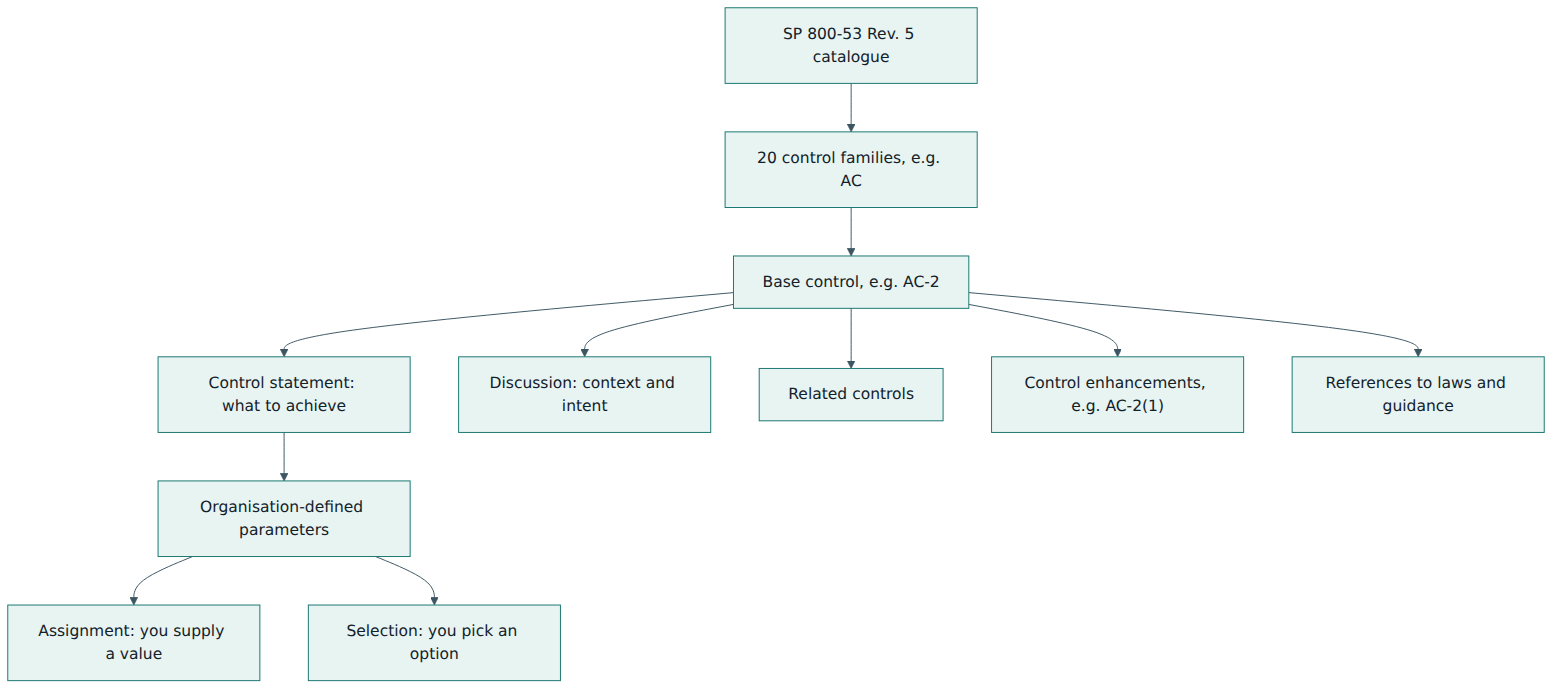
- Control statement. The normative part, often split into lettered items (a, b, c …). It says what outcome must be achieved, with parameters where the organisation must decide details.
- Discussion. Explanatory text: why the control matters, typical ways to meet it, and how it interacts with others. It helps you interpret the statement but adds no extra obligations.
- Related controls. Cross-references to controls that support or depend on this one. For account management, these point to authentication, auditing and personnel controls, among others.
- Control enhancements. Each has its own number in brackets, its own statement and discussion. Some strengthen the control (automation, faster response), others extend it to a new situation.
- References. Pointers to laws, policies, standards and other NIST publications with more detail.
When a control or enhancement is removed or merged, NIST does not reuse its number. It stays in the catalogue marked as withdrawn, with a note saying where its content went. This keeps old plans and audit records readable across releases.
Parameters in practice
Organisation-defined parameters are what make one catalogue work for organisations of very different sizes. A control might say that accounts must be disabled after an organisation-defined period of inactivity; one company may choose 90 days, a high-security system 30. A selection parameter might ask whether something happens on a schedule or when triggered by an event. Parameters can be set by the organisation, by an overlay, or by a programme such as FedRAMP, which publishes required values for many of them. Until every parameter in a selected control has a value, the control is not fully specified and cannot be assessed consistently.
The companion publications
SP 800-53 is part of a small family of documents that you will often see together:
- SP 800-53B – the control baselines: low, moderate and high security baselines plus a privacy baseline, and guidance on tailoring and overlays.
- SP 800-53A – the assessment procedures: how to check, for each control, whether it is implemented correctly, operating as intended and producing the desired outcome.
- SP 800-37 – the Risk Management Framework (RMF) that tells you when and how to select, implement, assess, authorise and monitor controls.
- FIPS 199 and FIPS 200 – the federal standards for categorisation and minimum requirements, with SP 800-60 helping map information types to impact levels.
NIST publishes the catalogue and baselines in OSCAL (the Open Security Controls Assessment Language), a machine-readable format in XML, JSON and YAML, and through its online Cybersecurity and Privacy Reference Tool. Many governance, risk and compliance (GRC) tools import these files, which means control text, parameters and baselines can flow straight into system security plans.
Lesson 4 – How it works in practice
The Risk Management Framework
The catalogue is a toolbox; the Risk Management Framework is the method for using it. SP 800-37 Revision 2 describes seven steps. They apply at the level of the organisation and at the level of each system, and they repeat through the system's life.
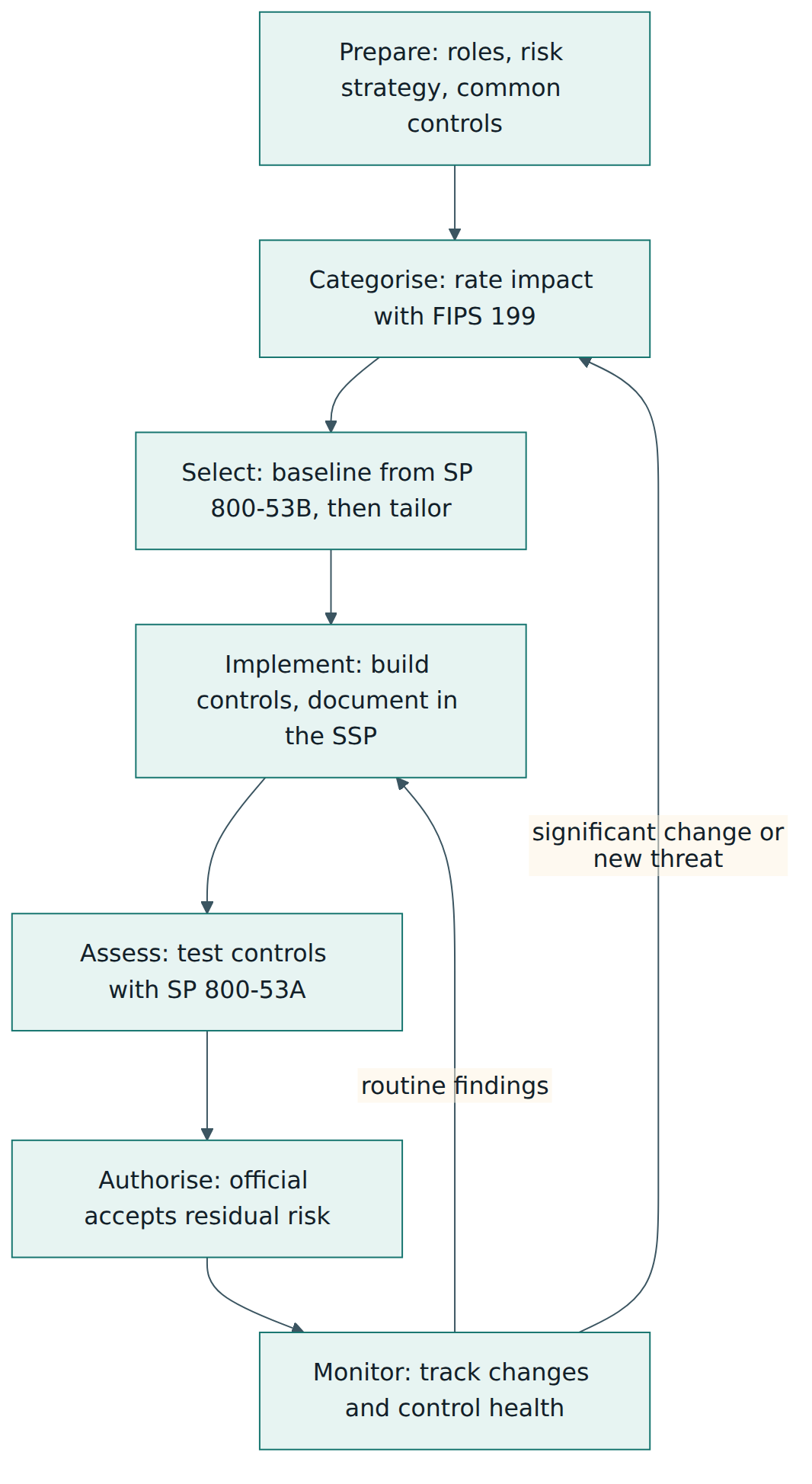
- Prepare. Establish the context: risk management roles, the organisation's risk tolerance, an inventory of systems, and the common controls that the organisation will provide to everyone. Good preparation is what stops every project from reinventing basic controls.
- Categorise. Describe the system and its information types, then rate the potential impact of losing confidentiality, integrity and availability as low, moderate or high. The highest of the three becomes the system's impact level.
- Select. Start from the matching SP 800-53B baseline (and the privacy baseline if PII is processed), apply overlays, tailor, and record the result.
- Implement. Put the controls in place and describe how each one is implemented in the system security plan (SSP), together with the privacy plan where relevant.
- Assess. An assessor, independent where required, checks the controls using SP 800-53A procedures and writes an assessment report.
- Authorise. A senior leader, the authorising official, reviews the package and decides whether the remaining risk is acceptable.
- Monitor. Continuously track the system, its environment and its controls, report status, and re-assess as things change.
From impact level to tailored baseline
Selecting controls is where the catalogue's size becomes manageable. Nobody implements all of it. The baselines in SP 800-53B give a starting point: a low impact system starts with fewer controls, a high impact system with more and with stronger enhancements. The privacy baseline is selected separately, based on whether the system processes PII, not on its security impact level.
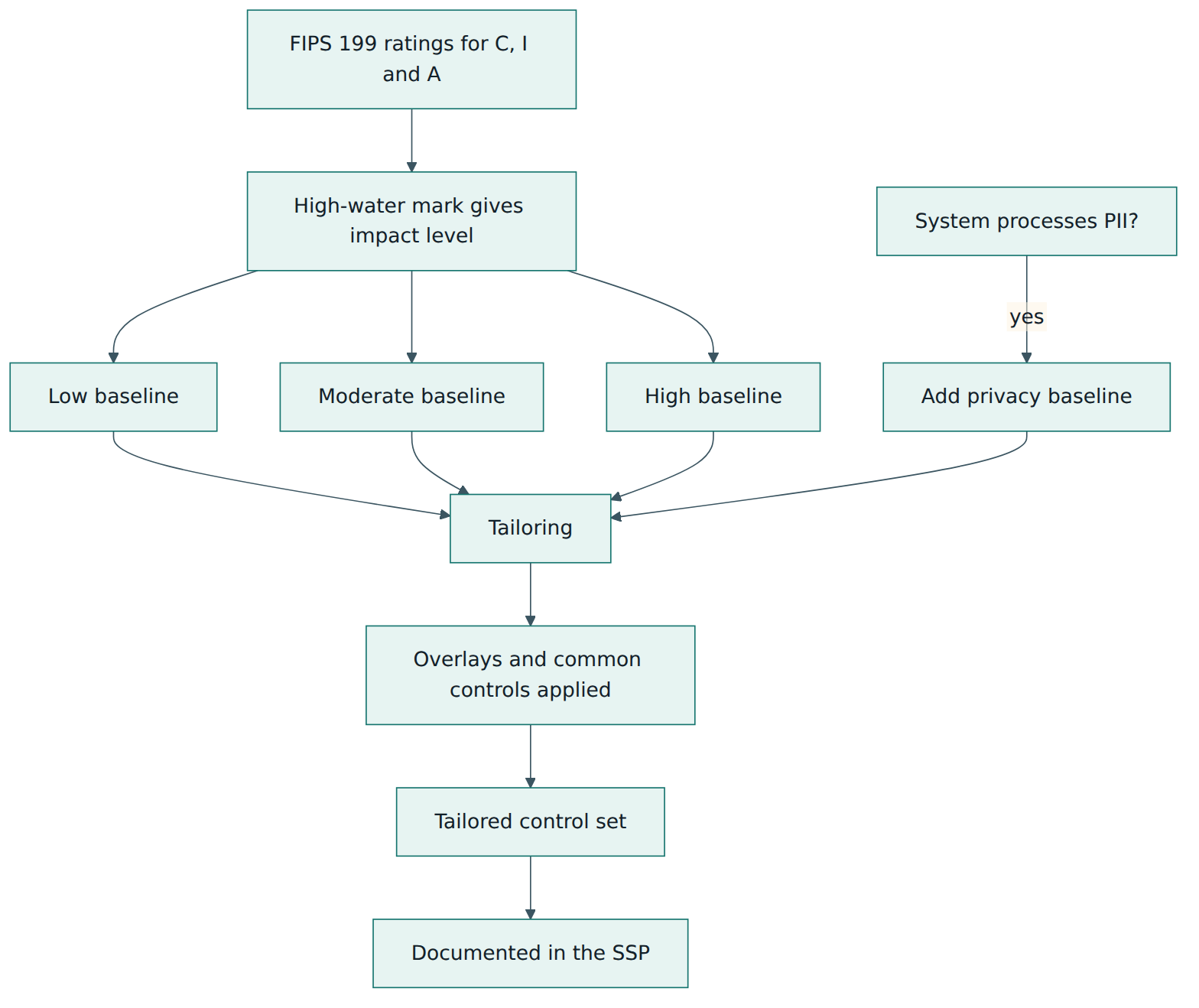
SP 800-53B describes tailoring as a set of activities, which in plain terms are:
- identifying which controls are provided as common controls and inherited, so the system only documents its own part;
- applying scoping considerations, for example removing wireless controls from a system with no wireless capability, with a written rationale;
- choosing compensating controls where a baseline control cannot be implemented;
- assigning values to every organisation-defined parameter;
- supplementing the baseline with extra controls or enhancements when the risk assessment shows the baseline is not enough;
- adding specification details that implementers need.
The baseline is therefore a starting point, not a finished answer. NIST is explicit that the baselines rest on assumptions (for example about the threat environment) and that organisations must check those assumptions against their own situation.
Roles
Several roles appear repeatedly. The system owner is accountable for the system and its security plan. The authorising official is a senior manager with the authority to accept risk on behalf of the organisation. The senior agency information security officer (or chief information security officer) and the senior agency official for privacy run the organisation-wide programmes. Common control providers operate inherited controls. Control assessors evaluate the controls. In smaller organisations one person may hold several roles, but the authorising official should not also be the person who built and assessed the system.
Artefacts
The RMF produces a recognisable set of documents. The system security plan describes the system, its boundary, its categorisation and, control by control, how each requirement is met and by whom. The privacy plan does the same for privacy controls. The security assessment report records what the assessor tested and found. The POA&M lists weaknesses with owners and dates. Together these form the authorisation package. Mature organisations keep them as living records in a GRC tool, ideally in OSCAL, rather than as documents written once and forgotten.
Lesson 5 – Assessment, certification and compliance
Assessing controls with SP 800-53A
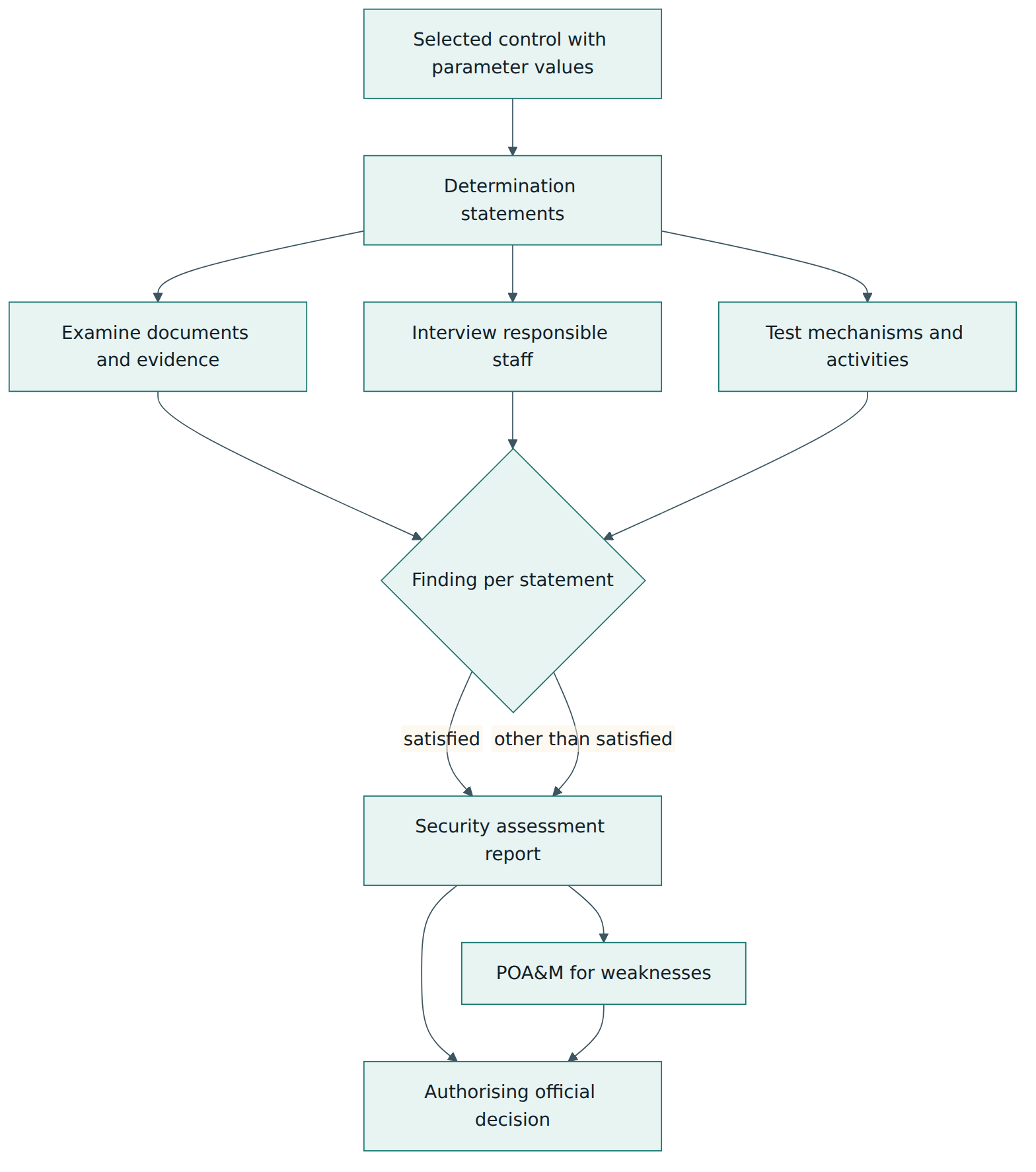
SP 800-53A Revision 5 (published January 2022 and updated with Release 5.2.0) provides an assessment procedure for every control and enhancement. Each procedure breaks a control into determination statements: small, checkable claims derived from the control text, such as "a period of inactivity is defined" and "accounts are disabled after that period". For each statement the assessor uses one or more of three methods on suitable assessment objects:
- Examine – reviewing specifications and evidence: policies, plans, configuration exports, logs, tickets.
- Interview – talking with the people who operate or are responsible for the control.
- Test – exercising mechanisms or activities under defined conditions and comparing the actual with the expected behaviour, for example trying to log in with a disabled account.
Each determination statement ends with a finding of satisfied or other than satisfied. "Other than satisfied" is deliberately neutral: it records that the assessor could not confirm the statement, whether because the control is missing, partly implemented or simply lacked evidence. The assessment can be scaled through two attributes: depth (how rigorous and detailed) and coverage (how many objects, such as how many servers or accounts, are sampled), each described at basic, focused or comprehensive levels.
Who assesses and how independent they are
Assessors can be internal staff, an agency's inspector general team, or a third party. The required level of independence depends on the impact level and on the programme. For federal systems the authorising official decides how independent the assessors must be. For cloud services seeking FedRAMP authorisation, assessments are carried out by accredited third-party assessment organisations (3PAOs). Self-assessment is useful for preparing, but it does not replace an independent assessment where one is required.
Authorisation, not certification
A frequent misunderstanding is that a company can be "SP 800-53 certified". There is no certification scheme for SP 800-53, and NIST does not certify organisations, products or people against it. What exists instead is:
- Authorisation to operate. A federal agency's authorising official grants an ATO to a particular system, based on its authorisation package. The ATO is a risk decision for that system, not a certificate of compliance with the whole catalogue.
- FedRAMP authorisation. The US government's cloud programme sets baselines derived from SP 800-53 and authorises cloud services that meet them, so that agencies can reuse one assessment. FedRAMP has been modernising its process (an initiative called FedRAMP 20x), so check its current requirements when you plan.
- Attestations and mappings. Private organisations may ask an auditor to report on their controls, often using SP 800-53 as the reference set, or show alignment by mapping SP 800-53 to frameworks for which certification does exist, such as ISO/IEC 27001.
- Personal credentials. Some professional certifications test knowledge of the RMF and SP 800-53, but they certify individuals, not systems.
Be careful with marketing that claims "full SP 800-53 compliance". Because no organisation implements every control, a meaningful statement always names the baseline, the tailoring and the assessment behind it.
Continuous monitoring
An authorisation is only as good as the system's current state. Continuous monitoring (described in SP 800-137 and the CA-7 control) means agreeing which controls are checked how often, collecting evidence automatically where possible (vulnerability scans, configuration compliance, log alerts), reporting status to the authorising official and updating the POA&M. Many organisations move towards ongoing authorisation, where the authorising official relies on this stream of evidence instead of a full re-assessment every few years.
Lesson 6 – Worked example
To tie the concepts together, follow a fictional mid-sized software company, Harbourline Analytics, as it prepares a cloud-hosted grants analytics service for a US federal agency. The agency requires an ATO based on SP 800-53 Revision 5, and Harbourline's leadership also wants to use the catalogue as its internal control framework.
Step 1 – Prepare
Harbourline names a system owner (the head of the analytics product), a security lead, a privacy lead and an internal assessor from a separate team. The agency appoints its authorising official. Harbourline records its risk tolerance and identifies the controls it already provides company-wide: single sign-on with multi-factor authentication, central logging, security awareness training, HR screening and the incident response team. These become common controls that the analytics service will inherit. Because the service runs on a large cloud platform, physical and environmental controls are inherited from the cloud provider, documented through that provider's own authorisation.
Step 2 – Categorise
The service holds grant applications, which include applicants' names, contact details and financial information. Working with the agency, Harbourline rates confidentiality as moderate (disclosure would cause serious but not catastrophic harm), integrity as moderate (altered data could distort funding decisions) and availability as low (the agency can wait a day if the service is down). The high-water mark gives an overall impact level of moderate. Because PII is processed, the privacy baseline also applies.
Step 3 – Select and tailor
The team imports the moderate baseline and the privacy baseline from NIST's OSCAL files into its GRC tool. Then it tailors:
- Common and inherited controls. PE controls are marked as inherited from the cloud provider; awareness training (AT) and personnel screening (PS) from the company programme. Logging (AU) is hybrid: the central platform stores and protects logs, while the application must generate the right events.
- Scoping. The service has no wireless network and issues no mobile devices, so the related controls are scoped out with a written rationale, approved by the authorising official.
- Parameters. The team fills in every organisation-defined value: the inactivity period after which accounts are disabled, session lock times, how often logs are reviewed, how quickly critical vulnerabilities must be fixed, how long backups are kept. Where the agency has its own required values, those win.
- Supplementing. The risk assessment shows that a compromise of an analyst's account could expose many applications, so the team adds stronger monitoring of privileged and bulk data access beyond the baseline.
- Compensating. A legacy reporting component cannot support the required authentication method. The team isolates it behind a gateway that enforces strong authentication and records the compensating control and its justification, with a plan to replace the component.
Step 4 – Implement
Engineers implement the controls as code where possible: infrastructure templates enforce encryption at rest and in transit (SC), configuration baselines are scanned against approved settings (CM), and a pipeline applies patches within the agreed time (SI-2 Flaw Remediation). The privacy lead writes the privacy notice, confirms the legal authority and purpose for each kind of PII the service collects (PT), and removes two data fields that the analytics did not actually need. For each control the SSP states who is responsible, what is implemented and where the evidence lives. The supply chain team documents the open-source components and suppliers (SR) and checks that third-party libraries are tracked in a software bill of materials.
Step 5 – Assess
An independent assessor uses the SP 800-53A procedures. For account management, the assessor examines the account policy and the identity system configuration, interviews the administrators, and tests by creating a dormant test account and checking that it is disabled on time. For incident response, the assessor reviews the plan and the results of a tabletop exercise. Most determination statements are satisfied. Three are other than satisfied: the application does not log failed administrator logins, the backup restore test has never been run, and one supplier lacks a documented security assessment. Each becomes an entry in the POA&M with an owner, a fix and a due date.
Step 6 – Authorise
The authorising official reviews the SSP, the assessment report and the POA&M. The missing log events are fixed before go-live; the restore test is scheduled for the next month; the supplier assessment is due within a quarter. Judging the residual risk acceptable, the official grants an authorisation to operate with conditions tied to the POA&M dates.
Step 7 – Monitor
Harbourline agrees a monitoring strategy: automated vulnerability and configuration scans every week, monthly reports to the agency including POA&M progress, a rotating annual assessment of a third of the controls, and re-assessment after any significant change. When NIST issues Release 5.2.0 with new guidance on deploying patches and updates, the security lead compares the new and revised controls with the current implementation of the SI and SA families, updates the patch pipeline's testing and rollback steps, and records the change in the SSP. Internally, Harbourline reuses the same tailored control set for two other products, turning SP 800-53 into the company's common language for security and privacy.
The example shows the real rhythm of SP 800-53 work: most effort goes into choosing, specifying and evidencing a sensible subset of controls, and the catalogue's value comes from the consistency it gives across systems, assessors and customers.
Lesson 7 – Relationship to other standards and frameworks
SP 800-53 is often used together with other frameworks, and NIST publishes official mappings between them. Understanding how they differ in purpose prevents a common mistake: treating them as competitors when they operate at different levels.
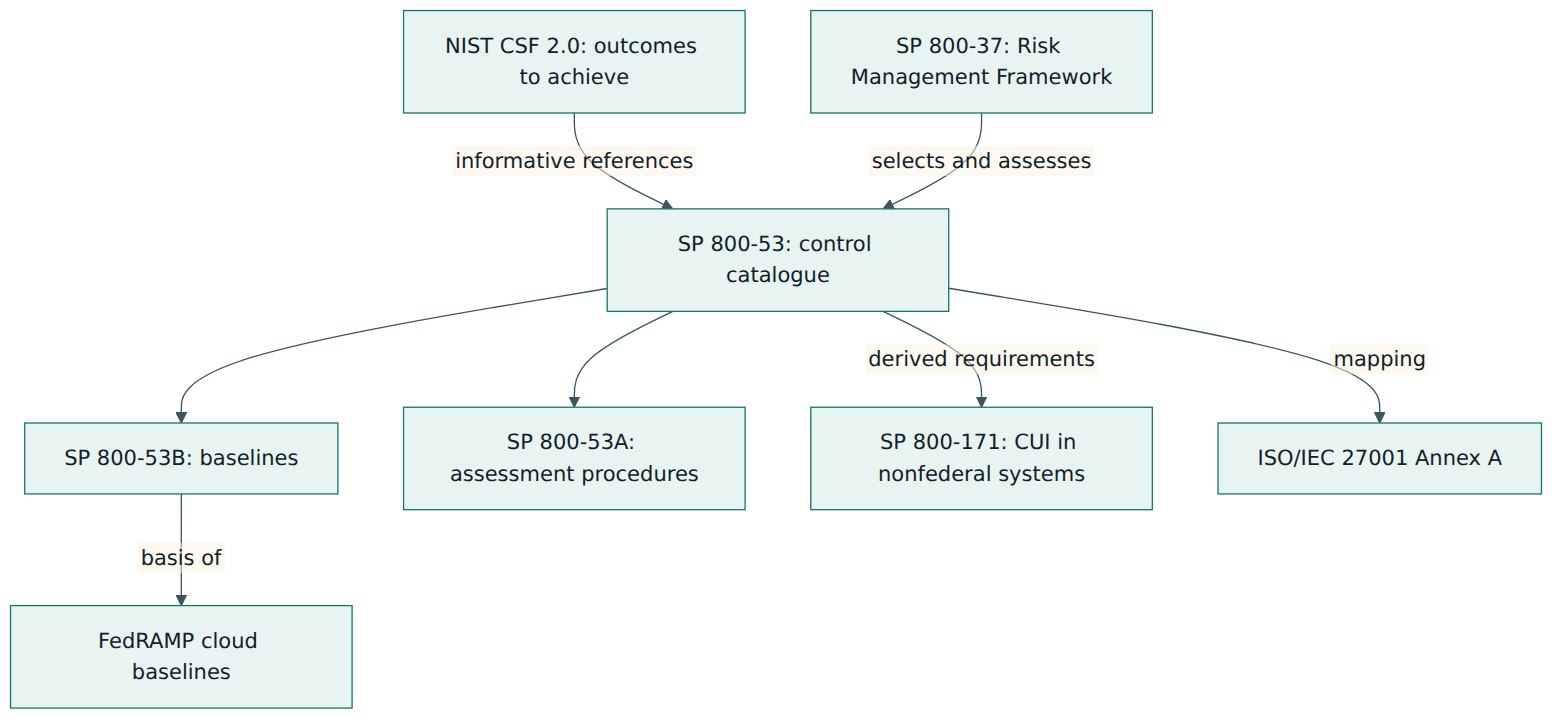
| Framework | Main purpose | Relationship to SP 800-53 |
|---|---|---|
| NIST Cybersecurity Framework (CSF) 2.0 | High-level outcomes organised under Govern, Identify, Protect, Detect, Respond and Recover; a common language for leaders | Describes what to achieve; SP 800-53 controls are listed as informative references showing how. Organisations often use the CSF for profiles and the catalogue for implementation detail. |
| NIST SP 800-171 Revision 3 | Security requirements for protecting controlled unclassified information (CUI) in nonfederal systems, such as contractors | Its requirements are derived from SP 800-53 controls, mostly at the moderate baseline, with items that are purely federal removed. The US defence contractor programme CMMC builds on SP 800-171. |
| FedRAMP | Standardised security authorisation for cloud services used by US federal agencies | Uses baselines built on SP 800-53 with added parameter values and requirements for cloud services. |
| ISO/IEC 27001:2022 | A certifiable information security management system with 93 reference controls in Annex A | Focuses on the management system and risk process; NIST publishes a mapping between SP 800-53 and ISO/IEC 27001. Many organisations get certified to ISO/IEC 27001 while using SP 800-53 for control detail. |
| CIS Critical Security Controls v8.1 | A prioritised set of 18 defensive actions with implementation groups | Much shorter and more prescriptive; CIS publishes mappings to SP 800-53. Useful for setting priorities in smaller organisations. |
| CNSSI No. 1253 | Categorisation and control selection for US national security systems | Uses the SP 800-53 catalogue with its own categorisation approach, baselines and overlays for national security systems. |
A useful way to remember the layers: the CSF says what good looks like, the RMF says how to manage risk through a system's life, SP 800-53 gives the detailed safeguards, SP 800-53A shows how to check them, and other programmes (FedRAMP, SP 800-171, sector rules) adapt that catalogue to their own communities. If you already hold an ISO/IEC 27001 certificate, the mapping lets you reuse much of your evidence, but you must still check SP 800-53 parameters and enhancements, which are often more specific than Annex A.
Common pitfalls and best practices
Pitfalls to avoid
- Trying to implement the whole catalogue. Teams that start with every control and enhancement drown in paperwork. Start from the right baseline and tailor it with a risk rationale.
- Treating the baseline as finished. Copying the moderate baseline without checking its assumptions, setting parameters or adding controls for known risks gives a false sense of coverage.
- Leaving parameters blank or vague. "In a timely manner" cannot be tested. Undefined parameters make controls impossible to assess and lead to inconsistent findings.
- Paper compliance. An SSP that describes intended controls rather than actual ones fails the first test-based assessment and damages trust with the authorising official.
- Ignoring inheritance boundaries. Assuming the cloud provider "does security" leaves hybrid controls half done; the customer's portion, such as application logging or account management, must still be implemented.
- Forgetting privacy. Treating the privacy baseline as optional when PII is processed, or handing it only to lawyers, misses the PT controls and the data minimisation they require.
- Claiming certification. Saying a product is "SP 800-53 certified" is inaccurate and can mislead customers; describe the baseline, assessment and authorisation instead.
Best practices
- Invest in common controls. Build strong organisation-wide controls once (identity, logging, training, incident response) so each system inherits them and documents only its part.
- Write down every tailoring decision. Record why controls were scoped out, added or replaced; assessors and future owners need the reasoning, not just the result.
- Use machine-readable sources. Import the official OSCAL or spreadsheet files and keep plans in a tool, so new releases can be compared and applied quickly.
- Automate evidence. Scans, configuration checks and log analytics provide continuous, objective evidence and make ongoing authorisation possible.
- Assess early and often. Run internal assessments with the SP 800-53A procedures during implementation, not only at the end, so weaknesses are cheap to fix.
- Keep the POA&M honest. Owners, realistic dates and regular review turn the POA&M into a risk management tool rather than a list of excuses.
- Watch for new releases. Follow NIST's public comment site and release notes, and plan a short review of affected controls after each release.
Summary and key takeaways
- SP 800-53 Revision 5 is NIST's catalogue of security and privacy controls; it is mandatory for US federal systems and widely used voluntarily elsewhere. The current release is 5.2.0 (August 2025).
- Revision 5 made controls outcome-based, integrated privacy, added supply chain risk management, moved baselines into SP 800-53B and opened the catalogue to any organisation.
- Controls are grouped into 20 families; each control has a statement, discussion, related controls, optional enhancements and references, with organisation-defined parameters to fill in.
- Categorisation with FIPS 199 sets a low, moderate or high impact level, which selects a baseline; the privacy baseline is added when PII is processed.
- Tailoring (common controls, scoping, compensating controls, parameter values, supplements) turns a baseline into a system's own control set.
- The Risk Management Framework in SP 800-37 puts the controls to work through seven steps, producing the SSP, assessment report, POA&M and authorisation decision.
- SP 800-53A assessments use examine, interview and test; findings are satisfied or other than satisfied. There is no SP 800-53 certification, only authorisations, attestations and mappings.
- The catalogue underpins SP 800-171, FedRAMP and CNSSI 1253, and maps to the CSF, ISO/IEC 27001 and the CIS Controls.
Reflection questions
- Pick a system you know. How would you rate its confidentiality, integrity and availability impact, and which baseline would that lead to? What assumptions behind that baseline might not hold for your system?
- Which controls in your organisation could be provided once as common controls, and what would each system still have to implement itself?
- Choose one control with an organisation-defined parameter that affects your work. What value would you set, and how would you justify it to an assessor?
- How would you explain to a sales colleague why the company should not describe its product as "SP 800-53 certified", and what accurate statement could replace it?
- If your organisation already uses ISO/IEC 27001 or the CSF, where would SP 800-53 add the most value, and where could it create duplicate work?
Further reading and official sources
- SP 800-53 Rev. 5, Security and Privacy Controls for Information Systems and Organizations – NIST CSRC
- SP 800-53B, Control Baselines for Information Systems and Organizations – NIST CSRC
- SP 800-53A Rev. 5, Assessing Security and Privacy Controls – NIST CSRC
- SP 800-37 Rev. 2, Risk Management Framework for Information Systems and Organizations – NIST CSRC
- SP 800-53 public comment site and release history – NIST CSRC
- NIST Risk Management Framework project (including free introductory courses) – NIST CSRC
- OSCAL – Open Security Controls Assessment Language – NIST
- FedRAMP – US General Services Administration
Original tutorial by xOps School (DevOpsSchool Private Limited), written from public sources about NIST SP 800-53. Not affiliated with or endorsed by the standard's owner; standard names are trademarks of their owners. Buy the official standard from its publisher for the authoritative text.