
ISO 21503 – Tutorial (about 60 minutes)
- View
ISO 21503 is the international guidance standard on programme management, published by the International Organization for Standardization (ISO). A programme is a group of related projects and other work that an organisation coordinates because, together, they deliver benefits that none of them could deliver alone. Sponsors, programme managers, PMO staff, transformation leads and the business managers who must make change stick use ISO 21503 as a neutral reference that sits above any particular method. After this tutorial you will be able to explain what makes a programme different from a large project, describe the main ideas and roles in the guidance, and use it to check how well your organisation runs its programmes.
Course overview
Edition and status: The current edition is ISO 21503:2022, Project, programme and portfolio management – Guidance on programme management, developed by ISO technical committee ISO/TC 258 (Project, programme and portfolio management). It is the second edition: it replaced ISO 21503:2017, which the committee catalogue now lists as withdrawn. The 2022 edition is listed as published and current (stage 60.60), and no revision project for it appears in the committee's catalogue of work in progress. Like every ISO standard it will be reviewed at least every five years, so watch the catalogue for a review result. Verified 2026-10-29 against the ISO/TC 258 committee catalogue and the ISO/TC 258 project page for ISO 21503.
Who it is for: programme managers and sponsors who want a method-neutral foundation; members of programme boards and steering groups who need to understand their part; PMO and transformation office staff who design how programmes are run; project managers whose projects sit inside a programme; and business managers who will own the new capabilities and benefits that programmes create.
Prerequisites: none. Basic familiarity with projects helps, and the companion course on ISO 21502 (project management) is useful but not required. Every term is explained when it first appears.
How to use this tutorial: read the seven lessons in order (about 45 minutes), study the five diagrams, then spend the remaining time on the reflection questions before you take the 25-question knowledge check.
Learning objectives:
- You will be able to explain why ISO 21503 exists, what it covers and what it intentionally leaves to methods and tools.
- You will be able to tell a programme apart from a project and from a portfolio, and use the core vocabulary correctly.
- You will be able to describe the main building blocks of the guidance: concepts, prerequisites, practices and roles.
- You will be able to describe a typical programme life cycle, its decision points and the way benefits are realised in waves.
- You will be able to explain how alignment with a guidance standard is assessed and why no accredited certification to it exists.
- You will be able to apply the guidance to a realistic transformation, from mandate to post-programme review.
- You will be able to relate ISO 21503 to the rest of the ISO 21500 family, to PMI's program management standard and to MSP.
Lesson 1 – Origins, purpose and scope
Why programmes need their own guidance
Imagine a bank that wants to cut the time it takes to open an account from five days to one hour. No single project can achieve that. The bank needs a new mobile app, a new identity-checking service, changes to its core banking system, retrained branch staff, new compliance procedures and a marketing campaign. Each of these can be run as a project with its own scope, budget and deadline. But if each project manager optimises only their own piece, the bank can end up with an excellent app that cannot talk to the core system, or a new process that staff were never trained on. Worse, nobody is watching whether the account-opening time actually falls, which was the whole point.
This is the gap that programme management fills. A programme groups the related pieces of work, coordinates their dependencies, keeps them pointed at a shared set of strategic objectives, and stays responsible for the benefits until they actually appear in the business. Programme management is therefore less about delivering things and more about steering change: deciding which pieces of work to start and stop, in what order, and how to absorb the results into everyday operations.
Many organisations learned this the hard way. Large transformations often fail not because individual projects fail, but because the parts never add up. Professional bodies responded with their own guidance: the UK government created Managing Successful Programmes (MSP), and the Project Management Institute (PMI) published a standard for program management (PMI uses the American spelling "program"). These are valuable, but each has its own vocabulary and assumptions. An international standard gives organisations, suppliers and partners from different countries a neutral, shared reference point.
From the 2017 edition to the 2022 edition
ISO published the first edition of ISO 21503 in 2017. At that time the family was built around ISO 21500:2012, a project management guidance document organised as process groups and subject groups. ISO/TC 258 then reorganised the family. Shared context and concepts for projects, programmes and portfolios moved into a new ISO 21500 (2021), and project-specific guidance became ISO 21502 (2020). ISO 21503 was revised in 2022 so that programme guidance fits this new arrangement and uses the same concepts and language as its siblings. The 2017 edition is withdrawn; if you see it cited in an old contract or policy, read it as a reference to the current edition unless the document deliberately fixes the year.
Scope: what the standard covers
ISO 21503 gives guidance on programme management. It is written to apply to any type of organisation, public or private, of any size and in any sector, and to programmes of any complexity. A five-person charity coordinating three related initiatives and a national government running a multi-year infrastructure programme can both use it, at very different levels of formality.
The standard covers the ideas, terms and concepts behind programme management, the conditions an organisation should have in place before programmes can succeed, good practice for directing and managing a programme, and the roles and responsibilities involved.
Scope: what it deliberately does not cover
- It does not prescribe processes, methods or tools. It will not tell you to use a particular template, software product, planning technique or agile framework. That choice is left to the organisation.
- It is not a requirements standard. It describes what good practice looks like, but it does not set out requirements that an auditor can certify against.
- It does not give detailed guidance on managing the individual projects inside a programme (that is ISO 21502) or on selecting and balancing a whole collection of investments (that is ISO 21504 on portfolio management).
- It does not cover the technical content of the work, whether software engineering, construction or clinical practice.
What "guidance" means
ISO distinguishes between documents that state requirements, written with "shall", and documents that give recommendations, written with "should". ISO 21503 is guidance, so its advice is expressed as recommendations. This matters in practice. An organisation can use it to design or improve its programme approach, to compare suppliers, to train staff or to structure an internal review. What it cannot do is claim "certification to ISO 21503" from an accredited body, because there are no requirements to certify. Lesson 5 returns to this point.
Lesson 2 – Key concepts and vocabulary
The ISO 21500 family shares a common vocabulary, collected in ISO 21506 and explained in context in ISO 21500. The explanations below are paraphrased for learning; the authoritative wording is in the standards themselves.
- Programme – a set of related components that an organisation manages in a coordinated way to achieve objectives and benefits that would not be available if each component were managed on its own.
- Component – any piece of work inside a programme: a project, a smaller programme (sometimes called a sub-programme), or other related work such as operational activities or a training effort.
- Programme management – the coordinated direction and management of a programme's components, governance, stakeholders and benefits so that the programme's objectives are met.
- Output – a tangible or intangible result that a component produces, such as a new system, a building or a trained workforce.
- Outcome – the change that results from using outputs, such as customers applying online instead of in branches.
- Benefit – a measurable improvement that one or more stakeholders regard as positive and that contributes to organisational objectives, for example reduced cost per new account.
- Dis-benefit – a measurable consequence that some stakeholders see as negative, for example higher licence fees or a loss of local jobs. Good programmes plan for these honestly.
- Programme sponsor – the senior person accountable for the programme achieving its objectives and benefits; they direct the programme on behalf of the sponsoring organisation.
- Programme manager – the person who leads the day-to-day management and coordination of the programme within the authority delegated by the sponsor.
- Programme board – a group of senior people, often chaired by the sponsor, that takes key decisions for the programme; organisations also call it a steering committee.
- Benefits owner – a business manager who is accountable for realising a particular benefit in operations, usually long after the components that enabled it have finished.
- Interdependency – a relationship in which one component depends on another, or on something outside the programme, for its inputs, timing or success.
- Programme roadmap – a high-level, time-based view of the components, major transitions and expected benefits; more strategic and less detailed than a project schedule.
- Transition – the planned move of outputs into everyday operations, including the handover of responsibility and the changes in behaviour that make outcomes happen.
- Stakeholder – any person or group that can affect, be affected by, or believe itself affected by the programme.
From strategy to benefits
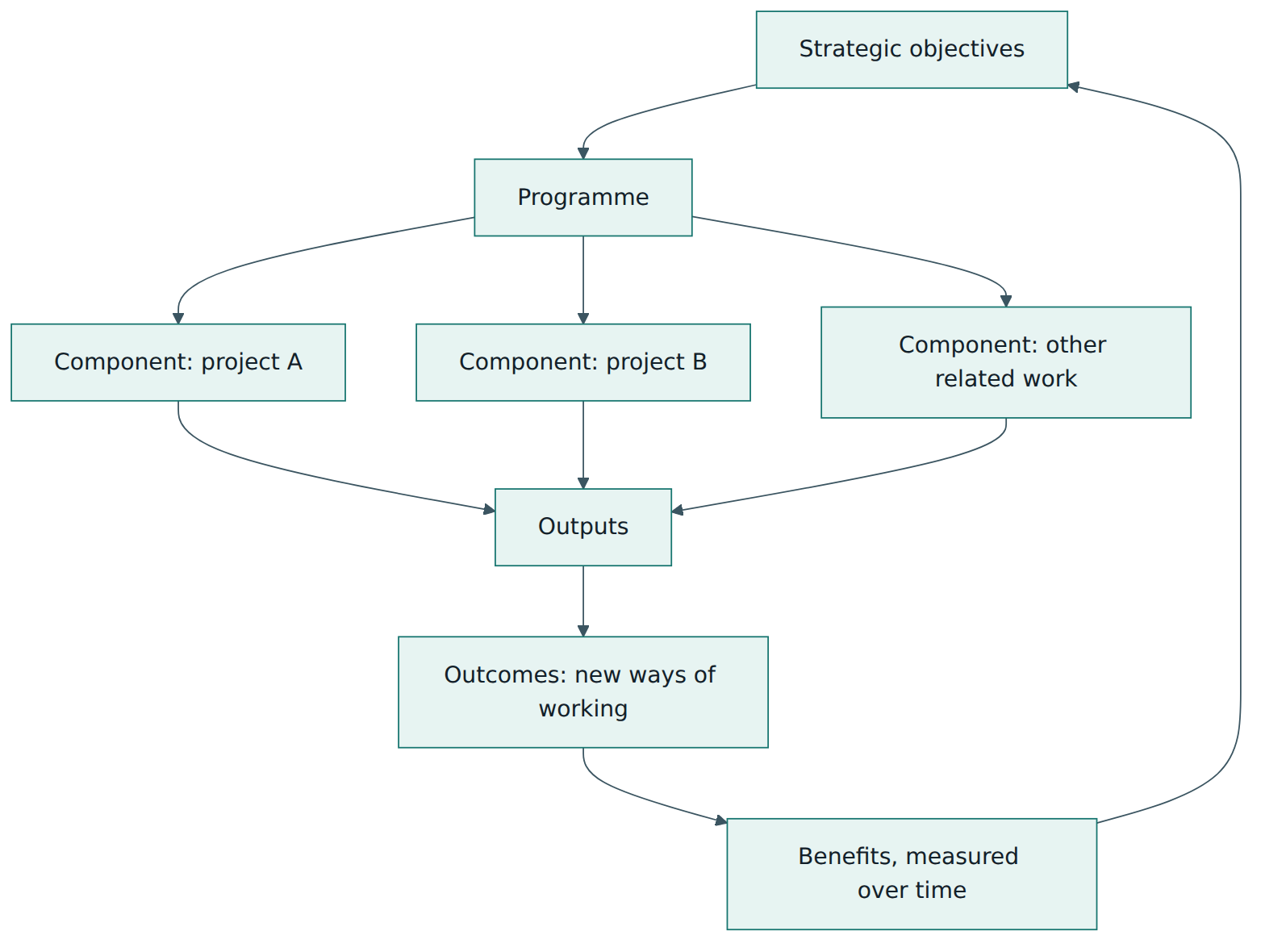
The single most important idea in programme management is the chain from strategy to benefits. An organisation sets strategic objectives. A programme is created to pursue some of them. Its components produce outputs. When people use those outputs, outcomes appear. Outcomes, measured over time, produce benefits, and those benefits feed back into the strategic objectives. A project can finish successfully when its output is accepted; a programme is only successful if the chain holds all the way to benefits.
Programme, project or portfolio?
Beginners often confuse the three management levels. The table summarises the usual distinctions used across the ISO 21500 family.
| Aspect | Project | Programme | Portfolio |
|---|---|---|---|
| Main purpose | Deliver defined outputs | Coordinate related work to realise benefits | Select and balance investments to meet strategy |
| Are the parts related? | One piece of work | Yes, components are interdependent | Not necessarily; grouped for decision-making |
| Time horizon | Defined start and end | Usually longer, ends when its objectives are achieved or no longer worthwhile | Ongoing, follows the planning cycle |
| Scope | Relatively fixed baseline | Evolves as learning and strategy change | Changes as investments enter and leave |
| Measure of success | Outputs to agreed time, cost and quality | Benefits and outcomes achieved | Overall value and strategic fit |
Why programmes are different in character
Three characteristics make programmes harder than projects. First, ambiguity: at the start you often know the destination but not the full route, so the set of components changes as you learn. Second, interdependence: delays and design choices in one component ripple into others. Third, change in the business: benefits only appear when people and processes change, which requires leadership from the business side, not just delivery skill. ISO 21503 therefore puts great weight on governance, benefits, stakeholder engagement and the coordination of components, rather than on detailed planning techniques.
A practical test is useful: if you could cancel the coordination role and let each piece of work run independently without losing value, you probably have a portfolio or a collection of projects, not a programme. If cancelling coordination would leave outputs that cannot be used together and benefits that nobody owns, you have a programme.
Lesson 3 – Structure of the standard
The building blocks
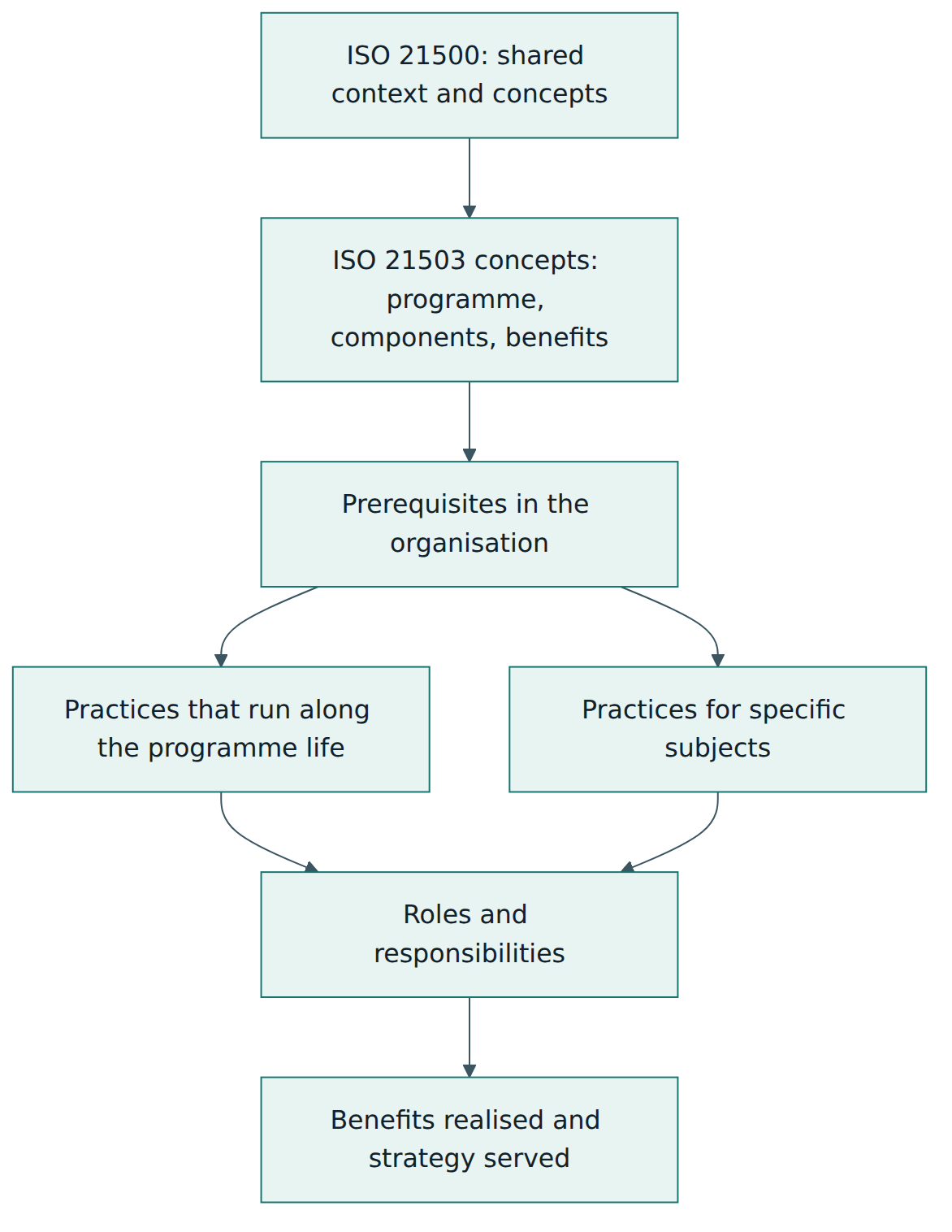
ISO 21503:2022 follows the usual layout of an ISO document: a scope, normative references and a terms and definitions clause come first. The guidance itself then covers four connected blocks. The ISO/TC 258 description of the standard names them: terms and concepts, prerequisites, practices, and roles and responsibilities. This tutorial teaches those blocks in a beginner-friendly order. Clause numbers and exact headings are best checked in the preview on the ISO Online Browsing Platform, because only the purchased text is authoritative.
Block 1 – Concepts
The concepts block explains what a programme is, how it relates to organisational strategy, to portfolios and to projects, and how outputs become outcomes and benefits. It also describes the environment a programme lives in: the organisation's culture, its governance arrangements, regulation, the market and the other change initiatives competing for the same people and money. Reading this block first prevents the most common misunderstanding, which is treating a programme as an oversized project.
Block 2 – Prerequisites
Programmes fail when the organisation around them is not ready. The prerequisites block describes the conditions that should exist before a programme can work well. Typical examples are a clear link to strategy, a governance framework that defines who can authorise and stop programmes, enough competent people in the key roles, a sponsor with real authority and time, an approach for managing benefits, and the ability of the business to absorb change. Think of these as the soil the programme is planted in. A gap here cannot be fixed by a better programme plan.
Block 3 – Practices
The practices are the heart of the guidance. Whatever exact headings the standard uses, programme practices can be read in two complementary ways.
- Along the life of the programme – how a programme is identified and justified, set up, directed, controlled, used to deliver components and transitions, and finally closed, together with what should happen after closure so that benefits continue to be tracked.
- By subject – the topics a programme must manage all the time, whatever phase it is in: planning and roadmaps, benefits management, stakeholder engagement and communication, management of risks and issues, resources and finance, change control, the coordination of interdependencies between components, quality and assurance, reporting, and learning from experience.
The two views overlap deliberately. Benefits management, for example, starts when the programme is justified, shapes every decision about which component to start next, and continues long after closure. Reading the life-cycle view tells you when something happens; reading the subject view tells you what good looks like in that topic.
Block 4 – Roles and responsibilities
The roles block explains who should oversee, direct and manage a programme and how responsibility flows between them. Lesson 4 describes these roles in detail. The essential idea is separation: the people who decide whether the programme is still worth doing should not be the same people who are judged on delivering it on time, and the people who will own the benefits must be involved from the start.
How the parts fit together
A useful mental model is a house. The concepts are the foundations, the prerequisites are the ground floor that must be solid, the practices are the rooms where the work happens, and the roles are the people who live in and look after the house. Because the 2022 edition was revised to sit alongside ISO 21502:2020 and ISO 21504:2022, readers who know one of these documents will recognise the same shape and language in the others. That consistency makes it easier to build a single governance model that covers projects, programmes and portfolios together.
What you will not find
You will not find templates, checklists of mandatory documents, maturity levels, scoring schemes or tool recommendations. If a training provider presents a "level 3 ISO 21503" scale or a list of "mandatory ISO 21503 artefacts", that material is the provider's own interpretation, not the standard.
Lesson 4 – How it works in practice
A typical programme life cycle
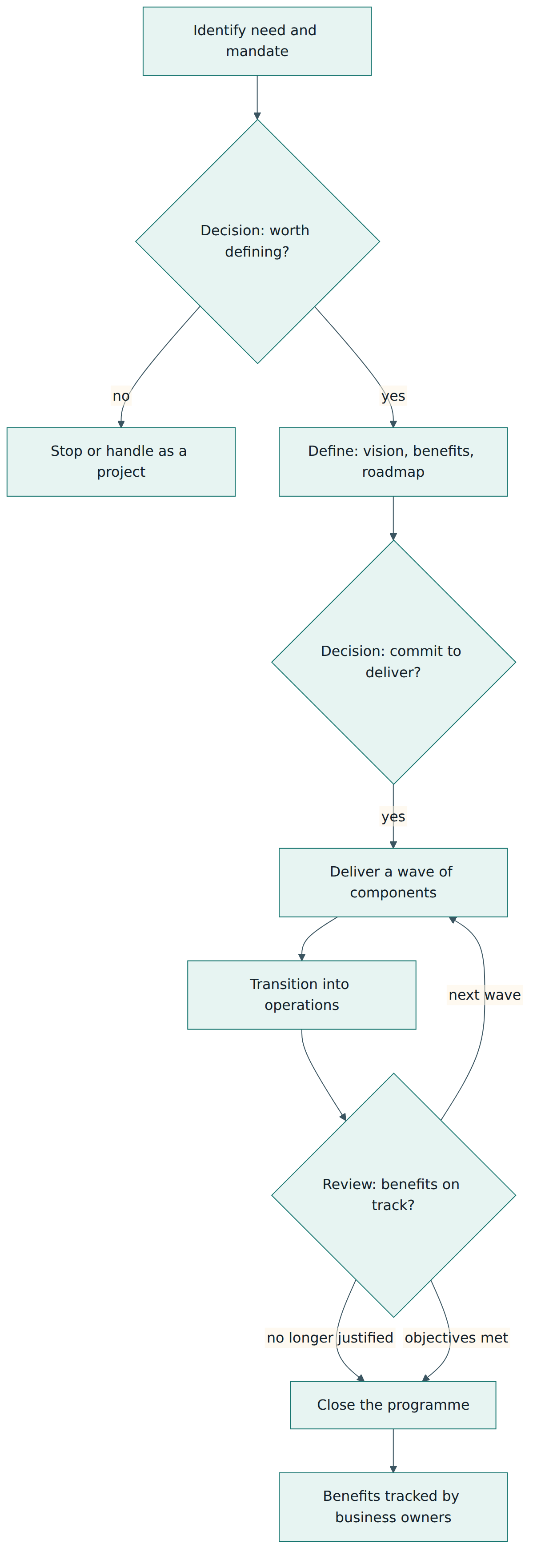
ISO 21503 does not impose a fixed life cycle, but most programmes pass through recognisable stages. The names below are generic; organisations and methods use their own.
- Identify – a strategic need or opportunity is recognised. A senior leader is given a mandate to explore it. The key question is whether a coordinated programme is really needed, or whether a single project or a portfolio decision would do.
- Define and set up – the programme's vision of the future state, the expected benefits, an initial roadmap, the governance arrangements, the key roles and a business case are prepared. The sponsoring organisation decides whether to commit.
- Deliver in waves – components are started, run, coordinated and closed. Because programmes are long, delivery is usually organised in waves or increments, each ending with a transition that puts new capabilities into use.
- Realise benefits – business owners embed the changes, and benefits are measured against their baselines. Results feed back into decisions about the next wave.
- Close – when the objectives have been achieved, or the programme is no longer justified, it is formally closed. Remaining benefit tracking is handed to business owners.
- Review after closure – a later evaluation checks whether the promised benefits really appeared and what can be learned. ISO 21513 now gives dedicated guidance on post-project and post-programme evaluation.
Decision points
A decision point is a planned moment at which the people who direct the programme look at the evidence and decide whether to continue, change direction or stop. In a project, such points mostly check delivery progress. In a programme they also check whether the strategy is still the same, whether earlier waves produced the outcomes expected, and whether the remaining components are still the best route. A programme that never considers stopping is not really being directed.
Who does what
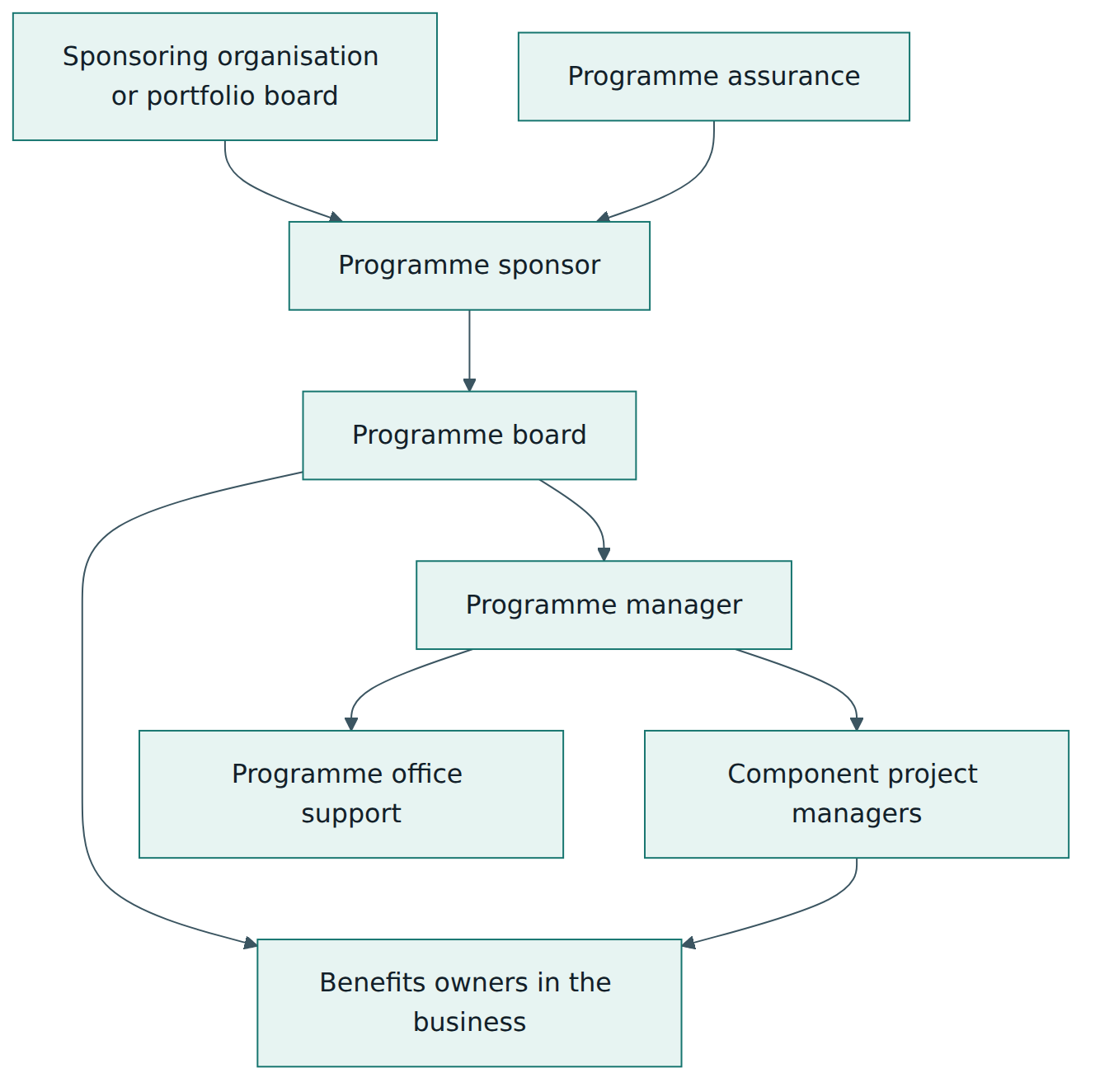
Programme roles are described by responsibility, not by job title. The same person may hold several roles in a small programme; in a large one each role may be a team.
- Sponsoring organisation – usually executive management or a portfolio board. It approves the programme as an investment, sets its strategic boundaries and decides on its continuation at major points.
- Programme sponsor – owns the case for the programme, champions it, chairs the programme board, and is accountable for benefits. The sponsor needs authority over resources and enough time to lead.
- Programme board – senior representatives of the business areas affected, key suppliers and sometimes finance or risk functions. It supports the sponsor in directing the programme.
- Programme manager – plans and coordinates the components, manages interdependencies, risks and issues across them, reports to the board and keeps the roadmap realistic.
- Business change or benefits owners – managers in the operational areas who prepare their people for change, accept outputs, and are accountable for realising specific benefits.
- Component managers – the project managers and team leads who deliver the components within the tolerances the programme sets.
- Programme office and assurance – support functions that keep information, plans and reports in order, and independent reviewers who give the sponsor confidence that the programme is being run properly.
Typical artefacts
The standard leaves the names and formats of documents to the organisation, but most programmes keep information like the following. What matters is the content and the decisions it supports, not the template.
- A mandate or brief that records why the programme was started and by whom.
- A vision or description of the future state the organisation wants to reach.
- A business case that brings together costs, benefits, dis-benefits, risks and options; it is updated at decision points.
- A benefits register and benefit descriptions with measures, baselines, targets, timing and owners.
- A roadmap showing waves, components, transitions and expected benefit timing.
- A governance description: roles, decision rights, tolerances and escalation routes.
- A stakeholder map and engagement plan.
- Registers for risks, issues, dependencies and decisions that span components.
- Regular programme reports and records of decisions at each decision point.
Coordinating components
The daily work of a programme manager is coordination. Interdependencies must be identified early and tracked like risks: who needs what, from whom, by when. Shared resources such as scarce architects or a single test environment need a programme-level view so that components do not compete destructively. Risks that affect several components, or that only appear when components are combined, belong at programme level. Changes proposed in one component must be checked for their impact on the others and on benefits. A component may be on time and within budget and still be a problem if its output no longer fits what the programme needs.
Implementing the guidance in an organisation
Organisations rarely adopt ISO 21503 in one step. A practical sequence is:
- Decide which initiatives are truly programmes and agree a simple definition and threshold.
- Compare the current way of running programmes with the guidance and record the gaps.
- Fix the prerequisites first: sponsor authority, decision rights, links to portfolio management and a basic benefits approach.
- Define the roles and the minimum information each programme must maintain, scaled by size and risk.
- Train sponsors and board members, not only programme managers; direction is where many programmes fail.
- Pilot the approach on one or two programmes, collect lessons and refine.
- Review periodically and connect the approach to project guidance (ISO 21502) and portfolio guidance (ISO 21504).
Tailoring and agile ways of working
The guidance is meant to be scaled. A small programme might combine the sponsor and board roles, keep benefits in a simple spreadsheet and hold monthly decision meetings. A national programme might have formal independent assurance, a large programme office and quarterly gateway reviews. Because ISO 21503 does not prescribe methods, programmes that deliver components using Scrum, Kanban or scaled agile frameworks can still align with it. In those settings, waves are often aligned with planning increments, and benefits are measured continuously rather than once at the end. The principles stay the same: a clear link to strategy, coordinated components, owned benefits and real decisions.
Lesson 5 – Assessment, certification and compliance
No accredited certification for organisations
Management system standards such as ISO 9001 or ISO/IEC 27001 contain requirements, and accredited certification bodies audit organisations against them. ISO 21503 is different. It is a guidance document made of recommendations, so there is no accredited certification scheme that certifies an organisation "to ISO 21503". If a supplier claims such certification, ask what exactly was assessed, by whom and against which criteria. A statement like "our programme approach is aligned with ISO 21503, as confirmed by an independent review in 2026" is honest; "ISO 21503 certified" is misleading unless it clearly refers to something else, such as a person's training certificate.
Certificates for individuals
Some commercial training organisations offer courses and personal certificates referring to the ISO 21500 family. These certify that a person passed that provider's exam; they are not issued by ISO and do not certify any organisation. Widely recognised individual credentials in programme management also come from method owners, for example PMI's Program Management Professional (PgMP) and the MSP certifications offered by PeopleCert. They test knowledge of those bodies' frameworks, which overlap strongly with ISO 21503 but are not the same document.
How alignment is assessed in practice
Organisations use ISO 21503 as a benchmark in several ways:
- Gap analysis – the programme approach is compared with each area of the guidance, and differences are recorded with their impact and an action owner.
- Programme health checks and gateway reviews – independent reviewers examine a live programme at key points, using the guidance as part of their criteria.
- Internal audit – auditors check whether the organisation's own programme policy, which may be based on ISO 21503, is actually followed.
- Maturity assessment – organisations may use a maturity model such as P3M3 to rate capability across projects, programmes and portfolios; such models are separate from ISO 21503 but can be used alongside it.
- Post-programme evaluation – a structured look back, after closure, at whether benefits were delivered and why; ISO 21513 gives guidance on this.
What good evidence looks like
A reviewer checking alignment wants to see that the guidance is lived, not just copied into a policy. Strong evidence includes decision records that show the board actually considered stopping or redirecting; benefits with real baselines and owners who can describe their numbers; a dependency log that is current and used in meetings; stakeholder engagement that changed something; and lessons from one wave that visibly changed the next. Weak evidence is a large binder of templates, filled in once at the start and never updated.
Contracts, regulation and public bodies
Because ISO 21503 is not a legal requirement, it applies only where someone chooses to adopt it. Public bodies and large clients sometimes reference the ISO 21500 family in procurement documents or internal governance policies, asking suppliers to show how their approach maps to the guidance. In that case, the contract or policy, not the standard, creates the obligation, and it should say clearly what evidence will be accepted.
Lesson 6 – Worked example
Northbay Logistics is a fictional mid-sized logistics company with twelve warehouses and 2,000 employees. Customers complain about late deliveries and poor tracking, and the board sets a three-year strategic objective: become the most reliable regional logistics partner, measured by on-time delivery and customer retention. The chief operating officer proposes a programme called "Reliable Delivery".
Step 1 – Identify: is this really a programme?
The executive team first checks whether a single project would do. The analysis shows several pieces of work that depend on one another: a new warehouse management system, a customer tracking portal, a data platform that joins the two, a redesign of picking and dispatch processes, consolidation of two older warehouses, and retraining of 800 staff. None of these creates the objective alone; the portal is useless without accurate data, and the new system will not raise reliability unless processes and skills change. The executive team agrees that a coordinated programme is needed and gives the COO a written mandate as programme sponsor.
Step 2 – Define and set up
The sponsor appoints an experienced programme manager and forms a programme board with the heads of operations, IT, finance and customer service, plus the key software supplier. Together they describe the future state: every order tracked end to end, dispatch errors halved, customers able to see their delivery status at any time.
They then define benefits carefully. On-time delivery is measured today at 86 percent; the target is 95 percent within two years of the first warehouse going live. Customer retention, cost per order and staff overtime are also chosen, each with a baseline, a measure, a target date and a named business owner. The head of operations owns on-time delivery; the head of customer service owns retention. The team also records dis-benefits honestly: temporary productivity losses during cut-over and the closure of one site, which affects local staff.
The roadmap organises delivery in three waves. Wave 1 builds the data platform and pilots the new system and processes at one warehouse. Wave 2 rolls out to six warehouses and launches the tracking portal. Wave 3 completes the rollout and the consolidation. A business case brings costs, benefits, risks and options together, and the executive team, acting as the sponsoring organisation, approves commitment to wave 1 only, with a review before wave 2.
Step 3 – Deliver wave 1 and coordinate components
Four components start: data platform, system configuration, process redesign and pilot training. The programme manager keeps a cross-component dependency log. Early on it shows that process redesign needs system screens two months before configuration had planned to produce them. Rather than let each project manager negotiate alone, the programme manager raises the conflict at the programme level, and the board agrees to bring forward one configuration sprint and delay a lower-value report. A risk that the pilot warehouse's peak season could overlap with cut-over is managed at programme level by moving the go-live date, because it affects several components and the benefits timeline.
The programme office maintains a single monthly report showing progress by component, top cross-cutting risks, the status of interdependencies and early benefit indicators. Independent assurance, provided by the internal audit team, reviews governance before the pilot goes live.
Step 4 – Transition and review
The pilot warehouse goes live. The head of operations, as benefits owner, leads the transition: supervisors are coached, old paper procedures are withdrawn, and the new process becomes the normal way of working. After three months, on-time delivery at the pilot site has risen from 86 to 91 percent, but dispatch errors have barely moved. Analysis shows the cause is not the system but a shift pattern that leaves the evening dispatch team under-trained.
At the decision point before wave 2, the board considers the evidence. It decides to continue, but changes the plan: a new component for shift redesign is added, the training approach is revised, and the portal launch is moved later so that customers do not see unreliable data. This is programme management working as intended: learning from outcomes changes the set of components.
Step 5 – Later waves and a strategic shift
During wave 2, the company acquires a smaller competitor with its own modern warehouse system. The sponsoring organisation asks whether wave 3 is still the best route. The programme board compares options and decides to integrate the acquired company's warehouses into the data platform rather than replace their system. The roadmap and business case are updated, and one planned component is cancelled. Stopping work that no longer adds value is a sign of strong direction, not failure.
Step 6 – Close and evaluate
Thirty months after the mandate, all planned capabilities are in operation, and on-time delivery across the network has reached 94 percent with a clear upward trend. The board decides that the programme's objectives are substantially met and that remaining improvement belongs to normal operations. The programme closes: contracts are completed, the team is released, documents are archived and lessons are recorded. Benefit tracking is handed to the business owners, who report it in the regular operations review. One year later, a post-programme evaluation confirms that the 95 percent target was reached and retention improved, and it records lessons on training and on adding components mid-programme for the next transformation.
What the example shows
- The decision to run a programme came from interdependent work serving one strategic objective, not from size alone.
- Benefits had baselines, targets and business owners from the start, so success could be judged on outcomes.
- Delivery in waves with decision points allowed learning and a strategic change to reshape the programme.
- Coordination of interdependencies, shared risks and resources happened at programme level, not inside each project.
- Closure did not end benefit tracking; ownership simply moved to operations.
Lesson 7 – Relationship to other standards and frameworks
The ISO 21500 family
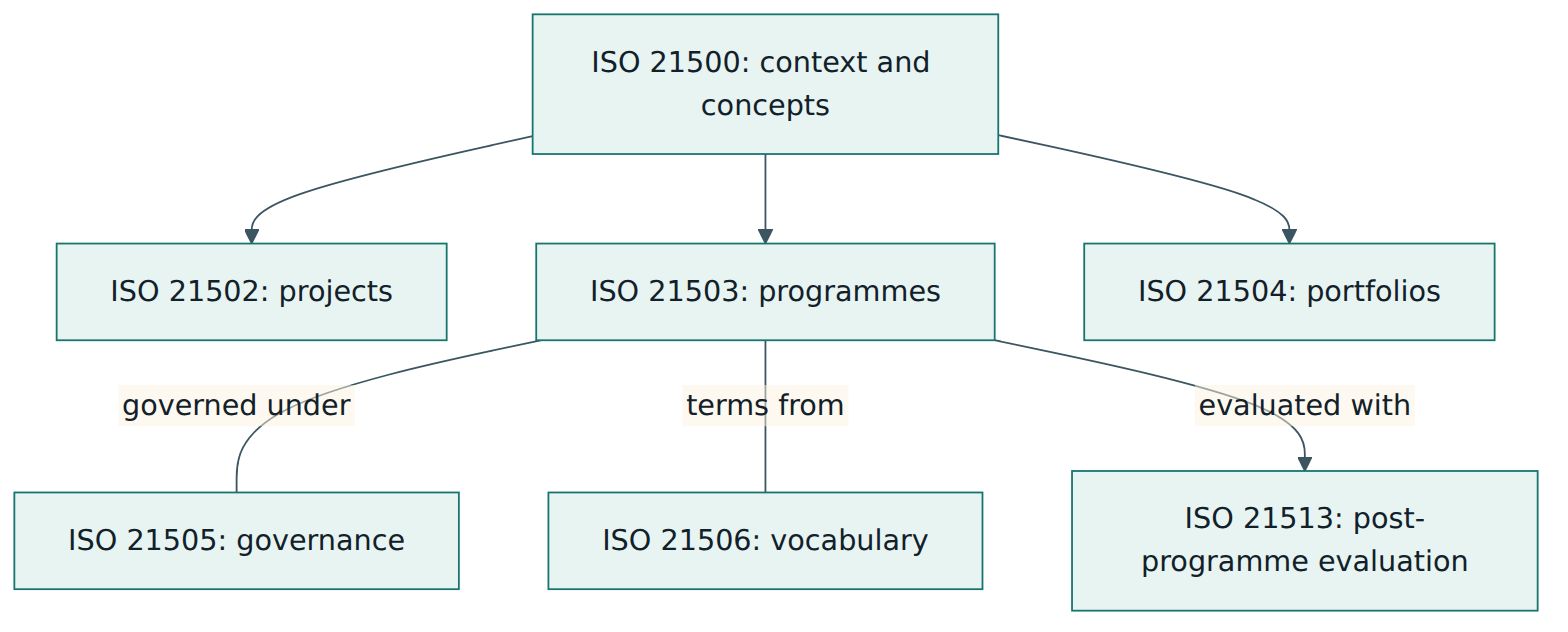
ISO 21503 is one member of the family developed by ISO/TC 258. ISO 21500:2021 provides shared context and concepts. Three guidance standards then address the three management levels: ISO 21502 for projects, ISO 21503 for programmes and ISO 21504 for portfolios. ISO 21505 covers governance across all three, and ISO 21506 brings the vocabulary together. Technique documents add detail, such as work breakdown structures (ISO 21511), earned value management (ISO 21508 and ISO 21512) and post-project and post-programme evaluation (ISO 21513:2026). The family keeps moving: as of 2026-10-29 the committee catalogue shows revisions of ISO 21500 and ISO 21502 under development, while ISO 21503:2022 itself has no revision project.
Comparison with related references
| Reference | Owner | Focus | Relationship to ISO 21503 |
|---|---|---|---|
| ISO 21500:2021 | ISO/TC 258 | Shared context and concepts for projects, programmes and portfolios | Provides the foundation and common language that ISO 21503 builds on |
| ISO 21502:2020 | ISO/TC 258 | Guidance on project management | Covers the components inside a programme; the programme sets their context and tolerances |
| ISO 21504:2022 | ISO/TC 258 | Guidance on portfolio management | The portfolio level selects and prioritises programmes and often acts as the sponsoring organisation |
| ISO 21505:2017 | ISO/TC 258 | Guidance on governance of projects, programmes and portfolios | Explains how the organisation's governing body directs and controls programme work |
| The Standard for Program Management | Project Management Institute | Principles and performance domains of program management | Very similar aims; uses PMI vocabulary and underpins the PgMP credential |
| MSP (Managing Successful Programmes) | PeopleCert (originally UK government) | A detailed programme method with principles, themes and processes | A method that can be used to apply ISO 21503; uses its own terms such as tranche and target operating model (called the blueprint before the 2020 edition) |
| P3M3 | PeopleCert (AXELOS) | Maturity model for project, programme and portfolio capability | Can be used to assess how mature an organisation's programme practice is |
Choosing and combining
ISO 21503 answers the question "what should good programme management include?" A method such as MSP answers "how exactly do we do it, with which documents and steps?" A maturity model answers "how capable are we, and what should we improve next?" Many organisations use all three: the standard as the neutral reference for their policy, a method or in-house playbook for day-to-day practice, and a maturity model to plan improvement. When you work with partners who use different methods, the ISO vocabulary gives you a shared language to agree roles and decisions.
Agile and product-based organisations
Organisations that organise around long-lived products and teams sometimes ask whether programmes still exist. In practice, any coordinated change across several teams aimed at shared benefits is a programme, whatever it is called. Scaled agile frameworks provide their own coordination structures; ISO 21503 can be used to check that, within those structures, someone still owns the link to strategy, the benefits and the decision to continue or stop.
Common pitfalls and best practices
Common pitfalls
- Calling a very large project a programme, then running it with project controls only, so that benefits and business change are nobody's job.
- Declaring success when all components have delivered, without measuring whether outcomes and benefits appeared.
- Defining benefits vaguely, without baselines, measures or named owners in the business, so they cannot be tracked or challenged.
- A sponsor who lacks authority or time, leaving the programme manager to make strategic decisions they are not entitled to make.
- Managing interdependencies informally, so conflicts between components surface late, as delays or rework.
- Treating the roadmap as fixed and never using decision points to redirect or stop components that no longer add value.
- Producing a large set of documents because a template exists, rather than because they support a decision.
- Claiming "certification" to a guidance standard, which misleads clients and auditors.
Best practices
- Start from strategy: write down which strategic objectives the programme serves and check that link at every decision point.
- Give each benefit a measure, a baseline, a target, a time frame and a business owner before committing to delivery.
- Deliver in waves that each end with a usable capability and a real review of outcomes.
- Separate directing from managing: the sponsor and board decide, the programme manager coordinates and recommends.
- Keep a live, programme-level view of dependencies, cross-cutting risks and shared resources, and use it in every board meeting.
- Involve the business owners of change from the start, and plan transition into operations as carefully as delivery.
- Scale governance and documentation to the size and risk of the programme, and review the approach regularly.
- Close deliberately: hand over benefits tracking, capture lessons and plan a post-programme evaluation.
Summary and key takeaways
- ISO 21503:2022 is ISO/TC 258's current guidance on programme management; it replaced the withdrawn 2017 edition and is aligned with ISO 21500:2021 and ISO 21502:2020.
- It is guidance written as recommendations, applies to any organisation and programme, and does not prescribe processes, methods or tools.
- A programme coordinates related components to realise benefits that would not be achieved if each were managed separately.
- The chain from strategy through outputs and outcomes to benefits defines programme success.
- The guidance covers concepts, prerequisites, practices and roles; prerequisites in the organisation are as important as the practices.
- Programmes are directed through decision points, delivered in waves with transitions, and can be redirected or stopped as strategy and evidence change.
- No accredited certification of organisations exists; alignment is shown through gap analyses, reviews, audits and evaluation.
- ISO 21503 sits beside ISO 21502 and ISO 21504 and works well with methods such as MSP and PMI's program standard.
Reflection questions
- Think of a large initiative in your organisation. Using the ideas in this tutorial, would you classify it as a project, a programme or part of a portfolio, and why?
- For one benefit your organisation expects from a current change, write down its measure, baseline, target, timing and owner. What was hardest to define?
- Which prerequisites for successful programmes are strongest and weakest in your organisation, and what would you fix first?
- Describe a decision point in a programme you know. What evidence was used, and was stopping or redirecting genuinely considered?
- If a client asked you to show that your programme approach aligns with ISO 21503, what evidence would you present, and what gaps might they find?
Further reading and official sources
- ISO 21503:2022 – Guidance on programme management (catalogue entry) – International Organization for Standardization
- ISO 21503:2022 project page – ISO/TC 258 Project, programme and portfolio management
- ISO/TC 258 catalogue of published and planned standards – International Organization for Standardization
- ISO 21502:2020 – Guidance on project management – ISO/TC 258
- ISO 21504:2022 – Guidance on portfolio management – ISO/TC 258
- The Standard for Program Management – Project Management Institute
Original tutorial by xOps School (DevOpsSchool Private Limited), written from public sources about ISO 21503. Not affiliated with or endorsed by the standard's owner; standard names are trademarks of their owners. Buy the official standard from its publisher for the authoritative text.