
ISO 55001 – Tutorial (about 60 minutes)
- View
ISO 55001 is the international standard that sets out the requirements for an asset management system: a structured, repeatable way for an organisation to decide how it acquires, uses, maintains, renews and disposes of its assets so that they deliver the most value at an acceptable cost and level of risk. Water and energy utilities, railways, ports, mines, local governments, hospitals, manufacturers and data-centre operators use it, and many seek independent certification against it. After this tutorial you will be able to explain what the standard asks for, connect organisational goals to day-to-day asset decisions, read the clause structure of the 2024 edition, understand how certification works, and spot the mistakes that turn asset management into paperwork.
Course overview
Edition and status: The current edition is ISO 55001:2024, Asset management — Asset management system — Requirements, the second edition, published by ISO in July 2024 (launched by the committee on 3 July 2024). It was prepared by ISO technical committee ISO/TC 251 Asset management and replaces the first edition, ISO 55001:2014. It is used together with ISO 55000:2024 (vocabulary, overview and principles), which was revised at the same time. The guidance standard ISO 55002 is still the 2018 edition, written for the 2014 requirements; ISO/TC 251 is revising it, and its May 2025 plenary communiqué reported a target of summer 2027 for the new edition. Verified 2026-10-29 on the ISO/TC 251 committee website (project pages, news items and the official ISO 55001:2024 and ISO 55000:2024 brochures); the ISO catalogue page could not be retrieved automatically, so confirm details there if you need the official record. Transition deadlines for certificates issued against the 2014 edition are set by accreditation and certification bodies, so check the date that applies to you with your certification body.
Who this is for: engineers, maintenance and reliability staff, operations managers, planners, finance and capital-investment teams, quality, risk and compliance professionals, and anyone in an asset-intensive organisation who has heard "we are aligning with ISO 55001" and wants to know what that means in practice. It is also useful for consultants, contractors and service providers who work inside a client's asset management system.
Prerequisites: none. A general idea of how an organisation runs (budgets, managers, suppliers, maintenance work) helps, but every asset management and management-system term is explained when it first appears. You do not need an engineering or accounting background.
By the end of this tutorial:
- You will be able to explain what asset management is, why ISO 55001 exists and what it does and does not require.
- You will be able to define the core vocabulary, including asset, asset portfolio, value, life cycle, SAMP, asset management plan and decision-making criteria.
- You will be able to describe the clause 4 to 10 structure of ISO 55001:2024 and the main changes from the 2014 edition.
- You will be able to trace the "line of sight" from organisational objectives through the SAMP and plans to work on individual assets.
- You will be able to outline how conformity is assessed, from internal audits and maturity assessments to third-party certification.
- You will be able to apply the standard to a realistic organisation and recognise common pitfalls in scope, data, decision-making and planning.
- You will be able to place ISO 55001 among related standards such as ISO 55000, ISO 55002, ISO 31000, ISO 9001 and ISO/IEC 19770-1.
Lesson 1 – Origins, purpose and scope
Why manage assets as a system?
Think about a town's water network. The pipes under the streets were laid over a hundred years by different teams with different materials. Pumps were bought from several suppliers. Records sit in spreadsheets, a geographic information system and the memory of a few long-serving fitters. Every year there is more work than money: a burst main here, an ageing pump there, a new housing estate that needs connecting, a regulator asking about leakage. Decisions are made, but often by whoever shouts loudest, by the size of last year's budget, or by fixing what broke most recently.
Asset management is the discipline of making those decisions deliberately. Instead of treating maintenance, capital projects, operations and finance as separate worlds, it asks one question across the whole life of every asset: what combination of cost, risk and performance gives the organisation the most value, now and in the future? A pump that is cheap to buy but expensive to run and unreliable may be a poor choice. A main that looks fine but would flood a hospital if it burst may deserve attention before a noisier but less critical pipe.
Most organisations already do some of this. What they often lack is a system: agreed policy, objectives, decision rules, roles, data, plans, checks and improvement loops that make good decisions repeatable rather than dependent on a few experienced people. ISO 55001 specifies what such a system must contain. It is a management-system standard, like ISO 9001 for quality or ISO 14001 for the environment. It tells you what the system must achieve and demonstrate, not how to maintain a transformer or how often to inspect a bridge.
From PAS 55 to the ISO 55000 series
The ISO standards grew out of earlier work in the United Kingdom. The British Standards Institution published PAS 55, a publicly available specification for the optimised management of physical assets, in 2004, developed with the Institute of Asset Management (IAM), and revised it in 2008. PAS 55 was adopted by many utilities and infrastructure owners and attracted international interest. ISO set up a project committee in 2010 to produce an international equivalent, and in 2014 it published three standards together: ISO 55000 (overview, principles and terminology), ISO 55001 (requirements) and ISO 55002 (guidelines). A permanent technical committee, ISO/TC 251, was later created to maintain and extend the series.
Drawing on a decade of feedback and experience from more than fifty countries, ISO/TC 251 published new editions of ISO 55000 and ISO 55001 in 2024, together with two new guidance standards on people (ISO 55012) and data (ISO 55013), and updated or new documents on finance alignment (ISO/TS 55010) and public policy (ISO 55011). The 2024 revision of ISO 55001 made requirements clearer on decision-making, realising value, strategic planning, risk and opportunity, data and knowledge, life cycle operations and what it calls predictive action. You will meet each of these in Lesson 3.
What the standard covers, and what it does not
ISO 55001 can be used by any organisation, public or private, large or small, and the organisation itself decides which of its assets fall inside the system. In practice it is most often applied to physical assets such as networks, plant, fleets, buildings and equipment, but the concepts also work for other kinds of assets, and the series now includes guidance on data assets. The standard is intended for three groups: people who build and run the asset management system, people and service providers who carry out asset management work, and internal or external parties who assess whether the organisation meets its own, legal, regulatory and contractual requirements.
ISO 55001 does not prescribe maintenance strategies, reliability techniques, accounting methods, software or performance targets. It does not say that you must use reliability-centred maintenance, a particular risk matrix or a specific enterprise asset management tool. It requires you to decide these things on purpose, document the reasons where needed, apply them consistently and keep improving them. This is why two certified organisations can look very different on the surface while both conforming.
Lesson 2 – Key concepts and vocabulary
The vocabulary for the series lives in ISO 55000:2024, and ISO 55001 also uses the common terms shared by all ISO management-system standards. The explanations below are paraphrased in plain language; when you implement the standard, use the official definitions.
- Asset – anything that has actual or potential value to the organisation. A pump, a road, a software licence, a dataset or a trained workforce can all be assets; what makes something an asset is the value it can provide, not whether it appears on a balance sheet.
- Asset portfolio – the set of assets that falls within the scope of the asset management system. Choosing the portfolio is one of the first and most important scoping decisions.
- Asset system – a group of assets that work together to deliver a function, such as a pumping station with its pumps, valves, power supply and controls. Managing assets as systems avoids optimising one part at the expense of the whole.
- Asset management – the coordinated activity of an organisation to realise value from its assets. "Coordinated" matters: it spans engineering, operations, finance, procurement, IT and people, not just the maintenance department.
- Asset management system (AMS) – the set of interrelated policies, objectives, processes, roles and supporting elements an organisation uses to direct and control its asset management. ISO 55001 specifies requirements for this system, not for the assets themselves.
- Value – the benefit an asset provides to the organisation and its stakeholders, which can be financial (revenue, avoided cost) or non-financial (safety, service, environmental or social outcomes). Each organisation must decide what value means for it.
- Life cycle – the stages an asset passes through, from identifying the need, through creation or acquisition, use, maintenance and improvement or renewal, to disposal. Asset management looks at the whole life cycle rather than the purchase price alone.
- Stakeholder (interested party) – a person or organisation that can affect, be affected by, or believe itself affected by a decision or activity, such as customers, regulators, owners, employees, communities and suppliers.
- Asset management policy – a short statement by top management of the intentions and direction for asset management, including the principles that guide decisions.
- Strategic asset management plan (SAMP) – documented information that translates organisational objectives into asset management objectives and sets out the approach for developing plans and the role of the asset management system in achieving them. It is the bridge between corporate strategy and asset plans.
- Asset management objective – a specific, measurable result that asset management must achieve, derived from organisational objectives, for example a target interruption rate or a maximum backlog of safety-critical work.
- Asset management plan – documented information that specifies the activities, resources, responsibilities and timescales for individual assets or groups of assets to achieve the objectives.
- Decision-making criteria – the agreed factors and thresholds used to compare options and choose between them, such as safety, service, cost over the whole life, risk and environmental effect. The 2024 edition requires a framework for asset management decision-making.
- Risk and opportunity – risk is the effect of uncertainty on objectives; an opportunity is a circumstance that could improve outcomes. The 2024 edition treats actions on risks and actions on opportunities in separate subclauses.
- Line of sight – the traceable link from organisational objectives down to the work done on a single asset, and from asset performance data back up to strategic decisions. The phrase is used widely in the asset management community, and ISO/TC 251 uses it to describe the strategic-to-operational alignment that the 2024 decision-making requirement strengthens.
- Predictive action – action based on anticipating the future behaviour of a parameter (condition, demand, failure rate, cost) so that the organisation can intervene at the best point, before problems or missed opportunities occur. It replaces "preventive action" from the 2014 edition.
- Documented information – information the organisation must control and keep, together with the medium that holds it, such as procedures, plans, registers and records.
- Nonconformity – a failure to meet a requirement, whether of the standard, of the organisation's own system, or of a legal or contractual obligation.
Principles and outcomes
The 2014 series described four "fundamentals" of asset management: value, alignment, leadership and assurance. ISO 55000:2024 reorganised this idea. It keeps value, alignment and leadership as core principles and describes three outcomes that organisations seek from asset management: assurance (confidence that assets will perform as required, with better oversight and accountability), adaptability (the ability to respond to change in demand, technology, regulation or climate) and sustainability (balancing economic, environmental and social considerations over the long term). ISO 55000:2024 also introduces the concept of asset management maturity, which encourages organisations to improve their capability step by step rather than treating conformity as the finish line.
How the layers fit together
A useful way to picture the vocabulary is as nested layers. The organisation as a whole runs organisational management to deliver its objectives. Asset management is the part of that activity concerned with realising value from assets. Within asset management, the asset management system is the set of elements that directs and controls the work. And the asset portfolio is the set of assets the system covers. ISO 55001 sets requirements for the third layer, but you cannot design it well without understanding the outer two.
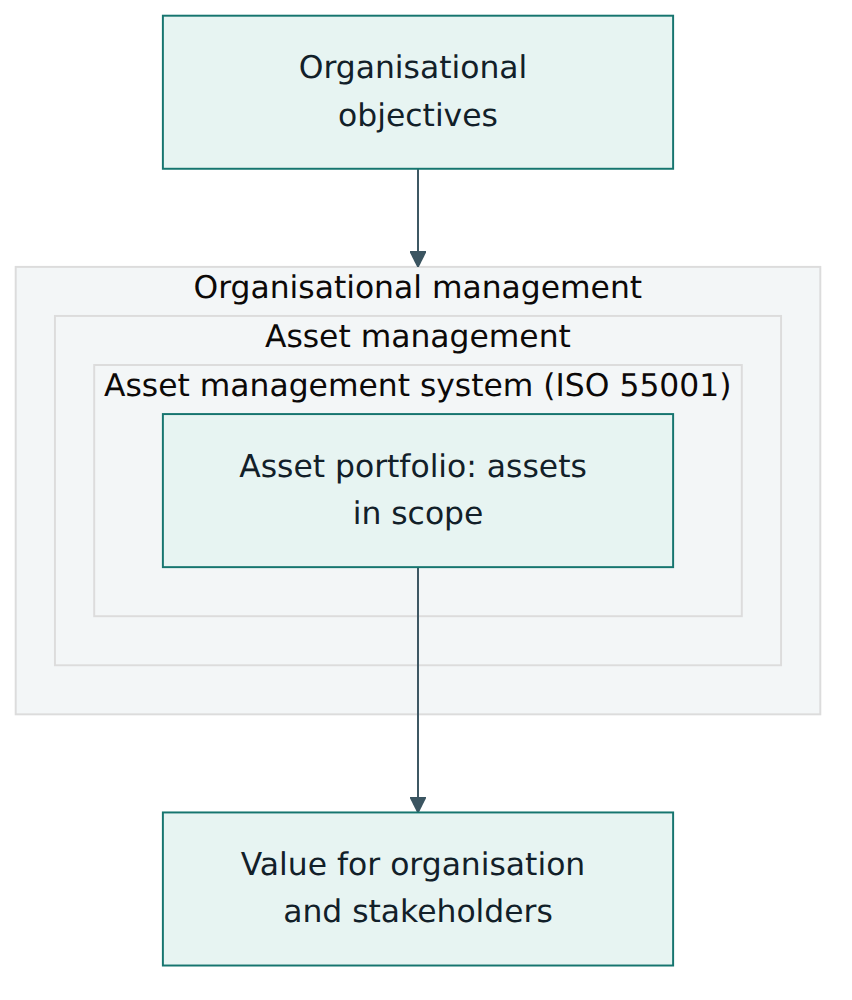
Notice what the picture implies. Asset management can exist without a formal system; many small organisations manage assets sensibly through experience. ISO 55001 adds the system layer so that the practice is consistent, evidenced and improvable. Conversely, an organisation can buy software and write procedures without changing how it actually decides things; then it has documents, but no asset management.
Lesson 3 – Structure of the standard
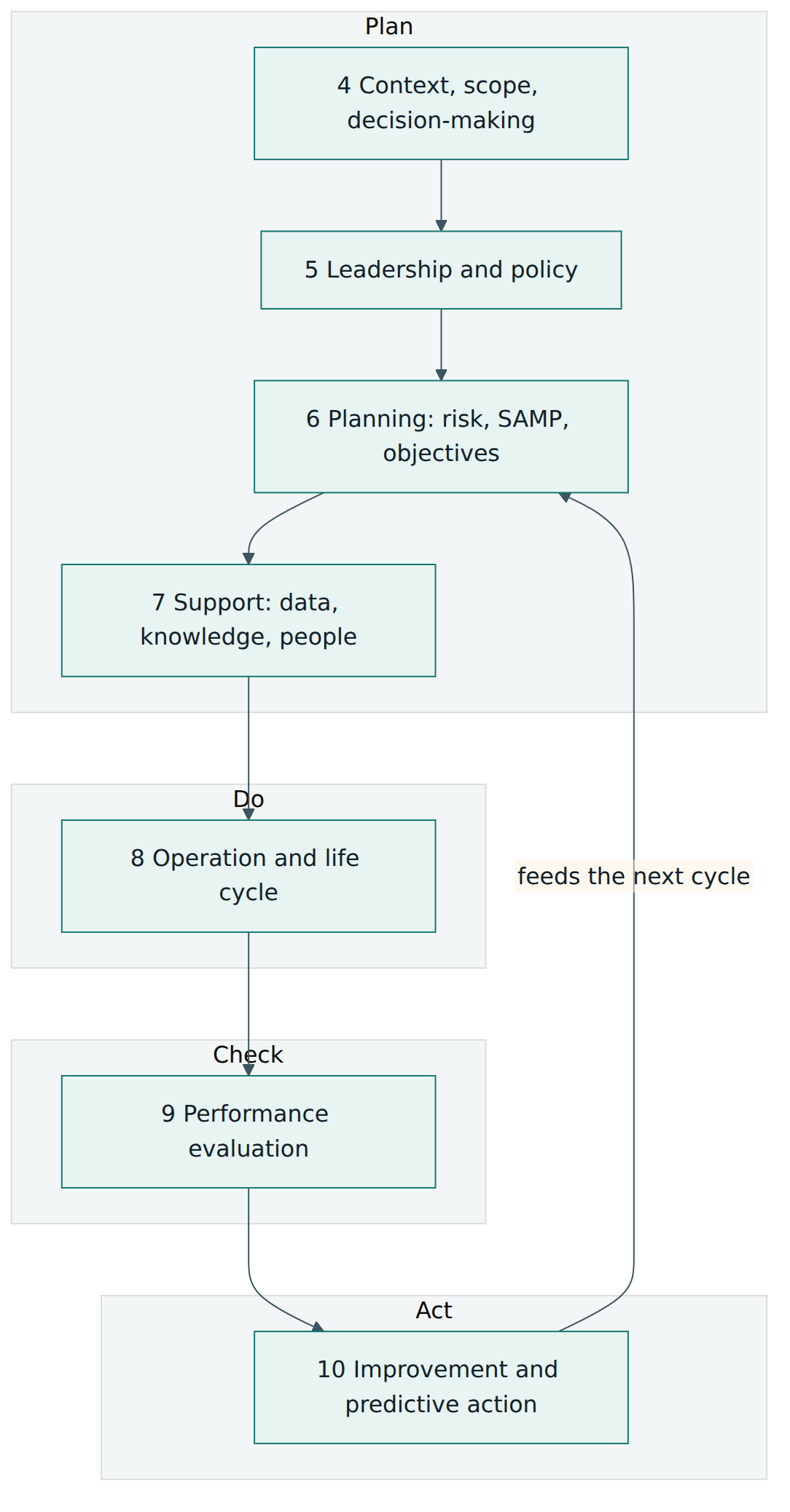
ISO 55001:2024 follows the ISO Harmonized Structure, the common skeleton shared by modern management-system standards. Clauses 1 to 3 cover scope, normative references (ISO 55000) and terms. Clauses 4 to 10 contain the requirements. If you know ISO 9001, ISO 14001 or ISO/IEC 27001, the headings will look familiar; what is specific to asset management is the content inside them. The descriptions below are summaries in our own words, not the text of the standard.
Clause 4 – Context of the organisation
The organisation determines internal and external issues relevant to its purpose and to its asset management, such as ageing infrastructure, regulation, funding constraints, climate, technology and workforce demographics. It identifies stakeholders and their needs and expectations, including those that become requirements, and the criteria stakeholders use in judging asset management decisions. It defines the scope of the asset management system, including which assets form the portfolio, and establishes, maintains and improves the system itself. New in 2024 is a subclause on asset management decision-making and value (4.5). It requires a decision-making framework: defined criteria for asset management decisions, appropriate methods, processes and tools, and consistent application from the boardroom to the work order, with the aim of realising value from assets. ISO/TC 251 has stressed that this requirement scales: a small organisation can meet it with a simple, clearly documented approach.
Clause 5 – Leadership
Top management must demonstrate leadership and commitment: making sure the asset management policy and objectives are set and compatible with the organisation's direction, integrating asset management requirements into business processes, providing resources, promoting cross-functional collaboration and supporting other managers in their roles. Top management establishes an asset management policy and assigns responsibilities and authorities, including for reporting on the performance of the system.
Clause 6 – Planning
Planning is where ISO 55001 differs most from other management-system standards. The organisation plans actions to address risks (6.1.2) and actions to address opportunities (6.1.3), now in two separate subclauses because most organisations handle the two differently. It must then develop a strategic asset management plan (6.2.1), set measurable asset management objectives aligned with organisational objectives (6.2.2), and plan how to achieve them (6.2.3), which in practice means asset management plans with actions, resources, responsibilities, timescales and ways to evaluate results. The revised objectives subclause is also meant to deepen top management's understanding of and engagement in asset management. The 2024 text makes clear that objectives need to be resourced, not merely listed, and that planning should balance cost, risk and performance. Changes to the system itself must also be planned.
Clause 7 – Support
Support covers resources, competence, awareness, communication and documented information, as in every Harmonized Structure standard. ISO 55001 adds two subclauses that matter greatly for assets. Data and information (7.6, revised) clarifies how data and information differ in an asset management context and requires the organisation to determine and manage the data and information it needs to support asset management decisions; ISO/TC 251 highlights configuration (knowing what assets you have and how they are built and connected) as a basic capability. Knowledge (7.7, new) requires the organisation to determine the knowledge needed to operate the system, manage it, and keep it current as requirements and trends change. This addresses a classic risk: critical know-how held only in the heads of a few long-serving staff.
Clause 8 – Operation
Operation puts the plans into effect. The 2024 edition makes life cycle management an explicit part of operational planning and control (8.1): processes for creating or acquiring, using, maintaining, improving, renewing and disposing of assets, with the actions on risks and opportunities from clause 6 built into operations, and documented information to show processes were carried out as planned. Changes to assets, processes or the organisation that could affect asset management are controlled. Clause 8.3, retitled for 2024 as externally provided processes, products, technologies and services, replaces the old word "outsourcing" to match the Harmonized Structure, without changing the requirements substantially: whatever the organisation obtains from outside, from contractors to software platforms, must be controlled so it supports the asset management objectives.
Clause 9 – Performance evaluation
The organisation decides what to monitor and measure, how, when and by whom, and evaluates both asset performance (for example availability, condition, cost and incidents) and the performance of asset management and of the system itself. Internal audits check that the system conforms to the organisation's own requirements and to ISO 55001 and that it is effectively implemented. Top management reviews the system at planned intervals; the 2024 edition adds explicit consideration of risks and opportunities, decision-making and improvement to the management review.
Clause 10 – Improvement
When a nonconformity or incident occurs, the organisation reacts, investigates causes, takes corrective action and checks that it worked. It continually improves the suitability, adequacy and effectiveness of asset management and the system. The new predictive action subclause (10.3) replaces the old preventive action requirement: the organisation establishes processes to predict the future behaviour of relevant parameters, such as deterioration, demand or cost, so it can anticipate problems and opportunities and choose the best moment to intervene.
What changed from 2014, in one place
- A new requirement for an asset management decision-making framework and a focus on realising value (clause 4).
- Separate treatment of risks and opportunities (clause 6).
- An explicit, simplified requirement for the SAMP, which had confused many users of the 2014 edition (clause 6).
- Revised data and information requirements and a new knowledge requirement (clause 7).
- Life cycle management made explicit in operational control, and "outsourcing" renamed externally provided processes, products, technologies and services, in line with the Harmonized Structure (clause 8).
- Management review widened to risks, opportunities, decision-making and improvement (clause 9).
- Predictive action replacing preventive action (clause 10).
Lesson 4 – How it works in practice
The line of sight
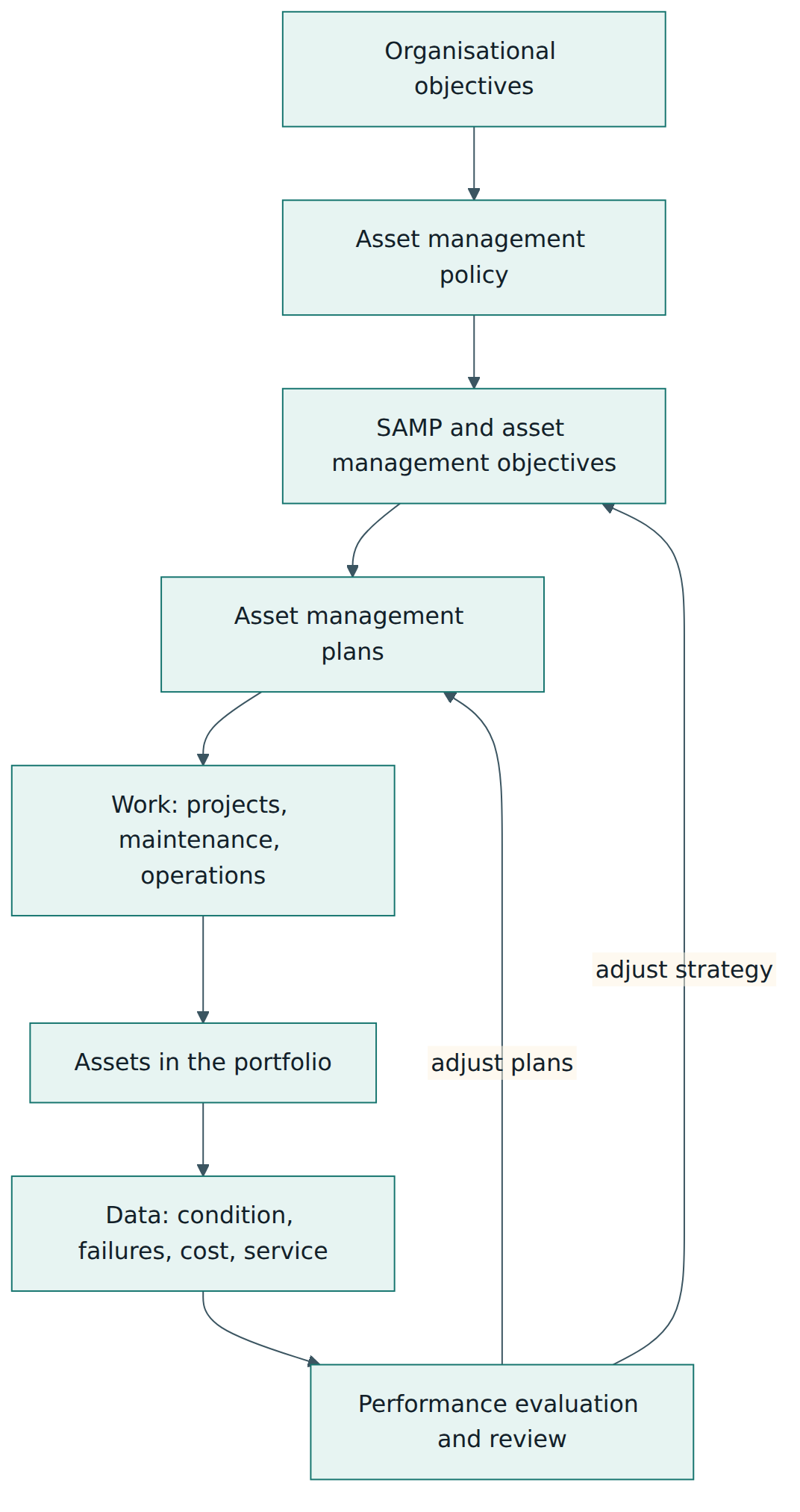
The single most important idea for putting ISO 55001 to work is the line of sight. Organisational objectives (for example "reliable, affordable water for a growing city") are translated by the policy and the SAMP into asset management objectives ("reduce supply interruptions by a third over five years without real-terms tariff increases"). Those objectives drive asset management plans for groups of assets ("replace the highest-risk 2 % of mains each year; install condition monitoring on all critical pumps"). The plans become work orders, purchases and projects. Then the arrow runs back: data about condition, failures, costs and service performance flows up, is analysed, and informs the next round of decisions. When an auditor asks a technician why a valve is being replaced this week, a good system can trace the answer all the way to a corporate objective.
Decision-making in practice
A decision-making framework need not be complicated. It typically defines who may decide what (for example, spending thresholds and approval levels), which criteria apply (safety, service, compliance, whole-life cost, environmental and social effects), how options are compared (risk-based prioritisation, life cycle costing, multi-criteria scoring) and how the decision and its reasons are recorded. The same criteria should apply whether the decision is a ten-year capital programme or a choice between repairing and replacing one motor. Consistency is what makes decisions defensible to regulators, owners and customers.
Two techniques appear in almost every mature system. Criticality assessment ranks assets by the consequence of their failure, so that effort goes where it matters most. Whole-life (life cycle) costing compares options by their total cost over the asset's life, including purchase, installation, operation, energy, maintenance, downtime and disposal, rather than the purchase price alone. Neither is mandated by name in ISO 55001, but both are common ways of meeting its requirements on decision-making and planning.
The asset life cycle
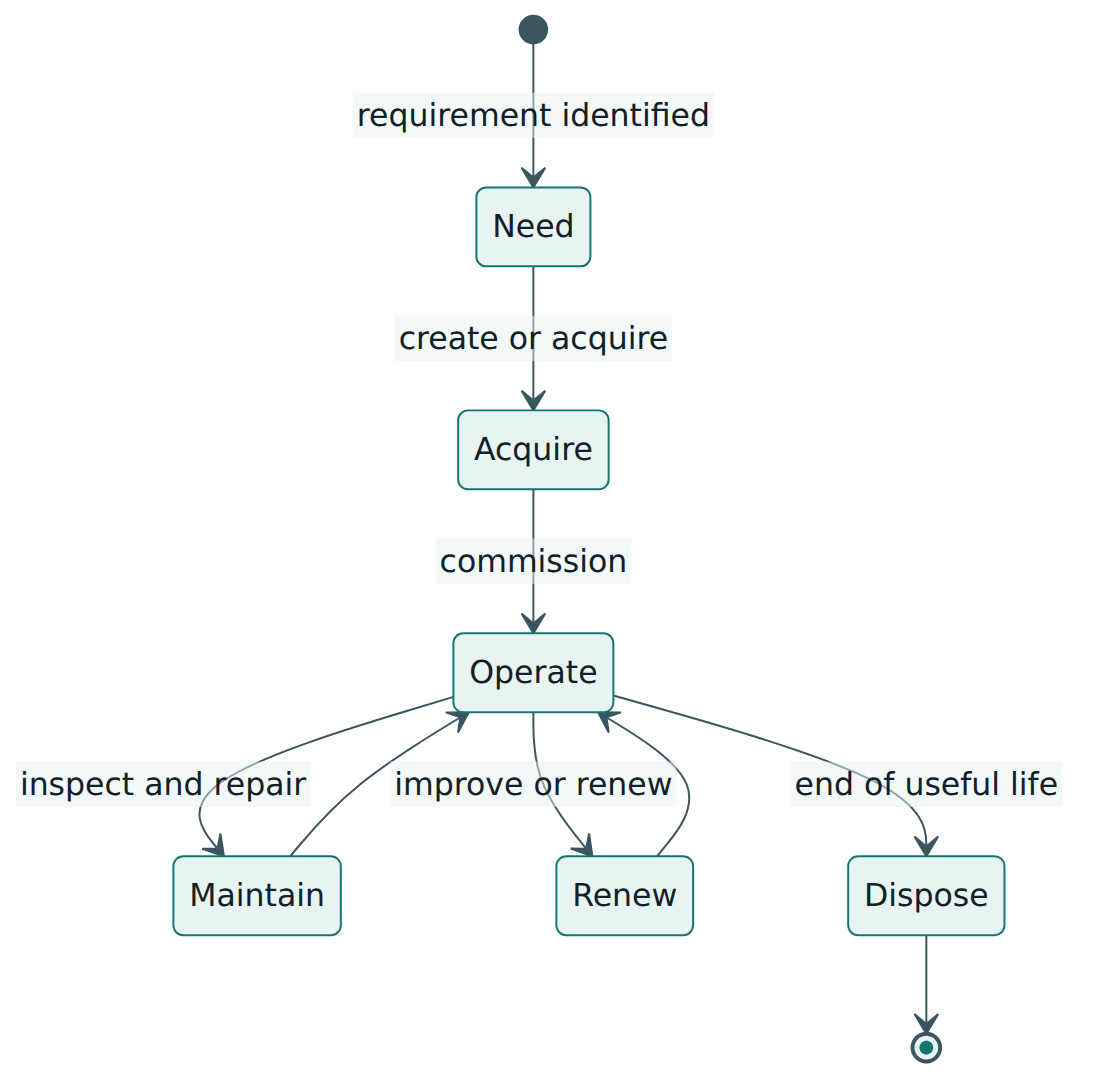
Every asset passes through recognisable stages. The organisation first identifies a need, which might be met by a new asset, by changing how existing assets are used, or by a non-asset solution such as managing demand. If an asset is needed, it is created or acquired; then it is operated and maintained; at some point it is improved, renewed or replaced; finally it is disposed of safely and responsibly. Decisions at each stage affect the others: a cheaper design may raise maintenance costs for decades, and a missing as-built record may make every future intervention slower. The 2024 edition requires the organisation to control these life cycle processes deliberately.
Roles
Asset management crosses departmental boundaries, so roles need to be clear. Common patterns include:
- Top management, who own the policy, approve the SAMP and resource it.
- An asset owner role, accountable for the value delivered by a portfolio or asset class and for deciding what is needed.
- An asset manager role, responsible for developing and running plans to meet the owner's requirements.
- Service providers, internal teams or contractors who carry out design, construction, maintenance or operation.
- Support functions: finance (budgets, depreciation, capital planning), procurement, IT and data, and human resources (competence and succession). ISO/TC 251 explicitly calls out the need to engage these functions.
The names vary. Some organisations use an "owner, manager, provider" model; others organise by asset class or region. ISO 55001 does not mandate a structure; it requires that responsibilities and authorities are assigned, communicated and understood.
Typical artefacts
When an organisation runs an asset management system, you would expect to find: an asset management policy; a scope statement and asset register; a stakeholder analysis; a decision-making framework with criteria; a risk and opportunity register; the SAMP; asset management objectives with measures; asset management plans for asset classes or systems; data and information standards; competence requirements and a knowledge-retention approach; life cycle procedures; contracts and controls for external providers; performance reports; internal audit reports; management review records; and records of nonconformities, corrective actions and predictive analyses. Not all of these are mandatory as separate documents; the organisation decides how to hold the information, but it must be able to show that the requirements are met.
Implementation steps
- Secure leadership commitment. Explain the business case in the language of the organisation's objectives: service, safety, cost, risk and regulatory confidence.
- Assess the current state. Run a gap analysis against ISO 55001 and, ideally, a maturity assessment so you know where to focus.
- Define scope and portfolio. Decide which assets, sites and activities are in the system, and why.
- Set direction. Agree the policy, the decision-making criteria and the SAMP with its objectives.
- Fix the foundations. Improve the asset register, data quality, criticality ratings and competence where the gap analysis shows weaknesses.
- Plan and deliver. Produce asset management plans for priority asset classes, and integrate them into budgets and work management.
- Measure and review. Monitor performance, audit internally, hold management reviews and act on what you learn.
- Improve and anticipate. Use trends and predictive analysis to intervene earlier and to refine plans each cycle.
Organisations usually phase this over several years, starting with the most critical assets. A system that covers a limited, well-chosen portfolio and works is better than one that covers everything on paper.
Lesson 5 – Assessment, certification and compliance
Ways to assess an asset management system
There are several levels of assessment, and they serve different purposes:
- Self-assessment and gap analysis – the organisation compares its practice with the requirements, often with a checklist or consultant support, to plan its work.
- Maturity assessment – a graded view of capability, usually from "innocent" or "aware" stages through to "excellent", across many subject areas. Professional bodies such as the Institute of Asset Management and members of the Global Forum on Maintenance and Asset Management have published models, and ISO 55000:2024 now introduces the concept of maturity. A maturity assessment tells you how good you are, not just whether you conform.
- Internal audit – required by clause 9: planned, objective audits by competent people to check that the system conforms and is effectively implemented.
- Second-party assessment – a customer, owner or regulator assesses a supplier or operator against ISO 55001 or its own requirements.
- Third-party certification – an independent certification body audits the system and, if it conforms, issues a certificate.
How certification works
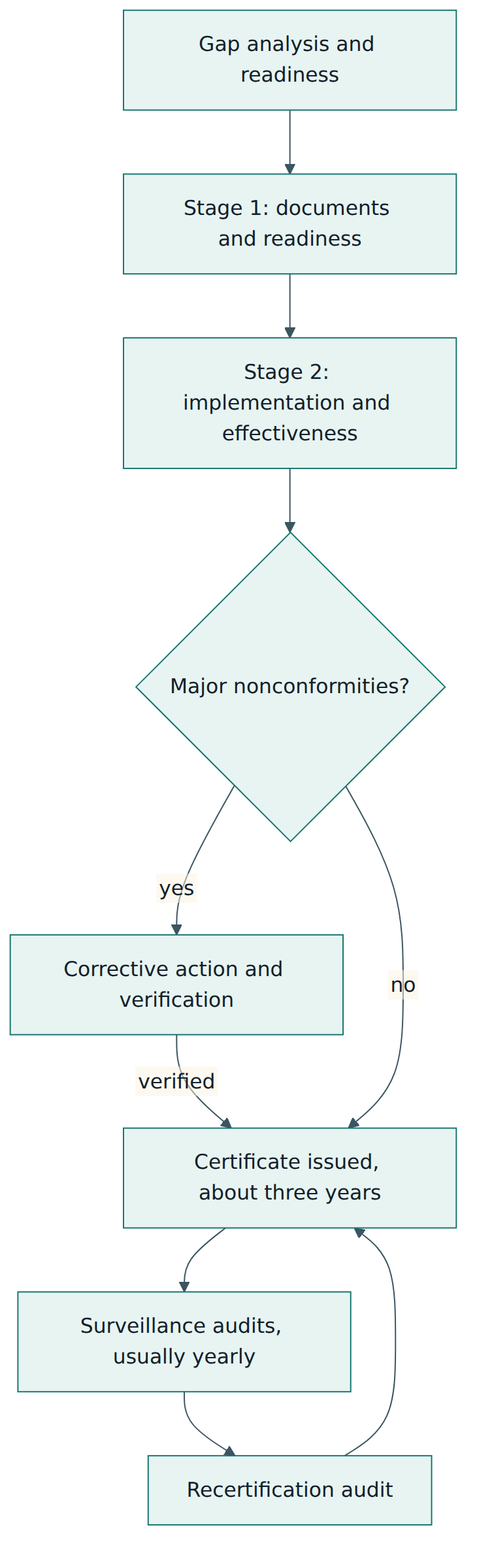
ISO itself does not certify organisations. Certification is carried out by certification bodies, which are normally accredited by a national accreditation body. Bodies certifying management systems work to ISO/IEC 17021-1, and for asset management there is a specific technical specification on auditor competence, ISO/IEC TS 17021-5. The usual cycle has these steps:
- Application and scoping – the organisation and certification body agree the scope (sites, assets, activities) and audit time.
- Stage 1 audit – a review of readiness: documented information, scope, the SAMP, planning, internal audit and management review. The auditor identifies any concerns that could block stage 2.
- Stage 2 audit – an on-site (or remote) evaluation of whether the system is implemented and effective, through interviews, records and observation of work. Auditors follow trails: from an objective in the SAMP to a plan to a work order, and from a failure record back to analysis and corrective action.
- Certification decision – if there are no unresolved major nonconformities, the body issues a certificate, typically valid for three years.
- Surveillance audits – usually annual, sampling parts of the system to confirm it is maintained and improving.
- Recertification – a fuller audit before the certificate expires starts a new cycle.
Findings and evidence
Certification bodies usually grade findings. A major nonconformity means a requirement is not met in a way that undermines the system, for example no SAMP, or decisions made with no defined criteria; a minor nonconformity is an isolated lapse, such as one asset plan not reviewed on schedule; an opportunity for improvement is a suggestion. Exact grading rules come from the certification body's procedures, not from ISO 55001. What auditors look for above all is evidence that decisions are traceable and consistent: that the same criteria are applied in practice, that data is good enough for the decisions it supports, and that lessons from failures and audits change what happens next.
Transition from the 2014 edition
Organisations certified to ISO 55001:2014 need to move to the 2024 edition within the transition period set by accreditation and certification bodies. Typical transition work includes defining the decision-making framework, splitting risk and opportunity actions, updating the SAMP to the new requirement, reviewing data and knowledge management, making life cycle controls explicit, updating supplier controls, revising management review inputs and setting up predictive action. Ask your certification body for the deadline and the form of the transition audit.
Is certification required?
ISO 55001 is voluntary. Some organisations certify because owners, regulators, lenders or clients ask for evidence of good asset stewardship; others use the standard as a benchmark without certifying. Certification is a statement of conformity, not of excellence: a certified organisation meets the requirements, while maturity assessment and performance results show how well it actually manages its assets.
Lesson 6 – Worked example
To tie the concepts together, follow a fictional organisation through its first two years. Rivermouth Water is a regional utility serving 400,000 people. It owns treatment works, 60 pumping stations, reservoirs and about 4,000 kilometres of mains. Its regulator expects lower leakage and fewer interruptions; its owners want stable tariffs; a new housing district is planned; and a third of its senior engineers will retire within eight years.
Step 1 – Context, stakeholders and scope
The leadership team holds workshops on internal and external issues: ageing cast-iron mains, rising energy prices, more frequent droughts and heavy rainfall, tighter regulation and the retirement wave. Stakeholder analysis lists customers, the regulator, the municipal owners, the environment agency, staff, contractors and neighbouring utilities, with what each expects. Rivermouth decides that the first scope will cover water supply assets (treatment, pumping, storage and distribution) but not its offices and vehicle fleet, which it will add later. The scope statement and the asset register become the starting point for the portfolio.
Step 2 – Decision-making framework and value
Rivermouth defines what value means for it: safe drinking water, continuity of supply, affordability, environmental protection and staff safety. It turns these into decision criteria with scoring scales, sets approval thresholds (engineers may approve repairs under a set value; larger renewals go to the capital board) and adopts two methods: criticality ratings for every asset and whole-life cost comparisons for options above a threshold. The framework is short, but it is applied to both the five-year capital plan and day-to-day repair-or-replace choices.
Step 3 – Policy, SAMP and objectives
The board approves an asset management policy committing to risk-based, whole-life decisions and to involving stakeholders. The SAMP links the corporate strategy to five asset management objectives with measures and targets, for example: reduce leakage by a defined percentage over five years, reduce unplanned interruptions longer than three hours, keep the backlog of safety-critical maintenance below a set level, cut pumping energy per cubic metre, and capture the knowledge of retiring experts for the 30 most critical assets. Each objective has an owner and is funded in the business plan.
Step 4 – Risks and opportunities
Risk workshops identify, among others, the failure of a single trunk main that feeds a hospital, a pumping station in a flood zone and poor data on pipe material in older districts. Opportunities include acoustic leak sensors, a government grant for energy-efficient pumps and the chance to design the new housing district's network for easy future maintenance. Actions are assigned and built into plans, separately for risks and opportunities.
Step 5 – Data, knowledge and people
A data review finds that 18 % of mains have unknown material and that pump condition data sits in paper logbooks. Rivermouth sets data standards, assigns data owners and starts a targeted survey. It records key pumping stations' operating knowledge through structured interviews and video walk-throughs, pairs retiring engineers with successors, and updates competence requirements for planners and supervisors.
Step 6 – Asset management plans and life cycle control
Plans are produced for each asset class. The mains plan ranks pipes by likelihood and consequence of failure and schedules replacement of the highest-risk lengths. The pump plan moves critical pumps from fixed-interval servicing to condition-based maintenance using vibration monitoring. For the new housing district, the design brief includes standard valve layouts, metering zones and complete digital as-built records, so that future operation is cheaper. Contracts with the main pipeline contractor now require data handover in Rivermouth's format, and the contractor's performance is reviewed against the objectives.
Step 7 – Evaluate, improve and predict
Monthly dashboards report the objectives. After the first year, an internal audit finds that two district teams still prioritise repairs by complaint volume rather than the agreed criteria; corrective action includes retraining and a change to the work-management system so that criticality is visible on every job. A burst on a trunk main is investigated to root cause. For predictive action, analysts model pipe deterioration by material, age and soil, and pump energy trends, to forecast where failures and efficiency losses will appear; renewal timing is adjusted accordingly. The management review considers performance, audit results, risks and opportunities, the quality of decisions and resources for the next year.
Step 8 – Certification
Rivermouth invites a certification body for a stage 1 audit, which asks for clearer links between two objectives and the plans that deliver them. At stage 2 the auditor follows trails from the SAMP to the mains renewal programme to individual work orders, interviews a planner about how criticality affects scheduling, and checks how the contractor's data was accepted. Two minor nonconformities are raised, on an out-of-date procedure and an incomplete training record, and corrected within the agreed time. The certificate is issued; in the second year the scope is extended to the vehicle fleet and offices.
What made this work was not the certificate but the line of sight: every significant decision could be traced to an objective, explained by the agreed criteria and supported by data that was getting better each year.
Lesson 7 – Relationship to other standards and frameworks
ISO 55001 rarely stands alone. It belongs to a family of asset management documents and shares structure with other management-system standards, so many organisations integrate it with existing systems. The table summarises the most important relationships.
| Standard or framework | What it is | How it relates to ISO 55001 |
|---|---|---|
| ISO 55000:2024 | Vocabulary, overview and principles of asset management | Defines the terms and principles ISO 55001 relies on; read it first. It is a normative reference, so its terms apply when you read the requirements. |
| ISO 55002:2018 | Guidelines for applying ISO 55001 | Explains and gives examples for each requirement; written for the 2014 requirements and under revision. Guidance only, not certifiable. |
| ISO/TS 55010:2024 | Guidance on aligning financial and non-financial asset management functions | Helps engineering and finance use consistent asset data, values and decisions, supporting the SAMP and planning. |
| ISO 55011:2024 | Guidance for developing public policy that enables asset management | Aimed at governments and policy makers rather than individual asset owners. |
| ISO 55012:2024 and ISO 55013:2024 | Guidance on people involvement and competence, and on data asset management | Support the knowledge, competence and data requirements of clause 7. |
| ISO 31000 | Risk management guidelines | Provides a widely used risk framework; ISO 55001 requires asset-related risks to be managed but does not mandate ISO 31000. |
| ISO 9001 and ISO 14001 | Quality and environmental management system requirements | Same Harmonized Structure, so policies, audits, reviews and document control can be integrated; ISO 55001 adds asset-specific planning, value and life cycle requirements. |
| ISO/IEC 19770-1 | IT asset management system requirements | Applies management-system thinking to software and hardware assets; can complement ISO 55001 where IT assets matter. |
| BSI PAS 55 | Earlier UK specification for physical asset management (2004, revised 2008) | The main predecessor of the ISO 55000 series and a key input to it; most organisations that used it have since moved to ISO 55001. |
Integration tips
Because the Harmonized Structure is shared, an organisation certified to ISO 9001 or ISO 14001 can reuse its document control, internal audit, management review and corrective action processes. What it must add are the asset-specific elements: the decision-making framework, the SAMP, asset management objectives and plans, life cycle controls, asset data and knowledge management, and predictive action. Professional bodies also publish broader descriptions of the discipline, such as the IAM's material on the subjects of asset management and the GFMAM Asset Management Landscape, which many organisations use alongside the standard to define capability and training.
Common pitfalls and best practices
Pitfalls
- Treating it as a maintenance project. Asset management is handed to the maintenance department while finance, operations, procurement and IT carry on as before, so whole-life decisions never happen.
- A SAMP that nobody uses. The strategic plan is written for the auditor, is not linked to budgets and does not change any decision.
- Buying software before defining decisions. An expensive enterprise asset management system is installed without agreed data standards or decision criteria, and it fills with poor data.
- Scope that is too wide or too vague. Everything is declared in scope, nothing is done thoroughly, and auditors find gaps everywhere.
- Criteria on paper, habit in practice. Decision rules exist, but work is still prioritised by complaint volume, budget history or the loudest voice.
- Ignoring knowledge loss. Critical know-how retires with experienced staff because nobody captured it.
- Weak control of external providers. Contractors deliver work without returning usable data, so the organisation loses track of what it owns.
Best practices
- Start from organisational objectives. Define value in the organisation's own terms and derive asset management objectives from it.
- Keep the decision framework simple and used. A short set of criteria applied consistently beats a sophisticated model nobody trusts.
- Focus first on critical assets. Use criticality to phase the work and to direct data improvement where it changes decisions.
- Make data fit for purpose. Assign data owners, set quality standards and require data handover in contracts.
- Bring finance in early. Align capital planning, budgets and asset valuations with the asset plans, as ISO/TS 55010 suggests.
- Measure leading indicators as well as outcomes. Track plan delivery, backlog and data quality, not only failures.
- Use audits and reviews to change decisions. Every finding should lead to a visible change in plans, criteria or practice.
Summary and key takeaways
- ISO 55001:2024 specifies requirements for an asset management system; it says what the system must achieve, not how to maintain particular assets.
- Asset management is the coordinated activity of realising value from assets, balancing cost, risk and performance across the whole life cycle.
- ISO 55000:2024 sets the vocabulary and principles: value, alignment and leadership, with assurance, adaptability and sustainability as outcomes.
- The standard follows the Harmonized Structure (clauses 4 to 10), with asset-specific content on decision-making, the SAMP, data, knowledge, life cycle control and predictive action.
- The line of sight connects organisational objectives through the policy, SAMP and plans to work on individual assets, with data flowing back to improve decisions.
- Certification is voluntary and done by accredited certification bodies through stage 1 and stage 2 audits, surveillance and recertification; maturity assessment shows how well, not just whether, you conform.
- Success depends on cross-functional ownership, consistent decision criteria, fit-for-purpose data and a phased focus on critical assets.
Reflection questions
- Pick an asset-intensive organisation you know. How would you describe "value" for its main assets, and which stakeholders would disagree about it?
- Choose one routine maintenance task in your workplace. Can you trace it up to an organisational objective? Where does the line of sight break?
- Which three decision criteria would you propose for comparing repair, refurbish and replace options for a critical machine, and why those?
- Where is your organisation's most critical asset knowledge held today, and what would happen if that person or system disappeared tomorrow?
- If you had to scope a first ISO 55001 system with limited resources, which assets would you include, which would you leave out for now, and how would you justify that to an auditor?
Further reading and official sources
- ISO 55001:2024 – Asset management system – Requirements – ISO
- ISO 55001: key changes and new sections for the 2024 edition – ISO/TC 251
- ISO 55000: vocabulary, overview and principles – ISO/TC 251
- ISO 55002: guidelines for the application of ISO 55001 – ISO/TC 251
- ISO launches new standards in the ISO 55000 series (July 2024) – ISO/TC 251
- The Institute of Asset Management – IAM
- ISO 55001 certification overview – NQA
Original tutorial by xOps School (DevOpsSchool Private Limited), written from public sources about ISO 55001. Not affiliated with or endorsed by the standard's owner; standard names are trademarks of their owners. Buy the official standard from its publisher for the authoritative text.