
ISO/IEC 42006 – Tutorial (about 60 minutes)
- View
ISO/IEC 42006 is the international standard that sets extra requirements for the organisations that audit and certify artificial intelligence management systems against ISO/IEC 42001. It is used mainly by certification bodies, their auditors and decision makers, and by the accreditation bodies that check them, but it matters just as much to any company that wants an AI certificate people can trust. After this tutorial you will be able to explain why the standard exists, describe how it builds on the general rules for certification bodies, follow an AI management system certification from application to recertification, and judge whether a 42001 certificate comes from a credible process.
Course overview
Edition and status: The current and only edition is ISO/IEC 42006:2025, Information technology – Artificial intelligence – Requirements for bodies providing audit and certification of artificial intelligence management systems, edition 1, published by ISO and IEC in July 2025 and developed by their joint subcommittee on artificial intelligence (ISO/IEC JTC 1/SC 42). It is a requirements standard, but its requirements apply to certification bodies, not to the organisations they certify. The United Kingdom adopted it unchanged as BS ISO/IEC 42006:2025 (published 31 July 2025), and the BSI catalogue lists that edition as current. No amendment or revision had been announced as of the verification date; like all ISO standards it will go through a systematic review about five years after publication. Verified 2026-10-29 against the BSI catalogue entry; the ISO catalogue page (iso.org/standard/42006) refuses automated access, so check it yourself for the latest status.
Who this is for: auditors and lead auditors who already audit management systems such as ISO 9001 or ISO/IEC 27001 and want to add AI; staff at certification bodies who review applications, plan audits or make certification decisions; compliance, risk and AI governance people preparing their organisation for an ISO/IEC 42001 audit; and buyers or regulators who need to judge what an AI management system certificate is worth.
Prerequisites: none. It helps to know roughly what a management system is (a set of policies, processes and records that an organisation uses to reach its objectives) and that ISO/IEC 42001 is the management system standard for AI. Every other term is explained when it first appears.
By the end of this tutorial:
- You will be able to explain what problem ISO/IEC 42006 solves and why AI certification needed rules beyond the generic ones.
- You will be able to place it correctly in the conformity assessment chain: ISO/IEC 17011, ISO/IEC 17021-1, ISO/IEC 42006 and ISO/IEC 42001.
- You will be able to define the key vocabulary: certification body, accreditation, impartiality, audit time, certification scope, technical expert, nonconformity and more.
- You will be able to describe how the standard is organised and where its AI-specific additions sit.
- You will be able to follow an AI management system certification step by step, from application review through stage 1 and stage 2 to surveillance and recertification.
- You will be able to judge the competence an AI audit team needs and what a credible certificate and scope statement look like.
- You will be able to recognise common pitfalls on both sides of the audit table.
Lesson 1 – Origins, purpose and scope
A certificate is only as good as the certifier
Imagine two companies that both put "ISO/IEC 42001 certified" on their websites. The first was audited for nine days by a team that included an engineer who had built machine learning systems, read the company's AI impact assessments, sampled model monitoring records and interviewed the data science lead. The second was audited for a day and a half by an auditor who had never worked with AI, checked that an AI policy existed and moved on. Both certificates look the same to a customer. Only one tells you something real.
This is the core problem that every certification scheme has to solve. A certificate is a promise made by a third party: "We looked, and this organisation meets the standard." The value of that promise depends entirely on how carefully the third party looked and whether it was competent and independent. For familiar disciplines such as quality management, decades of practice, shared guidance and experienced auditors make the results fairly consistent. Artificial intelligence was different. When ISO/IEC 42001 was published at the end of 2023, organisations rushed to get certified, but there was no common, AI-specific rulebook telling certification bodies how much AI knowledge their auditors needed, how long an AI audit should take or what the certificate should say.
ISO/IEC 42006 is that rulebook. It does not tell organisations how to manage AI – that is the job of ISO/IEC 42001. Instead it tells the auditors of those organisations how to behave, what they must know and how their certification process must work, so that a 42001 certificate from one certification body means roughly the same as one from another.
Where it comes from
The standard was developed by ISO/IEC JTC 1/SC 42, the joint subcommittee of ISO (the International Organization for Standardization) and IEC (the International Electrotechnical Commission) responsible for artificial intelligence. SC 42 also produced the rest of the AI management family:
- ISO/IEC 22989 gives AI concepts and terminology, including the roles organisations play around AI systems.
- ISO/IEC 42001 specifies requirements for an AI management system (AIMS), the certifiable standard at the centre of the family.
- ISO/IEC 23894 gives guidance on AI risk management and ISO/IEC 42005 gives guidance on AI system impact assessment.
- ISO/IEC 42006 completes the picture by setting rules for the bodies that certify against 42001.
The model for this kind of document already existed. For information security, ISO/IEC 27006-1 adds security-specific requirements on top of the general rules for management system certification bodies. ISO/IEC 42006 does the same job for AI: it is a "sector add-on" to the general rules, not a replacement for them.
Scope in plain words
In summary, ISO/IEC 42006 covers:
- requirements and guidance for bodies that audit and certify AI management systems against ISO/IEC 42001;
- additions to the general certification body requirements in ISO/IEC 17021-1, which still apply in full;
- competence criteria for the people involved in AIMS certification, linked to the AI roles an organisation can play and to the clauses of ISO/IEC 42001;
- AI-specific aspects of the certification process, such as defining the scope, planning audit duration and examining AI-specific evidence.
It does not cover how an organisation should build its AI management system, how to test a model, or legal compliance with AI regulations. It also does not create a "product certificate" for an AI system: a 42001 certificate says that an organisation's management system conforms, not that any particular model is safe, fair or accurate. Keeping that distinction clear is one of the most important things this course will teach you.
Why it matters to everyone, not only auditors
Customers, partners and regulators increasingly ask suppliers for evidence of responsible AI. A 42001 certificate is becoming one of the answers. Because ISO/IEC 42006 shapes how those certificates are earned, it matters to three groups. Certification bodies must meet it to be accredited. Organisations seeking certification benefit from knowing what auditors will be required to examine and how long the audit will take. And anyone relying on a certificate can use it to ask sharp questions: Was the body accredited? Did the team include AI competence? Does the scope cover the AI systems I care about?
Lesson 2 – Key concepts and vocabulary
Certification has its own vocabulary, much of it defined in ISO/IEC 17000 (conformity assessment vocabulary) and ISO/IEC 17021-1. These are the terms you need to read ISO/IEC 42006 with confidence. The explanations are in plain words, not the official definitions.
- Conformity assessment – any activity that shows whether specified requirements are met: testing, inspection, certification and accreditation are all forms of it.
- Third-party certification – an independent body, with no stake in the organisation or its customers, attests that requirements are met. First-party is self-declaration; second-party is a customer auditing its supplier.
- Certification body (CB) – the organisation that performs audits and issues management system certificates. ISO/IEC 42006 is written for CBs.
- Client – the organisation whose management system is being certified. In this course we also call it the "auditee".
- Accreditation – formal recognition by an authoritative body that a CB is competent and impartial for a defined scope. Accreditation bodies themselves work to ISO/IEC 17011.
- Accreditation body (AB) – usually one per country, for example UKAS in the United Kingdom, ANAB in the United States, DAkkS in Germany or NABCB in India. ABs assess CBs against ISO/IEC 17021-1 plus any sector standard such as ISO/IEC 42006.
- Artificial intelligence management system (AIMS) – the policies, objectives, processes, roles and controls an organisation uses to develop, provide or use AI responsibly, as specified in ISO/IEC 42001.
- Impartiality – objectivity: the CB's decisions are based on evidence and are not influenced by commercial pressure, self-interest or familiarity. Threats to impartiality include the CB having consulted for the client or depending heavily on one client's fees.
- Competence – the ability to apply knowledge and skills to achieve intended results. ISO/IEC 42006 cares about demonstrated competence, not just attendance certificates.
- Certification function – a distinct task in the certification process, such as reviewing applications, auditing, reviewing audit reports and making certification decisions. Competence is defined per function.
- Technical expert – a person who gives specific knowledge to the audit team but does not act as an auditor. In AI audits this is often someone with deep machine learning or data engineering experience.
- Audit time – the time needed to plan and carry out a complete and effective audit of the client's management system. Audit duration on site is part of it.
- Certification scope – the boundaries of what the certificate covers: which organisation, sites, activities and, for AIMS, which AI roles and systems.
- AI roles – the positions an organisation can occupy in relation to AI, drawn from ISO/IEC 22989: for example AI provider, AI producer (developer), AI customer (user), AI partner or AI subject. The role changes what the AIMS must address and what auditors must look at.
- Statement of applicability – the document required by ISO/IEC 42001 that lists which Annex A controls the organisation applies, with justification for exclusions. Auditors use it to plan sampling.
- Nonconformity – a requirement that is not met. CBs normally grade nonconformities as major (the system cannot achieve its intended results, or a requirement is absent or broken down) or minor (a lapse that does not threaten the system as a whole).
- Certification cycle – the three-year period of a certificate: initial audit, surveillance audits in the following years, then recertification.
The conformity assessment chain
The most useful mental model is a chain of trust in which each link is checked by the one above it. At the top, ISO/IEC 17011 says how accreditation bodies must work, and accreditation bodies evaluate each other through international peer review. Accreditation bodies assess certification bodies against ISO/IEC 17021-1 and, for AI, ISO/IEC 42006. Certification bodies audit organisations against ISO/IEC 42001. Customers and regulators at the bottom rely on the whole chain.
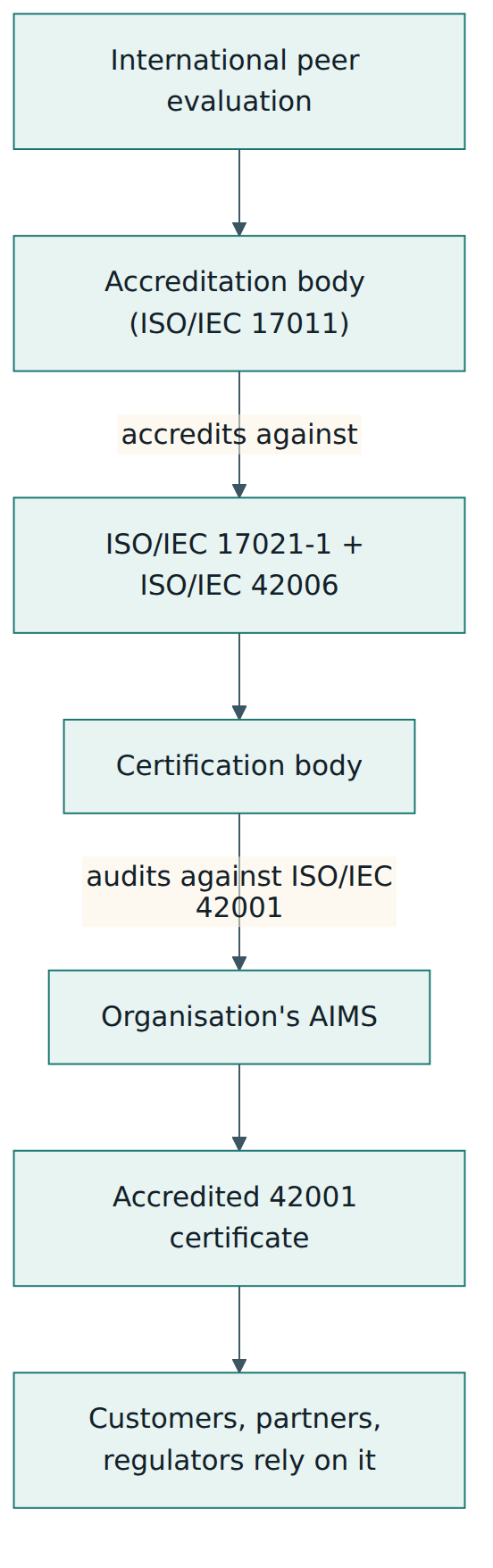
International recognition of accreditation used to run through the International Accreditation Forum (IAF) multilateral arrangement. From 1 January 2026 the IAF and ILAC (the laboratory accreditation network) combined their work in a new organisation, Global Accreditation Cooperation Incorporated (Global ACI), which runs its own multilateral recognition arrangement. For a learner the point is the same: accredited certificates from one participating country are meant to be accepted in the others.
Accredited versus unaccredited certification
Nothing legally stops a company from calling itself a certification body and issuing 42001 certificates without accreditation. Such certificates are not necessarily worthless, but nobody independent has checked that the body meets ISO/IEC 17021-1 and ISO/IEC 42006. That is why procurement teams increasingly ask for accredited certificates and why ISO/IEC 42006 is, in practice, the price of entry for a serious AI certification business.
Lesson 3 – Structure of the standard
Built as a layer on ISO/IEC 17021-1
ISO/IEC 17021-1 is the general standard for all bodies that audit and certify management systems – quality, environment, security, energy and now AI. It has a well-known layout. ISO/IEC 42006 is written as a set of additions to that general standard, so the practical way to study it is against the clause layout of ISO/IEC 17021-1: each AI-specific requirement or piece of guidance supplements a particular general requirement. Where 42006 adds nothing to a topic, the general requirement applies unchanged. A certification body therefore always reads the two documents side by side.
The clauses below are the ISO/IEC 17021-1 headings; the descriptions paraphrase what the general standard covers and where the AI-specific additions of 42006 matter most. Check the exact clause numbering of 42006 itself in your own copy of the standard.
| Clause | Topic | What it is about, and where AI adds detail |
|---|---|---|
| 1–3 | Scope, normative references, terms | What the standard applies to; ISO/IEC 17021-1 and ISO/IEC 42001 are the key documents it depends on; terms come from the conformity assessment and AI vocabularies. |
| 4 | Principles | Impartiality, competence, responsibility, openness, confidentiality, responsiveness to complaints and a risk-based approach – the values behind every other clause. |
| 5 | General requirements | Legal and contractual matters, management of impartiality, liability and financing. AI raises new impartiality questions, for example a CB group that also sells AI assurance or model-testing services. |
| 6 | Structural requirements | Organisation and top management, structuring certification activities so that impartiality is safeguarded, and control of branch offices, agents and partners. |
| 7 | Resource requirements | Competence of personnel, use of auditors and technical experts, outsourcing. This is where most of the AI-specific substance lives: competence criteria linked to AI roles and to 42001 clauses. |
| 8 | Information requirements | Public information, certification documents and directories of certified clients. For AI, how the scope and AI roles are described on the certificate. |
| 9 | Process requirements | Application review, audit programme and time, multi-site sampling, stage 1 and stage 2, reporting, decision, surveillance, recertification, special audits, suspension, withdrawal, appeals and complaints – with AI-specific considerations in planning and audit evidence. |
| 10 | Management system requirements for certification bodies | The CB's own management system: document control, internal audit, corrective action, management review. |
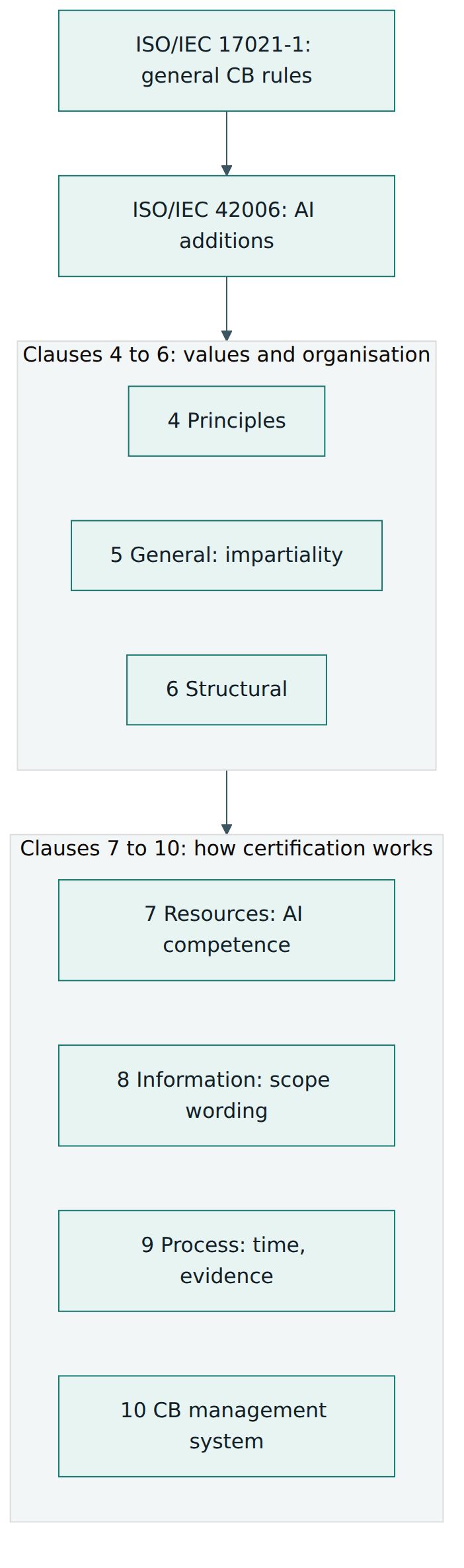
Where the AI substance concentrates
If you read the standard for the first time, three areas deserve the most attention.
Competence (17021-1 clause 7, resources). The general standard already requires a CB to define competence for each certification function. ISO/IEC 42006 says what that competence means for AI. The criteria are tied to the AI roles that a client can play and to the requirements of ISO/IEC 42001, so that, for example, the knowledge needed to audit an AI developer differs from the knowledge needed to audit an organisation that only uses third-party AI services. Lesson 4 looks at this in detail.
Process (17021-1 clause 9). Here the standard deals with matters such as establishing the certification scope, determining audit time, planning which AI systems and Annex A controls to sample, and the kinds of evidence auditors should examine – for example AI risk assessments, AI system impact assessments, data management records and lifecycle documentation. The general flow of stage 1, stage 2, surveillance and recertification stays the same as in every management system scheme.
Information (17021-1 clause 8). Certificates must describe what is certified clearly enough that a reader cannot be misled. For AI, a vague scope such as "artificial intelligence" is not good enough. The scope should make the organisation's AI roles and the relevant activities and AI systems understandable.
Requirements and guidance
Like other ISO requirements documents, ISO/IEC 42006 uses "shall" for requirements that an accreditation body will check, "should" for recommendations and "may" for permissions. When you study it, mark the "shall" statements first – those are what a CB must be able to show evidence for during its accreditation assessment.
Lesson 4 – How it works in practice: competence and the certification process
Competence per function
A certification decision is the result of several people doing different jobs. ISO/IEC 17021-1 already separates these functions, and ISO/IEC 42006 sets AI-specific competence criteria for each of them. The BSI summary of the standard lists the people it is written for: application reviewers, auditors, report reviewers, certification decision makers, appeal decision makers and those who evaluate certification personnel. Each needs a different mix.
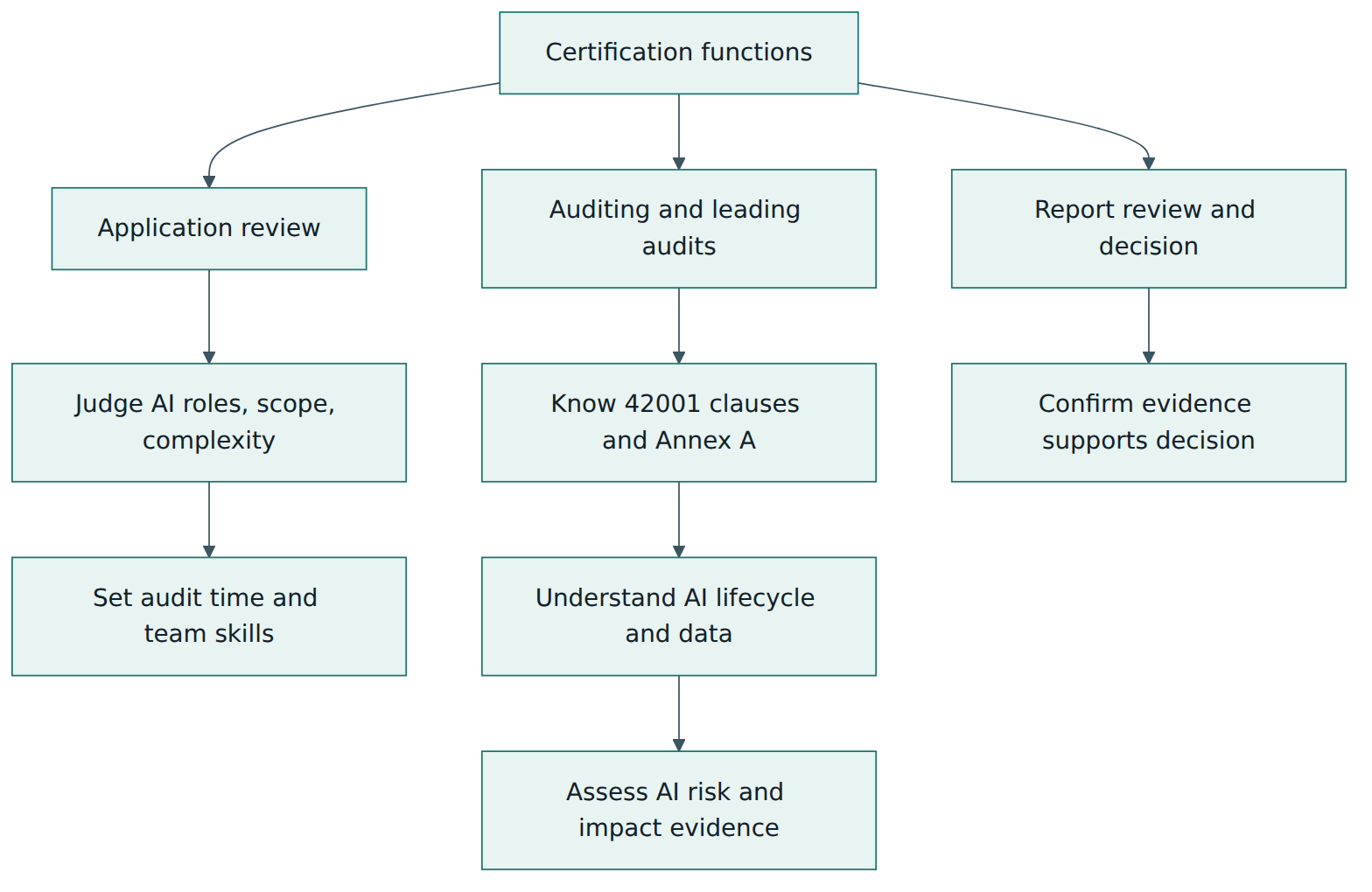
Application reviewers need enough AI understanding to read a client's application and recognise what kind of organisation it is: does it build models, integrate third-party AI, or simply use AI tools? How many AI systems, how critical, how fast do they change? Their judgement sets the audit time and the competence the audit team must have, so an application reviewer who cannot tell a chatbot pilot from a fleet of credit-scoring models will under-plan the audit.
Auditors need the deepest knowledge. Typical areas include: the requirements of ISO/IEC 42001 and the purpose of its Annex A controls; AI concepts and the AI system lifecycle (design, data collection and preparation, training, verification and validation, deployment, operation and monitoring, retirement); data quality and data management; AI risk assessment and impact assessment; and the legal and regulatory context that applies to the client's AI. Not every team member needs all of this, but the team as a whole must cover it. The lead auditor must also be able to manage the team and integrate the evidence.
Report reviewers and decision makers must understand AI well enough to tell whether the evidence in the audit report actually supports a recommendation to certify. They are not re-auditing; they are checking that the audit was competent, complete and coherent, and that the scope wording is accurate.
Demonstrating competence
A CB cannot simply declare that its auditors are competent. It has to define criteria, evaluate people against them, keep records and monitor performance over time – for example by witnessing auditors in action and reviewing their reports. Typical evidence includes education and work experience in AI-related fields, training on ISO/IEC 42001, audit experience under supervision, and periodic performance reviews. Because AI changes fast, continuing professional development is not optional in practice: an auditor who learned about AI before generative models became common will need to update their knowledge.
Using technical experts
Sometimes the audit team lacks a specific piece of knowledge, for example deep familiarity with computer vision in medical devices. The CB can then add a technical expert. The expert advises the team, helps auditors ask the right questions and interprets technical evidence, but does not make audit findings on their own. The CB still has to check the expert's impartiality and confidentiality, just like an auditor's.
The certification process step by step
The process for a 42001 certificate follows the same overall path as any accredited management system certification. ISO/IEC 42006 adds AI-specific content to many of the steps.
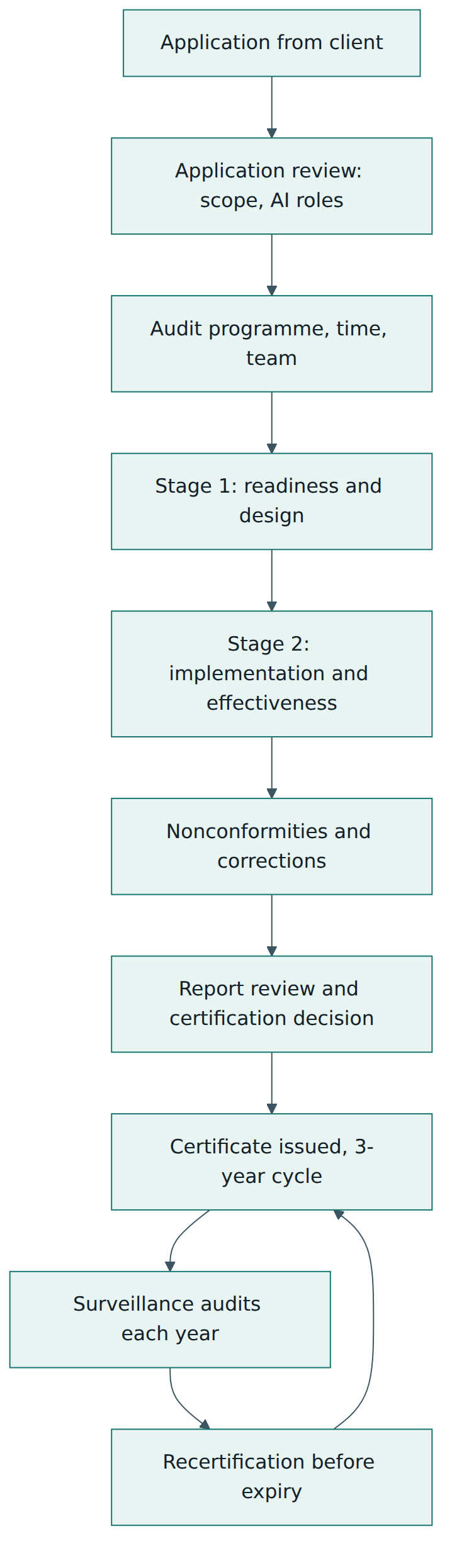
- Application. The client provides information: legal entity, sites, number of people, the AI systems in scope, its AI roles, outsourced processes and any existing certifications.
- Application review. The CB confirms it understands the client, can define a clear scope, has competent people available and can manage any impartiality threats. If it cannot cover the client's AI area competently, it must decline or acquire the competence first.
- Audit programme, time and team. The CB plans the whole three-year cycle, determines audit time considering the size and complexity of the client's AIMS, and picks a team whose combined competence matches the scope.
- Stage 1. Mostly a review of design and readiness: Is the AIMS documented? Is the scope sensible? Have AI risk assessments, impact assessments and the statement of applicability been completed? Are internal audit and management review planned or done? The outcome tells the client what must be fixed before stage 2 and helps the CB finalise the stage 2 plan.
- Stage 2. The main evaluation of implementation and effectiveness. Auditors interview people, observe work, sample AI systems and examine records to see whether the AIMS actually works – for example whether a model change triggered the defined review, whether monitoring results were acted on and whether impact assessments were updated.
- Nonconformities. Findings are graded. Major nonconformities must be corrected and verified before certification; for minor ones the CB usually accepts a credible corrective action plan.
- Report review and decision. People who did not take part in the audit review the report and decide. The separation of audit and decision is a core safeguard of impartiality.
- Certificate. Issued for a three-year cycle with a scope statement that describes what is covered.
- Surveillance. At least once a year, the CB checks parts of the system, always including key elements such as internal audit, management review, complaints, changes and progress on earlier findings. For AI, significant changes – new AI systems, new roles, major model updates – are natural surveillance topics.
- Recertification. Before the certificate expires, a recertification audit confirms continued conformity and effectiveness over the whole cycle.
Audit time
Audit time is one of the most contested topics in certification, because time costs money and clients naturally want less of it. Generic schemes base the starting point on the number of people working under the organisation's control and then adjust for complexity. ISO/IEC 42006 asks the CB to consider AI-specific factors when it determines how much time is needed. Factors that sensibly push time up include the number and diversity of AI systems, whether the organisation develops AI or only uses it, the severity of possible impacts on people, the degree of automation in decisions, the pace of model change and how much of the AI lifecycle is outsourced. Factors that may reduce time include a narrow, stable scope or a mature, integrated management system already certified to another standard. The CB must be able to justify its calculation; an AB will check that justification.
Status of a certificate
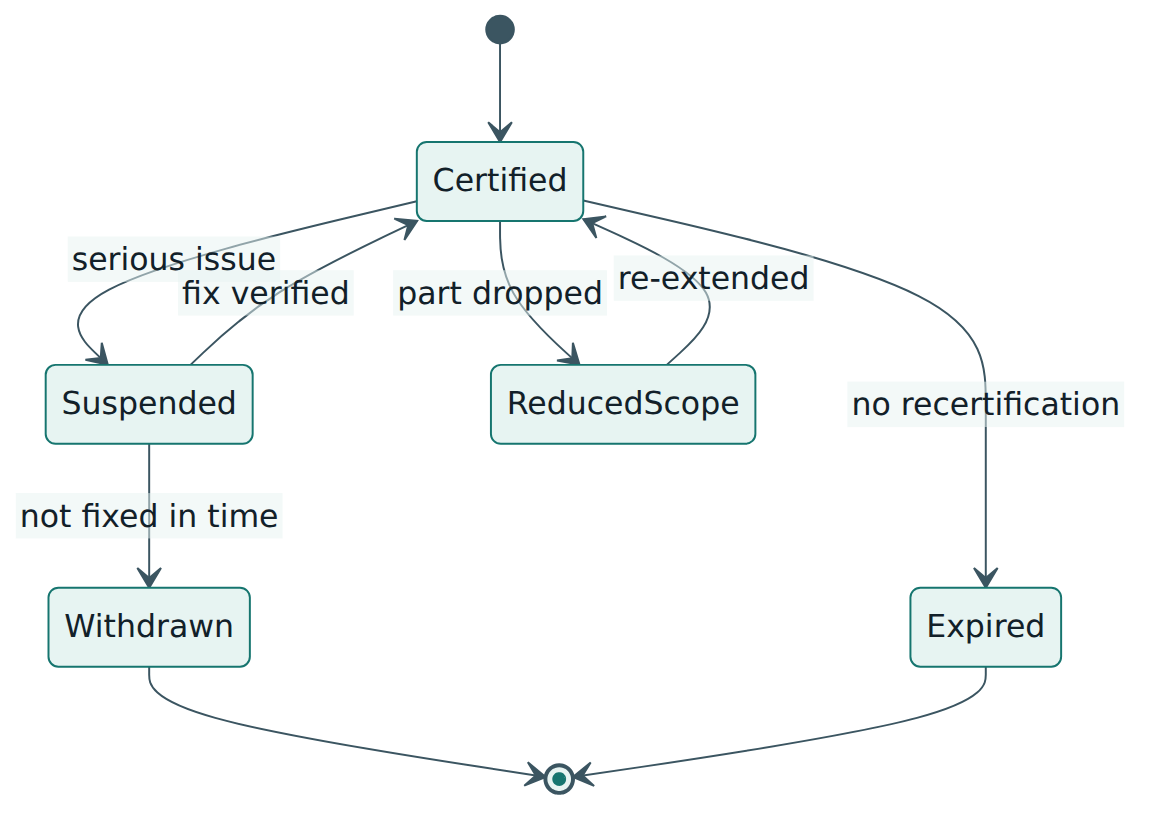
A certificate is not permanent. If a client fails to correct serious problems, refuses surveillance or misuses the certificate, the CB can suspend it. A suspended certificate can be restored once the problems are fixed, or withdrawn if they are not. The scope can also be reduced, for instance when the client stops providing a particular AI service.
Lesson 5 – Assessment, accreditation and compliance
Who assesses whom
Because ISO/IEC 42006 applies to certification bodies, "compliance" with it is demonstrated through accreditation. An organisation that wants to use AI responsibly is never certified to ISO/IEC 42006; it is certified to ISO/IEC 42001 by a body that conforms to 42006. If a vendor tells you it is "42006 certified", either it is a certification body accredited for AIMS certification, or it has misunderstood the standard.
An accreditation body assesses a CB in several ways:
- Office assessment – reviewing the CB's procedures, competence criteria, personnel records, impartiality analysis, audit time method and a sample of client files.
- Witness assessment – an AB assessor accompanies a CB audit team to a real client and observes how the team audits, whether they ask competent AI questions and whether the findings are sound.
- File review – checking that reports support decisions and that scope statements are accurate.
- Surveillance and reassessment – accreditation also runs in cycles, with regular surveillance of the CB and a full reassessment periodically.
The transition from early 42001 certification
ISO/IEC 42001 was published in December 2023; ISO/IEC 42006 followed in July 2025. In the gap, some accreditation bodies accredited AIMS certification using ISO/IEC 17021-1 together with their own interim requirements or pilot programmes. Once ISO/IEC 42006 was published, accreditation bodies began moving accredited CBs onto it, each according to its own transition arrangements. The details – deadlines, extra witness audits – differ between accreditation bodies, so a CB or an interested client should check the published notices of its own accreditation body rather than assume a single global date.
How a client can check a certificate
Anyone relying on a 42001 certificate can run a few quick checks that follow directly from the logic of ISO/IEC 42006:
- Is the certificate accredited? Look for an accreditation mark and verify it in the accreditation body's directory of accredited CBs and their scopes.
- Is the certificate valid? Use the CB's public directory or verification service to confirm status (certified, suspended, withdrawn) and expiry date.
- What exactly is in scope? Read the scope statement. Does it cover the AI service or product you are buying, and the role (developer, provider, user) that matters to you?
- Is the CB credible for AI? Ask how the audit team's AI competence was ensured and roughly how many audit days were involved.
What a certificate does not prove
Even a perfectly run 42006-conformant audit does not prove that a specific model is unbiased, robust or legal. Auditors sample; they examine whether the organisation has a functioning system for identifying and treating AI risks and impacts and whether it follows its own processes. If you need assurance about a particular AI system's behaviour, you need additional evidence such as testing reports, conformity assessments under applicable law or contractual audit rights.
Regulation
Regulators are interested in AI management standards, and the EU AI Act, for example, relies on harmonised standards for its high-risk requirements. However, ISO/IEC 42006 is not itself a regulation and an accredited 42001 certificate is not, on its own, legal approval of an AI system. Treat any claim that "42001 certification makes you compliant with the AI Act" with caution; the relationship is supportive, not automatic.
Lesson 6 – Worked example: certifying an AI health analytics company
This example follows a fictional certification body, Meridian Assurance, and its fictional client, Calder Health Analytics, through a first 42001 certification under ISO/IEC 42006. It is simplified, but every step reflects the logic you have learned.
Step 1 – The certification body prepares
Meridian is already accredited for ISO 9001 and ISO/IEC 27001 certification. It wants to add AIMS. Its quality manager compares the current procedures with ISO/IEC 42006 and finds three gaps. First, its competence criteria say nothing about AI, so it writes new criteria for each function and maps them to AI roles and 42001 clauses. Second, its audit time calculator has no AI factors, so it adds questions on the number of AI systems, development versus use, impact severity, automation and change rate. Third, its impartiality risk analysis does not consider a sister company in the same group that sells model-validation services; Meridian records the threat and decides it will not certify any client that the sister company has advised on its AIMS within the previous two years.
Meridian then qualifies its people. Two experienced ISO/IEC 27001 lead auditors take 42001 training and study AI lifecycle material; one data scientist with ten years of machine learning experience is qualified as a technical expert and later as an auditor after supervised audits. Meridian applies to its accreditation body, which reviews the procedures and witnesses an audit before granting accreditation for AIMS certification.
Step 2 – Calder applies
Calder Health Analytics has 180 staff and builds a machine learning model that helps hospital staff prioritise radiology scans for review. It also uses a third-party large language model to summarise clinical notes for its own support team. In its application, Calder lists both systems and describes itself as an AI developer and provider for the triage product and an AI user for the internal summarisation tool.
Step 3 – Application review
Meridian's application reviewer, who is qualified for this function, notes several complexity factors: a product that influences clinical prioritisation (high potential impact on patients), in-house model development with frequent retraining, health data, and a mix of roles. She concludes that the team needs someone with practical ML lifecycle knowledge and someone familiar with health data regulations. Using Meridian's justified method, she sets audit time above the baseline for a company of 180 people and records why. She also checks impartiality: no Meridian group company has advised Calder.
The draft scope is: "Development, provision and monitoring of machine-learning-based radiology triage software for hospitals, and use of a third-party AI service for internal summarisation of support documentation, as AI developer, provider and user, at the London and Leeds sites." It is specific enough that a hospital buyer would know what is covered.
Step 4 – Stage 1
The lead auditor and the technical expert review Calder's AIMS documents remotely and visit the main site for a day. They find the AI policy, objectives, risk assessment, impact assessments for both systems and a statement of applicability. Two concerns emerge: the impact assessment for the triage model has not been updated since a retraining that changed the input image sources, and no internal audit of the AIMS has been completed yet. The stage 1 report flags both as areas that must be addressed before stage 2, and the stage 2 plan is adjusted to spend more time on model change management.
Step 5 – Stage 2
Six weeks later the team returns. They sample three model releases from the past year and trace each through the change process: was the data reviewed, was performance validated on relevant patient groups, was the impact assessment re-examined, who approved the release? Two releases are fully traceable. The third was deployed after an urgent fix without the defined validation sign-off. The team interviews the head of data science, the clinical safety officer and an engineer on the monitoring rota, and checks dashboards showing drift alerts and how they were handled. For the summarisation tool they review supplier due diligence and usage rules for staff.
Findings:
- Major nonconformity: the urgent release bypassed the required validation, and Calder had no defined emergency change route, so the control for AI system deployment did not operate in a way that ensures intended results.
- Minor nonconformity: monitoring alerts were handled but the review records for two alerts were incomplete.
- Opportunity for improvement: the competence records for data annotators could be more detailed.
Step 6 – Correction and decision
Calder defines an emergency change procedure with retrospective validation within a fixed number of days, retrospectively validates the urgent release and trains staff. Meridian verifies the evidence remotely and closes the major nonconformity. For the minor nonconformity Calder submits a corrective action plan, which Meridian accepts for follow-up at the first surveillance audit. A certification decision maker who did not take part in the audit reviews the report, confirms that the evidence supports the scope and grants the certificate.
Step 7 – Surveillance and change
In the following year Calder starts offering its triage model through a partner's cloud platform. At surveillance Meridian reviews this change: the AI role is unchanged, but there is a new supplier relationship and a new deployment environment, so the team examines how the AIMS addressed them and confirms the scope wording still fits. The minor nonconformity from stage 2 is verified as closed. At year three, recertification looks back over the whole cycle before a new certificate is issued.
What the example teaches
Notice where ISO/IEC 42006 made a difference: Meridian had to build AI-specific competence before it could sell AI certification; the application review used AI complexity to set time and team; the scope named roles and systems; and the auditors traced model changes and impact assessments rather than only reading policies. Without those requirements, a certificate could have been issued on the strength of well-written documents alone.
Lesson 7 – Relationship to other standards and frameworks
ISO/IEC 42006 only makes sense alongside its neighbours. The table compares the most important ones.
| Standard / framework | Who it applies to | What it does | Relationship to ISO/IEC 42006 |
|---|---|---|---|
| ISO/IEC 42001 | Organisations that develop, provide or use AI | Requirements for an AI management system | The standard that 42006-conformant bodies audit against. |
| ISO/IEC 17021-1 | All management system certification bodies | General requirements for competence, impartiality and the certification process | The base layer; 42006 adds AI-specific requirements on top and never replaces it. |
| ISO/IEC 17011 | Accreditation bodies | Requirements for bodies that accredit conformity assessment bodies | Governs the bodies that assess CBs against 17021-1 and 42006. |
| ISO/IEC 27006-1 | Information security management system CBs | Security-specific additions to 17021-1 for ISO/IEC 27001 certification | A sister "sector add-on"; CBs often run 27001 and 42001 schemes together. |
| ISO 19011 | Anyone who audits management systems | Guidance on auditing principles, audit programmes and auditor competence | Useful guidance for auditors; not a requirements document for accreditation. |
| ISO/IEC 23894 and ISO/IEC 42005 | Organisations managing AI | Guidance on AI risk management and AI system impact assessment | Shape the evidence auditors expect to see; auditors need to understand them. |
| ISO/IEC 22989 | Everyone working with AI standards | AI concepts and terminology, including AI roles | Provides the vocabulary for describing roles and scope. |
Integrated audits
Many organisations already hold ISO/IEC 27001 or ISO 9001 certificates. Because all these standards share the ISO harmonized structure (clauses 4–10 for context, leadership, planning, support, operation, performance evaluation and improvement), CBs can run integrated audits that cover several systems at once. ISO/IEC 42006 does not forbid this, but it does not let AI competence be diluted either: an integrated team must still include the AI competence needed for the 42001 part, and the audit time must still allow the AI-specific evidence to be examined properly.
Frameworks that are not certification schemes
The NIST AI Risk Management Framework, the OECD AI principles and similar documents are influential but voluntary and not certifiable in the ISO sense. An organisation may use them inside its 42001 AIMS, and auditors may see them referenced, but ISO/IEC 42006 governs only how 42001 certification is carried out.
Regulation and conformity assessment
Laws such as the EU AI Act have their own conformity assessment routes, sometimes involving notified bodies designated by authorities. Those routes follow the law, not ISO/IEC 42006. The two can coexist: a company might hold an accredited 42001 certificate and also complete a legal conformity assessment for a high-risk system, and the management system evidence can support both.
Common pitfalls and best practices
Pitfalls
- Calling the wrong thing certified. Organisations claim to be "ISO/IEC 42006 certified" or present a 42001 certificate as proof that a particular model is fair or safe. Neither claim is correct.
- Treating AI as just another IT scope. A CB assigns a security auditor with no AI background and no technical expert, so the audit checks documents but cannot judge model lifecycle evidence.
- Vague scope statements. A certificate that says only "AI management" hides which systems and roles were audited and misleads customers.
- Under-calculated audit time. Commercial pressure pushes the time below what the complexity justifies, leaving no time to trace model changes or impact assessments.
- Consulting and certifying the same client. A CB, or a closely linked company, helps design the client's AIMS and then certifies it – a classic self-review threat to impartiality.
- Relying on unaccredited certificates without checking. Buyers accept any certificate logo without checking accreditation, validity or scope.
- Letting competence go stale. Auditors qualified once are never re-evaluated, even though AI practice and regulation change quickly.
Best practices
- Read 17021-1 and 42006 together. Map every AI-specific requirement to the general clause it supplements, and build procedures from the combined text.
- Define competence by function and AI role. Keep a competence matrix that shows which people may review applications, audit, review reports or decide for which kinds of AI client.
- Use technical experts deliberately. Bring them in when the team lacks specific knowledge, brief them on their advisory role and check their impartiality.
- Sample real AI evidence. Trace actual model changes, impact assessments, data records and monitoring alerts, not only policies and procedures.
- Write precise scopes. Name the AI roles, main activities and systems so that a reader knows exactly what the certificate covers.
- Document the audit time rationale. Record the factors that raised or lowered time so that an accreditation assessor can follow the logic.
- As a client, prepare like the auditor thinks. Make your AI inventory, roles, risk and impact assessments and change records easy to trace before stage 1.
Summary and key takeaways
- ISO/IEC 42006:2025 sets additional requirements for certification bodies that audit and certify AI management systems against ISO/IEC 42001.
- It supplements ISO/IEC 17021-1 and is best read against its clause layout; the general requirements always still apply.
- Organisations are certified to ISO/IEC 42001, never to ISO/IEC 42006; conformity with 42006 is shown through accreditation.
- Its core contribution is AI-specific competence, defined for each certification function and linked to AI roles and 42001 clauses.
- The certification process – application review, stage 1, stage 2, decision, surveillance, recertification – stays familiar but must examine AI-specific evidence and justify AI-aware audit time.
- Impartiality matters more as certification groups expand into AI consulting and testing services.
- A clear scope statement naming roles and systems is what lets customers rely on a certificate.
- A 42001 certificate shows a working management system, not that any individual AI system is safe, fair or legally compliant.
Reflection questions
- Your company buys an AI service from a supplier that shows a 42001 certificate. Which four things would you check, and what would make you ask for more evidence?
- If you ran a certification body, which AI complexity factors would you build into your audit time method, and how would you justify each one to an accreditation assessor?
- Describe a situation in which a certification body group's AI testing or consulting services could threaten impartiality, and how you would manage it.
- Write a scope statement for an organisation you know that uses or builds AI. What roles and systems would you name, and what would you leave out?
- In the worked example, what could have gone wrong if Meridian had sent only a document-focused auditor without AI lifecycle knowledge?
Further reading and official sources
- ISO/IEC 42006:2025 Requirements for bodies providing audit and certification of AI management systems – ISO
- BS ISO/IEC 42006:2025 catalogue entry and overview – BSI
- ISO/IEC 42001:2023 Artificial intelligence – Management system – ISO
- ISO/IEC 17021-1:2015 Requirements for bodies providing audit and certification of management systems – ISO
- ISO/IEC JTC 1/SC 42 Artificial intelligence (committee page) – ISO
- Global Accreditation Cooperation Incorporated (Global ACI) – Global ACI
Original tutorial by xOps School (DevOpsSchool Private Limited), written from public sources about ISO/IEC 42006. Not affiliated with or endorsed by the standard's owner; standard names are trademarks of their owners. Buy the official standard from its publisher for the authoritative text.