
NIST SP 800-161 Rev.1 – Tutorial (about 60 minutes)
- View
NIST Special Publication 800-161 Revision 1 is the US National Institute of Standards and Technology's main guidance on cybersecurity supply chain risk management (C-SCRM): how an organisation finds, assesses and reduces the cyber risks that come from the suppliers, products and services it depends on. It was written for US federal agencies, but many companies, hospitals, critical-infrastructure operators and technology suppliers use it voluntarily because it is free, detailed and built on the familiar NIST risk management and control catalogues. After this tutorial you will be able to explain what C-SCRM is, find your way around the publication, run its risk process across the three organisational levels, choose and flow down controls, and judge how supply chain practices are assessed.
Course overview
Edition and status: The current edition is NIST SP 800-161 Rev. 1, Cybersecurity Supply Chain Risk Management Practices for Systems and Organizations, by authors from NIST and Boston Consulting Group. Revision 1 was first published in May 2022 and replaced the original SP 800-161 from 2015. NIST then issued an errata release, SP 800-161r1-upd1, which carries updates dated 1 November 2024 and supersedes the May 2022 text. Its revision-history appendix lists the changes: references updated to CSF 2.0 and the current SP 800-160 volumes, a confusing procurement table removed, a semiconductor example added, revised risk assessment and vulnerability-report guidance (RA-3, RA-5), RA-3(1) and PM-30 added to the C-SCRM baseline, and new glossary terms. The guidance that responds to Executive Order 14028 (Appendix F) lives on a NIST web page, not in the PDF. NIST's C-SCRM project page lists Rev. 1 Update 1 as final, with no newer draft revision. Related newer material includes SP 800-18 Rev. 2 (June 2026), which covers writing system-level C-SCRM plans, and a fillable version of the publication's scoping questionnaire (December 2025). The publication is free and not subject to copyright in the United States. Verified 2026-10-29 on the NIST Computer Security Resource Center (CSRC).
Who this is for: security and risk managers, procurement and vendor-management staff, IT and OT engineers, system owners, auditors, compliance staff and anyone at a supplier who must answer a customer's supply chain security questions. It suits both public-sector and private-sector readers.
Prerequisites: none. A rough idea of what a security control is and how an organisation buys technology will help, and every term is explained when it first appears.
By the end of this tutorial:
- You will be able to explain why supply chain cyber risk needs its own discipline and what problem SP 800-161 Rev. 1 solves.
- You will be able to define the core vocabulary: acquirer, supplier, system integrator, external system service provider, criticality, provenance, flow-down and more.
- You will be able to navigate the publication: its three chapters, the control overlay in Appendix A and the supporting appendices.
- You will be able to describe the three-level approach and the frame, assess, respond and monitor process as applied to suppliers.
- You will be able to build C-SCRM into the acquisition life cycle and into contracts, and prioritise foundational, sustaining and enhancing practices.
- You will be able to explain how C-SCRM programmes and suppliers are assessed, and why there is no "SP 800-161 certificate".
- You will be able to relate SP 800-161 Rev. 1 to SP 800-53, the Cybersecurity Framework 2.0, the SSDF, ISO/IEC 27036 and other neighbours.
Lesson 1 – Origins, purpose and scope
Why supply chains became a cyber problem
Almost nothing an organisation runs today is built entirely in-house. A typical system contains commercial software, open-source libraries, cloud services, firmware written by a chip vendor, network equipment assembled in several countries and support provided by managed service companies. Each of these parties has its own staff, tools, sub-suppliers and weaknesses. If any of them is compromised, careless or dishonest, the problem can travel downstream into your environment through a trusted channel: a software update, a support connection, a replacement part or an outsourced administrator.
Well-known incidents have made this concrete. In 2020, attackers inserted malicious code into the build process of a widely used network-monitoring product, so customers installed the backdoor themselves through a signed update. In 2021, criminals abused a remote-management tool used by managed service providers to push ransomware to many of their clients at once. In late 2021, a critical flaw in the open-source Log4j library showed how a single small component can sit inside thousands of products whose owners did not even know they used it. Counterfeit network hardware and grey-market electronic parts have long caused reliability and security problems in government and industry. None of these is a classic "someone hacked our firewall" story. Each is a case where the weakness was introduced or exploited somewhere along the chain of parties that design, build, deliver, operate and support technology.
The root difficulty is what NIST calls information asymmetry. The buyer usually cannot see how a product was designed, who wrote its code, where it was manufactured, what components it contains or how a service provider protects its own network. The further you go down the chain, to a supplier's suppliers, the less visibility and control you have. C-SCRM is the discipline of managing that risk deliberately instead of hoping that trusted brands are always trustworthy.
From early guidance to Revision 1
NIST began publishing supply chain guidance with an interagency report on notional supply chain practices for federal systems (NIST IR 7622) and then the original SP 800-161 in 2015. Over the following years several things changed. Industry case studies, collected by NIST in 2015 and 2019 and summarised in NIST IR 8276, showed which practices worked in real companies. The 2018 SECURE Technology Act created the Federal Acquisition Security Council (FASC) and required federal agencies to assess supply chain risk. SP 800-53 Revision 5 (2020) added a dedicated Supply Chain Risk Management (SR) control family. Executive Order 14028 in May 2021 called for stronger software supply chain security, including software bills of materials.
Revision 1, published in May 2022 after two public drafts, folded all of this together. It integrates C-SCRM into enterprise-wide risk management, aligns its controls with SP 800-53 Rev. 5, adds templates and threat-scenario examples, and includes an appendix for federal agencies on the supply chain risk assessments required by the Federal Acquisition Supply Chain Security Act (FASCSA). The November 2024 update corrected and clarified the text without changing its overall design.
Purpose and scope
The publication's purpose is to help organisations identify, assess, select and implement risk management processes and mitigating controls for cybersecurity risks throughout the supply chain. Three features of its scope matter for beginners.
- It covers the whole life cycle. C-SCRM applies from research and design through manufacturing, acquisition, delivery, integration, operation and maintenance to disposal. Risks can appear at any stage, including long after purchase.
- It covers products and services. Hardware, software, firmware, cloud and managed services, system integration, maintenance and even non-IT services that touch technology (for example, a facilities contractor with remote access to building controls) are all in scope. Both information and communications technology (ICT) and operational technology (OT) are included.
- It is not one-size-fits-all. NIST expects every organisation to tailor the guidance to its size, resources and risk. The publication describes practices and offers a rough prioritisation, but it does not prescribe a fixed maturity roadmap.
The guidance is written in terms of an "enterprise", NIST's word for an organisation at the top of its hierarchy, where senior leaders own risk. A large enterprise may contain several organisations, each with its own leadership. For federal agencies using cloud services, NIST says to apply FedRAMP guidance first and then use SP 800-161 Rev. 1 for anything FedRAMP does not address. For everyone else the publication is voluntary, but it is widely referenced by buyers, regulators and suppliers as a common vocabulary.
Lesson 2 – Key concepts and vocabulary
C-SCRM brings together security, procurement, legal, engineering and risk people who each use words differently. SP 800-161 Rev. 1 defines a shared vocabulary. These are the terms you will meet most often.
- Supply chain – the linked set of organisations, people, processes and resources involved in designing, producing, delivering, operating and retiring a product or service, including your suppliers' own suppliers.
- Cybersecurity supply chain risk management (C-SCRM) – the organised, ongoing work of finding, judging and controlling cybersecurity risks that arise anywhere in the supply chain, together with the strategies, policies, processes and procedures an organisation uses to respond to them.
- Acquirer – the organisation that obtains a product or service. In SP 800-161 Rev. 1 the reader is usually the acquirer, though suppliers use it to understand what their customers will ask.
- Supplier – an organisation that provides products, typically commercial off-the-shelf (COTS) items, or in a government context government off-the-shelf (GOTS) items. Suppliers range from tiny specialists to global corporations.
- Developer or manufacturer – the party that builds a system, component or service. Developers often hold privileged access and can either add security or introduce vulnerabilities.
- System integrator – a company that assembles, customises, tests or operates a solution to the acquirer's requirements, often with several layers of subcontractors behind it.
- External system service provider – a provider, such as a cloud or managed service company, that performs mission or business functions for you. Outsourcing reduces your visibility, but you remain accountable for the risk.
- Other ICT/OT-related service provider – any provider whose service needs physical or logical access to your technology, from consultants to a security firm watching cameras through a cloud portal.
- Criticality – how essential a product, service, system or supplier is to your missions, safety and business. Criticality analysis decides where to spend C-SCRM effort first.
- Provenance and pedigree – the documented origin and history of a component (who made it, where, and every change of custody) and the validation that it is what it claims to be.
- Counterfeit – an item that is not what it is presented as, for example a copied or relabelled part. Counterfeits can be unreliable or deliberately altered.
- Software bill of materials (SBOM) – a machine-readable inventory of the components inside a piece of software, used to track known vulnerabilities and origins.
- Flow-down – passing a requirement from the acquirer to the prime contractor and on to relevant subcontractors through contracts, so that controls do not stop at the first tier.
- Threat scenario – a story-like sequence of threat events from one or more threat sources, used to analyse how a supply chain weakness could be exploited and what the impact would be.
- Supply chain risk information (SCRI) – data about the characteristics and risk factors of a product, service or source, such as ownership, location, past incidents, alerts or assessment results, shared within and between organisations.
- Foreign ownership, control or influence (FOCI) – a risk factor describing whether a foreign government or entity could direct or pressure a supplier. It is especially relevant to government buyers.
- Risk appetite and risk tolerance – appetite is the broad amount of risk leadership is willing to pursue; tolerance is the acceptable variation for a specific objective, process or system.
- C-SCRM PMO – a programme management office, or similar dedicated team, that provides C-SCRM services such as supplier assessments, templates and reporting to the rest of the enterprise.
The dimensions of C-SCRM
SP 800-161 Rev. 1 stresses that supply chain risk is not only about confidentiality. It describes C-SCRM as sitting where many qualities meet: security, integrity (no tampering, authentic parts), resilience (the ability to withstand and recover from disruption), reliability, quality, safety, suitability (the right product for the purpose), usability, efficiency, maintainability and scalability, all resting on an organisational culture of awareness. A single supplier failure can affect several of these at once. A vendor going bankrupt, a factory flood or a sanctions decision can be as damaging as a malicious implant, which is why the publication treats non-adversarial threats alongside adversarial ones.
How risk is formed
The publication uses the classic NIST risk model. A threat may be adversarial (malware insertion, espionage, counterfeiting) or non-adversarial (natural disaster, poor quality, geopolitical events, legal changes affecting supply). A vulnerability may be external to you (a weak supplier, many suppliers depending on the same sub-supplier) or internal (unpatched systems, weak controls, low awareness). Likelihood is the probability that a threat exploits a vulnerability within a given time; for adversaries it depends on capability and intent, for natural events on historical frequency. Impact is the degree of harm to missions, assets, people or other organisations. Risk is the combination of likelihood and impact. Supply chain risks are often slow and hidden: a weakness may sit unnoticed for years, and after an incident it can be hard to prove it came from the supply chain at all.
Lesson 3 – Structure of the publication
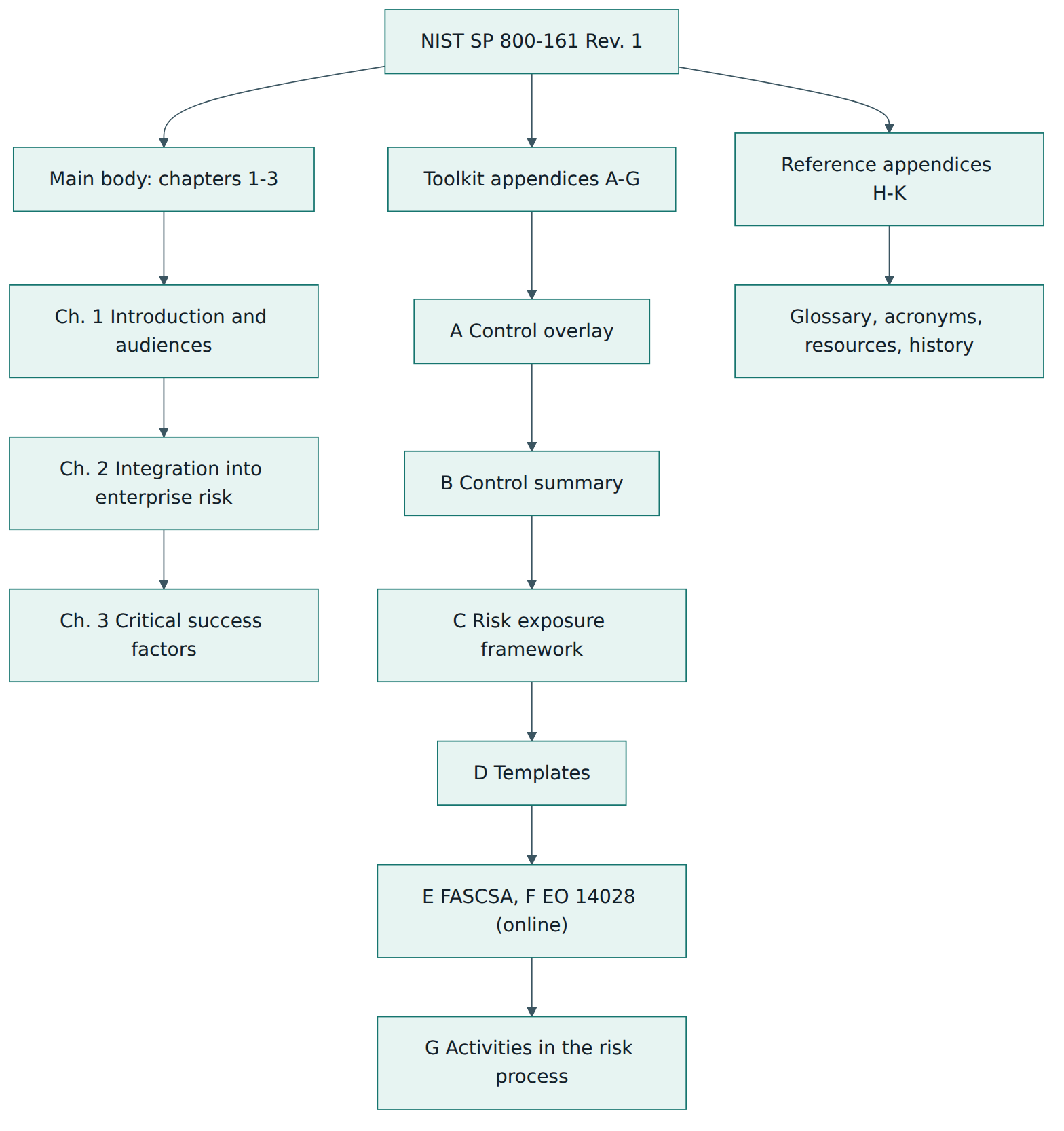
At first glance SP 800-161 Rev. 1 is intimidating: more than 300 pages, most of them appendices. In practice it has a short main body that explains the approach and a set of appendices you consult as tools. Knowing which part answers which question saves a lot of time.
The main body
Chapter 1, Introduction, sets out the purpose, audience and background. A helpful feature is its set of reader profiles: enterprise risk and C-SCRM owners should read everything; mission and business owners, acquisition staff, security operators and system developers each get a short list of recommended sections. Chapter 1 also explains the methodology: the publication builds on SP 800-39 for the multilevel risk approach, on SP 800-37 Rev. 2 (the Risk Management Framework) for system-level activities, and on SP 800-53 Rev. 5 for controls.
Chapter 2, Integration of C-SCRM into enterprise-wide risk management, makes the business case, describes how supply chain risks arise, and explains the three levels of risk management and the role of a C-SCRM PMO. This is the conceptual heart of the document.
Chapter 3, Critical success factors, covers what makes programmes work in practice: C-SCRM in acquisition, supply chain information sharing, training and awareness, key practices grouped as foundational, sustaining and enhancing, measurement, and dedicated resources (funding and people).
The three levels
Following SP 800-39, the publication manages risk at three levels, each producing its own documents.
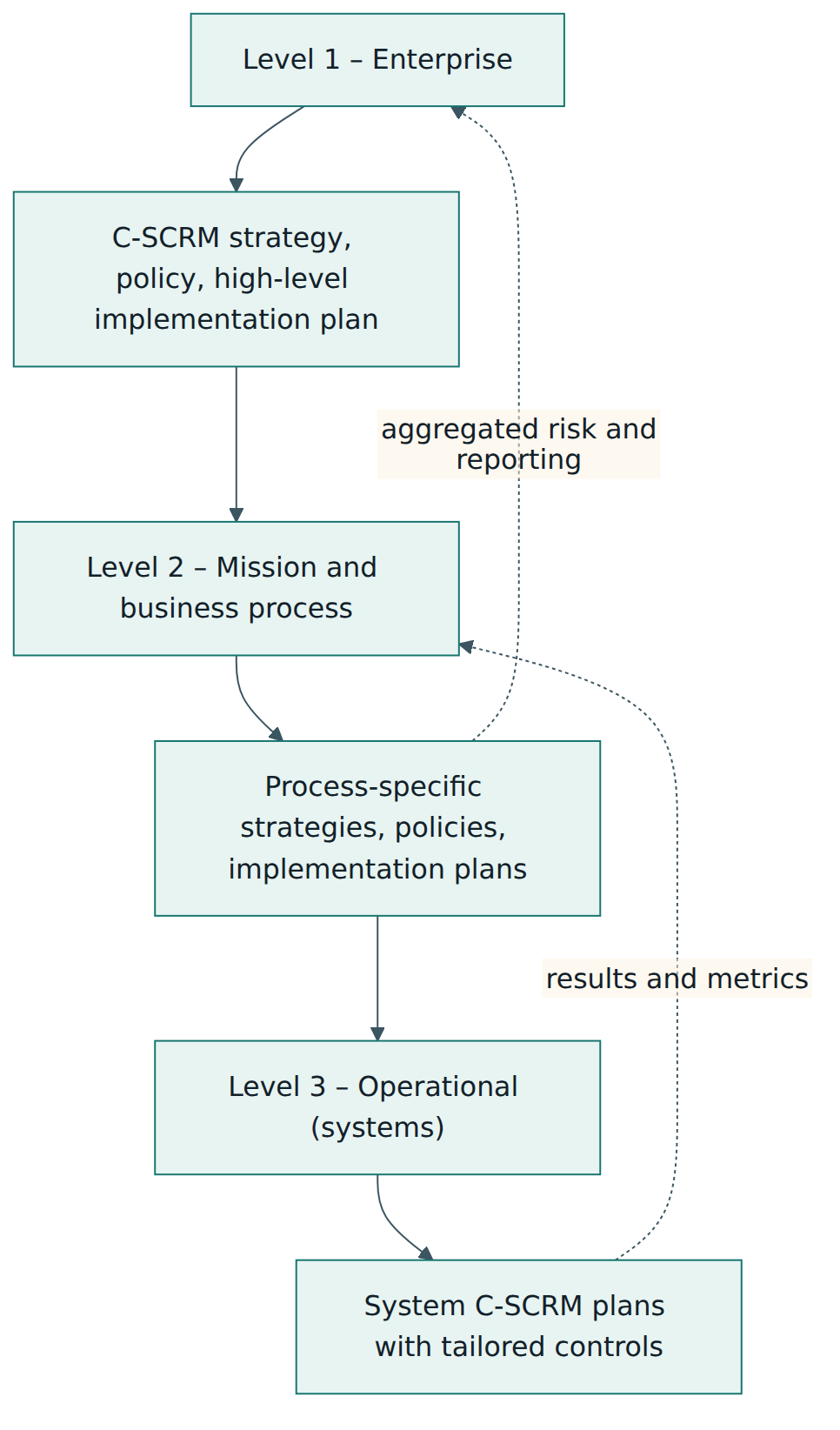
- Level 1, Enterprise. Executives (for example the CEO, CIO, CISO, chief risk officer, chief acquisition officer and legal counsel) set the C-SCRM strategy, policy and high-level implementation plan, establish governance, define risk appetite and decide which decisions are delegated. Accountability ultimately rests with the head of the organisation.
- Level 2, Mission and business process. Programme managers, engineering, research and development, and acquisition and supplier-relationship managers tailor the enterprise direction to each mission or business line, set risk tolerances, develop implementation plans and manage most third-party relationships.
- Level 3, Operational. System owners, architects, developers, testers, contracting staff and control engineers write C-SCRM plans for individual systems, select and tailor controls and apply them throughout the system development life cycle (SDLC).
Information flows both ways. Upper levels constrain lower ones, and lower levels report results that refine strategies above. Small and mid-sized organisations may collapse these levels into fewer roles; the logic still applies.
Appendix A: the control overlay
Appendix A is what most practitioners mean when they say "the 800-161 controls". It is an enhanced overlay of SP 800-53 Rev. 5: NIST selected the controls and enhancements from the main catalogue that matter for supply chain risk, organised them into the same 20 control families, and added supplemental C-SCRM guidance to each. Controls that are general security hygiene but not specific to supply chains are left out. Each entry follows a simple format: the control identifier and name, supplemental C-SCRM guidance, the level or levels (1, 2, 3) where it applies, related controls and relevant enhancements.
A few items are new and do not exist in SP 800-53 Rev. 5: a counterintelligence training enhancement (AT-3(6)), SBOMs for open-source projects as part of component inventory (CM-8(10)), maintenance monitoring and information sharing (MA-8), and a supplier inventory control (SR-13). The Supply Chain Risk Management family itself (SR-1 to SR-12 from SP 800-53, plus SR-13) covers policy, the supply chain risk management plan, controls and processes, provenance, acquisition strategies, supplier assessments, operations security, notification agreements, tamper resistance, inspection, component authenticity and disposal.
Appendix B and the other toolkit appendices
- Appendix B, C-SCRM Control Summary, is a table of all the controls with columns showing which belong to the C-SCRM baseline (a suggested starting set), which should flow down to subcontractors, and at which levels each applies. It is the quickest way to draft a control set or contract annex.
- Appendix C, Risk Exposure Framework, gives a six-step method for building and analysing threat scenarios, plus six worked scenarios such as foreign influence over a supplier, telecommunications counterfeits, industrial espionage, malicious code insertion, unintentional compromise and vulnerable reused components.
- Appendix D, Templates, offers outlines for a C-SCRM strategy and implementation plan, a C-SCRM policy, a system C-SCRM plan and a supply chain risk assessment, including a scoping questionnaire.
- Appendix E, FASCSA, is guidance for US federal executive agencies on the supply chain risk assessments the law requires: baseline risk factors, documentation, a five-level risk severity schema and escalation.
- Appendix F now simply points to NIST's online guidance written in response to Executive Order 14028 (software supply chain security, SBOMs, vulnerability management and attestation topics), so that it can be updated without reissuing the PDF.
- Appendix G details C-SCRM activities within each step of the risk management process, with inputs, activities and outputs at every level.
- Appendices H to K are the glossary, acronyms, resources and the revision history that records the 2024 update.
Lesson 4 – How it works in practice
The risk management process
SP 800-161 Rev. 1 does not invent a new risk process; it applies the SP 800-39 cycle of frame, assess, respond and monitor to supply chains, at each of the three levels.
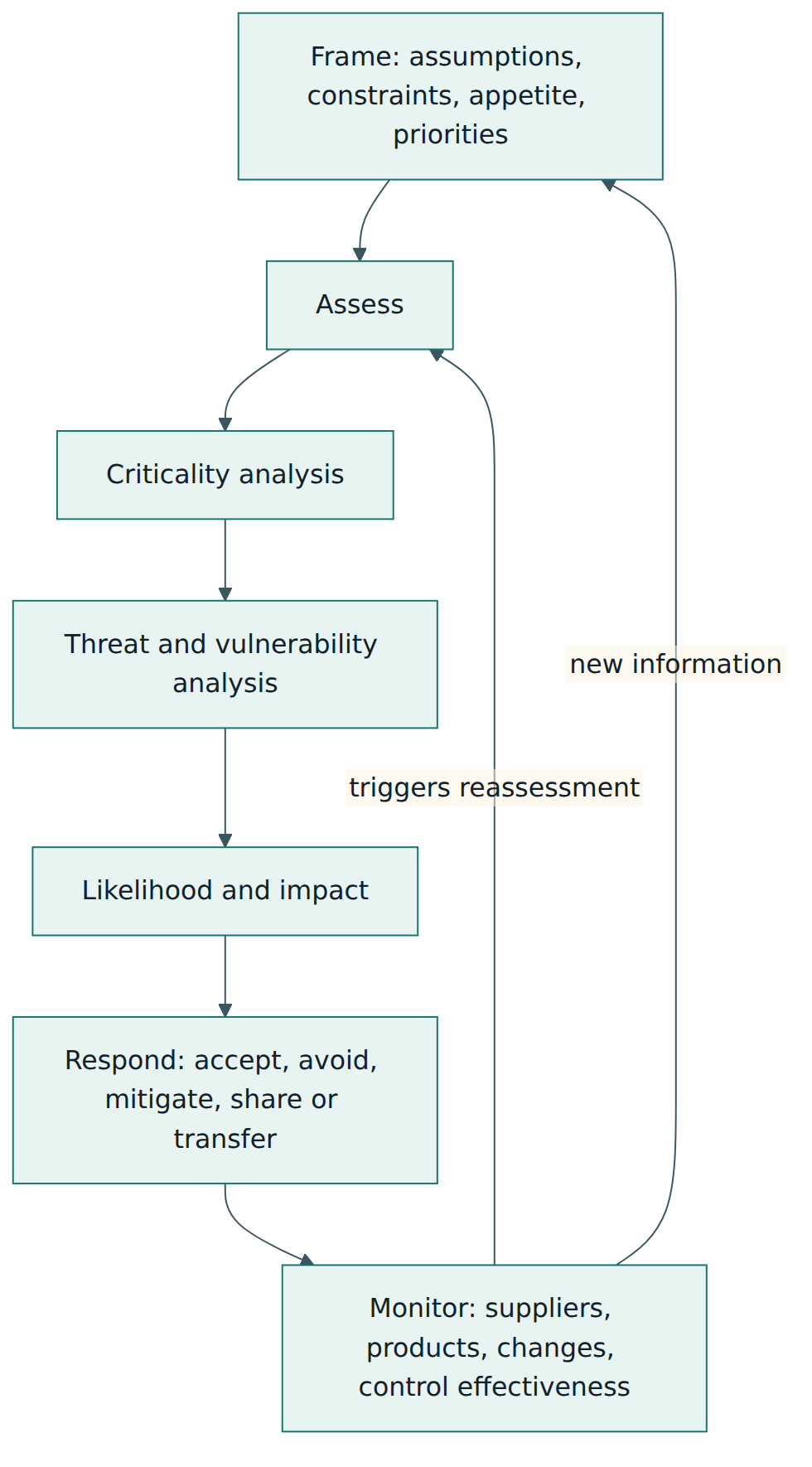
Frame. Leaders make their assumptions explicit: which threats and vulnerabilities matter, what constraints apply (laws, budgets, policies), how much risk is acceptable and which trade-offs they will make, for example cost against assurance. The output is the context, captured in the C-SCRM strategy, that every later decision uses.
Assess. Assessment starts with criticality analysis: which missions, systems, components and suppliers matter most. It then looks at threats and vulnerabilities for those critical items and estimates likelihood and impact. NIST notes that suppliers should be assessed on a prioritised basis; you cannot examine every vendor in depth.
Respond. For each significant risk the organisation chooses to accept it, avoid it (for example, not buying the product), mitigate it with controls, share it or transfer it (for example, through contract terms or insurance). Mitigation means selecting, tailoring and implementing controls, usually drawn from Appendix A.
Monitor. Supply chains change constantly: suppliers are acquired, move production, suffer breaches or release updates. Monitoring tracks those changes, checks that controls still work and feeds new information back into framing and assessment.
Building a programme: roles and operating models
C-SCRM cannot live in one department. The publication recommends a multidisciplinary team drawn from information security, procurement, enterprise risk, engineering, software development, IT, legal and HR, usually started from the top with a council of senior leaders and a charter. Below that, working groups handle day-to-day issues. Organisations can run C-SCRM centrally (a PMO that performs supplier assessments and keeps the risk register as a shared service), decentrally (each business line does its own) or in a hybrid. Centralisation gives consistency and specialist skills; decentralisation suits very different business units. A PMO typically offers advisory support, templates and tools, supplier and product risk assessments, information-sharing management, a C-SCRM risk register, training material and reporting to executives.
C-SCRM in acquisition
Buying is where an organisation has the most leverage over suppliers, so the publication puts acquisition first among its critical success factors. A crucial early step is an accurate inventory of supplier relationships, contracts and the products and services each supplier provides. With that inventory, suppliers can be grouped, for instance into strategic, mission-critical, sustaining and standard categories, so that effort goes where criticality is highest and single points of failure, such as a sole source of supply, become visible.
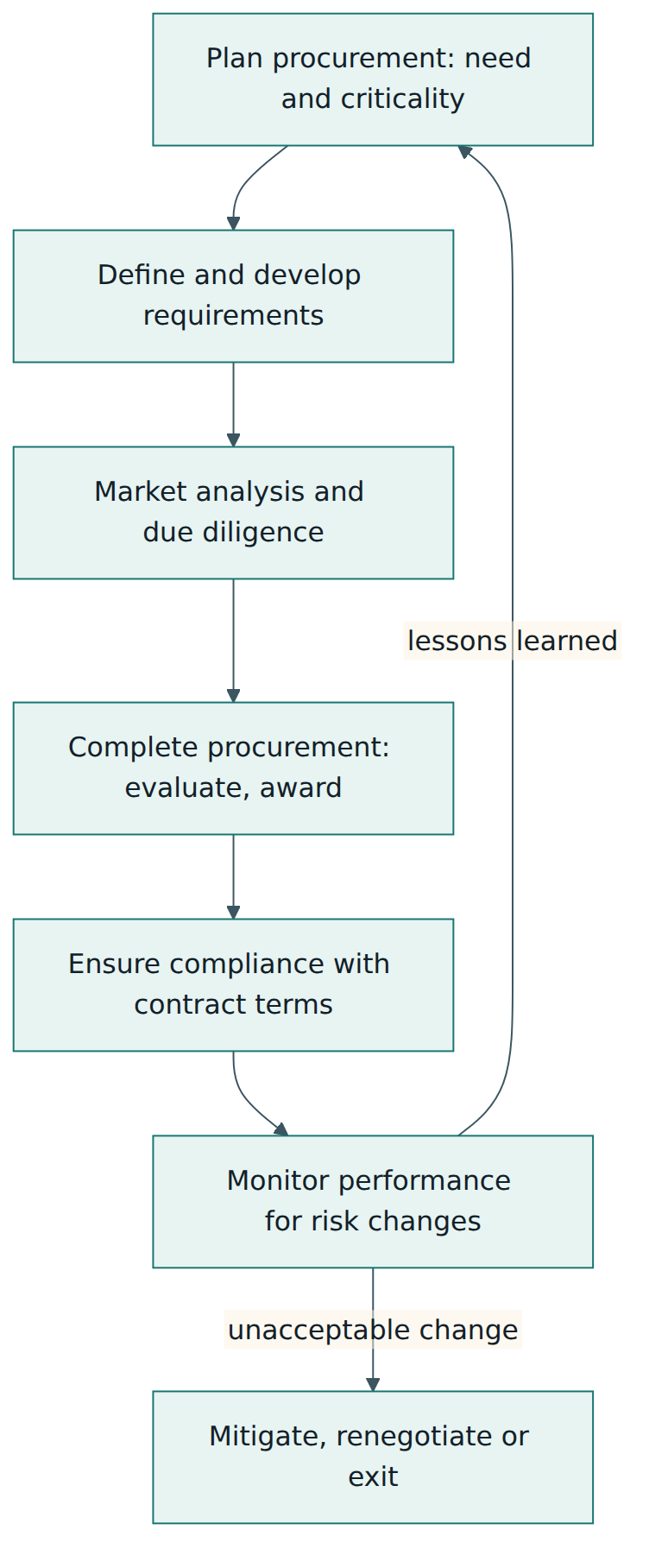
Drawing on NIST IR 7622, the publication names six steps in which acquisition policies should include C-SCRM: plan the procurement, define and develop requirements, perform market analysis, complete the procurement, ensure compliance, and monitor performance for changes that affect supply chain risk. In each step C-SCRM adds something specific. During planning, the team decides how critical the purchase is, which drives how much risk it can tolerate. Requirements include supply chain expectations next to cost, schedule and performance. Market research and due diligence build a supplier risk profile, perhaps using questionnaires or requests for information, and consider market concentration. Offers are evaluated against C-SCRM criteria by a mixed team of procurement, business, system and technical experts. The publication explicitly advises against "lowest price, technically acceptable" selection for ICT and OT purchases, stressing that security is a critical factor in buying decisions: under that method, once a bid meets the minimum, stronger supply chain security earns no credit and price alone decides.
Contracts then carry the requirements forward. NIST lists the kinds of provisions to include: meeting security requirements as a condition of award; flow-down of relevant controls to subcontractors with performance objectives that can be checked; periodic revalidation of supplier compliance; agreed ways to report vulnerabilities, incidents and serious disruptions; clear roles for responding to supply chain incidents; and grounds for termination if risk changes and cannot be brought back within tolerance. Practical techniques such as tamper-evident packaging, trusted distribution channels, buying from original manufacturers or authorised resellers, and hiding the end use of a purchase can add protection where risk is high.
Not everything arrives through procurement. Open-source software, internal shared services and repurposed equipment are acquired outside the purchasing process, so C-SCRM must cover these routes as well, for example by drawing open-source packages only from vetted repositories.
Information sharing and training
Organisations learn about supply chain threats faster together. The publication encourages formal information-sharing arrangements, such as Information Sharing and Analysis Centres (ISACs) and, for federal agencies, the FASC's information-sharing processes, and points to SP 800-150 for practical sharing practices. Informal, unmanaged sharing can create legal exposure. On training, everyone needs basic awareness (for example, how to report a suspicious delivery), while people with significant C-SCRM roles, such as buyers, engineers and contract lawyers, need role-based training. The NICE Workforce Framework (SP 800-181) can provide common job-role language.
Key practices: foundational, sustaining, enhancing
To help organisations decide where to start, Chapter 3 groups key practices into three tiers.
- Foundational practices create an enduring capability: a dedicated multidisciplinary team or PMO, senior leadership support, a risk hierarchy and process, governance and policy, a way to measure supplier and product criticality, C-SCRM built into procurement, a quality programme, a supplier management programme, incident management that can trace root causes into the supply chain, processes to confirm that suppliers disclose vulnerabilities, and governance of embedded software components, for example with SBOMs.
- Sustaining practices build on that base: a threat-informed security programme, third-party assessments, site visits and certifications for critical suppliers, formal continuous monitoring and reassessment, defined risk appetite and tolerances, formal information sharing, reporting top supply chain risks to the senior risk committee, C-SCRM integrated into the SDLC and into contracts, critical suppliers included in contingency and incident exercises, and defined metrics.
- Enhancing practices aim at adaptive and predictive capability: automation, quantitative and probabilistic risk analysis, forward-looking (leading) indicators and participation in communities of practice.
NIST advises reaching a base level in the foundational practices before chasing advanced ones. An organisation running Bayesian models on supplier risk while it still has no supplier inventory has its priorities upside down.
A typical implementation sequence
Putting the pieces together, a first-year programme often looks like this: secure an executive sponsor and charter a cross-functional team; write a short C-SCRM policy and strategy from the Appendix D templates; build the supplier and product inventory; run criticality analysis; assess the most critical suppliers; select and tailor controls from Appendix A and B; update contract templates with flow-down clauses; train buyers and system owners; set up monitoring and a risk register; and report a handful of metrics to leadership. Each step is revisited as the programme matures.
Lesson 5 – Assessment, certification and compliance
There is no SP 800-161 certificate
SP 800-161 Rev. 1 is a NIST guideline, not a certifiable management system standard. NIST does not accredit auditors against it, there is no official conformity mark and no certificate saying "compliant with 800-161". When a vendor claims to be "800-161 certified", ask what was actually assessed, by whom and against which controls. This is very different from, for example, ISO/IEC 27001, where accredited certification bodies issue certificates.
Who must use it
For US federal agencies, C-SCRM is not optional. The publication was developed under the Federal Information Security Modernization Act, and the Federal Acquisition Supply Chain Security Act requires executive agencies to assess the supply chain risk of the products and services they acquire, consistent with NIST standards and guidelines. Appendix E exists to support that requirement. Agencies are also overseen through their normal security assessment and audit routes, such as inspectors general. For organisations outside the federal government, use is voluntary, but customers, regulators and sector bodies may reference it in contracts or guidance. Suppliers to the US government often meet its controls indirectly when agencies flow requirements down through contracts.
Assessing the controls
Because Appendix A is an overlay of SP 800-53 Rev. 5, the same assessment approach applies. Assessors can use the procedures in SP 800-53A (examine documents, interview people, test mechanisms) to determine whether C-SCRM controls are implemented correctly, operating as intended and producing the desired outcome. Within the federal Risk Management Framework, C-SCRM controls appear in a system's security or C-SCRM plan, are assessed alongside other controls, and inform the authorising official's decision to accept risk.
Assessing suppliers
Assessing your suppliers is a separate activity. The publication describes several methods, and expects the rigour to match the supplier's criticality:
- supplier self-assessment or self-attestation, often through a questionnaire;
- acquirer review of evidence, documentation and past performance;
- independent third-party assessments and recognised certifications, for example ISO/IEC 27001 for information security management or IEC 62443-4-1 for secure product development;
- site visits and inspections for the most critical sources.
NIST encourages acquirers to reuse a supplier's existing evidence where it fits, which saves money on both sides, while recognising that reuse is not always enough, for example when a previously audited supplier starts producing a new product. It also warns that demanding too much transparency can drive suppliers away from bidding, so requirements should be proportional to criticality. For US federal software purchases, attestation that a producer follows secure development practices has been part of policy since Executive Order 14028; because the details of that policy have changed over time, check current Office of Management and Budget (OMB) and CISA guidance rather than relying on older summaries.
Measuring the programme
A C-SCRM programme should be measured like any other. The publication suggests three complementary views: assessing capability against a framework such as the Cybersecurity Framework (its implementation tiers give a simple scale from partial to adaptive), measuring progress of C-SCRM initiatives, and measuring performance against desired outcomes. It outlines a metrics development process based on NIST's performance measurement guidance: identify stakeholders, define goals, review policies, review the current implementation, then build measures of implementation level, effectiveness and efficiency, and business or mission impact. Example measures differ by level: adoption of policy and adherence to risk appetite at Level 1, effectiveness of mitigations and process-level exposure at Level 2, and design effectiveness, operating effectiveness and cost efficiency of controls at Level 3.
The federal risk severity schema
For federal agencies, Appendix E defines a five-level supply chain risk severity schema, modelled on the government's cyber incident severity schema. Lower levels describe agency-managed risks (low or moderate, and high non-adversarial risk to critical assets). Higher levels describe adversary-related risks that could affect several agencies or national security, up to urgent risks with imminent impact. The level determines how fast the agency must respond, who decides, and whether information must be escalated, for example to the FASC. Agencies map their own risk ratings onto this schema rather than replacing them. Note that the FASCSA definition of supply chain risk focuses on malicious adversaries, whereas SP 800-161 Rev. 1 also covers accidental and natural risks.
Lesson 6 – Worked example: a regional hospital group builds a C-SCRM programme
Riverside Health is a fictional group of four hospitals and twenty clinics. It is not a federal agency, but its board adopts SP 800-161 Rev. 1 as the basis of its supplier security programme after a medical-imaging vendor's remote support tool was abused at another hospital in the region. Riverside depends on an electronic health record (EHR) hosted in the cloud, about 6,000 connected medical devices, a managed service provider (MSP) for its network, and roughly 450 active suppliers.
Step 1 – Governance and framing (Level 1)
The chief executive makes the chief information security officer accountable for C-SCRM and charters a C-SCRM council with procurement, clinical engineering, legal, finance, HR and IT. Using the Appendix D templates, the council writes a two-page policy and a strategy. The framing is explicit: patient safety and availability of clinical systems come first; the group accepts moderate risk for administrative suppliers but very little for anything touching patient care; budget allows one dedicated analyst plus part-time council members. Because Riverside is mid-sized, it creates a small PMO inside the security team rather than a large office.
Step 2 – Inventory and criticality (Level 2)
Procurement and finance export all active contracts; clinical engineering adds device vendors that are paid through other budgets; IT adds open-source and free cloud tools found in use. The resulting supplier inventory (in the spirit of control SR-13) is mapped to services. A criticality analysis sorts suppliers into four groups: 22 "mission-critical" (EHR host, MSP, imaging, infusion pumps, laboratory systems), 60 "sustaining", 30 "strategic" and the rest "standard". Two single points of failure stand out: one sub-supplier provides the laboratory analysers' software for two different brands, and one MSP has administrator access to every site.
Step 3 – Threat scenarios with the Risk Exposure Framework
The council uses the six-step method from Appendix C on its top concern.
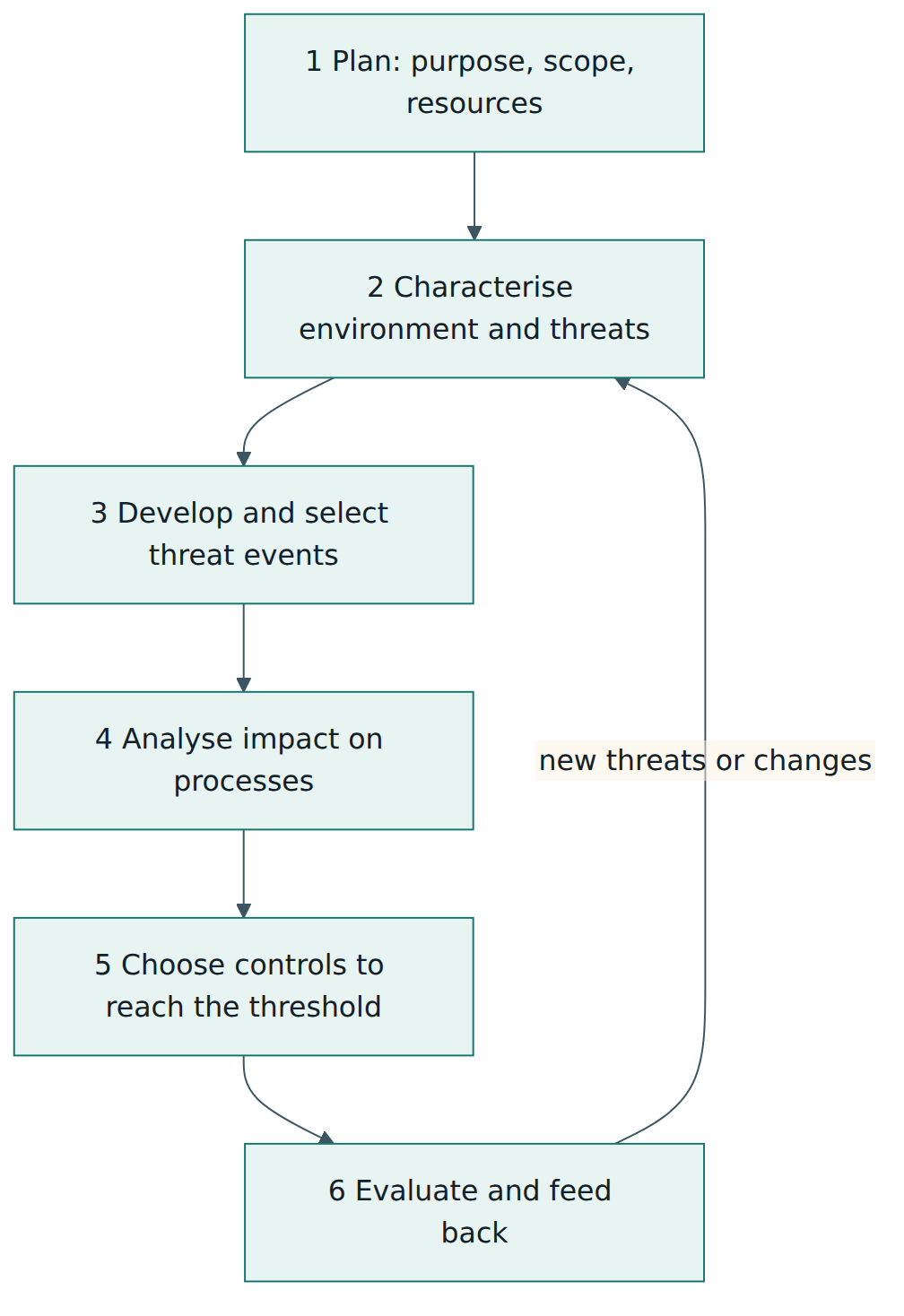
The scenario: a criminal group compromises the imaging vendor's support portal and uses the vendor's always-on remote connections to reach Riverside's radiology network, encrypting image archives. The team characterises the environment (40 imaging devices, vendor connections that bypass the main VPN, shared vendor accounts), lists threat events, and analyses the impact chain: radiology stops, emergency department diagnosis slows, patients are diverted, and procurement must urgently find replacement parts. The most likely impact is two days of disruption; the worst case is a week, with patient harm possible. Both exceed the council's risk threshold for clinical systems.
Step 4 – Selecting and flowing down controls (Level 3)
Using Appendix A and the baseline and flow-down columns in Appendix B, the radiology system owner's C-SCRM plan selects and tailors controls:
- Remote access (AC-17) and access enforcement (AC-3): vendor sessions on request only, through a monitored jump host with multi-factor authentication; accounts revoked promptly when vendor staff change.
- Supplier assessments and reviews (SR-6): a deeper assessment of the imaging vendor, including its own remote-support security and its incident history.
- Notification agreements (SR-8): the vendor must notify Riverside of compromises and relevant vulnerabilities within agreed time limits.
- Component inventory (CM-8) with SBOMs where available, so that a newly disclosed library flaw can be matched to devices quickly.
- Incident response (IR family) and contingency planning (CP family): the vendor joins Riverside's annual ransomware exercise, and image archives get offline backups.
Legal updates the contract template so that these requirements, plus the right to periodic revalidation and termination if risk cannot be reduced, apply to all mission-critical suppliers and flow down to their subcontractors who touch Riverside systems.
Step 5 – Acquisition changes
For the next purchase of infusion pumps, the request for proposal includes C-SCRM criteria worth a meaningful share of the evaluation score: secure development evidence (for example, IEC 62443-4-1 certification or an equivalent independent assessment), an SBOM, a coordinated vulnerability disclosure process, a support period long enough to cover the device's life, and purchase only from the manufacturer or authorised distributors. The lowest bid fails on support lifetime and SBOM, and the evaluation team, which includes clinical engineering and security, selects the second-lowest.
Step 6 – Monitoring and metrics
The PMO keeps a risk register and subscribes to the health-sector ISAC. Mission-critical suppliers are reassessed yearly or when something changes (a merger, a breach, a move of hosting region). The council reports quarterly on a few measures: percentage of mission-critical suppliers assessed in the last 12 months, contracts with current C-SCRM clauses, vendor remote sessions outside approved windows, and time to identify affected devices after a major vulnerability disclosure. After eighteen months Riverside has the foundational practices largely in place and starts on sustaining ones: role-based training for buyers, joint exercises with more suppliers, and defined risk tolerances per service line.
What the example shows
Riverside did not implement every control in Appendix A, and it did not try to assess 450 suppliers in depth. It used criticality to focus, threat scenarios to make risk concrete for executives, the baseline and flow-down columns to draft controls and contract clauses, and the three levels to give everyone a clear role. That is the intended way to use the publication.
Lesson 7 – Relationship to other standards and frameworks
SP 800-161 Rev. 1 sits in a family of NIST documents and next to several international standards. Understanding the neighbours prevents duplicated effort.
| Document | Owner | Main purpose | Relationship to SP 800-161 Rev. 1 |
|---|---|---|---|
| SP 800-53 Rev. 5 | NIST | Catalogue of security and privacy controls, including the SR (Supply Chain Risk Management) family. | The parent catalogue. SP 800-161 Rev. 1 selects relevant controls, adds C-SCRM guidance, levels and flow-down markings, and introduces a few new items. |
| Cybersecurity Framework (CSF) 2.0 | NIST | Outcome-based framework for managing cybersecurity risk, with a Govern function that includes a supply chain category (GV.SC). | The CSF says what outcomes to achieve; SP 800-161 Rev. 1 explains how to achieve the supply chain ones in detail. CSF tiers can be used to gauge C-SCRM maturity. |
| SP 800-37 Rev. 2 and SP 800-39 | NIST | The Risk Management Framework for systems and the multilevel organisational risk approach. | SP 800-161 Rev. 1 borrows the three levels from SP 800-39 and runs its system-level work through RMF steps. |
| SP 800-218 (SSDF) | NIST | Secure software development practices for software producers. | Covers how a supplier builds software securely; acquirers use it to set expectations of software suppliers within a C-SCRM programme. |
| ISO/IEC 27036 (multi-part) | ISO/IEC | Information security for supplier relationships, including ICT supply chain and cloud guidance. | An international counterpart focused on supplier relationships; often used alongside ISO/IEC 27001. Both can inform contracts and assessments. |
| ISO 28000 | ISO | Certifiable security management system standard, first written for supply chain security; covers physical and logistics security as well as cyber. | Complements C-SCRM for organisations whose main concern is physical and logistics security; offers certification, which SP 800-161 does not. |
| NIST IR 8276 | NIST | Key C-SCRM practices observed in industry case studies. | A short, accessible companion; SP 800-161 Rev. 1 cites it as a source for its key practices. |
| IEC 62443-4-1 | IEC | Secure product development life cycle requirements for industrial automation components. | Named as an example of a formal certification acquirers can use as evidence about OT suppliers. |
How the pieces fit
A useful way to see the relationships is by question. "What supply chain outcomes should we achieve?" is answered by CSF 2.0. "How do we organise, assess and respond to supply chain risk across the enterprise?" is answered by SP 800-161 Rev. 1. "Which exact controls apply?" is answered by SP 800-53 Rev. 5 through the 800-161 overlay. "How should our software suppliers build securely?" is answered by the SSDF. "What do international customers expect in supplier agreements?" is often answered by ISO/IEC 27036. Many organisations use several of these together, with SP 800-161 Rev. 1 acting as the operational playbook.
Related NIST companions
NIST has published shorter material to make C-SCRM approachable, including quick-start guides and a fact sheet on its C-SCRM project page. SP 800-18 Rev. 2, finalised in June 2026, explains what system-level security, privacy and C-SCRM plans should contain, which complements the C-SCRM plan template in Appendix D. For US contractors handling controlled unclassified information, SP 800-171 Rev. 3 includes supply chain requirements derived from the same SP 800-53 family, so work done under SP 800-161 Rev. 1 often supports those obligations too.
Common pitfalls and best practices
Pitfalls
- Treating C-SCRM as a questionnaire exercise. Sending the same long security questionnaire to every vendor and filing the answers produces paperwork, not risk reduction. Focus depth on critical suppliers and act on the findings.
- No supplier inventory. Without a current list of suppliers, contracts and what each provides, criticality analysis is guesswork and incidents reveal dependencies too late.
- Vague contract language. Writing "the supplier shall comply with NIST SP 800-161" is unenforceable and unclear. NIST itself warns against it; select the specific controls that matter for the product or service.
- Stopping at the first tier. Requirements that are not flowed down to subcontractors leave the deeper chain unmanaged.
- Ignoring routes outside procurement. Open-source packages, free cloud tools and repurposed equipment bypass purchasing controls unless the programme explicitly covers them.
- A security-only team. Running C-SCRM solely from the security office, without procurement, legal and engineering, leaves it without leverage over contracts or designs.
- Assess once, never again. Supplier risk changes with mergers, relocations, breaches and product updates; a two-year-old assessment says little about today.
- Lowest-price buying for critical technology. Selecting critical ICT or OT purely on price means security criteria never influence the result.
Best practices
- Start with leadership and framing. Get an executive owner, a cross-functional council and an explicit statement of risk appetite before buying tools.
- Use criticality to focus. Tier suppliers and products, and match assessment depth to the tier.
- Use the appendices as tools. Draft documents from the Appendix D templates, controls from Appendix B's baseline and flow-down columns, and risk stories with the Appendix C framework.
- Write specific, verifiable contract clauses. Include notification duties, revalidation rights, flow-down and exit conditions.
- Reuse existing evidence. Accept relevant certifications and independent assessments where they cover your needs, and ask for more only where they do not.
- Include suppliers in resilience work. Exercise incident response and recovery with critical suppliers before a real incident.
- Share and consume threat information formally. Join a sector ISAC or equivalent rather than relying on ad hoc contacts.
- Measure and report. Track a few meaningful metrics per level and report top supply chain risks to the senior risk committee.
Summary and key takeaways
- NIST SP 800-161 Rev. 1 (May 2022, with the November 2024 Update 1) is NIST's core guidance on cybersecurity supply chain risk management; it is final and current as of October 2026.
- C-SCRM addresses risks that enter through suppliers, products and services across the whole life cycle, from malicious implants and counterfeits to supplier failure and natural disruption.
- The publication integrates C-SCRM into enterprise risk management at three levels (enterprise, mission and business process, operational), each with its own documents and roles.
- Risk is handled through the frame, assess, respond and monitor cycle, with criticality analysis deciding where to focus.
- Appendix A is an enhanced overlay of SP 800-53 Rev. 5 controls with C-SCRM guidance; Appendix B marks baseline and flow-down controls; Appendices C and D provide threat scenarios and templates.
- Acquisition is the main lever: build C-SCRM into every procurement step and into specific, flowed-down contract clauses.
- There is no SP 800-161 certification; federal agencies must apply C-SCRM under law, others use it voluntarily, and suppliers are assessed through attestation, reviews, third-party assessments and certifications proportional to criticality.
- Prioritise foundational practices first, then sustaining and enhancing ones, and measure progress with metrics suited to each level.
Reflection questions
- List five suppliers or services your organisation depends on. Which of them would you rate as mission-critical, and what evidence would you use to justify that rating?
- Think of a product your team installed recently. How much do you know about its provenance, components and the supplier's own sub-suppliers, and what would you ask to learn more?
- Draft three specific contract requirements you would flow down to a managed service provider with administrator access to your systems. How would you verify each one?
- Which of the foundational practices does your organisation already have, which are missing, and which one would you tackle first?
- Write a short threat scenario for a non-adversarial supply chain event, such as a key supplier's factory closing. What impact would it have and which controls would reduce it?
Further reading and official sources
- NIST SP 800-161 Rev. 1 (Update 1): Cybersecurity Supply Chain Risk Management Practices for Systems and Organizations – NIST CSRC
- Cybersecurity Supply Chain Risk Management (C-SCRM) project, quick-start guides and fact sheet – NIST CSRC
- NIST IR 8276: Key Practices in Cyber Supply Chain Risk Management – Observations from Industry – NIST CSRC
- NIST SP 800-53 Rev. 5: Security and Privacy Controls for Information Systems and Organizations – NIST CSRC
- NIST SP 800-18 Rev. 2: Developing Security, Privacy, and C-SCRM Plans for Systems – NIST CSRC
- NIST Cybersecurity Framework 2.0 – NIST
- ICT Supply Chain Risk Management Task Force: Threat Scenarios Report (v3) – CISA
Original tutorial by xOps School (DevOpsSchool Private Limited), written from public sources about NIST SP 800-161 Rev.1. Not affiliated with or endorsed by the standard's owner; standard names are trademarks of their owners. Buy the official standard from its publisher for the authoritative text.