
Lean Management – Tutorial (about 60 minutes)
- View
Lean Management is a way of running an organisation that starts from what the customer values, then steadily removes the waste, unevenness and overburden that sit between a request and its delivery, while developing the people who do the work into capable problem solvers. It grew out of the Toyota Production System and is now used in factories, hospitals, banks, software teams, public services and offices. After this tutorial you will be able to explain where lean came from and why it works, use its core vocabulary correctly, apply the five lean principles to a real process, describe the management system that keeps improvement going, and recognise the most common ways organisations get lean wrong.
Course overview
Edition and status: Lean Management is a management philosophy and body of practice, not a single published standard, so it has no edition number, no owning standards body and no official certification of organisations. Its reference points are the Toyota Production System (TPS), documented by Toyota Motor Corporation; the term "lean production", coined by John Krafcik in 1988 and popularised by Womack, Jones and Roos in The Machine That Changed the World (1990); and the five lean principles set out by James Womack and Daniel Jones in Lean Thinking (1996). The Lean Enterprise Institute (LEI, lean.org) today frames lean through its Lean Transformation Framework of five questions. Two formal documents touch lean directly: SAE J4000, a recommended practice from SAE International for measuring lean implementation (current version J4000_202104, dated April 2021), with its companion user manual SAE J4001; and ISO 18404:2015, which describes competencies for Six Sigma and Lean personnel and was reviewed and confirmed by ISO in 2025, so the 2015 edition remains current (a draft revision was abandoned in June 2025). Verified 2026-10-29.
Who it is for: engineers, operations and service managers, quality and continuous-improvement staff, project and delivery leads, analysts and team leaders who are new to lean or who have met isolated lean tools (5S, kanban boards, value stream maps) and want to understand the whole system behind them.
Prerequisites: none. It helps to think of one process you know well, at work or at home, and keep it in mind while you read; every concept here can be tried on it.
How to use this tutorial: read the seven lessons in order (about 45 minutes), study the five diagrams, then spend the rest of the hour on the reflection questions before taking the 25-question knowledge check.
Learning objectives:
- You will be able to explain the origins of lean in the Toyota Production System and its two foundations, continuous improvement and respect for people.
- You will be able to define the core vocabulary of lean, including value, the forms of waste, flow, pull, takt time, jidoka and kaizen.
- You will be able to apply the five lean principles, from defining value to pursuing perfection, to a process of your own.
- You will be able to describe the elements of a lean management system: standard work, visual management, daily huddles, leader standard work, gemba walks, A3 problem solving and strategy deployment.
- You will be able to explain how lean maturity is assessed and which recognition and personal certification options exist, and why none of them certifies an organisation as "lean".
- You will be able to walk through a realistic value stream improvement from current state to sustained future state.
- You will be able to relate lean to Six Sigma, Total Quality Management, ISO 9001, agile methods and the Theory of Constraints.
Lesson 1 – Origins, purpose and scope
From flow lines to the Toyota Production System
The ideas behind lean are older than the word. In the early twentieth century Henry Ford showed that a product could move through a factory in a continuous line instead of waiting in piles between departments. Ford's flow, however, depended on enormous volumes of a single model. After the Second World War, Toyota in Japan faced the opposite situation: a small, poor domestic market that wanted many kinds of vehicles in small quantities, little money to spend on stock or machines, and a workforce that could not simply be laid off when demand fell. Toyota could not copy mass production, so it had to invent a different way to make cars efficiently.
Several people shaped the answer. Sakichi Toyoda, founder of the Toyoda group, had earlier invented an automatic loom that stopped itself when a thread broke, so that no defective cloth was produced and one person could look after many looms. That idea of building the detection of problems into the work became jidoka. His son Kiichiro Toyoda, who started the car business, argued that parts should arrive exactly when they were needed, neither earlier nor later, which became just-in-time. Taiichi Ohno, a production engineer who rose to senior management, spent decades turning these ideas into a working system on the shop floor, and Eiji Toyoda pushed for their thorough adoption across the company. Shigeo Shingo, an industrial engineer who worked closely with Toyota, contributed techniques such as quick changeovers and mistake-proofing. The result became known as the Toyota Production System (TPS).
How "lean" got its name
In the 1980s a research programme at the Massachusetts Institute of Technology compared car plants around the world. One of its researchers, John Krafcik, described the Toyota-style plants as "lean" in a 1988 article, because they used less of everything: less human effort, less space, less investment and less inventory, to produce more variety with fewer defects. The 1990 book The Machine That Changed the World by James Womack, Daniel Jones and Daniel Roos brought the term to a wide audience. In 1996 Womack and Jones published Lean Thinking, which generalised the lessons beyond car making into five principles that any organisation could apply. Womack went on to found the Lean Enterprise Institute in 1997, and similar non-profit bodies appeared in other countries.
Purpose: value, waste and people
Lean has a simple stated purpose: deliver what the customer values, with as little waste as possible, in a way that respects and develops everyone involved. Three ideas sit inside that sentence. First, value is defined by the customer, not by the organisation's internal departments. Second, most of the time and effort in a typical process does not create value; it is waiting, checking, moving, correcting or producing things no one asked for. Third, the people closest to the work are the ones best placed to see and remove that waste, provided managers give them the method, the time and the safety to do so.
Toyota itself expresses this balance in "The Toyota Way", which rests on two pillars: continuous improvement and respect for people. Many organisations that adopt lean copy the first pillar and forget the second. The tools then become a cost-cutting programme, staff learn to fear improvement because it removes jobs, and the effort fades. Lean that works treats respect as an operational necessity: you cannot improve a process continuously unless the people inside it want to make problems visible.
Scope: far beyond the factory
Lean began in manufacturing but is not limited to it. Hospitals use it to cut waiting times and reduce errors; banks and insurers use it in back-office processing; governments use it for permits and benefits; software teams use lean ideas through Lean Software Development, kanban boards, continuous delivery and the Lean Startup approach. The physical details change, but the questions stay the same: what does the customer value, how does work flow towards them, where does it wait or go wrong, and how do we learn our way to something better? "Lean Management" in this course means the whole system: the philosophy, the principles, the improvement methods and, above all, the daily management behaviours that keep improvement alive.
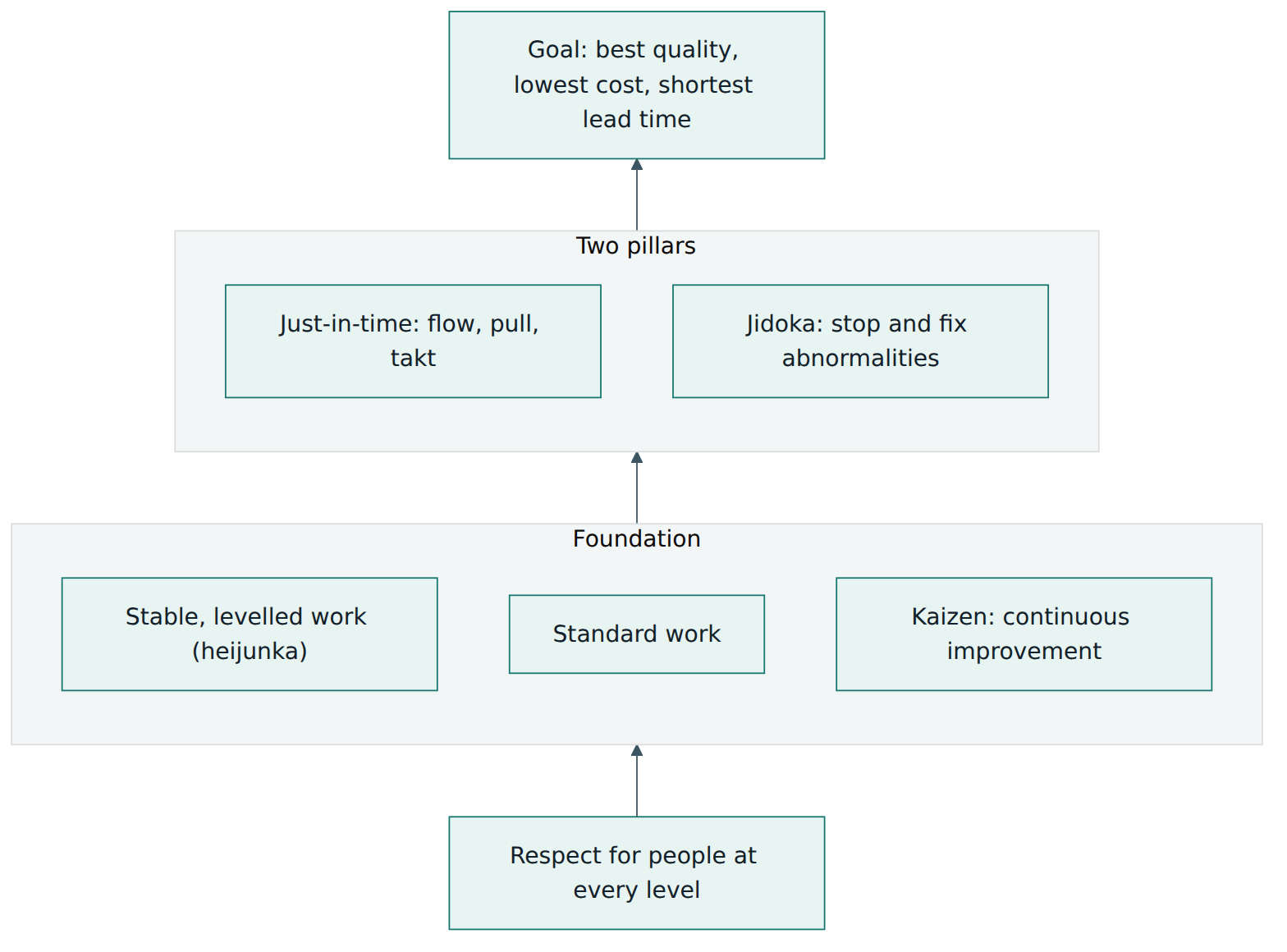
Figure 1 shows the picture many lean practitioners use to explain TPS. The roof is the goal the customer cares about. The two pillars are the main mechanisms: just-in-time makes the right thing flow at the right moment, and jidoka makes sure that a problem stops the work instead of being passed downstream. Neither pillar can stand on an unstable floor, so the foundation is levelled, standardised work and a habit of daily improvement. Beneath everything is respect for people, because the system runs on their judgement. If one part is missing, for example just-in-time without jidoka, the house leans: material flows quickly, but defects flow quickly too.
Lesson 2 – Key concepts and vocabulary
Lean has a large vocabulary, partly Japanese and partly English. You do not need every term, but the following ones appear in almost every lean conversation. Learn the idea behind each word rather than the word itself.
- Value – what a customer is willing to pay for or would choose if asked: the right product or service, of the right quality, at the right time and price. Value is always judged from the customer's point of view.
- Value-added and non-value-added work – an activity adds value if it changes the product or service in a way the customer wants and is done right first time. Everything else is non-value-added. Some non-value-added work is currently necessary (for example a legal check), so lean distinguishes "necessary waste" to minimise from "pure waste" to eliminate.
- Muda, mura, muri – the three enemies of flow. Muda is waste, activity that consumes resources without creating value. Mura is unevenness, such as a surge of orders on Monday and idle time on Friday. Muri is overburden, asking people or machines to work beyond a reasonable, sustainable load. Unevenness causes overburden, and both generate waste, so lean tries to level the work, not only to cut visible waste.
- The forms of waste – Ohno's classic list has seven categories: transport, inventory, motion, waiting, overproduction, over-processing and defects. Many practitioners add an eighth: unused human talent. Figure 2 summarises them.
- Value stream – all the steps, value-added and not, needed to take one product or service family from request to delivery, including the information flows that trigger the work. A value stream normally crosses several departments.
- Flow – work moving from one value-adding step to the next without stopping, ideally one piece at a time. The opposite is batch-and-queue, where work waits in piles between departments.
- Pull – producing or starting work only when the next step downstream, and ultimately the customer, signals a need. Its opposite is push, where work is started according to a forecast or schedule regardless of whether anyone downstream is ready.
- Kanban – a signal, originally a card, that authorises the production or movement of a specific quantity. Kanban systems cap the amount of work in the system and make pull visible. In knowledge work a kanban board with work-in-process limits plays the same role.
- Takt time – the pace of customer demand: available working time divided by the number of units the customer needs in that time. If a team works 450 minutes a day and customers need 30 items a day, takt time is 15 minutes. It sets the rhythm the process must match.
- Lead time and cycle time – lead time is the total elapsed time a customer waits, from request to delivery. Cycle time is how often a unit is completed by a step or process (definitions vary slightly between sources, so always state yours). Touch time is the time someone actually works on the item.
- Work in process (WIP) – items that have been started but not finished. Little's Law connects the measures: on average, lead time equals WIP divided by throughput. More WIP means longer waits.
- Jidoka – building quality in by detecting abnormalities and stopping to deal with them, so defects are not passed on. It is sometimes translated as "automation with a human touch".
- Andon – a visual or audible signal, such as a cord, button or light, that a worker uses to call for help when something is wrong. Pulling the andon is expected and welcomed, not punished.
- Poka-yoke – mistake-proofing: designing a step so that an error is impossible or is caught immediately, for example a connector that fits only one way or a form that will not submit without a mandatory field.
- Heijunka – levelling the volume and mix of work over time, so that the process sees a steady demand rather than peaks and troughs.
- Standard work – the current best known way to do a task, written down and followed, usually stating sequence, timing and the expected amount of work in hand. It is the baseline for improvement, not a permanent rule.
- Kaizen – continuous improvement through many small changes made by the people doing the work. A "kaizen event" or "kaizen blitz" is a focused improvement workshop of a few days; daily kaizen is the ongoing habit.
- Gemba – "the real place" where value is created: the shop floor, ward, service counter or code repository. A gemba walk is a manager's visit to observe the work and ask questions, not to issue orders.
- 5S – a method for organising a workplace so that problems are visible: sort, set in order, shine, standardise and sustain.
- PDCA – Plan, Do, Check, Act: the scientific learning cycle behind every lean improvement, associated with W. Edwards Deming and Walter Shewhart.
- A3 – a structured problem-solving and communication format that fits a whole problem story (background, current condition, root cause, countermeasures, plan, follow-up) onto one A3-sized sheet.
- Hoshin kanri – strategy deployment: a method for choosing a few breakthrough objectives and cascading them through the organisation with "catchball", a two-way negotiation between levels.
- SMED – single-minute exchange of dies, Shingo's method for reducing changeover time by moving setup work outside the time the process is stopped. Short changeovers make small batches economical.
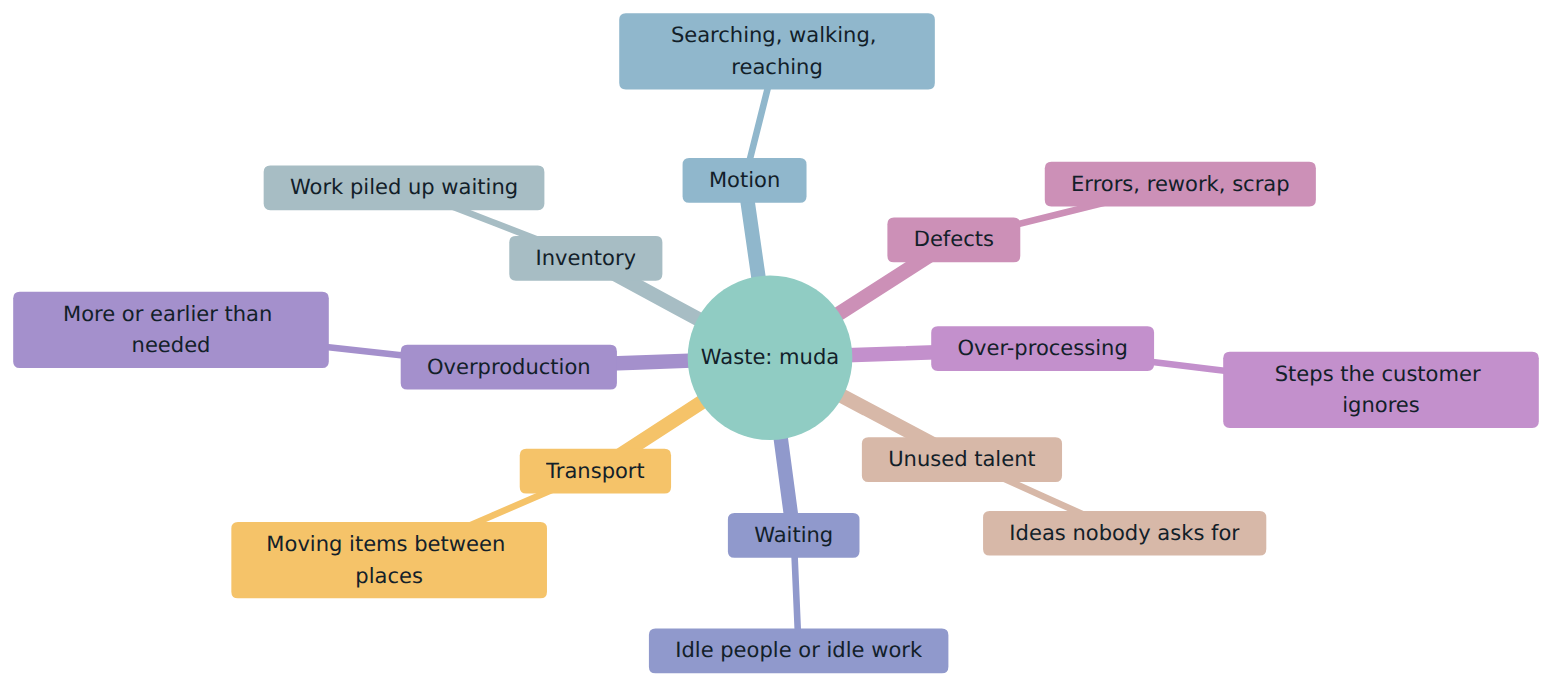
Figure 2 groups the wastes you will hunt for in any process. Ohno regarded overproduction as the worst, because it causes most of the others: making things before they are needed creates inventory, which must be moved, stored, counted and searched, and which hides defects until it is too late. In an office the same categories apply. Inventory becomes a queue of unprocessed requests; transport becomes hand-offs between systems or teams; motion becomes switching between screens; over-processing becomes reports nobody reads or approvals that add no assurance; defects become incomplete forms that bounce back. A useful habit is to walk a process with this list in hand and give each observed waste a category: naming waste is the first step to seeing it.
Why the vocabulary matters
Lean terms are compact ways of describing cause and effect. Saying "we have mura on Mondays that creates muri for the team and muda in the form of overtime and errors" explains a whole chain of problems in one sentence. Equally, misusing the vocabulary is a warning sign. A team that calls any meeting a "kaizen", or any to-do list a "kanban", has adopted the words without the discipline. When you introduce a term, explain the behaviour it implies.
Lesson 3 – Structure: principles, frameworks and models
Because lean is not a single standard, it has no clauses. Instead it has several well-known structures that describe it from different angles. You will meet all of them in practice, so it is worth knowing how they fit together.
The five lean principles
Womack and Jones condensed lean thinking into five principles that are applied in sequence and then repeated.
- Specify value from the end customer's standpoint, for a specific product or service family. Ask what the customer needs, when, and at what price, and what they would refuse to pay for.
- Identify the value stream for each family: map every step from request to delivery and classify each as value-adding, necessary non-value-adding or pure waste. Remove the pure waste first.
- Make value flow: arrange the remaining steps so that work moves without interruption, rearranging departments, layouts or team structures where needed and shrinking batch sizes.
- Let the customer pull: once flow exists, start work only when the downstream step or customer signals a need, so nothing is produced ahead of demand.
- Pursue perfection: repeat the cycle, because every round of improvement reveals new waste. Perfection, meaning value with zero waste, is a direction, not a destination.
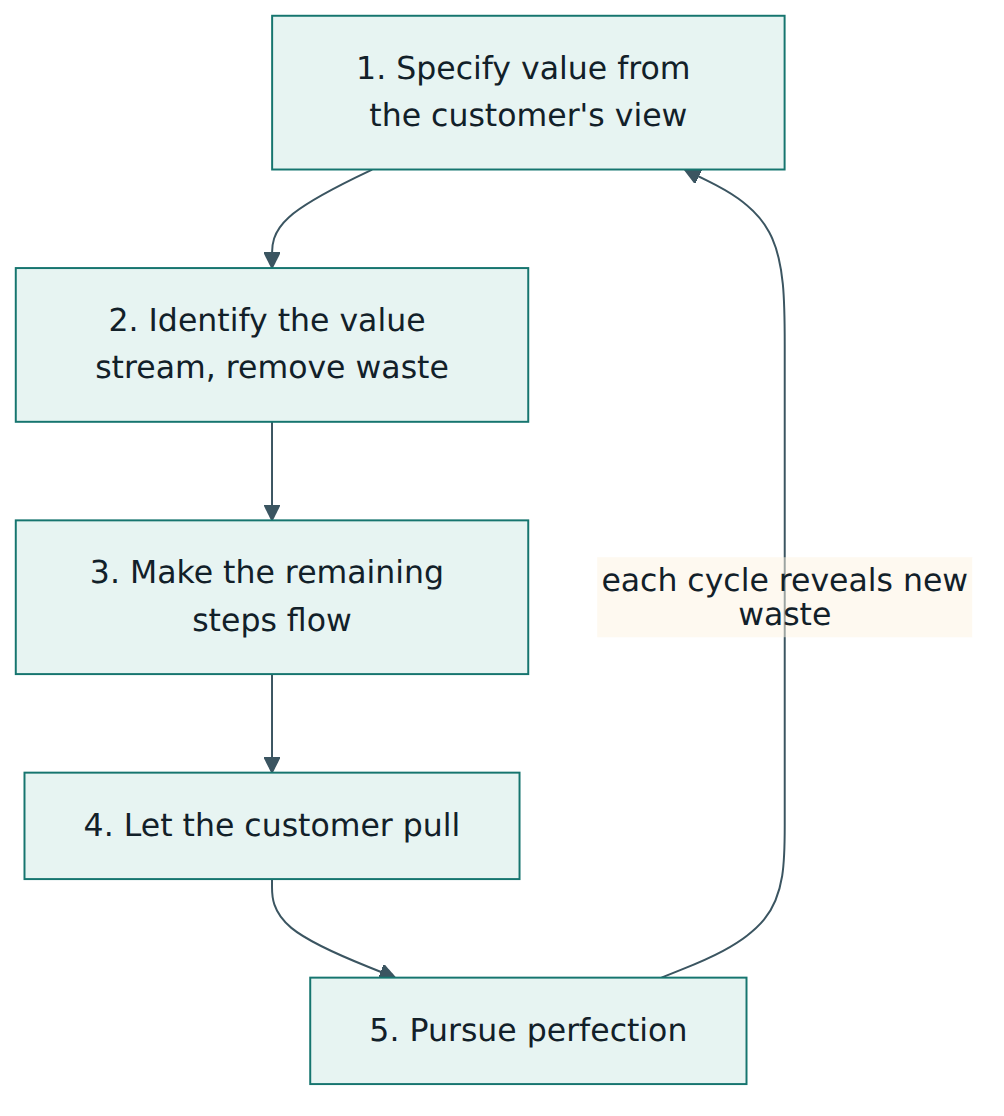
The order in Figure 3 matters. Organisations that start with flow or pull, for instance by installing kanban cards before they understand what the customer values, often make the wrong thing flow faster. Equally, pull without flow is unstable: if each step has long, unpredictable delays, a downstream signal cannot be met in time and the team falls back on stockpiles. Womack later summarised lean even more briefly as purpose, process and people, which leads naturally to LEI's current framework.
LEI's Lean Transformation Framework
The Lean Enterprise Institute describes lean transformation as five questions an organisation keeps asking, often drawn as a house. In paraphrase: What is our purpose, meaning what customer problem are we solving? How do we improve the actual work that solves it? What capabilities do people need to do and improve that work? What management system and leadership behaviours support this? And what basic thinking, mindset and assumptions underlie the whole effort? The framework is deliberately not a checklist of tools. It reminds leaders that methods such as value stream mapping are only answers to the "work" question; without the other four, improvements do not last.
The Toyota Way and TPS
Toyota describes its own system through TPS, with its two pillars of just-in-time and jidoka shown in Figure 1, and through the Toyota Way, a statement of values built on continuous improvement and respect for people. Within continuous improvement Toyota emphasises challenge (a long-term vision), kaizen and going to see at the gemba; within respect for people it emphasises mutual trust and teamwork. Many lean frameworks are, in effect, attempts to explain this system to organisations that did not grow up inside it.
The Shingo Model
The Shingo Institute, based at Utah State University and named after Shigeo Shingo, publishes the Shingo Model. It links culture (its foundation), guiding principles, systems, tools and results, on the insight that ideal results need ideal behaviours, which are driven by purpose and systems and informed by principles. Its ten guiding principles are grouped into three dimensions: cultural enablers (such as respecting every individual and leading with humility), continuous improvement (such as assuring quality at the source, improving flow and pull, seeking perfection, embracing scientific thinking and focusing on process) and enterprise alignment (such as creating value for the customer, creating consistency of purpose and thinking systemically). The model is valuable because it explains why tools alone fail: a tool produces a result only if the system around it encourages the right behaviour.
SAE J4000 and ISO 18404
Two formal documents give lean a measurable shape. SAE J4000, from the automotive engineering body SAE International, is a recommended practice that groups lean best practices into elements and allows an organisation to score how far each is implemented on four levels, with the highest level representing best practice. Its companion, SAE J4001, is a user manual explaining how to evaluate the levels. ISO 18404 does not describe how to be lean; it describes the competencies expected of people in Six Sigma and Lean roles (Green Belt, Black Belt and Lean practitioner levels) and of organisations that deploy them.
Lesson 4 – How lean management works in practice
The phrase "Lean Management" is a reminder that lean is not something a specialist team does to a process once. It is a way managers run the organisation every day. This lesson follows a typical transformation from the first value stream to a sustained management system.
Step 1 – Start from purpose and a real problem
Successful lean efforts begin with a business problem that matters to customers and leaders: deliveries are late, quality complaints are rising, a service takes weeks when competitors take days. Leaders agree what success looks like in customer terms, such as lead time, quality and cost, and pick one value stream as a "model line" where they will learn before spreading the approach. Starting everywhere at once usually means improving nowhere deeply.
Step 2 – Go to the gemba and map the current state
A small cross-functional team, including people who do the work, walks the value stream from the customer backwards and draws a current-state value stream map. The map shows each process step, the information flow that triggers it, the inventory or queue in front of it, and data such as touch time, waiting time, error rate and the number of people. Adding up touch time and comparing it with total lead time gives flow efficiency; in office processes it is often only a few per cent, which shows that the item spends most of its life waiting. The map is drawn by hand from observation, not from the procedure manual, because the documented process and the real one usually differ.
Step 3 – Design the future state
The team then designs a future-state map that applies the principles: remove steps that add no value, combine steps into a flow cell or single team, reduce batch sizes, set a pace linked to takt time, introduce pull signals and WIP limits between steps that cannot yet flow continuously, and build in quality with mistake-proofing so errors are caught at the source. Each change is written as a hypothesis with an expected effect, because lean treats every change as an experiment.
Step 4 – Implement through PDCA
Changes are tried quickly, often in a short kaizen event, and their effect is measured against the prediction. If the result differs, the team learns why and adjusts. A standard work document captures each successful change so it becomes the new baseline. A3 reports keep the reasoning visible: anyone can read on one page what problem was tackled, what the root cause was, what was tried and what happened.
Step 5 – Build the daily management system
Here many efforts succeed or fail. Improvements decay unless something in the daily routine notices when the process drifts. A lean management system typically includes the following elements, which reinforce one another.
- Visual management: boards at the workplace showing the plan versus actual output by hour or day, open problems, quality and safety status, so that anyone can tell at a glance whether the process is normal.
- Tiered daily huddles: short stand-up meetings, team first, then supervisors, then managers, where abnormalities are raised and escalated within hours rather than at the monthly review.
- Leader standard work: a routine for each level of manager, describing what they check, where and how often, for example reviewing the team's board and attending a huddle each morning.
- Gemba walks: leaders go to where the work happens to understand problems first-hand, asking open questions and coaching rather than giving answers.
- Problem-solving discipline: a common method, such as A3 thinking with root-cause analysis (for example asking "why" repeatedly until a fixable cause is found), applied to the problems the huddles surface.
- Strategy deployment (hoshin kanri): a small number of annual breakthrough objectives agreed with teams through catchball and linked to their daily measures, so improvement effort is aimed at what matters most.
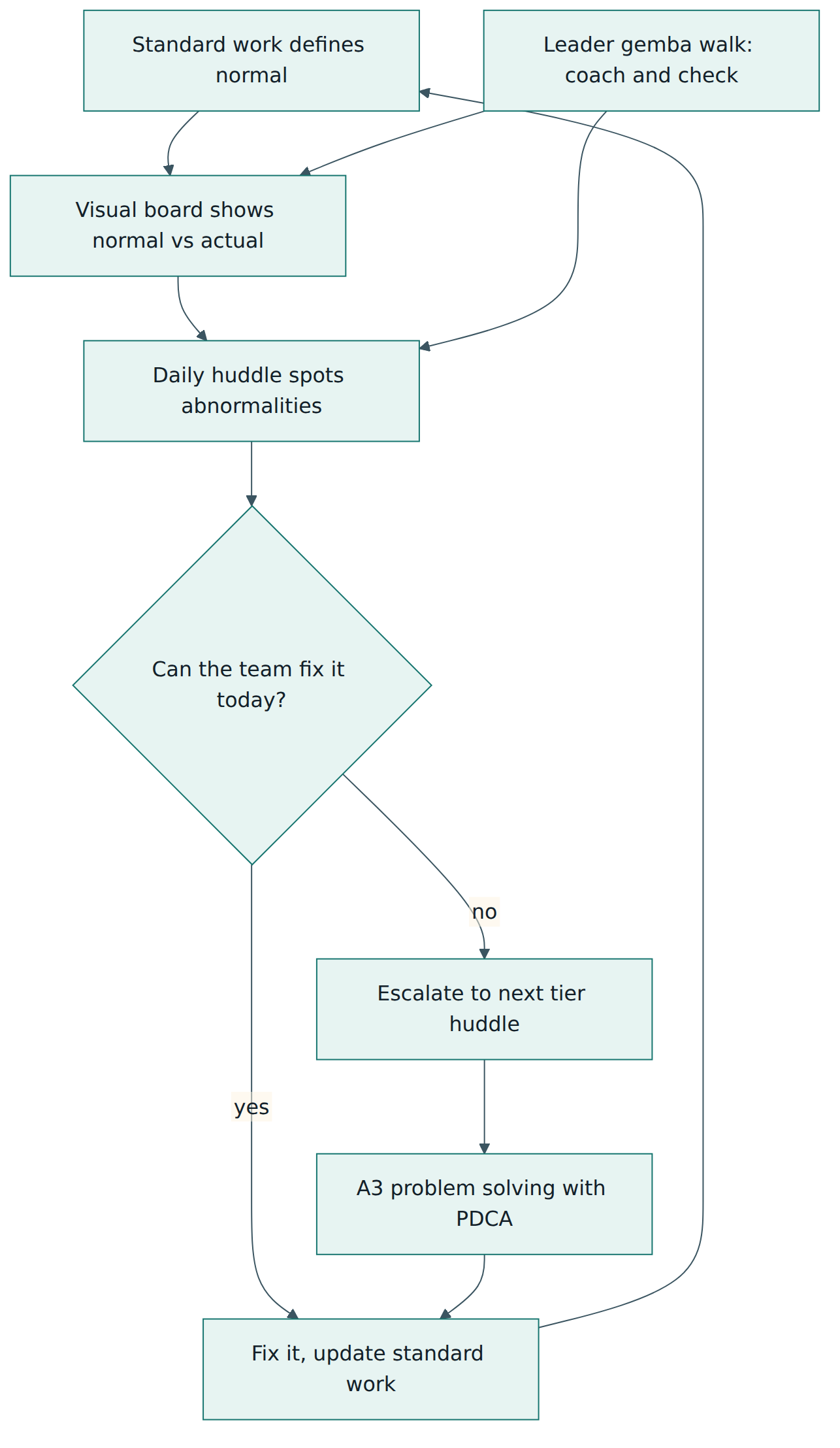
Figure 4 shows why these elements belong together. Without standard work there is no "normal", so a board cannot show deviation. Without a board, a huddle relies on memory and opinion. Without escalation, larger problems sit with a team that cannot solve them. Without leader standard work and gemba walks, the routine quietly stops after a few weeks. The loop also shows the cultural requirement: if raising a problem leads to blame, people stop raising problems and the whole system goes blind.
Roles
Lean does not require a fixed set of job titles, but several roles recur. An executive sponsor owns the business case and removes barriers. A value stream manager or owner is accountable for the end-to-end flow of a product or service family, across departmental boundaries. Team leaders run daily huddles and respond to andon calls. A small lean promotion office or group of coaches teaches methods and supports problem solving, but does not own the improvements: line managers do. Most importantly, every front-line employee is expected to follow standard work and suggest improvements to it.
Artefacts
Typical lean artefacts are value stream maps (current and future state), standard work sheets, visual boards, kanban cards or boards with WIP limits, A3 reports, a suggestion or idea system, leader standard work checklists and, at strategic level, a hoshin plan such as an X-matrix. None of them is mandatory; each exists to make work or thinking visible so that it can be improved.
Lean in knowledge work and IT
In software and IT operations the same ideas appear under different names. A deployment pipeline is a value stream; a kanban board with WIP limits is pull; small batches are small, frequent releases; jidoka is a build that stops the line when an automated test fails; a blameless post-incident review is a form of A3 thinking that relies on respect for people. In Lean Software Development, Mary and Tom Poppendieck translated the wastes for software, for example partially done work, extra features, hand-offs, task switching, delays and defects. Recognising these parallels helps technical teams use lean without copying factory practices literally.
Lesson 5 – Assessment, certification and compliance
A common first question is "how do we get certified in lean?" The honest answer is that there is no lean equivalent of ISO 9001 certification. No accredited body audits an organisation against a lean standard and issues a certificate of conformity. What exists instead are maturity assessments, recognition programmes, personal qualifications and, most importantly, performance measures.
Maturity assessments
Many organisations build an internal lean maturity assessment: a set of practices or behaviours, such as visual management, standard work or problem solving, each rated on a scale by trained assessors who observe the gemba and interview people. SAE J4000 offers a published reference for this approach, scoring the implementation of lean elements on four levels and using the companion J4001 manual to guide evaluation; it originated in the automotive supply chain but can be adapted elsewhere. A good assessment looks for evidence of behaviour (do teams use the board to make decisions?) rather than the presence of artefacts (is there a board on the wall?).
Recognition programmes
The Shingo Institute runs a recognition process, often called the Shingo Prize, in which examiners evaluate how deeply an organisation's culture and systems reflect the Shingo guiding principles. Recognition is given at Bronze, Silver or Prize level, and applicants submit an achievement report with three years of results data. Recognition is an award for demonstrated culture and results, not a compliance certificate, and organisations that pursue it usually use the model as an improvement guide long before applying.
Personal qualifications
Individuals can obtain lean or Lean Six Sigma qualifications from many universities, professional bodies and training providers, often described as belts (yellow, green, black and so on). These schemes are not centrally governed, and the content and rigour vary widely: some require a completed, verified improvement project, others only an exam. ISO 18404 provides a reference description of the competencies expected at Green Belt, Black Belt and Lean practitioner level, and some bodies align their schemes with it. When judging a qualification, look at what the candidate had to demonstrate rather than the colour of the belt.
Measuring lean performance
Ultimately lean is judged by results that customers and employees feel. Useful measures include:
- Lead time from request to delivery, and its variability.
- Flow efficiency: touch time divided by lead time.
- Quality at source: first-pass yield or the share of items that need no rework.
- Delivery performance: on time and in full, measured against the date promised to the customer.
- WIP and inventory levels, often expressed as days of work in the system or inventory turns.
- Safety and people measures: injuries, staff engagement and the number of improvement ideas implemented per person.
- Cost and productivity, interpreted carefully, because short-term cost cutting can damage flow.
Two cautions apply. First, avoid measuring lean by counting activities, such as the number of kaizen events held or 5S audits passed; these are inputs and can rise while customer results stay flat. Second, use measures to learn, not to punish. If a team is blamed every time its board turns red, the board will soon be kept green by gaming the numbers, and the visibility that lean depends on will be lost.
Compliance relationships
Although lean itself is not certifiable, it often lives alongside certifiable systems. An organisation certified to ISO 9001 can use lean methods to meet that standard's expectations for continual improvement and corrective action. In regulated environments such as medical devices, aviation or food, lean changes must still respect validation, traceability and safety rules: removing an inspection step is only waste if the risk it controls is genuinely handled elsewhere, for example through mistake-proofing upstream.
Lesson 6 – Worked example: speeding up quotations at a pump maker
This example is fictional but realistic. "Northfield Pumps" is a medium-sized company that designs and builds industrial pumps to customer specifications. Its sales are growing slowly while competitors are winning more orders. Interviews with lost customers reveal a common complaint: Northfield takes about eleven working days to send a quotation, while competitors answer within three. The leadership team decides that the quote-to-order process will be its first lean model line.
1. Purpose and value
The team starts by asking customers what a good quotation looks like. The answers are clear: a correct price and delivery date, a confirmation that the pump meets the technical requirements, and an answer within a few days. Customers do not value the internal approvals, the reformatted spreadsheets or the elaborate cover letter. The team writes a one-sentence purpose: "Give every customer a correct, complete quotation within three working days." It agrees three measures: quotation lead time, the share of quotes needing rework, and the win rate.
2. Current-state value stream map
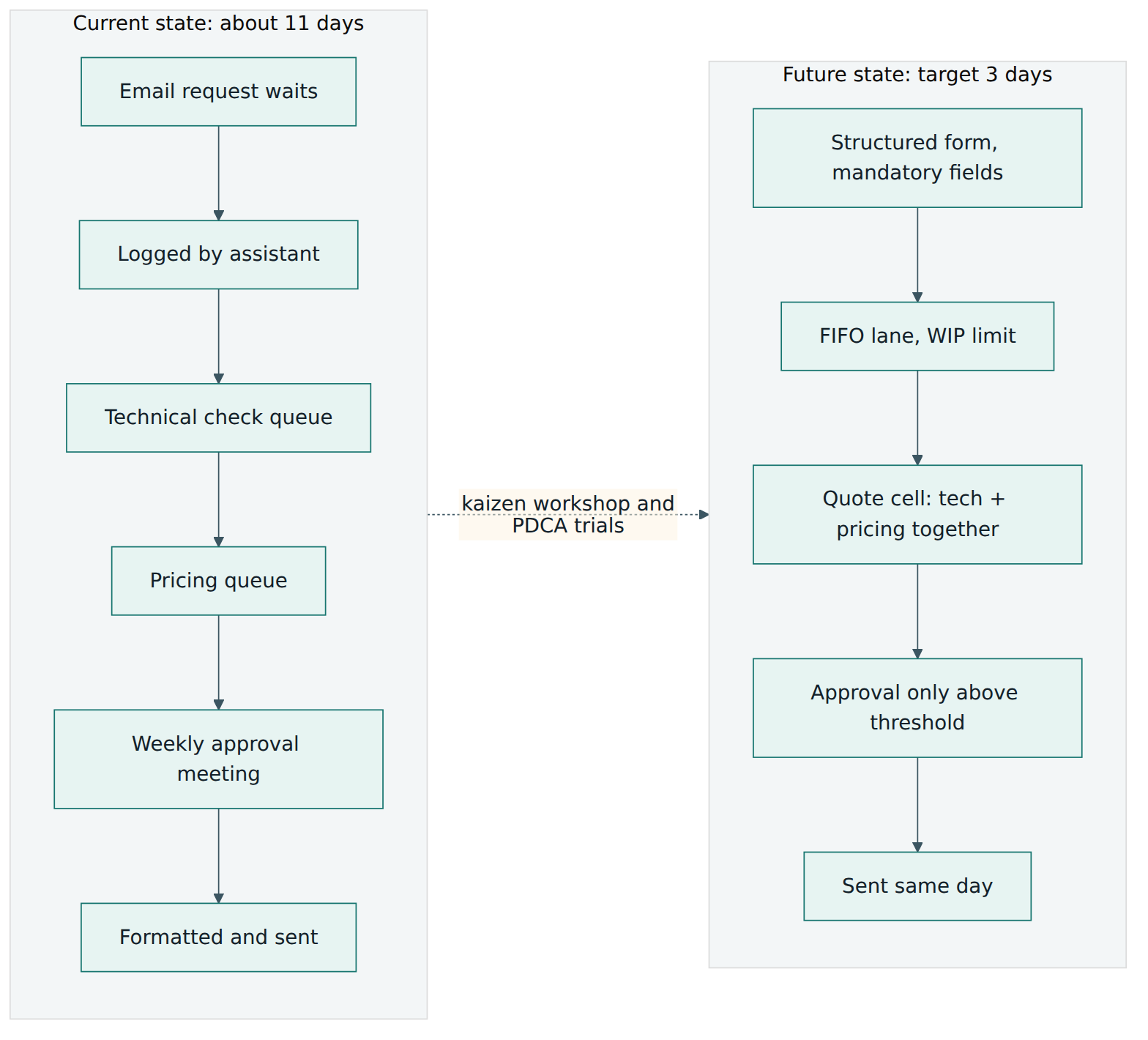
A team of six, including a sales engineer, a pricing analyst, an application engineer and a sales assistant, follows twenty recent requests through the office. They map these steps: the request arrives by email and waits to be logged; a sales assistant enters it into the customer system; an application engineer checks technical feasibility; pricing calculates costs; a manager approves the quote in a weekly approval meeting; the sales assistant formats and sends it. They record what they see:
- Total lead time averages eleven working days, about 88 working hours, while the actual touch time is about 3.5 hours: flow efficiency is around 4 %.
- About 22 % of requests are sent back to the customer at least once because information is missing, which adds several days each time.
- Requests wait in four separate queues, and the weekly approval meeting alone adds an average of two and a half days.
- Staff copy the same data into three systems, a clear case of over-processing and motion.
- Demand is uneven: most requests arrive on Mondays after trade shows and weekend emails, overloading the team early in the week.
3. Takt time and future state
The team calculates takt time. The quotation team has 450 minutes of available time per day and receives about 30 requests per day on average, so takt time is 450 ÷ 30 = 15 minutes: the process must complete a quote every 15 minutes to keep up. Touch time is well under takt for most steps, which confirms that the problem is waiting, not lack of capacity.
The future-state design applies the principles. A structured request form with mandatory technical fields acts as poka-yoke, so incomplete requests are caught at intake. A small cross-functional "quote cell" of a sales engineer, an application engineer and a pricing analyst sits together and handles each request in flow. Standard configurations are priced from an agreed price book, and approval is needed only above a defined value or risk threshold, so the weekly meeting is replaced by same-day approval for the few exceptions. A visible board with a first-in, first-out lane and a WIP limit prevents the cell from starting more quotes than it can finish. Monday peaks are levelled by having two people from the wider sales team trained to join the cell at the start of the week.
4. Experiments and results
The team does not switch everything on at once. It runs a two-week trial of the structured form and measures the rework rate, then trials the cell for one product family, then extends it. Each trial is recorded on an A3. Some ideas fail: an attempt to automate pricing for all configurations stalls because the price book is incomplete, so the team narrows it to the ten most common configurations. After six months the results are encouraging: average quotation lead time has fallen to about three days, rework has dropped from 22 % to about 8 %, and the win rate has started to rise. No one lost their job; the time released was used to follow up open quotes with customers, which was itself a source of extra orders.
5. Sustaining the gains
To stop the process drifting back, the team writes standard work for intake, the cell and approvals. The cell holds a ten-minute huddle every morning at its board, reviewing yesterday's quotes against target and today's queue. The sales manager adds two items to her leader standard work: attend the huddle twice a week and review one A3 each week. Problems the cell cannot solve, such as gaps in the price book, are escalated to a weekly tier-two huddle with engineering and finance. Finally, the leadership team includes "order-to-delivery lead time" in next year's hoshin plan, and the people who ran the quotation model line are asked to coach the next value stream, production scheduling. The perfection principle is at work: a faster quote has exposed that production lead time is now the bottleneck customers notice.
What the example teaches
Notice the order of events. The team started from customer value, saw the work directly, measured lead time and waste, designed a future state using flow, pull and mistake-proofing, tested changes as experiments, and then built daily management to sustain them. Tools appeared only where they solved a specific problem. And people were treated as the source of improvement rather than its victim, which is why they were willing to make problems visible in the first place.
Lesson 7 – Relationship to other standards and frameworks
Lean is often combined with, or confused with, other approaches. Knowing the differences helps you choose the right tool and explain lean to colleagues who come from another tradition.
| Approach | Main focus | Relationship to lean |
|---|---|---|
| Six Sigma and Lean Six Sigma | Reducing variation and defects with statistical methods and structured projects (DMAIC) | Complementary: lean attacks waste and delay, Six Sigma attacks variation. Lean Six Sigma combines both; ISO 18404 covers competencies for both. |
| Toyota Production System / Toyota Way | Toyota's own production and management system and values | The source of lean. Lean is the generalised, Western description of ideas Toyota developed. |
| Kaizen | Continuous, incremental improvement by everyone | A core lean practice and mindset; lean adds flow, pull and the management system around it. |
| Total Quality Management (TQM) | Organisation-wide commitment to quality and customer satisfaction | Shared roots in Deming's teaching and PDCA; lean places more emphasis on flow and lead time. |
| ISO 9001 | Certifiable requirements for a quality management system | Lean methods can help meet ISO 9001's improvement and corrective-action expectations; ISO 9001 gives a governance frame lean lacks. |
| Theory of Constraints (TOC) | Finding and exploiting the single constraint that limits throughput | Compatible: TOC tells you where to focus first; lean improves flow and removes waste across the stream. |
| Agile, Scrum and the Kanban method | Delivering knowledge work in small increments with fast feedback | Agile draws on lean ideas such as small batches, pull and WIP limits; the Kanban method is a direct application of lean flow to knowledge work. |
| Shingo Model | Principle-based model of operational excellence culture | A framework for assessing and building the culture that sustains lean practices. |
Lean and Six Sigma
The most common pairing deserves a closer look. A process can be slow without being variable and variable without being slow. Lean tools reveal where work waits and where effort adds no value; Six Sigma tools find the statistical causes of inconsistent output. Many organisations start with lean, because simply removing waits and hand-offs often produces quick, visible gains, and bring in Six Sigma methods for persistent defects whose cause is not obvious. Problems arise when either becomes a bureaucracy of certified experts running projects disconnected from daily management.
Lean and quality management systems
ISO 9001 and its sector variants say what a management system must achieve, such as controlled processes, corrective action and continual improvement, but not how to run daily work. Lean supplies many of the "how" practices. Organisations that integrate the two avoid running a paper-based quality system on one side and a lean programme on the other; instead, standard work becomes the controlled procedure, and A3 problem solving becomes the corrective-action method.
Lean and agile
Agile methods share lean's focus on customer value, small batches and fast learning. The Scrum Guide explicitly names lean thinking as one of its foundations. Lean adds a value-stream perspective that looks beyond a single team to the whole flow from idea to customer, which is useful when an agile team is fast but the organisation around it is slow.
Common pitfalls and best practices
Pitfalls to avoid:
- Treating lean as a toolkit. Installing 5S, boards and kanban cards without changing how managers lead produces a "lean museum" that looks tidy and changes nothing.
- Using lean to cut headcount. If improvement leads directly to layoffs, people stop revealing waste. Plan in advance how released capacity will be used for growth or new work.
- Starting with solutions. Copying a future state from another site, or jumping to automation, before understanding customer value and the current state.
- Kaizen events without follow-through. A busy week of workshops followed by no standard work and no daily management; within months the process returns to where it started.
- Optimising one department. Making one step faster while work still queues elsewhere; the customer sees no difference, and inventory simply piles up in front of the next step.
- Blaming people for problems. Punishing those who raise issues or pull the andon kills the visibility lean depends on.
- Measuring activity instead of outcomes. Counting events, trained belts or audits rather than lead time, quality and customer results.
Best practices:
- Start from a real business problem and a single model value stream, and learn deeply there before spreading.
- Go and see. Base decisions on direct observation at the gemba and on data gathered there, not on reports or assumptions.
- Treat every change as an experiment, with a prediction, a test and a check, using PDCA and A3 thinking.
- Build the management system early: standard work, visual boards, tiered huddles and leader standard work, so gains are sustained.
- Develop people as problem solvers; leaders coach with questions rather than handing out answers.
- Manage the whole value stream across departments, with an owner accountable for end-to-end flow.
- Level the work and limit WIP before pushing for speed, because stability makes problems visible and solvable.
Summary and key takeaways
- Lean Management is a philosophy and management system, rooted in the Toyota Production System, that delivers customer value with minimal waste while respecting and developing people.
- It is not a single published standard and there is no certification of an organisation as lean; SAE J4000 and the Shingo Model support assessment, and ISO 18404 describes practitioner competencies.
- The core vocabulary centres on value, the three enemies muda, mura and muri, the forms of waste, flow, pull, takt time, jidoka and kaizen.
- The five principles, specify value, identify the value stream, make it flow, let the customer pull and pursue perfection, are applied in order and repeated.
- Lasting results come from the daily management system: standard work, visual management, tiered huddles, leader standard work, gemba walks, A3 problem solving and strategy deployment.
- Lean performance is judged by customer and people outcomes such as lead time, quality at source and on-time delivery, not by the number of tools deployed.
- Lean complements Six Sigma, ISO 9001, the Theory of Constraints and agile methods rather than replacing them.
- The most common failures are treating lean as a toolkit or a cost-cutting exercise; respect for people is what keeps improvement going.
Reflection questions
- Choose a process you work in. Who is its end customer, what do they truly value, and which steps would they refuse to pay for if they could see them?
- Estimate the lead time and the touch time for one item passing through that process. What is the flow efficiency, and where does the item spend most of its waiting time?
- Which of the eight forms of waste can you observe in your own team this week? Give one concrete example of each that you find, and say which you would tackle first and why.
- If your organisation released 20 % of a team's capacity through lean improvements, what would leaders need to say and do beforehand so that staff kept proposing improvements?
- Design a simple daily management routine for your team: what would be on the visual board, who would attend the huddle, and what would trigger escalation to the next level?
Further reading and official sources
- What is Lean? – Lean Enterprise Institute
- Lean Thinking and Practice (Lean Lexicon) – Lean Enterprise Institute
- Toyota Production System – Toyota Motor Corporation
- The Shingo Model – Shingo Institute, Utah State University
- ISO 18404:2015 – Six Sigma and Lean competencies – International Organization for Standardization
- SAE J4000 – Best Practice in Implementation of Lean Operation – SAE International
Original tutorial by xOps School (DevOpsSchool Private Limited), written from public sources about Lean Management. Not affiliated with or endorsed by the standard's owner; standard names are trademarks of their owners. Buy the official standard from its publisher for the authoritative text.