
P3M3 – Tutorial (about 60 minutes)
- View
P3M3, the Portfolio, Programme and Project Management Maturity Model, is a framework for judging how well an organisation, rather than any single project, is able to deliver change through its portfolios, programmes and projects. It is used by portfolio offices, PMO leads, transformation directors, internal auditors and consultants in government bodies, utilities, transport agencies, banks and other organisations that run many change initiatives at once. After this tutorial you will be able to explain how the model is built, read a P3M3 maturity profile, describe how a formal assessment runs, and plan a sensible improvement journey based on its results.
Course overview
Edition and status: The current model is P3M3 version 3, released in 2015 by AXELOS. P3M3 was first published by the UK Office of Government Commerce (OGC) in the mid-2000s, revised as version 2 in 2008 (with a minor 2.1 update in 2010), and then restructured in version 3, which added cross-cutting "threads" and more detailed diagnostic attributes. In August 2021 AXELOS released a digital P3M3 assessment tool for use by its consulting partners. PeopleCert acquired AXELOS in 2021 and now markets the model as PRINCE2 P3M3; its official pages and an October 2025 PeopleCert overview still describe the version 3 structure (three sub-models, seven perspectives, five maturity levels, threads and attributes). We found no announcement of a version 4 or of a revision in progress. P3M3 is a proprietary best-practice model, not an ISO or national standard, and the detailed attribute sets are licensed to accredited assessors. This tutorial explains the publicly described structure in its own words and does not reproduce model content. Verified 2026-10-29 against PeopleCert's P3M3 pages and its October 2025 overview.
Who it is for: PMO and portfolio office staff, project and programme managers, transformation and change leads, governance and assurance teams, internal auditors, and anyone asked to "find out how mature our project delivery is" or to prepare for a P3M3 assessment.
Prerequisites: none. It helps if you know the difference between a project and a programme, but the tutorial defines both.
How to use this tutorial: work through the seven lessons in order (about 45 minutes), study the four diagrams, then spend the remaining time on the reflection questions before you take the 25-question knowledge check.
Learning objectives:
- You will be able to explain why P3M3 exists, who created and owns it, and what it does and does not assess.
- You will be able to use its vocabulary correctly: sub-model, perspective, thread, attribute, maturity level and assessment.
- You will be able to describe the structure of the model: three sub-models, seven perspectives, five maturity levels and the cross-cutting threads.
- You will be able to describe what typically changes in an organisation as it moves from one maturity level to the next.
- You will be able to outline how a self-assessment and a full assessment by an accredited partner work, and what optional certification adds.
- You will be able to plan a realistic, prioritised improvement roadmap from a P3M3 maturity profile.
- You will be able to relate P3M3 to PRINCE2, MSP, MoP, CMMI, OPM3 and the ISO 2150x guidance standards.
Lesson 1 – Origins, purpose and scope
The problem P3M3 addresses
Most organisations deliver change through temporary initiatives: a new IT system, a merger of two departments, a road scheme, a regulatory programme. When one initiative fails, people usually blame the project manager, the supplier or bad luck. When many initiatives keep failing in similar ways, the cause is more likely to be the organisation itself: unclear ways of starting and stopping work, no consistent approach to risk or benefits, funding decisions made without evidence, and a habit of depending on a few heroic individuals. A maturity model gives a structured way to look at those organisational causes.
The core idea is simple. If the way an organisation delivers change is defined, shared, measured and improved, results become more predictable: projects are more often on time and on budget, programmes deliver the benefits they promised, and the portfolio funds the right things. If success depends on whichever manager happens to be in charge, results swing up and down each time people change. P3M3 helps an organisation move from the second situation towards the first, and it gives a common yardstick for tracking that progress over time.
Where the model came from
The idea of process maturity levels came from software engineering. The Capability Maturity Model (CMM), developed at the Software Engineering Institute at Carnegie Mellon University, described five staged levels from improvised work to continuously optimised processes. The UK Office of Government Commerce, which was then responsible for public-sector best-practice guidance such as PRINCE2 for projects, MSP for programmes and later MoP for portfolios, applied the same staged thinking to the management of change. The result, first released in 2005, was P3M3, which applied staged maturity levels to the management of projects, programmes and portfolios.
Version 2, published in 2008, separated the model into three sub-models (portfolio, programme and project) and introduced seven process perspectives. Version 3, released in 2015 by AXELOS (the joint venture that took over the UK government best-practice portfolio in 2014), kept that overall shape but made the model more diagnostic. It added threads, which are themes such as planning, assurance and behaviours that run across every perspective, and it described each level in terms of detailed attributes that assessors can test with evidence. In 2021 PeopleCert acquired AXELOS, and the model is now offered as PRINCE2 P3M3 through PeopleCert's accredited consulting partners.
What P3M3 is for
Organisations typically use P3M3 for four purposes:
- Baselining: finding out, with evidence, how capable the organisation currently is at managing portfolios, programmes and projects.
- Diagnosis: identifying where weaknesses are systemic, for example benefits that are never tracked after projects close, rather than one-off.
- Improvement planning: deciding which capabilities to strengthen first and building a roadmap that management can fund and track.
- Assurance and confidence: showing a board, a regulator, a funding body or a client that delivery capability is understood and improving.
Scope and limits
P3M3 assesses an organisation or a clearly defined part of one, such as a ministry, a division or a group of business units with a shared delivery approach. It is not a health check for one project, and it does not tell you whether a particular programme will succeed. It also does not prescribe a method: PeopleCert describes the model as framework agnostic, so an organisation that uses its own lifecycle, an agile approach or PMI standards can still be assessed. The model looks at processes, but also at people, information, tools and behaviours, because a well-written process that nobody follows does not create capability.
Finally, P3M3 is not a certificate for individuals. People can be trained and licensed as P3M3 assessors, but the maturity result always belongs to the organisation that was assessed, and only for the scope that was assessed.
Lesson 2 – Key concepts and vocabulary
P3M3 uses a small set of terms precisely. Learn them before you look at the structure, because assessment reports are written in this language.
- Maturity – the extent to which an organisation's way of working in an area is defined, consistently used, measured and improved, so that outcomes become predictable. It describes the organisation, not individual skill.
- Capability – what the organisation can reliably do. Maturity levels are a way of describing growing capability in steps.
- Maturity model – a structured description of what an organisation typically looks like at each level of maturity, used as a yardstick for assessment and improvement.
- Project – a time-limited undertaking, with its own management team, that produces specified outputs (products) and is justified by a business case.
- Programme – a temporary structure that coordinates a group of related projects and other work to achieve outcomes and benefits linked to strategy, which no single project could achieve alone.
- Portfolio – the total investment an organisation (or part of it) makes in change, managed as a whole so that the right initiatives are selected, balanced, funded and stopped in line with strategy.
- Sub-model – one of the three parts of P3M3: the portfolio model, the programme model and the project model (often abbreviated PfM3, PgM3 and PjM3). Each can be used on its own or with the others.
- Perspective – one of seven management areas assessed in each sub-model, such as risk management or benefits management. Each perspective receives its own maturity level.
- Thread – a theme that runs across every perspective, such as planning, assurance or behaviours. Threads let assessors see, for example, whether weak tools hold back several perspectives at once.
- Attribute – a detailed, evidence-testable statement of what is typically present at a given level for a given thread and perspective. Attributes are the lowest level of the model and the basis for scoring.
- Maturity level – one of five stages (1 Awareness of process, 2 Repeatable process, 3 Defined process, 4 Managed process, 5 Optimised process). A perspective that does not meet the level 1 criteria is recorded as level 0.
- Maturity profile – the set of results across sub-models and perspectives, usually shown as a table or radar chart. A profile is more informative than any single number.
- Assessment – the process of comparing the organisation's practices and evidence with the model. P3M3 distinguishes light-touch self-assessment from evidence-based full assessment.
- Accredited Consulting Partner (ACP) – a consultancy accredited by PeopleCert to deliver official P3M3 assessments using licensed assessors and tools.
- Benefits – measurable gains that stakeholders value and that come from the outcomes of change. Benefits are what justify investing in change.
- Assurance – independent activities that give decision-makers confidence that something (a plan, a product, a process, a benefit claim) is fit for purpose.
Maturity is about the system, not heroes
A useful way to grasp maturity is to ask: "If our best programme manager left tomorrow, would the next programme be managed in roughly the same way, to the same standard?" In an immature organisation the honest answer is no; each manager brings a personal method. In a mature one the answer is yes, because the approach is embedded in shared standards, training, tools, governance and habits. That is why P3M3 looks beyond documents to roles, competencies, information and behaviours.
Why three separate sub-models?
Portfolio, programme and project management are different disciplines. A business can be excellent at delivering individual projects yet poor at choosing which projects to run, or good at programmes while its portfolio board never stops anything. Splitting the model into three sub-models lets the organisation see these differences instead of averaging them away. It also lets an organisation assess only what it actually does: a small organisation with no programmes might use only the project and portfolio models.
Lesson 3 – Structure of the model
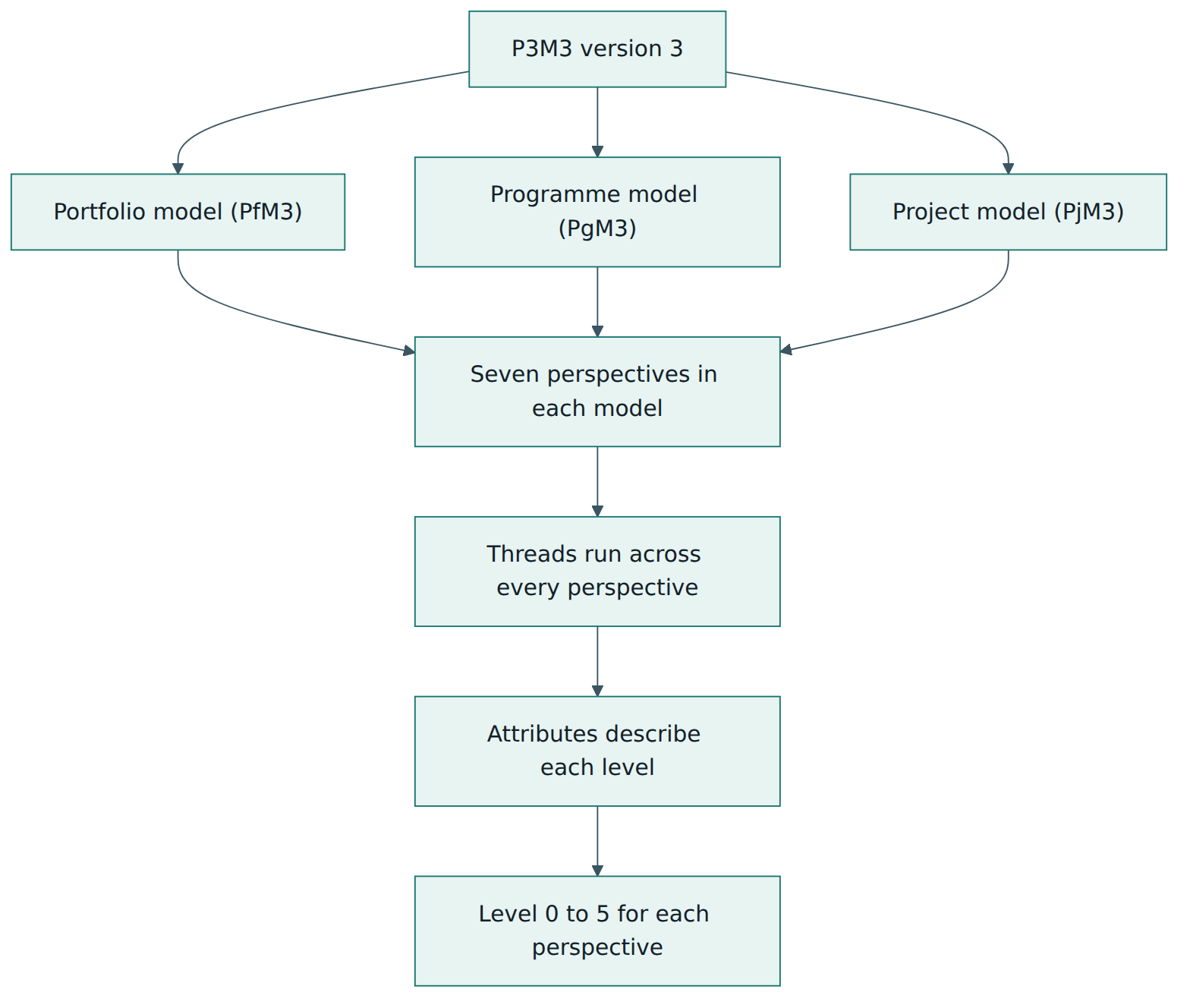
P3M3 version 3 has a layered structure. At the top are the three sub-models. Within each sub-model the same seven perspectives are assessed. Each perspective is examined through a set of threads, and at the most detailed layer each thread is described by attributes for each of the five levels. Assessors gather evidence against the attributes and roll the results up into a maturity level for every perspective in every sub-model assessed.
The seven perspectives
The perspectives are the "pillars" of the model. They are the same in all three sub-models, although what good looks like differs between a project and a portfolio. The table paraphrases what each perspective is about.
| Perspective | What it examines (in plain words) | Example question an assessor might explore |
|---|---|---|
| Organisational governance | How initiatives are aligned with the organisation's strategic direction, and how start-up, continuation and closure decisions are controlled from outside the initiative | Who decides that a project may start, and against which criteria? |
| Management control | How the initiative itself keeps its direction through its lifecycle, with stages or break points where it can be redirected or stopped | Are there defined points where the sponsor reviews progress and can stop the work? |
| Benefits management | How desired outcomes and benefits are defined, made measurable, owned and actually realised | Who tracks the benefits after the project has closed? |
| Risk management | How threats and opportunities are identified, assessed and managed in a balanced way | Is there a common approach to risk, and do risks escalate in a consistent way? |
| Stakeholder management | How stakeholders are identified and engaged, and how communications are planned and carried out | How are affected groups identified, and how is their feedback used? |
| Finance management | How costs are estimated in a business case, categorised, controlled and monitored across the investment lifecycle | Are costs tracked against the approved business case, and by whom? |
| Resource management | How all resources (people, facilities, equipment, information, tools, supporting teams) are planned, acquired and deployed | How are scarce specialists allocated across competing initiatives? |
A common source of confusion is the difference between organisational governance and management control. Governance looks from the outside in: is this initiative still the right thing for the organisation, and is it being started and closed under proper authority? Management control looks from the inside: is the initiative itself being directed and controlled well through its lifecycle? An organisation can have strong internal project controls and still fund projects that do not fit strategy, which would show up as a gap between the two perspectives.
Version 2 used slightly different names for two perspectives (stakeholder engagement and financial management). You may still see the older names in reports or articles written before 2015.
The five maturity levels
Each perspective is rated on the same five-level scale. Levels are cumulative: an organisation at level 3 is also expected to show the characteristics of levels 1 and 2. The descriptions below are paraphrased summaries.
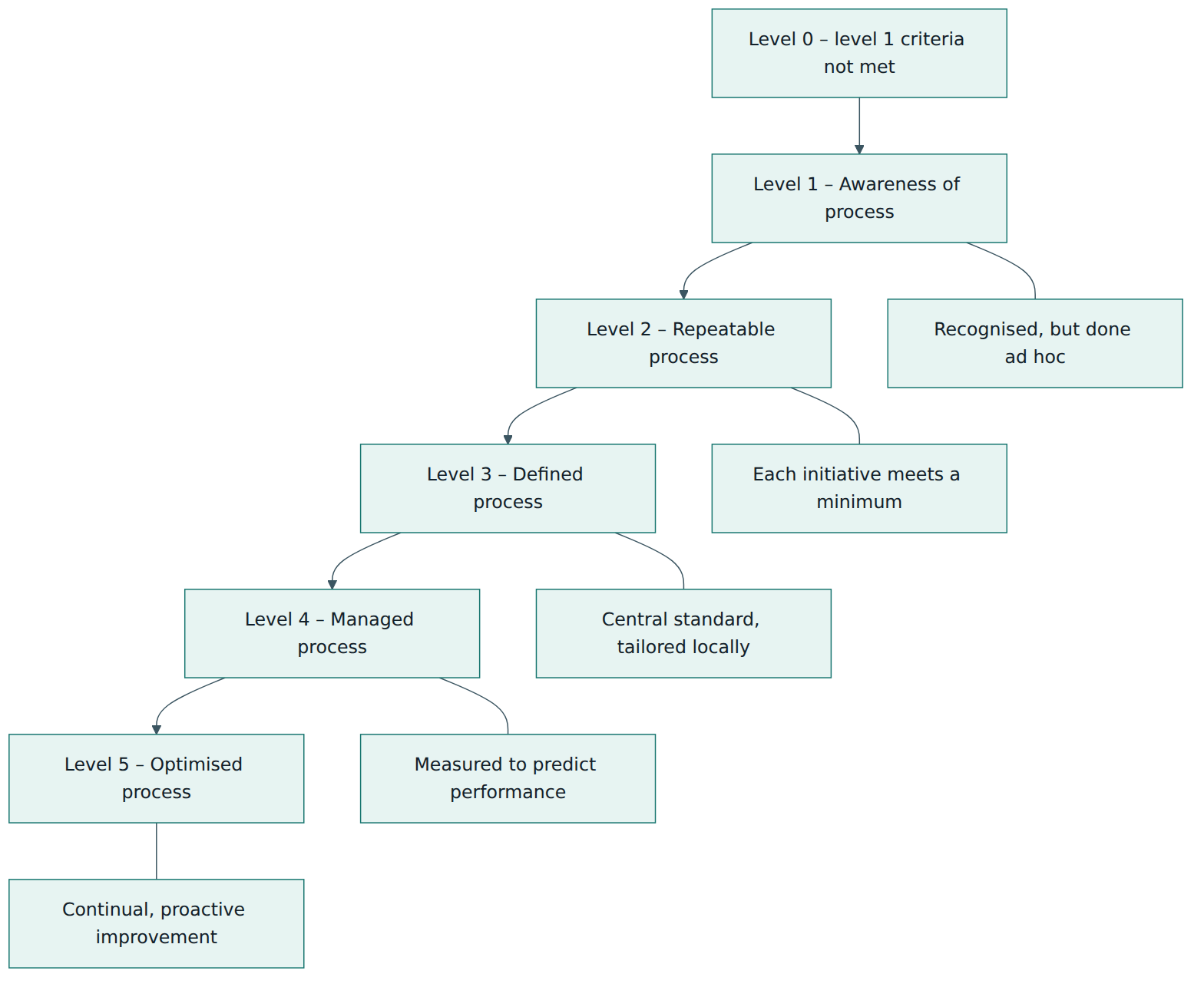
- Level 1 – Awareness of process: the organisation recognises projects, programmes or a portfolio as distinct from business as usual and does some of the activities, but there is no consistent approach. Success depends heavily on individuals.
- Level 2 – Repeatable process: each initiative is run with its own processes and practices that meet a minimum specified standard. There are pockets of good practice, but little consistency between initiatives or business units.
- Level 3 – Defined process: the organisation owns a centrally defined, controlled approach, and individual initiatives tailor it to their needs within agreed limits. Roles, training and governance support the common approach.
- Level 4 – Managed process: the organisation collects and keeps measurements about how well it manages its initiatives and uses them, together with quality management, to predict future performance. At portfolio level this includes understanding capacity and prioritising accordingly.
- Level 5 – Optimised process: the organisation continually improves its approach, using proactive problem management and technology, so that predictability and performance keep improving over time.
The jump from level 2 to level 3 is the one most organisations focus on. Level 2 means "each team does something reasonable". Level 3 means "we have one organisational way of working that everyone uses and adapts sensibly". Practitioners often describe level 3 as the point at which the organisation stops depending on individuals. Levels 4 and 5 require reliable data and a culture of measurement, which take years to build.
Threads
Version 3 added threads so that the model could diagnose why a perspective is weak, not only that it is weak. A thread is examined inside every perspective. PeopleCert's current overview lists thirteen threads, which fall into three groups.
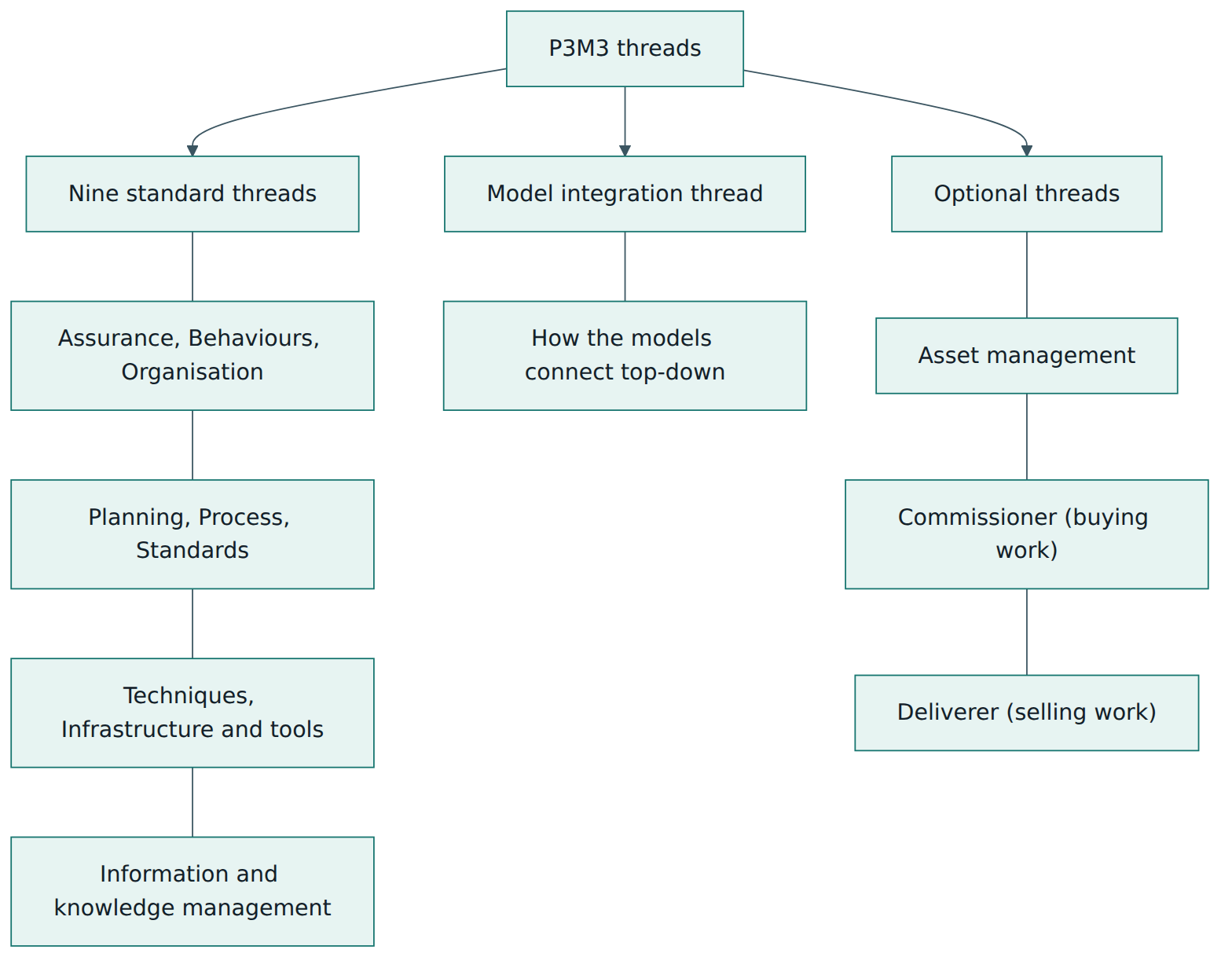
- Assurance – independent checks that provide confidence the approach is appropriate and working.
- Behaviours – focus, motivation, prioritisation and the commitment of leaders and teams to the perspective.
- Information and knowledge management – how information, including lessons learned, is captured, stored, organised and reused.
- Infrastructure and tools – anything from a template to an enterprise portfolio management system that supports the perspective.
- Organisation – structures, roles, responsibilities, competency frameworks, training and coaching.
- Planning – how the activities of the perspective are planned (what, when, how, by whom, at what cost).
- Process – the sequence of activities used to manage the perspective, for example a cycle of identifying, analysing, responding to and reviewing risks.
- Standards – policies, rules and classifications that the organisation expects people to conform to.
- Techniques – the specific methods used to carry out the process, such as a particular estimating or risk-evaluation technique.
- Model integration – how the portfolio, programme and project approaches connect, for example whether a programme's controls fit with those of its projects. It is included only in the programme and portfolio models, and it looks from the top down at what enables that integration.
- Asset management (optional) – for organisations whose change creates, modifies or retires physical or infrastructure assets.
- Commissioner (optional) – commercial activities of a client that specifies work and buys it from others, such as procurement.
- Deliverer (optional) – commercial activities of a supplier that delivers work for clients, such as bidding.
Optional threads are included when they are relevant. A rail operator that commissions construction contractors might add asset management and the commissioner thread; a consultancy that sells projects to clients might add the deliverer thread.
Attributes and scoring
For each combination of sub-model, perspective and thread, the model describes attributes at each level. For example, in the programme model's risk perspective, the assurance thread has one attribute at level 1 (occasional assurance reviews touch on risk), a stronger one at level 3 (risk assurance is part of an integrated, centrally defined assurance plan) and so on. Assessors judge how far the evidence shows each attribute to be present, and the results are combined into a level for each perspective. Reports often show results in more detail than whole levels, for instance a heat map of perspectives against threads, so that the organisation can see exactly which threads hold a perspective back. The exact scoring rules belong to the licensed assessment method, which is one reason official results come only from accredited assessors.
Lesson 4 – How P3M3 works in practice
Deciding why and what to assess
Every useful P3M3 exercise starts with a clear purpose. Is the organisation trying to set a baseline before a transformation, to diagnose repeated delivery failures, to satisfy a funding body, or to check progress after an improvement programme? The purpose drives the scope, and the scope has three dimensions:
- Organisational boundary: the whole enterprise, one division, or a portfolio office and the initiatives it oversees. The boundary should match a unit that genuinely shares a delivery approach.
- Sub-models: any combination of portfolio, programme and project. An organisation should assess what it actually does and what matters to the purpose.
- Perspectives and optional threads: all seven perspectives give the full picture and are required for certification; a narrower selection can make sense for an internal diagnostic focused on, say, benefits and risk.
Roles
Several roles appear in almost every P3M3 exercise. A senior sponsor, usually an executive or board member, commissions the assessment and commits to act on it; without that sponsorship, findings tend to be ignored. A coordinator, often the head of the enterprise PMO or portfolio office, arranges access to documents and people. The assessment team, led by a licensed assessor for a full assessment, gathers and evaluates evidence. Interviewees are drawn from all levels: board members, portfolio managers, programme and project managers, finance, risk, HR and the teams doing the work. Finally, an improvement owner turns the findings into a funded improvement plan.
Gathering evidence
P3M3 is evidence-based. Assessors look for three kinds of evidence. First, the framework documents: policies, lifecycle descriptions, templates, governance terms of reference. These show what should happen. Second, the records of real initiatives: business cases, plans, risk registers, board minutes, benefits reports, lessons logs. These show what actually happens. Third, people's accounts in interviews and workshops, which explain why there are gaps between the two. Comparing the three sources is the heart of a good assessment.
A typical document review samples a handful of projects and programmes from each portfolio in scope, chosen to represent different sizes, business units and stages. Choosing only showcase initiatives would give a flattering but false picture.
From profile to roadmap
The output of an assessment is a maturity profile plus findings and recommendations. Turning that into improvement is where value is created. Good practice is to:
- Agree a target profile for a defined period, linked to business goals; not every perspective needs the same target.
- Look for root causes that cut across perspectives, which the threads make visible (for example, no competency framework weakens every perspective).
- Prioritise a small number of improvements by the risk they reduce and the business value they enable.
- Run the improvements as a managed change initiative, with an owner, a plan, a budget and benefits of its own.
- Embed changes through standards, training, tools and governance, not just new templates.
- Reassess after a sensible interval to measure progress and reset priorities.
Because maturity levels are cumulative, it usually pays to fix the foundations first. Trying to introduce measurement-based prediction (level 4) on top of processes that each team runs differently (level 2) produces data that cannot be compared.
Using P3M3 alongside agile and hybrid delivery
Some teams assume a maturity model forces heavy, document-driven processes. P3M3 does not prescribe a lifecycle or particular documents; it asks whether the organisation has a recognised, consistent, measured and improving way to govern initiatives, control them, manage benefits and risk, engage stakeholders, manage money and allocate resources. An organisation that runs agile delivery teams inside a portfolio can show strong maturity if, for example, its funding decisions use consistent criteria, its teams follow a common but adaptable way of working, and its benefits are tracked and fed back into prioritisation.
Lesson 5 – Assessment, certification and compliance
Self-assessment
A self-assessment is a light-touch exercise in which people inside the organisation rate their own practices against simplified descriptions of each level, perspective by perspective. AXELOS has offered self-assessment questionnaires for P3M3 in the past; check with PeopleCert for what is currently available. Self-assessment is useful to introduce senior managers to the model, to get a first rough picture and to decide where a full assessment should focus. Its weakness is bias: people tend to rate intentions and policies rather than real behaviour, and different respondents interpret the descriptions differently. A facilitator who challenges answers and asks for examples improves reliability. A self-assessment result is never an official P3M3 rating.
Full assessment
A full assessment is independent, evidence-based and diagnostic. It is delivered by one of PeopleCert's Accredited Consulting Partners, using assessors who have been trained and tested on the model and licensed to use the official attribute sets and digital tool. PeopleCert issues a P3M3 Assessor credential to individuals who meet its requirements. The assessment follows a recognisable sequence of stages.
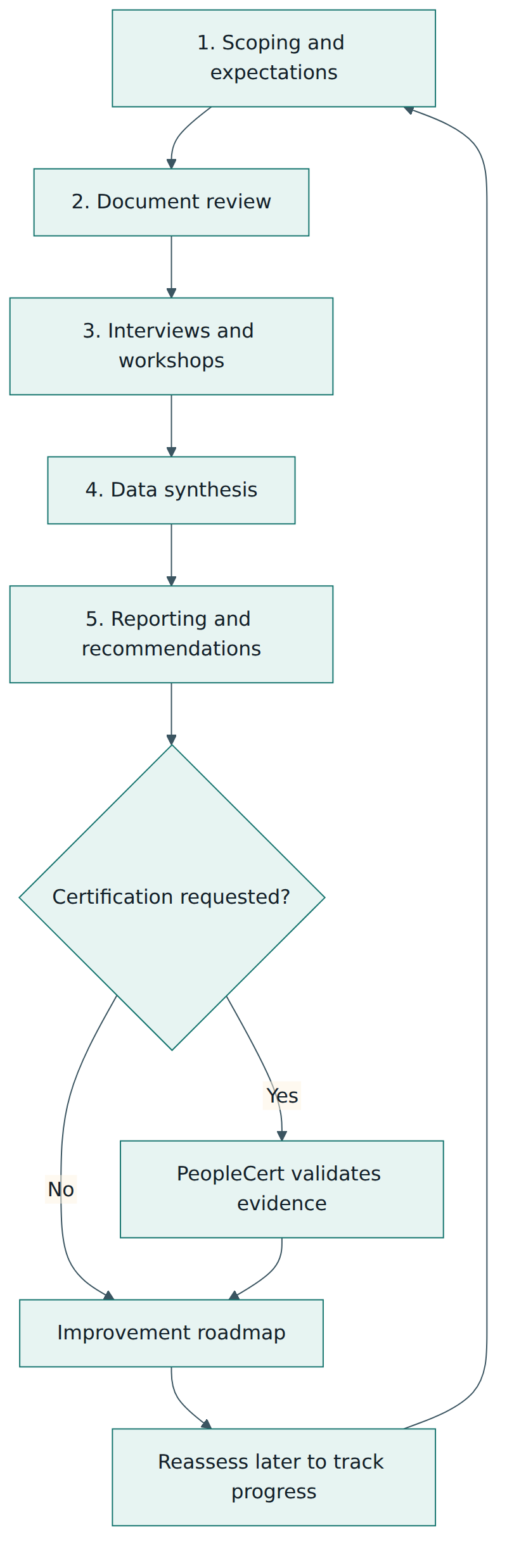
- Scoping and expectations: agree purpose, organisational boundary, sub-models, perspectives and timing; identify the initiatives to sample and the people to interview. If certification is wanted, confirm the exact organisational name and scope to appear on it.
- Document review: examine the organisation's portfolio, programme and project frameworks and a sample of real initiatives, and record provisional findings against the attributes.
- Interviews and workshops: discuss what the documents showed, test how things work in practice, and, if agreed, run surveys to reach more people.
- Data synthesis: combine all evidence, check that scores are consistent across perspectives and sub-models, and validate key conclusions with the coordinator or sponsor so that there are no surprises.
- Reporting and recommendations: present results at a level suited to the audience: an executive summary focused on business impact, the maturity profile, the main strengths and weaknesses, and prioritised recommendations, with technical detail in appendices.
PeopleCert describes the assessment report as typically covering areas for improvement (prioritised by the risks they mitigate and the value they enable), critical success factors for the improvement programme, and current achievements, including comparison with earlier goals when the organisation has been assessed before. Benchmarks and a detailed roadmap can be added by agreement.
Optional certification
An organisation that wants to show its result externally can request certification. In that case PeopleCert reviews the key findings and evidence and validates the assessment report before a maturity certificate is issued. According to PeopleCert, a certified assessment must include all seven perspectives, and the certificate states the scope that was assessed. This matters: a certificate covering the project model in one division says nothing about the programme model or about other divisions.
How to read and use a rating
P3M3 results are reported per perspective within each sub-model assessed, so an organisation might be at level 3 for project risk management but level 1 for portfolio benefits management. Treat any attempt to summarise this profile in a single number with care; the value is in the pattern. If a perspective fails to meet the level 1 criteria, it is recorded as level 0, which is not unusual for benefits management in organisations that never track benefits after delivery.
There is no law or regulation that generally requires P3M3. It is a voluntary best-practice model. Some public bodies and clients ask for maturity evidence as part of governance, funding or supplier selection, and a validated P3M3 result is one way to provide it, but the scheme is about capability improvement, not legal compliance.
What a good assessor does
Experienced assessors look for consistency between what is written, what is done and what people believe. They triangulate evidence, sample beyond the showcase initiatives, interview across levels, and avoid scoring a perspective on the strength of a policy that nobody follows. They also keep the conversation focused on improvement: a maturity assessment that becomes a blame exercise teaches people to hide problems at the next one.
Lesson 6 – Worked example
The following organisation is fictional, but the steps follow the approach described in this tutorial.
The situation
Riverside Regional Transport is a public transport authority with about 2,500 staff. It runs a capital portfolio of around 40 projects and three programmes: a fleet replacement programme, a ticketing modernisation programme and a station accessibility programme. Over the last three years several projects have overrun badly, the ticketing programme has delivered systems but no measurable reduction in fare evasion, and the regional funding body has asked for evidence that the authority can manage a planned increase in investment. The new chief executive sponsors a P3M3 assessment and asks the head of the enterprise PMO to coordinate it.
Step 1 – Purpose and scope
The sponsor states two purposes: give the funding body a credible, independent picture of delivery capability, and produce a two-year improvement roadmap. Because external confidence matters, the authority asks for a certified assessment, so all seven perspectives are included. The scope covers the whole authority and all three sub-models, since the problems appear to involve portfolio decisions as well as delivery. As a capital-asset owner that buys most of its delivery from contractors, the authority also includes the optional asset management and commissioner threads.
Step 2 – Evidence gathering
The accredited partner's assessors review the authority's project lifecycle guide, investment governance terms of reference and finance policy, then sample two programmes and eight projects of different sizes and stages. They interview board members, the portfolio manager, programme and project managers, the finance business partner, the head of procurement and several team members, and run a workshop with operations managers who receive the outputs of projects.
Some clear patterns emerge. Project managers use a common lifecycle with stage gates, and most projects have a business case, a risk register and a plan; however, each department has modified the templates and gate criteria. Programme benefits are listed in business cases but nobody owns them after projects close. The portfolio board approves new investments one at a time, with no view of total capacity, and almost never stops anything. Lessons learned are written but stored in project folders where nobody finds them.
Step 3 – The baseline profile
After data synthesis the assessors present this (illustrative) profile:
| Perspective | Project model | Programme model | Portfolio model |
|---|---|---|---|
| Organisational governance | 2 | 2 | 1 |
| Management control | 3 | 2 | 1 |
| Benefits management | 1 | 1 | 0 |
| Risk management | 2 | 2 | 1 |
| Stakeholder management | 2 | 2 | 1 |
| Finance management | 2 | 2 | 2 |
| Resource management | 2 | 1 | 1 |
The thread analysis adds the diagnosis. The information and knowledge management thread is weak everywhere, which explains why lessons are not reused. The organisation thread shows that there is no competency framework for project and programme roles, and the behaviours thread shows that portfolio board members see their role as approving, not challenging or stopping. The commissioner thread shows that contracts reward delivery of assets but not the outcomes that the benefits depend on.
Step 4 – Interpreting the result
The profile tells a coherent story. Projects are reasonably controlled internally (management control at level 3 in the project model), which is why individual project managers felt the authority was doing well. But the organisation selects and governs its investments weakly (portfolio governance at level 1) and does not manage benefits at all at portfolio level (level 0). That combination explains how the ticketing programme could deliver its systems on time yet produce no measurable value: nobody was responsible for the benefit, and nobody at portfolio level would have noticed.
Step 5 – The improvement roadmap
The sponsor and the PMO agree a two-year target profile rather than chasing level 3 everywhere. Priorities are chosen by the risk they reduce and the value they unlock:
- Benefits management first: define a simple, organisation-wide benefits approach, assign a benefit owner in the business for every programme and major project, and add benefits tracking to the portfolio dashboard. Target level 2 in all three models, then level 3 in the programme model.
- Portfolio governance: introduce consistent investment criteria, a quarterly portfolio review that considers capacity and the whole portfolio, and explicit authority to pause or stop initiatives. Target level 2, then 3.
- Standardise what already works: turn the project lifecycle into one centrally owned standard with clear tailoring rules, removing departmental variants, so that project perspectives can reach level 3 consistently.
- Cross-cutting enablers: a competency framework and training path for project, programme and portfolio roles; a central, searchable lessons library; and changes to contract terms so that suppliers share responsibility for outcomes where possible.
The improvement work is itself run as a small programme with its own business case and benefits (for example, fewer late projects and evidence of benefit realisation), and the PMO reports progress to the board every quarter.
Step 6 – Reassessment
Two years later the authority commissions a second assessment. Portfolio benefits management has moved from level 0 to level 2, portfolio governance from 1 to 2, and most project perspectives are now at level 3. The report compares the result with the targets that were set, notes that the programme model has improved more slowly than planned, and recommends the next priorities. The funding body accepts the certified result as part of its evidence that the authority can manage a larger capital programme. Equally important, staff can explain how and why their ways of working have changed.
Lessons from the example
- A good project-level score can hide weak portfolio and benefits capability; assessing all three sub-models revealed the real problem.
- The threads turned a list of low scores into a diagnosis with root causes that could be fixed.
- Targets were selective and linked to business needs instead of "level 3 everywhere".
- Improvement was managed as change, with an owner, a budget, benefits and a reassessment.
Lesson 7 – Relationship to other standards and frameworks
P3M3 sits in a family of guidance. Some documents tell you how to manage projects, programmes and portfolios; others, like P3M3, tell you how mature the organisation is at doing so. Mixing the two up is a common mistake.
| Framework | Owner | What it is | Relationship to P3M3 |
|---|---|---|---|
| PRINCE2 (projects), MSP (programmes), MoP (portfolios) | PeopleCert (AXELOS) | Best-practice methods and guidance for managing projects, programmes and portfolios | Same family and vocabulary as P3M3, but they describe how to do the work; P3M3 measures how mature the organisation's way of working is, whichever method it uses |
| CMMI (V3.0) | ISACA (CMMI Institute) | Model of practices with capability and maturity levels and formal appraisals, focused on development, services and suppliers | The staged-level idea in P3M3 comes from the CMM tradition; CMMI covers engineering and service delivery broadly, while P3M3 concentrates on portfolio, programme and project management |
| OPM3 | PMI | Organizational Project Management Maturity Model; third edition 2013, not updated since, and PMI discontinued its OPM3 professional credential in 2017 | Covered the same three domains but used a continuum of best practices rather than staged levels; P3M3 remains a maintained alternative with an active assessment scheme |
| ISO 21502, ISO 21503, ISO 21504 | ISO | Guidance standards for project, programme and portfolio management | Describe good practice at each level; they are not maturity models but can serve as reference practices when designing the organisation's approach that P3M3 then assesses |
| PMBOK Guide and PMI standards for programme and portfolio management | PMI | Bodies of knowledge and standards for project, programme and portfolio management | A widely used alternative method set; because P3M3 is framework agnostic, an organisation using PMI standards can still be assessed with P3M3 |
| Kerzner Project Management Maturity Model | Harold Kerzner (author) | Five-level model with questionnaires, focused mainly on project management | Simpler and project-focused; useful for a quick internal view, whereas P3M3 covers three sub-models and has accredited assessment |
P3M3 and the P3O guidance
Portfolio, Programme and Project Offices (P3O) guidance, from the same family, describes how to design support offices such as an enterprise PMO. P3O and P3M3 work well together: a PMO is often the owner of the improvement roadmap, and a P3M3 assessment shows which services the PMO should provide first (for example benefits tracking or a lessons library).
P3M3 and ISO-style management systems
Organisations with an ISO 9001 quality management system already have habits that support maturity: documented processes, internal audit, management review and continual improvement. Those habits help at levels 3 to 5. But a quality certificate does not imply a high P3M3 result, because ISO 9001 does not examine benefits management, portfolio prioritisation or programme governance in the way P3M3 does.
Choosing a maturity model
If your main concern is how well the organisation selects, governs and delivers change through portfolios, programmes and projects, P3M3 is a natural choice, especially where PRINCE2, MSP or MoP vocabulary is already used. If your concern is engineering and service processes more broadly, CMMI may fit better. Some organisations use both, with P3M3 for the change portfolio and CMMI for software or service units. Whatever you choose, use one model consistently over time; results from different models cannot be compared directly.
Common pitfalls and best practices
Common pitfalls
- Treating the maturity level as the goal, so people produce documents to raise the score instead of improving delivery and outcomes.
- Setting the same target level for every perspective and sub-model, regardless of business need, cost or the organisation's starting point.
- Assessing only the project model and concluding the organisation is mature, while portfolio selection and benefits realisation stay weak.
- Relying on a self-assessment as if it were evidence-based, or presenting a home-made result as an official P3M3 rating.
- Sampling only showcase initiatives, so the assessment reflects the best managers rather than the organisation.
- Jumping to level 4 measurement before processes are consistent, which produces numbers that cannot be compared.
- Commissioning an assessment without senior sponsorship, then leaving the report unfunded and unread.
Best practices
- Start from a clear purpose agreed with an executive sponsor, and let that purpose drive the scope.
- Use the thread analysis to find cross-cutting root causes, such as missing competencies or poor knowledge management, and fix those first.
- Agree selective, time-bound targets linked to strategy, and prioritise improvements by the risk they reduce and the value they enable.
- Run improvement as a managed change initiative with an owner, budget, benefits and regular reporting.
- Embed new ways of working through standards, training, tools, governance and leadership behaviour, not just templates.
- Reassess with the same model and comparable scope so that progress can be measured honestly over time.
- Communicate results openly and without blame, so that people stay candid in future assessments.
Summary and key takeaways
- P3M3 measures the organisation's ability to deliver change through portfolios, programmes and projects; it does not judge individual projects or people.
- Version 3 (2015) is current; the model is owned by PeopleCert (which acquired AXELOS) and is marketed as PRINCE2 P3M3, while remaining framework agnostic.
- The structure has three sub-models, seven perspectives assessed in each, threads that cut across the perspectives, and detailed attributes for each of five levels.
- The levels run from awareness through repeatable, defined and managed to optimised; a perspective that misses level 1 is recorded as level 0.
- Self-assessment is quick and useful for orientation; full assessments are evidence-based and delivered by accredited consulting partners, with optional certification validated by PeopleCert.
- The maturity profile, read with the thread analysis, is far more useful than any single number.
- Value comes from the improvement roadmap: selective targets, root-cause fixes, managed change and reassessment.
- P3M3 complements methods such as PRINCE2, MSP, MoP, PMI standards and ISO 2150x; it assesses maturity rather than prescribing how to manage.
Reflection questions
- Think of your own organisation. Which of the three sub-models would you include in a first assessment, and why would you include or leave out the others?
- Pick one perspective, such as benefits management, and describe the evidence you would expect to find if your organisation were at level 2 and at level 3. What would be different?
- Your organisation's project model scores well but nobody can say whether recent programmes delivered value. Which perspectives and threads would you examine to explain this?
- A board member wants "level 3 everywhere within a year". How would you respond, and what alternative target would you propose?
- How would you design the assessment and its communication so that teams describe real practice honestly rather than presenting their best side?
Further reading and official sources
- PRINCE2 P3M3 maturity model for organisations – PeopleCert
- PRINCE2 P3M3 Maturity Model leaflet (PDF) – PeopleCert
- PRINCE2 P3M3 maturity model assessment – PeopleCert (PRINCE2 official site)
- Become a PRINCE2 P3M3 Accredited Consulting Partner – PeopleCert
- PRINCE2 P3M3 Overview webinar slides, October 2025 (PDF) – PeopleCert
- P3M3 Assessor credential – PeopleCert on Credly
- P3M3 – Wikipedia (history and criticisms)
Original tutorial by xOps School (DevOpsSchool Private Limited), written from public sources about P3M3. Not affiliated with or endorsed by the standard's owner; standard names are trademarks of their owners. Buy the official standard from its publisher for the authoritative text.