
People CMM – Tutorial (about 60 minutes)
- View
The People Capability Maturity Model (People CMM, also written P-CMM or PCMM) is a staged roadmap for improving how an organisation attracts, develops, organises, motivates and retains its workforce. It was created at the Software Engineering Institute (SEI) of Carnegie Mellon University and is used by IT services firms, banks, government agencies, outsourcing providers and other knowledge-intensive organisations that want people management to become a disciplined, measurable process rather than a set of good intentions. After this tutorial you will be able to explain the model's five maturity levels and 22 process areas, plan an improvement programme, understand how People CMM appraisals work, and position the model next to CMMI, ISO standards and business excellence frameworks.
Course overview
Edition and status: The current and latest edition is the People Capability Maturity Model (P-CMM), Version 2.0, Second Edition, published by the SEI in July 2009 as technical report CMU/SEI-2009-TR-003 (authors Bill Curtis, William Hefley and Sally Miller). Version 1 appeared in 1995 and Version 2.0 in 2001; the 2009 Second Edition updated the explanatory material and sub-practices of Version 2 without changing its five levels or 22 process areas. No newer edition has been published as of the verification date. Stewardship of the SEI's CMM and CMMI products passed to the CMMI Institute in 2013, and ISACA acquired the CMMI Institute in 2016. ISACA's current flagship model, CMMI V3.0 (2023), contains its own People domain with a Workforce Empowerment practice area; that domain is part of CMMI and is not a new edition of the People CMM. ISACA's current CMMI pages describe CMMI People but do not mention stand-alone People CMM appraisals, so we could not confirm whether they are still offered today, so check with ISACA or an authorised lead appraiser before planning a formal rating. The 2009 model report remains freely downloadable from the SEI. Verified 2026-10-29.
Who it is for: HR and talent professionals, engineering and delivery managers, quality and process improvement staff, L&D (learning and development) teams, and anyone whose organisation has said "we want to reach People CMM Level 3" and who needs to understand what that really means. It is equally useful if you already know CMMI and want to see how the same maturity logic applies to people practices.
Prerequisites: none. Some experience of being hired, appraised, trained or promoted inside an organisation helps, because the model is about exactly those everyday activities.
How to use this tutorial: read the seven lessons in order (about 45 minutes), study the five diagrams, then spend the remaining time on the reflection questions before you take the 25-question knowledge check.
Learning objectives:
- You will be able to explain why the People CMM was created, who owns it, and what problem it solves for knowledge-intensive organisations.
- You will be able to define the model's core vocabulary, including workforce competency, competency community, workgroup, unit and institutionalisation.
- You will be able to name the five maturity levels and describe the process areas and cultural change at each level.
- You will be able to describe the architecture of a process area: purpose, goals, implementation practices and the four institutionalisation practice categories.
- You will be able to plan a realistic improvement programme and choose an appropriate appraisal class for a given need.
- You will be able to recognise common misuses such as level fever and level skipping, and relate the People CMM to CMMI, ISO 9001, ISO 10015, ISO 30414 and the Baldrige framework.
Lesson 1 – Origins, purpose and scope
From software processes to people practices
In the late 1980s and early 1990s the SEI published the Capability Maturity Model for Software (SW-CMM). It was built on an insight by Watts Humphrey: organisations cannot jump straight to continuous improvement; they must remove obstacles in a particular order. First they get basic management control of commitments, then they standardise their best practices, then they manage by data, and finally they improve continuously. Many software companies used the SW-CMM and discovered a recurring problem: their process improvements stalled because of people issues. Training was thin, performance feedback was poor, careers were unclear, offices were crowded and pay was not competitive. Process models said little about these topics.
Organisations asked the SEI for a similar roadmap for workforce practices. The result, with sponsorship from US defence and Army information offices and broad industry participation, was the People CMM Version 1 in 1995. Bill Curtis led the work, together with Bill Hefley and Sally Miller. Version 2.0 followed in 2001 after six years of field use; among other changes it moved the building of process-based workgroups from level 4 down to level 3, because organisations were starting that work earlier than the first version assumed. The Second Edition of 2009 refreshed the explanatory text and added experience from global use, in industries ranging from IT and business process outsourcing to pharmaceuticals, hospitality, construction, energy, banking and government.
What problem does it solve?
Most organisations already know many good people practices: competency models, mentoring, 360-degree feedback, incentive pay, team building, knowledge management. The People CMM authors argued that the real barriers are lack of management commitment and piecemeal adoption. A company buys a new appraisal tool, launches a mentoring scheme or introduces team bonuses in isolation, and the initiative fades because the surrounding practices do not support it. The People CMM treats workforce management as a set of organisational processes that must be installed in a sensible order, as reinforcing bundles, and kept alive by management.
Its stated primary objective is to improve workforce capability: the knowledge, skills and process abilities available to perform the organisation's business activities. Higher capability means the organisation is more ready to perform its critical work, more likely to get predictable results, and better able to benefit from investments in process improvement or new technology.
Guiding principles
The model rests on ten principles, which can be paraphrased as follows. In mature organisations workforce capability is directly linked to business performance and is a source of competitive advantage. Capability must be defined in relation to strategic business objectives. Knowledge work shifts attention from job elements to workforce competencies. Capability can be measured and improved for individuals, workgroups, competencies and the whole organisation. Investment should go first to the competencies that underpin the core business. Operational managers, not only the HR department, are responsible for the capability of their people. Improving capability can be run as a process built from proven practices. The organisation provides improvement opportunities and individuals are responsible for using them. Finally, because technologies and organisational forms change quickly, workforce practices and competencies must keep evolving.
Scope
The People CMM covers workforce practices: staffing, communication, work environment, performance management, training, compensation, competency development, careers, workgroups, participation, mentoring, knowledge assets, quantitative management of capability, and continuous innovation of the practices themselves. It does not cover the technical processes used to build products or deliver services; those belong to models such as CMMI. It does not prescribe a particular HR system, legal employment rules, or an organisational chart. Although it was designed for knowledge-intensive organisations, it can be tailored to almost any setting, and it is aimed at an organisation (a company, division, agency or site with an identifiable executive) rather than at individual people. Nobody "gets People CMM certified" as a person; an organisational unit is appraised against the model.
Lesson 2 – Key concepts and vocabulary
The People CMM uses words that sound familiar but have precise meanings. Learning them first makes the rest of the model much easier to read.
- Workforce practice – any organisational practice for attracting, developing, organising, motivating or retaining people, such as recruiting, appraisal, training or compensation. The model treats these practices as processes that can be defined, measured and improved.
- Workforce capability – the level of knowledge, skills and process abilities available to the organisation for performing its business activities. It indicates readiness, likely results and the potential to benefit from improvements.
- Workforce competency – a distinct cluster of knowledge, skills and process abilities that people acquire through education or experience and that the organisation needs, for example "software testing", "credit risk analysis" or "nursing care". An organisation typically has several workforce competencies.
- Process ability – the ability to perform the defined work processes of a competency, as opposed to knowing about a subject or having a general skill. This third element is what separates the People CMM's idea of competency from simple skills lists.
- Competency community – the group of people across the organisation who share a particular workforce competency, regardless of which unit they sit in.
- Competency-based process – the defined way people in a workforce competency apply their knowledge, skills and process abilities within the organisation's business processes.
- Organisation – the entity in which the improvement programme is applied, with an identifiable executive responsible for its operations and performance.
- Unit – a well-defined component of the organisation, such as a department, section or project, with a person accountable for its performance objectives. Units can contain other units.
- Workgroup – people who work closely together on highly interdependent tasks to achieve shared objectives. The lowest-level unit may be a single workgroup or contain several.
- Empowered workgroup – a workgroup granted considerable autonomy over how it performs its work and, sometimes, over some of its own workforce activities such as selection or development.
- Maturity level – an evolutionary plateau at which the organisation's workforce practices have been transformed to produce a new level of capability. There are five.
- Process area – a cluster of related practices that, performed together, satisfy a set of goals contributing to the capability of a maturity level. There are 22, each assigned to exactly one level.
- Goal – an organisational state that must exist when a process area is effectively implemented. Goals are the required components used in appraisals.
- Practice – a sub-process that contributes to achieving a goal. Practices are expected components: an organisation normally implements them, but an equally effective alternative can satisfy the goal.
- Institutionalisation – building a practice into the organisation's culture so that it is effective, repeatable and lasting, rather than dependent on a few enthusiastic people.
- Human capital management (HCM) – managing people as a strategic matter whose value can be analysed, measured and improved, rather than as an administrative function left to HR.
Two further distinctions help. The People CMM talks about practices (the defined processes) and activities (what people actually do when they carry them out). It also separates roles from people: an executive manager, a manager, the individual, and the human resources function are roles, and one person may fill several roles. "Human resources" in the model means any staff function responsible for a workforce practice, even if that function does not sit in an HR department.
Lesson 3 – Structure of the model
Five maturity levels
Like all CMMs, the People CMM has five maturity levels. Each level is a foundation for the next, and each brings a distinct cultural change in how the organisation treats its people.
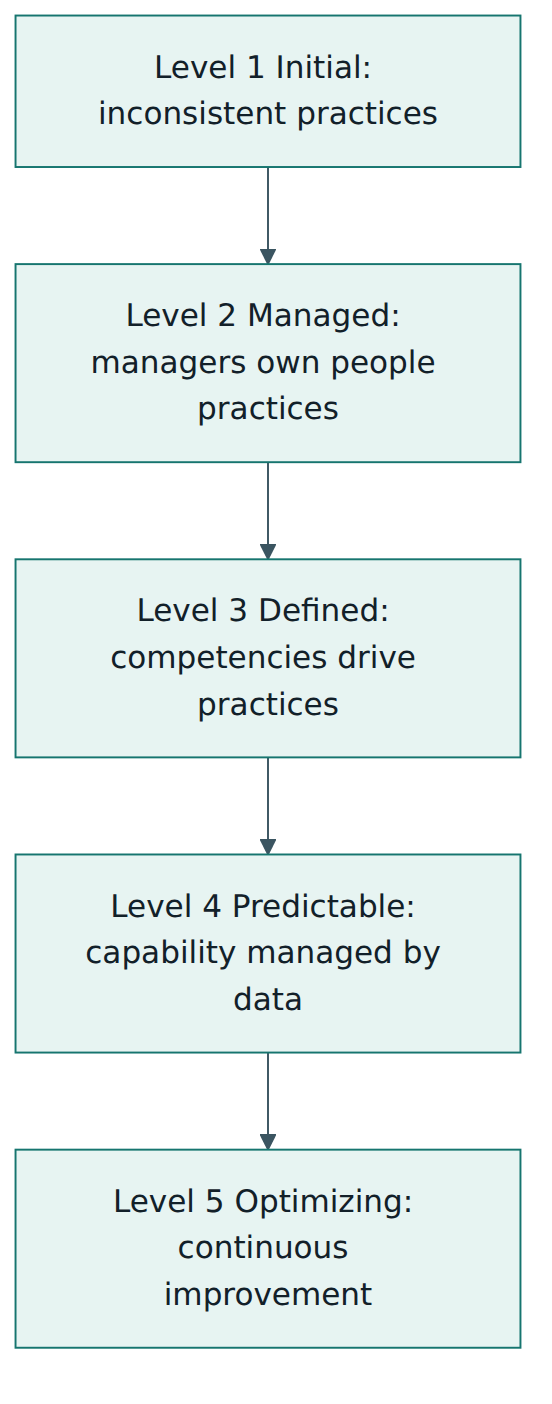
Level 1 – Initial. Workforce practices are applied inconsistently, sometimes ritualistically. Managers may not see people development as part of their job; results depend on individual heroes, overtime and luck. Level 1 has no process areas: an organisation is at level 1 simply because it has not yet satisfied all the level 2 goals.
Level 2 – Managed. Managers take responsibility for managing and developing the people in their units. Basic practices such as staffing, performance discussions and compensation adjustments become a repeatable discipline, and the unit can meet its work commitments without burning people out. The culture is focused at the unit level.
Level 3 – Defined. The organisation identifies the workforce competencies its business strategy requires, describes them, and aligns its workforce practices with developing them. A professional culture emerges around shared competencies, and the workforce is managed as a strategic asset through strategic workforce planning.
Level 4 – Predictable. The organisation quantifies and manages the capability of its workforce and of its competency-based processes. Shared experience is captured as reusable assets, mentoring becomes structured, workgroups are empowered, and performance and capacity for work become predictable.
Level 5 – Optimizing. Everyone focuses on continuous improvement of personal, workgroup and organisational capability. The organisation evaluates innovative workforce practices in trials, deploys successful ones rapidly, and aligns performance at all levels with business objectives.
The 22 process areas
Each level from 2 to 5 contains between three and seven process areas. The table lists them with a one-line paraphrase of their intent.
| Level | Process area | Intent in plain words |
|---|---|---|
| 2 Managed | Staffing | Match committed work to available people; recruit, select and transition people fairly and formally. |
| 2 Managed | Communication and Coordination | Share information openly and give people the interpersonal skills to coordinate their work. |
| 2 Managed | Work Environment | Provide physical conditions and resources that let people work without needless distraction or risk. |
| 2 Managed | Performance Management | Set objectives linked to committed work, discuss performance continuously, handle problems and recognise excellence. |
| 2 Managed | Training and Development | Close the gap between each person's skills and what their assignment needs, then offer development. |
| 2 Managed | Compensation | Reward people equitably according to their contribution and value, through an organisation-wide strategy. |
| 3 Defined | Competency Analysis | Identify and describe the knowledge, skills and process abilities of each workforce competency. |
| 3 Defined | Workforce Planning | Link workforce activities to current and future business needs through strategic and unit plans. |
| 3 Defined | Competency Development | Continuously build capability in each competency through graduated learning and community support. |
| 3 Defined | Career Development | Give people development plans, graduated career paths and clear promotion criteria. |
| 3 Defined | Competency-Based Practices | Re-base staffing, performance and pay practices on developing competencies, not only on unit needs. |
| 3 Defined | Workgroup Development | Organise work around competency-based processes and roles, from forming a workgroup to disbanding it. |
| 3 Defined | Participatory Culture | Share business information and involve people in decisions that affect their work. |
| 4 Predictable | Competency Integration | Combine the processes of different competencies into seamless multidisciplinary work. |
| 4 Predictable | Empowered Workgroups | Give workgroups authority over how they work and over some of their own workforce activities. |
| 4 Predictable | Competency-Based Assets | Capture knowledge and artefacts from competency-based work and package them for reuse. |
| 4 Predictable | Quantitative Performance Management | Use process performance baselines to predict and control the results of competency-based processes. |
| 4 Predictable | Organizational Capability Management | Measure capability in each competency and quantify the effect of workforce practices on it. |
| 4 Predictable | Mentoring | Run structured mentoring with defined objectives, selected and prepared mentors. |
| 5 Optimizing | Continuous Capability Improvement | Help individuals and workgroups keep improving their personal and team work processes. |
| 5 Optimizing | Organizational Performance Alignment | Align performance of individuals, workgroups and units with organisational objectives. |
| 5 Optimizing | Continuous Workforce Innovation | Find, trial and deploy improved or innovative workforce practices and technologies. |
Notice the pattern. Level 2 process areas mostly operate inside each unit, with one exception: Compensation must be coordinated centrally so that people perceive the system as fair. Level 3 shifts the focus to the whole organisation and its competencies. Level 4 adds measurement and empowerment, and level 5 adds continuous change.
Inside a process area
Every process area has the same internal architecture. A purpose statement and a short description explain what the area is for. Three to five goals state the conditions that must exist when the area is in place: several implementation goals plus one institutionalisation goal. Practices contribute to the goals, and practices are grouped into five categories.
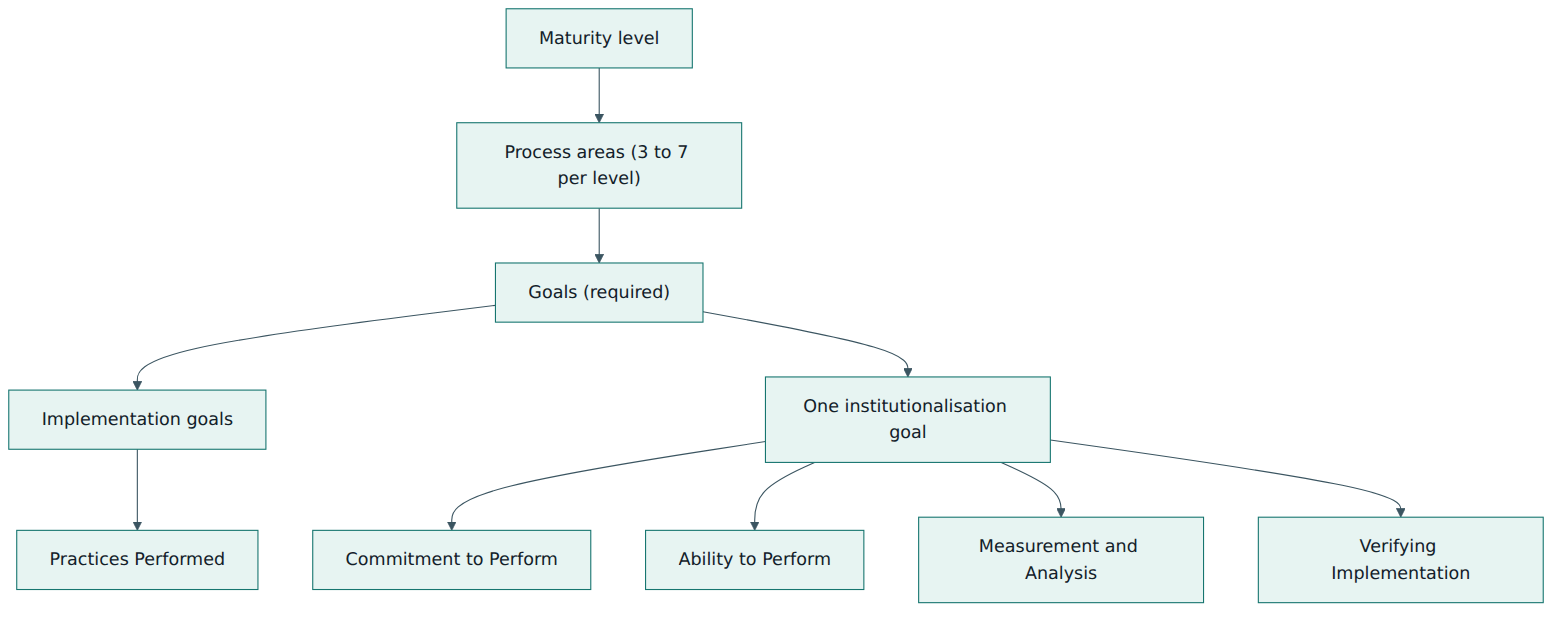
- Practices Performed – the implementation practices: the actual workforce activities, such as documenting performance objectives or conducting selection interviews. This is the largest category.
- Commitment to Perform – what the organisation does to make the area endure: typically a written policy, executive sponsorship and an assigned organisational role.
- Ability to Perform – preconditions: resources, structure, and the preparation or training of those who carry out the practices.
- Measurement and Analysis – measures of how well and how consistently the practices are carried out.
- Verifying Implementation – objective reviews by executive management, responsible individuals or the HR function to confirm that activities follow the policies and procedures.
The model also classifies its components. Goals are required: an appraisal judges whether they are satisfied. Practice statements are expected: an organisation normally implements them, but a different practice that achieves the same goal is acceptable. Everything else — sub-practices, examples, notes and references — is informative, guidance that helps interpretation but is not checked line by line. This is why the People CMM describes what should happen rather than how: it may say that individual performance should be reviewed periodically, but not how often or with which form.
Four threads across the levels
Process areas live at a single level, but they are linked across levels by four areas of concern, called threads. Each thread shows how a practice started at one level is transformed at higher levels. For example, unit-level training at level 2 becomes organisation-wide competency development at level 3.
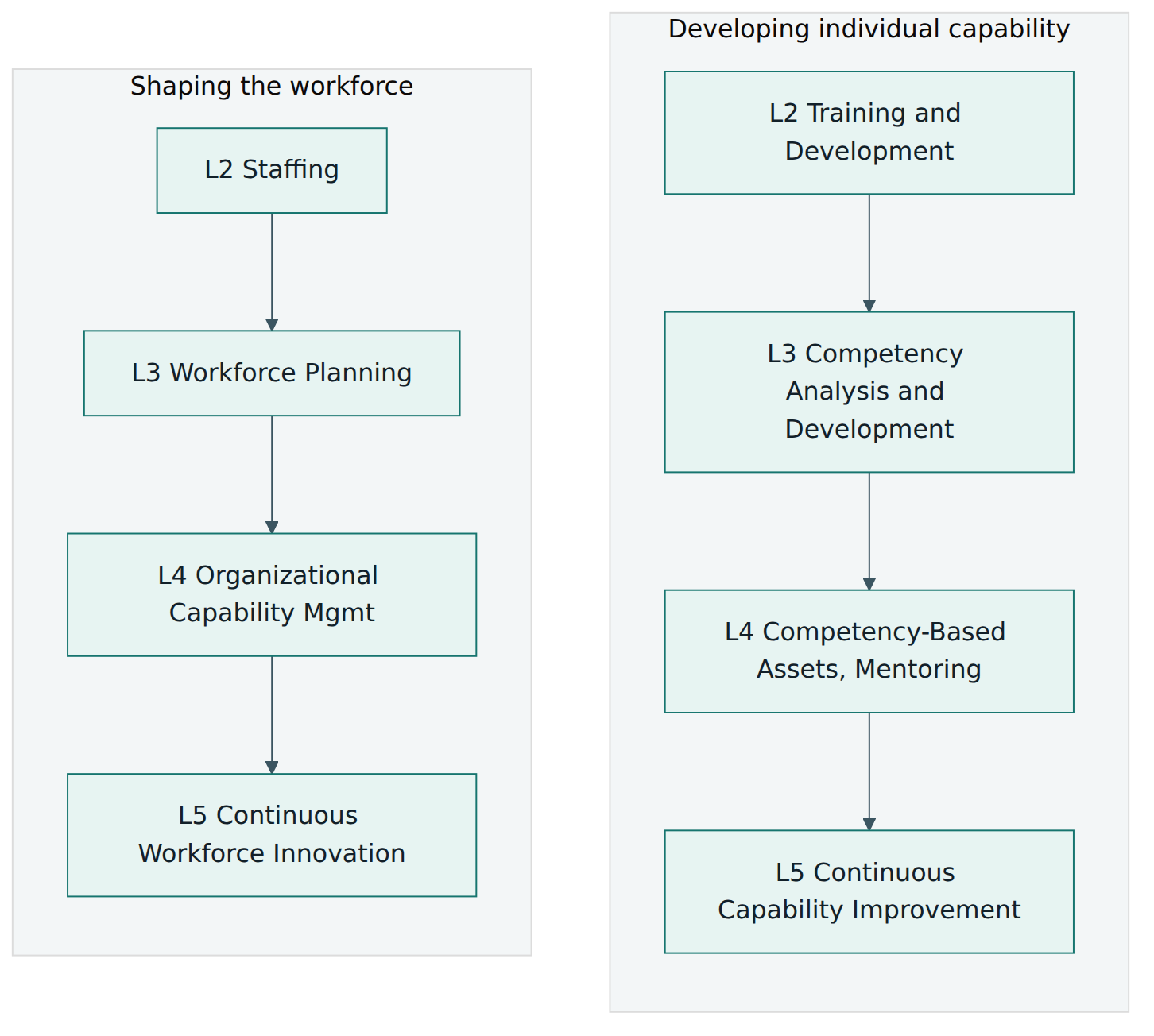
The other two threads work the same way. Building workgroups and culture runs from Communication and Coordination (level 2) through Workgroup Development and Participatory Culture (level 3) to Competency Integration and Empowered Workgroups (level 4), and on to Continuous Capability Improvement at level 5, where workgroups improve how their members' personal processes fit together. Motivating and managing performance runs from Work Environment, Performance Management and Compensation (level 2) through Competency-Based Practices and Career Development (level 3) to Quantitative Performance Management (level 4) and Organizational Performance Alignment (level 5). Thinking in threads is useful when an organisation is tempted to drop a process area: removing one link weakens everything above it in the same thread.
Lesson 4 – How it works in practice
Roles
The People CMM is not an HR department project. The model assigns responsibilities across four main roles. Executive managers sponsor the programme, set policy, protect resources for long-term improvement and review progress. Managers at every level — line managers, project managers, workgroup leaders — perform most workforce activities with their own people: setting objectives, discussing performance, identifying training needs, recommending pay adjustments. Individuals take responsibility for using the development opportunities offered to them. The human resources function designs and coordinates organisation-wide practices, advises units, and shares responsibility for measurement and verification, acting as a quality assurance function for workforce processes. At level 3 and above, organisational roles such as process owners or competency managers coordinate each process area or competency across the whole organisation.
A typical improvement programme
Because the People CMM is a process-improvement model, its adoption follows the familiar improvement cycle: understand the current state, plan, implement, check, and repeat. Figure 4 shows a common sequence.
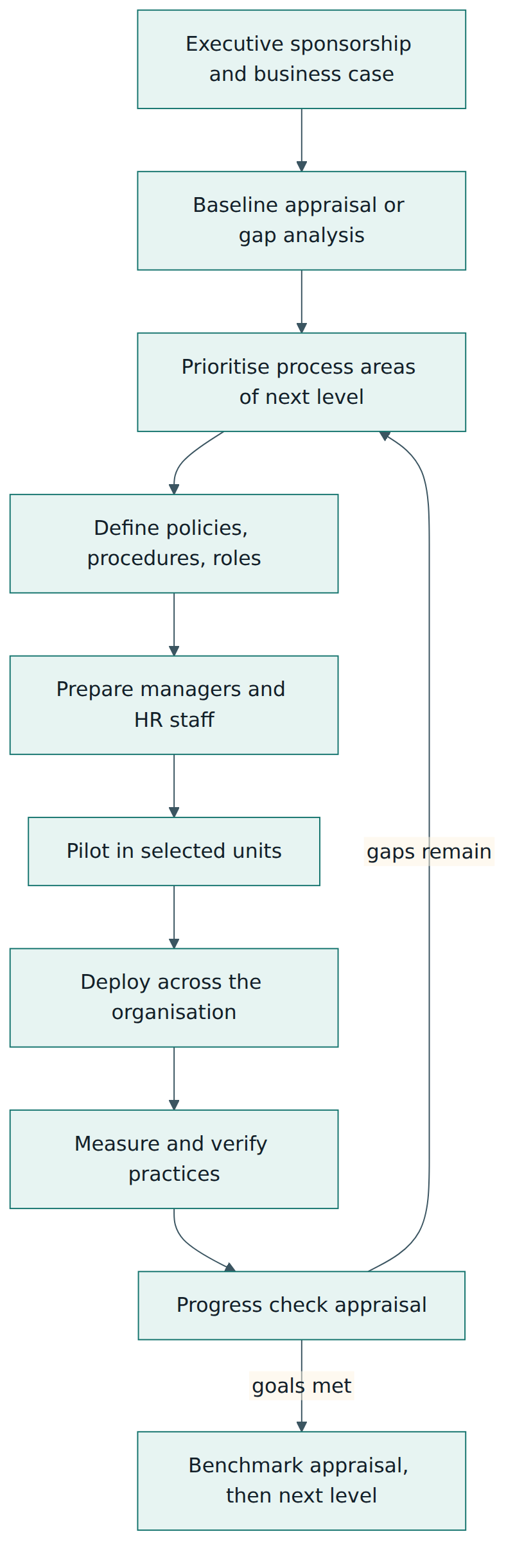
1. Sponsorship and business case. The programme starts with an executive who wants a business outcome: lower attrition of key staff, faster ramp-up of new hires, stronger succession, or a workforce able to sustain process maturity. The People CMM is most useful when tied to such outcomes rather than to a certificate.
2. Baseline. A light appraisal or gap analysis compares current practices with the goals of the next level. It also identifies strengths that should be preserved.
3. Prioritise. The organisation usually targets the process areas of the next maturity level as a bundle. The model's research basis is that people practices reinforce each other; performance management without equitable pay, or empowerment without communication skills, tends to fail.
4. Define. For each process area, a small working group drafts the policy, procedures, templates and role descriptions. At level 2 these can be simple: a documented selection process, a performance objective template, a unit training plan, a compensation strategy reviewed for equity.
5. Prepare people. Managers are trained to conduct selection interviews, performance discussions and development conversations, and HR staff learn to support them. This addresses the Ability to Perform category.
6. Pilot and deploy. New practices are tried in a few units, adjusted, and then rolled out with communication to the whole workforce. Individuals need to see that the practices are real and fair.
7. Measure and verify. Simple measures show whether practices are happening (for example, the share of staff with documented objectives or completed training plans) and whether they work (time to fill positions, voluntary attrition among high performers). Executive reviews and HR checks verify compliance.
8. Check and continue. Interim appraisals show remaining gaps. When the goals of a level are met, the organisation may seek a formal rating and then begin the next level.
Typical artefacts
Evidence of a working People CMM implementation is ordinary HR and management material, used consistently: workforce policies; staffing and selection procedures; orientation plans; performance objectives and records of performance discussions; unit training plans and records; a compensation strategy and equity reviews; competency descriptions in a repository; a strategic workforce plan; personal development plans and career path descriptions; workgroup charters; mentoring programme objectives; competency-based asset libraries; and, at higher levels, process performance baselines and capability trend data. The model does not require any particular software tool.
Time horizons
Level 2 practices usually run in short cycles such as a financial year: annual budgets, periodic objectives and pay reviews. Level 3 and above add longer strategic horizons — workforce plans that look three to five years ahead for critical competencies. Moving one maturity level is therefore a multi-year effort in most organisations, and the culture change matters as much as the documents.
Lesson 5 – Assessment, appraisal and ratings
Appraisal, not certification
Organisations are appraised against the People CMM; they are not certified the way an ISO 9001 management system is certified by an accredited body. An appraisal examines an organisational unit's practices against the model and produces findings — strengths and weaknesses — and, for the most rigorous class, a maturity level rating. Press releases often say "PCMM Level 5 certified", but the accurate wording is "appraised and rated at maturity level 5" for a defined organisational unit at a given date.
The SCAMPI with People CMM method
The original People CMM-Based Assessment Method was retired by the SEI: from 2008 the SEI stopped accepting its results. Since then the supported method has been the Standard CMMI Appraisal Method for Process Improvement (SCAMPI) applied to the People CMM, often called "SCAMPI with People CMM". The 2009 report describes three classes.
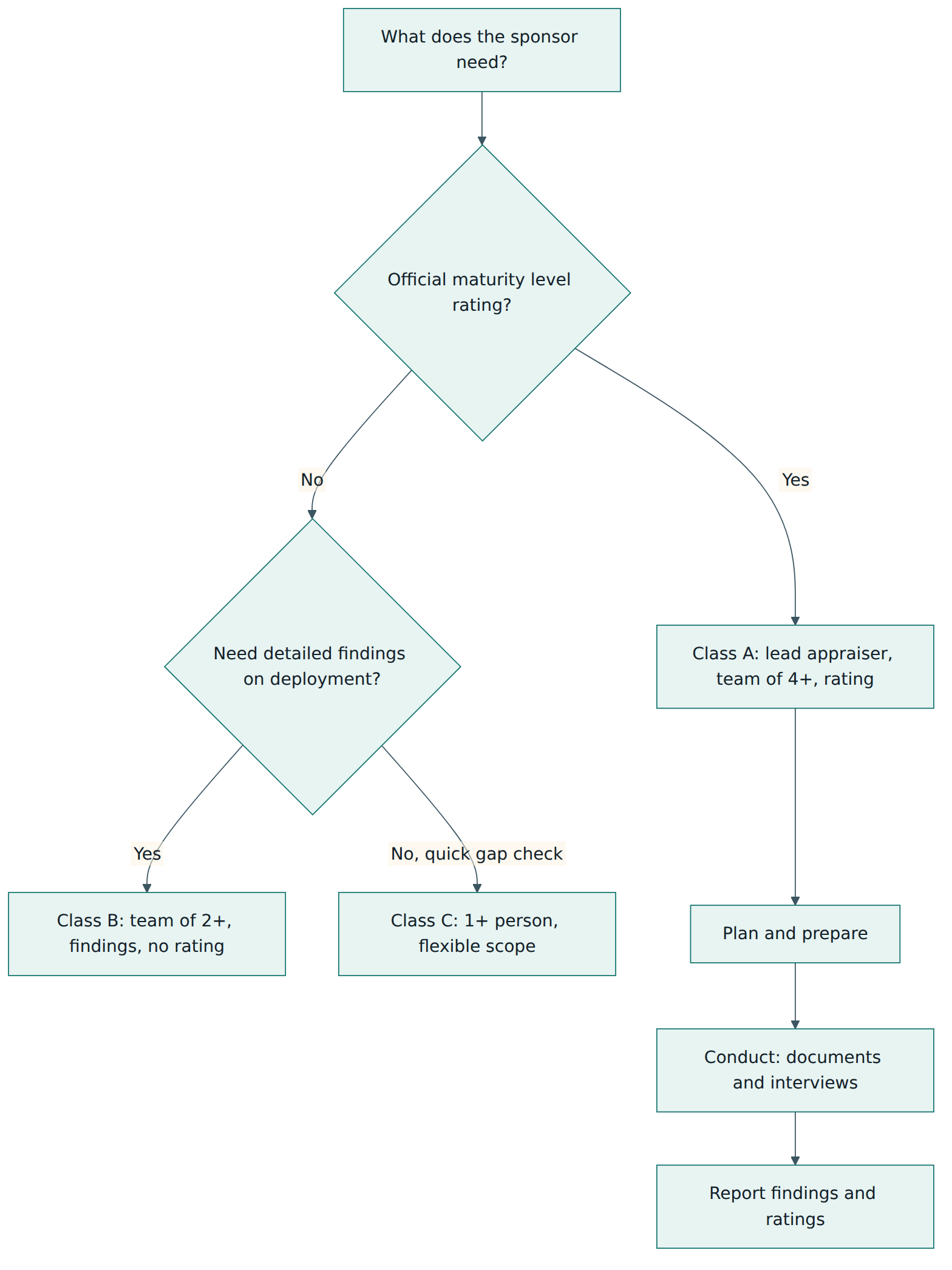
- Class A is the most rigorous and the only class that can produce a maturity level rating suitable for benchmarking. It is led by an authorised lead appraiser with a trained team (at least four people in the SEI's 2009 rules), requires both documents and interviews as objective evidence, and must cover the whole organisational unit in scope.
- Class B uses fewer resources (a minimum team of two). It gives detailed findings and characterises how well practices are deployed, which makes it good for checking progress towards a target level. It does not produce ratings.
- Class C is the lightest. One trained person can perform it, the scope can be a single process area, goal or practice, evidence can come from documents or interviews (even questionnaires), and validation of findings with participants is not required. It is used for quick gap analyses, readiness checks and monitoring new practices.
How a Class A appraisal works
A Class A appraisal has three phases. In Plan and prepare, the sponsor states objectives, and the lead appraiser and organisation agree the organisational unit, the process areas in scope, the sample of units and the interview plan; the organisation usually gathers documented evidence in advance. In Conduct, the team verifies documents, interviews managers, HR staff and individuals at several levels, and reaches consensus on whether each practice is implemented across the organisational unit. Goal ratings are derived from practice implementation, process area ratings from goal ratings, and the maturity level from the process areas of that level and all lower levels. In Report, the team presents findings and ratings to the sponsor, and an appraisal data package goes to the model steward for quality control.
Because the People CMM deals with organisational units such as departments or business units, the evidence base differs from a CMMI project-focused appraisal: interviews include HR and managers, and practices are checked at organisation, unit, workgroup, competency and individual levels. Appraisal interviews follow a non-attribution rule so that individuals can speak openly.
Validity, multi-model appraisals and rating limits
Under the SEI's 2009 policies, Class A results were valid for a maximum of three years from the end of the appraisal. A People CMM Class A appraisal could also be combined with a CMMI appraisal in a multi-model appraisal, sharing conventions and logistics, but the People CMM result is reported as a separate analysis with its own maturity level. Remember the status note in the course overview: current appraisal rules and availability are set by the steward (now ISACA's CMMI Institute), so confirm them before relying on these 2009 figures.
A rating is a statement about a specific organisational unit at a specific time. It does not say every team in a large company works at that level, nor that the level will hold if practices decay. When you assess a supplier, ask which unit was appraised, when, by whom, and at which level, and prefer to see the profile of strengths and weaknesses rather than only the number.
Lesson 6 – Worked example
This example is fictional but realistic. Kestrel Analytics is an IT and data services company with about 1,400 employees in two delivery centres. It holds ISO 9001 certification and has used CMMI for its delivery processes for several years. Clients are satisfied with quality, but the company suffers from high attrition of experienced data engineers, uneven appraisal practices between managers, and slow staffing of new projects. The chief executive asks the HR director and the head of delivery to use the People CMM to fix this.
Step 1 – Sponsorship and objectives
The chief executive becomes the sponsor and sets business objectives for the programme: cut voluntary attrition among senior engineers, reduce the time to staff a new project, and give every employee a visible career path. A steering group of the HR director, two delivery heads and the quality manager is formed. Everyone agrees that a maturity rating is a secondary goal; the primary aim is these business outcomes.
Step 2 – Baseline
An external consultant trained in the People CMM runs a Class C gap analysis over three weeks, interviewing managers and staff in a sample of units and reviewing HR documents. Findings: recruiting and selection are reasonably formal (a strength in Staffing), but performance objectives are not linked to project commitments, some managers never hold performance conversations, training is booked ad hoc with no unit plan, and pay rises are negotiated case by case, so staff perceive them as unfair. Communication of company results is limited to senior managers. The verdict: Kestrel operates at maturity level 1, with partial implementation of several level 2 process areas.
Step 3 – Level 2 programme
The steering group decides to implement all six level 2 process areas together over 18 months, rather than only Performance Management, because the gap analysis showed that unfair pay and missing training would undermine any new appraisal process. It assigns an owner for each process area: an HR business partner for Staffing and Compensation, a delivery manager for Performance Management, the L&D lead for Training and Development, the facilities manager for Work Environment and a communications manager for Communication and Coordination.
Concrete changes include: a capacity check before accepting new project commitments, so units are not chronically overloaded; a standard objective-setting template linked to each person's committed work; quarterly performance conversations, with a simple record; a training plan for every unit based on the skills needed for current assignments; a company-wide pay structure and an annual equity review; noise and equipment improvements in the older office; and monthly open forums where delivery heads share results and answer questions. Each process area receives a policy signed by the chief executive (Commitment to Perform), manager training on conversations and interviewing (Ability to Perform), a few simple measures (Measurement and Analysis) and quarterly reviews by the steering group (Verifying Implementation).
Step 4 – Checking progress
After a year, a Class B appraisal finds that most practices are deployed, but two units still skip performance conversations during busy release periods, and the compensation equity review has not been explained to staff. The owners fix these weaknesses: the conversations are moved to fixed dates outside release windows, and the HR director presents the equity review results at an open forum. Measures show that the share of employees with documented objectives has risen from under half to almost everyone, and that attrition of senior engineers is starting to fall.
Step 5 – Rating and the next level
Six months later an authorised lead appraiser and a team of five conduct a Class A appraisal of the two delivery centres. All goals of the level 2 process areas are rated satisfied and the organisational unit is rated at maturity level 2. The steering group now plans level 3. Its first step is Competency Analysis: defining workforce competencies such as data engineering, data science, cloud operations and delivery management, with their knowledge, skills and process abilities. These descriptions will then feed Workforce Planning (how many people in each competency the three-year strategy needs), Competency Development (graduated learning paths), Career Development (technical and management career ladders) and Competency-Based Practices (pay and selection partly based on competency growth). Workgroup Development and Participatory Culture will follow, building on the communication habits created at level 2.
What the example shows
Kestrel did not buy a tool or write a thick manual. It changed how managers behave, made pay fairer and more transparent, connected people practices to business commitments, and kept the practices alive through policy, preparation, measurement and review. It also benefited from its CMMI work: delivery processes were already defined, which will make competency-based processes at level 3 easier to describe. The People CMM gave it an order of work and a way to check progress, while the business objectives kept the programme honest.
Lesson 7 – Relationship to other standards and frameworks
The People CMM is one of several frameworks that touch people management. Knowing the differences helps you combine them instead of duplicating work.
| Framework | What it is | How it relates to the People CMM |
|---|---|---|
| CMMI V3.0 (ISACA) | Best-practice model for capability and performance across domains such as development, services, suppliers, security, safety, data, virtual work and people. | The People CMM grew out of the same maturity framework. CMMI's People domain and Workforce Empowerment practice area address some of the same themes in CMMI's architecture, while the People CMM provides a deeper, stand-alone, staged model of 22 workforce process areas. The two were designed to be used together: People CMM builds the workforce and culture that sustain process maturity. |
| ISO 9001 | International requirements standard for quality management systems, certified by accredited bodies. | ISO 9001 requires the organisation to determine and ensure the competence of people doing work that affects quality (clause 7.2) and to support awareness and communication. The People CMM goes much further, but its competency and training practices produce useful evidence for ISO 9001 audits. |
| ISO 10015 | ISO guidelines for competence management and people development within a quality management context. | Covers how to define competence needs, plan and deliver development and evaluate results. It overlaps mainly with the Training and Development, Competency Analysis and Competency Development process areas, and is guidance rather than a maturity model. |
| ISO 30414 | ISO standard for internal and external human capital reporting; the 2025 edition, which replaced the 2018 guidelines, sets requirements and recommendations for metrics such as turnover, workforce costs and training. | Focuses on what to measure and report about the workforce. Its metrics can feed the Measurement and Analysis practices and the quantitative work of levels 4 and 5, but it does not describe practices or levels. |
| Baldrige Excellence Framework | US performance excellence framework with a Workforce category, used for self-assessment and the national quality award. | Assesses workforce environment and engagement as one part of overall organisational performance, using a scoring approach rather than maturity levels. The People CMM offers a detailed improvement path for that category. |
| Investors in People | UK-originated accreditation framework for people management practices, assessed by its own assessors. | Similar purpose, different owner and assessment scheme. Organisations sometimes use one for public accreditation and the other as an internal improvement roadmap. |
A few practical rules follow from these comparisons. If you already run CMMI, the People CMM is the natural partner for the people side, and joint planning prevents two improvement programmes from competing for the same managers' time. If you hold ISO 9001, map your competence and training procedures to the level 2 and level 3 process areas so the same records serve both. If you report human capital metrics under ISO 30414 or similar guidance, use those metrics as the measurement backbone of your People CMM programme. And if you use a business excellence framework, treat the People CMM as the detailed roadmap for strengthening its workforce criteria.
Common pitfalls and best practices
Common pitfalls
- Level fever. The rating becomes more important than the business benefit. Teams prepare for the appraisal instead of making practices work, and weaknesses are hidden. The 2009 model warns that this is most likely when ratings are used in contract awards, for example in outsourcing.
- Skipping levels. Introducing empowered teams, team bonuses or skills databases before basic performance management, fair pay and communication are in place. These high-maturity practices fail under stress and leave the workforce more cynical than before.
- Treating level 3 as the finish line. Competency definitions go stale as technology and business change. Without renewal, managers stop using them and the organisation slides back towards level 2 or even level 1.
- Dropping inconvenient process areas. Declaring a process area "not applicable" because it is hard, without analysing its thread. Removing one area weakens others at the same level and higher in the same thread.
- Making it an HR-only project. If managers do not own the practices, the documents exist but the behaviour does not change.
- Piecemeal adoption. Implementing one popular practice in isolation instead of the reinforcing bundle of a maturity level.
- Paperwork over practice. Producing forms and templates for the appraisal while performance conversations and development plans remain empty rituals.
Best practices
- Start from business objectives. Define what the organisation wants to improve — retention, ramp-up time, succession, delivery predictability — and measure it alongside practice adoption.
- Secure executive sponsorship and manager ownership. Executives set policy and resources; managers perform most workforce activities; HR designs and supports.
- Implement a level as a bundle. Plan all process areas of the target level together, accepting that some will move faster than others.
- Institutionalise deliberately. For every process area, address policy, preparation, measurement and verification, not only the implementation practices.
- Use appraisals for learning. Use lighter appraisal classes for gap analysis and progress checks, and keep the full rating for when it is genuinely needed.
- Adopt higher-level practices carefully. A higher-level practice may be adopted early if it addresses a real need, but check the foundation it depends on and limit how many you introduce out of order.
- Integrate with existing frameworks. Reuse CMMI, ISO 9001 and human capital reporting work instead of creating parallel systems.
- Use maturity profiles when evaluating suppliers. Compare strengths and weaknesses against process area goals as a risk analysis, rather than relying on the level number alone.
Summary and key takeaways
- The People CMM, from the SEI, applies the CMM maturity framework to workforce practices; the current edition is Version 2.0, Second Edition (2009), and stewardship has passed to ISACA's CMMI Institute.
- Its aim is to raise workforce capability — knowledge, skills and process abilities — in line with business objectives, by installing people practices as an integrated system.
- Five maturity levels (Initial, Managed, Defined, Predictable, Optimizing) contain 22 process areas, each at exactly one level, linked by four threads.
- Each process area has goals (required), practices (expected) and informative material; practices fall into Practices Performed plus four institutionalisation categories.
- Level 2 makes managers responsible for their people; level 3 builds organisation-wide competencies; level 4 manages capability quantitatively and empowers workgroups; level 5 improves continuously.
- Organisations are appraised, not certified; only the most rigorous appraisal class produces a maturity level rating, and a rating applies to a defined unit at a point in time.
- Level fever, level skipping, ignoring process areas and HR-only ownership are the classic failure modes.
- The People CMM complements CMMI, ISO 9001, ISO 10015, ISO 30414 and business excellence frameworks rather than replacing them.
Reflection questions
- Think of your own organisation. Which of the six level 2 process areas are working well, which are weak, and what evidence would you show an appraiser for each?
- Pick one workforce competency that matters to your business. How would you describe its knowledge, skills and process abilities, and who belongs to its competency community?
- Your leadership wants to introduce team-based bonuses next quarter. Using the threads and level structure, what foundations would you check first, and what risks would you raise?
- A client asks for proof of your People CMM maturity. What would you tell them about what a rating means and does not mean, and what additional information would you offer?
- How would you combine an existing CMMI or ISO 9001 programme with a People CMM programme so that managers experience one coherent set of practices rather than two?
Further reading and official sources
- People Capability Maturity Model (P-CMM), Version 2.0, Second Edition – Software Engineering Institute, Carnegie Mellon University
- People CMM Version 2.0, Second Edition (full report, CMU/SEI-2009-TR-003, PDF) – Software Engineering Institute
- People Capability Maturity Model (P-CMM) Version 2.0 (2001, CMU/SEI-2001-MM-001) – Software Engineering Institute, Carnegie Mellon University
- CMMI People – CMMI Institute, ISACA
- CMMI Performance Solutions – ISACA
- People Capability Maturity Model – Wikipedia
Original tutorial by xOps School (DevOpsSchool Private Limited), written from public sources about People CMM. Not affiliated with or endorsed by the standard's owner; standard names are trademarks of their owners. Buy the official standard from its publisher for the authoritative text.