
VDA 6.3 – Tutorial (about 60 minutes)
- View
VDA 6.3 is the process audit method of the German automotive industry. Carmakers use it to judge whether a supplier's development and production processes can be trusted to deliver good parts, and suppliers use it to audit their own plants and their own sub-suppliers. It gives every auditor the same question catalogue, the same scoring scale and the same rules for turning scores into an A, B or C rating. After this tutorial you will be able to explain how a VDA 6.3 audit is structured, read and challenge an audit result, and prepare a plant or a project for one.
Course overview
Edition and status: the current edition is VDA Volume 6 Part 3, Process Audit, 4th revised edition, January 2023 (released 2 January 2023), usually cited as VDA 6.3:2023. It is published by the Quality Management Center of the German Association of the Automotive Industry (VDA QMC) in German and English. The method was first published in 1998 and revised in 2010, 2016 and 2023. The 2023 edition replaced the 3rd revised edition of December 2016; VDA QMC states that results from the two editions are not directly comparable. VDA QMC lists the 2023 edition as the present edition, and no newer revision has been announced; binding clarifications are issued separately as "sanctioned interpretations" (SIs) and FAQs. VDA 6.3 is an industry association publication, not an ISO or IEC standard, and it does not lead to a company certificate. Verified 2026-10-29 against the VDA QMC webshop entry for the 2023 edition, the VDA QMC SI/FAQ sheet for the 2023 edition and the VDA QMC process auditor qualification pages.
Who it is for: supplier quality engineers, internal auditors, plant and quality managers, project and launch managers, and engineers at automotive suppliers or carmakers who are new to VDA 6.3 and expect to perform, host or act on a process audit.
Prerequisites: none. A rough picture of how a car part is developed and produced helps, and familiarity with quality basics such as FMEA or control plans is useful but not required. Every term is explained when it first appears.
By the end of this tutorial:
- You will be able to explain what a process audit is and how it differs from a system audit and a product audit.
- You will be able to name the process elements P1 to P7 and say which ones apply to development and which to series production.
- You will be able to describe how the production element P6 is evaluated per process step using the turtle model.
- You will be able to apply the 10-8-6-4-0 scoring scale, calculate degrees of fulfilment and derive the A, B or C classification, including the downgrading rules.
- You will be able to plan and run a VDA 6.3 audit from risk analysis to closed action plan.
- You will be able to explain how process auditors are qualified and why there is no VDA 6.3 company certificate.
- You will be able to position VDA 6.3 against IATF 16949, ISO 19011, Automotive SPICE and related VDA volumes.
Lesson 1 – Origins, purpose and scope
Why a common process audit method exists
A car is assembled from thousands of parts, most of them made by a supply chain of tier-1 suppliers (modules and systems) and tier-2 or tier-3 suppliers (components, materials, sub-assemblies). A defect at any point in this chain can stop a vehicle assembly line, trigger a field recall or, in the worst case, put people at risk. The carmaker, usually called the OEM (original equipment manufacturer), therefore needs to know not only whether parts are good today but whether the processes that make them will keep producing good parts tomorrow.
Inspecting finished parts gives only a snapshot. A management system certificate tells you that documented procedures exist, but not how well a particular production line, with its particular machines and people, actually runs. What the buyer needs is a close look at the real processes, on the shop floor and in the project office, judged against expectations that every auditor applies the same way. That is the job of a process audit.
Before VDA 6.3, each German carmaker had its own audit questionnaire and its own scoring logic. A supplier serving four carmakers could be audited four times on the same line with four different checklists and get four results that could not be compared. The VDA, the German Association of the Automotive Industry, responded by publishing a common process audit method in 1998. Its quality body, VDA QMC, maintains it and has revised it three times since. Today the method is used far beyond Germany: many global carmakers and tier-1 suppliers name VDA 6.3 in their supplier requirements, and suppliers in Asia and the Americas train VDA 6.3 auditors.
What a process audit is, and what it is not
Quality auditing in the automotive world uses three kinds of audit, and it pays to keep them apart from the start:
- A system audit checks whether a quality management system as a whole is complete and effective, for example against IATF 16949. It is broad and asks whether the organisation has the right processes in place.
- A process audit checks how well specific processes work in practice: a development project, a production line, a supplier management process. It is deep and asks whether these processes are capable of delivering the required quality reliably. VDA 6.3 belongs here.
- A product audit checks finished products against their specifications, from the customer's point of view. In the VDA family this is covered by a separate volume, VDA 6.5.
VDA 6.3 focuses on risk. Its aim is to find weaknesses in a process before they turn into defective parts, missed launch dates or customer complaints. The question catalogue is written so that an auditor can follow a product from the first project idea through development, purchasing and production to delivery and field support, and ask at each stage whether the process is under control.
Scope across the product life cycle
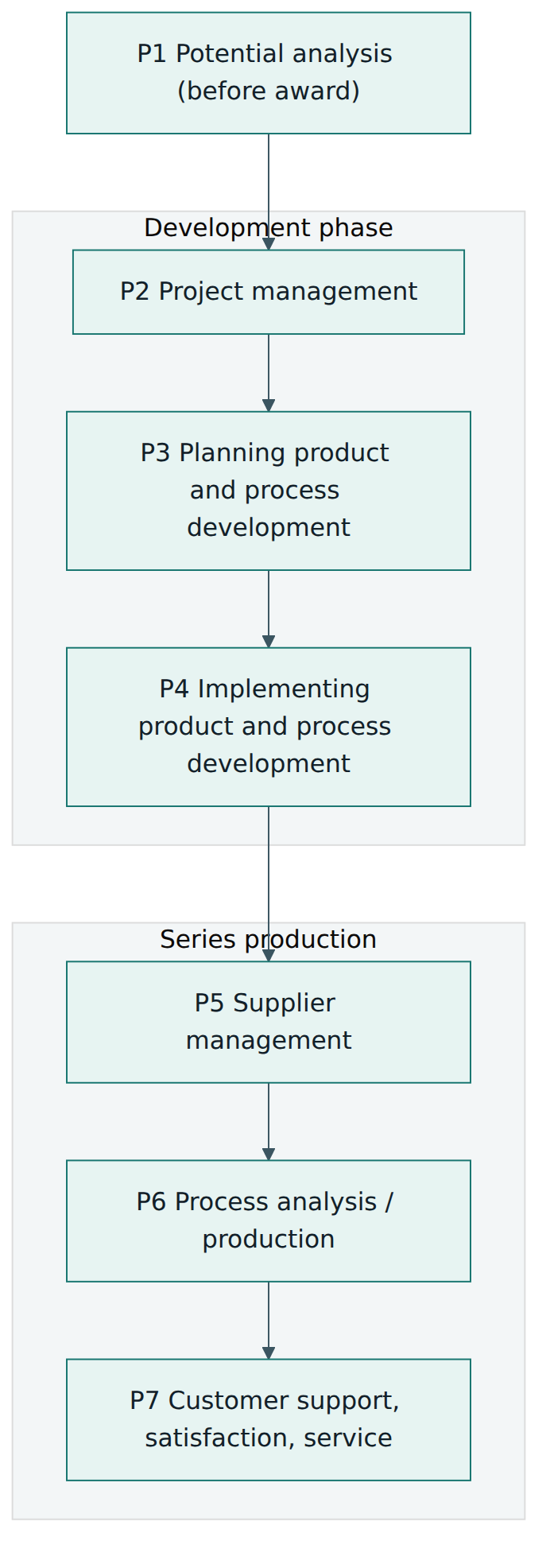
The 2023 edition focuses on physical products, such as parts and assemblies, including their embedded software. The 2016 edition also contained a chapter on process audits of services; the 2023 edition removed it. The volume's title lists four application areas: potential analysis of a candidate supplier, product and production process development, product and production process implementation, and series production. These areas are spread over seven process elements, named P1 to P7, which Lesson 3 explains in detail.
Who uses VDA 6.3
Three groups of users apply the same method for different reasons:
- Customers auditing suppliers. A carmaker or tier-1 supplier sends its supplier quality engineers to evaluate a candidate before awarding business, to check a project before launch, or to investigate a plant after quality problems.
- Organisations auditing themselves. IATF 16949 requires automotive suppliers to audit their manufacturing processes, and many customers expect VDA 6.3 to be the method used for these internal process audits.
- Suppliers auditing their own suppliers. A tier-1 supplier is responsible for its supply chain, so it uses VDA 6.3 on its tier-2 suppliers in the same way its customer uses it on them.
Because all three use the same catalogue and scoring rules, a result produced in one place can be understood in another.
What changed in the 2023 edition
The 2023 revision kept the core of the method and modernised the content. The questionnaire structure, the scoring scale per question, the A/B/C classification, the turtle model for production and the downgrading rules were all retained. The main changes were these:
- Software aspects were built into the questions, reflecting how much vehicle parts now depend on embedded software.
- The content was aligned with Automotive SPICE (for software and system development) and with the VDA maturity level assurance method for new parts.
- Requirements on purchasing activities were added to the development elements P3 and P4.
- Auditor qualification was specified, and notes on conducting remote audits were added.
- The general audit process chapter was removed, because ISO 19011 already describes how to manage and conduct audits; the chapters on services and on best practice and lessons learned were removed too, and the glossary moved online.
- The separate evaluation of transport and parts handling inside the production element was dropped, some questions of special significance were redefined, and some potential analysis questions were reallocated.
The catalogue grew from 58 to 59 questions. Since several questions and evaluation details changed, a score achieved under the 2016 edition cannot be compared one-to-one with a 2023 score, which matters when a customer looks at a supplier's audit history.
Lesson 2 – Key concepts and vocabulary
VDA 6.3 has a compact vocabulary. Many terms are translations of German originals, so you will see slightly different English wording in different companies. The meaning matters more than the exact label.
- Process audit – an evaluation of specific processes in practice, aimed at finding risks to quality, delivery and cost before they reach the customer.
- Potential analysis (P1) – an evaluation of a candidate supplier or a new location, line or technology before a contract is awarded; it predicts whether the organisation could run the required processes, using a selection of questions from the other elements.
- Process element – one of the seven blocks P1 to P7 into which the question catalogue is divided, each covering a stage of the product life cycle.
- Question catalogue – the set of 59 audit questions for P2 to P7, each with minimum requirements the auditor expects to see and examples of typical evidence.
- Star question (*-question) – a question of special significance, marked with an asterisk, whose low scores trigger stricter downgrading of the overall result.
- Process step – a distinct step of the production chain chosen for evaluation in P6, such as moulding, painting or final assembly; each selected step is evaluated with the full set of P6 questions.
- Sub-element – one of the six groups of questions inside P6 (inputs, process flow, personnel, material resources, effectiveness, outputs).
- Turtle model – a diagram that looks at a process from six sides: what goes in, what comes out, who does the work, with what equipment, by which method, and how performance is measured. VDA 6.3 uses it to structure P6.
- Degree of fulfilment – a percentage showing how many points were achieved out of the points possible for the evaluated questions; it is calculated for each element, process step and sub-element, and overall.
- Overall degree of fulfilment (EG) – the percentage of points achieved across all evaluated questions of the audit; the starting point for the classification.
- Classification – the final rating A (quality capable), B (conditionally quality capable) or C (not quality capable).
- Downgrading rules – rules that lower the classification, regardless of the overall percentage, when a single element, process step or star question shows a serious weakness.
- Product group – a set of similar products made with similar processes; when a supplier makes several product groups, the result can be stated per group.
- Special characteristics – product or process characteristics that affect safety, legal compliance, fit or function and need extra controls; the catalogue checks how they are identified and controlled.
- Risk analysis – the auditor's preparation step of identifying which processes and steps carry the highest risk, so that the audit time goes where it matters most.
- Remote audit / hybrid audit – an audit performed fully at a distance using communication technology, or partly on site and partly remote; the 2023 edition explains when this is suitable.
Three ideas that hold the method together
Evidence over intention. A VDA 6.3 auditor scores what the process actually does, shown through records, observation and interviews, not what a procedure says should happen. A control plan that lists a check is worth little if the operator at the station does not perform it.
Risk orientation. The audit cannot cover every station and every document. The auditor uses risk analysis to choose process steps and to decide how deep to go. A safety-relevant crimping step deserves more attention than a cardboard packing step.
Weakest link logic. A high average must not hide a critical weakness. This is why the downgrading rules exist: one badly controlled process step or one failed star question can lower the rating even when the overall percentage looks excellent.
Lesson 3 – Structure of the volume and the question catalogue
How the book is organised
Besides the question catalogue for P2 to P7, the 2023 volume contains application guidance (what a process audit is, where it fits in the product life cycle, how the potential analysis differs from the process audit, and how to identify process risks before an audit), requirements for the qualification of process auditors, notes on remote audits, a chapter on the potential analysis (P1) and the rules for evaluating a process audit: scoring of single questions, degrees of fulfilment, overall classification, downgrading and product groups. Terms are no longer defined in the book itself but in an online glossary that VDA QMC maintains for all its volumes.
The process elements in detail
Each element is a group of questions about one stage of the product life cycle. The table below paraphrases the focus of each element; the exact questions and their minimum requirements are in the volume.
| Element | Focus | Typical evidence an auditor looks for |
|---|---|---|
| P1 Potential analysis | Can a candidate supplier or new site run the processes needed for a new product? | Experience with similar products, development and production capacity, quality system, sub-supplier base, logistics |
| P2 Project management | Is the development and launch project organised, resourced, planned and steered? | Project organisation, resource plans, customer-agreed schedule, risk and change management, escalation |
| P3 Planning product and process development | Are requirements known, feasibility assessed and development activities planned? | Requirements lists, feasibility studies, development and test plans, purchasing plans, resource plans |
| P4 Implementing product and process development | Are the plans carried out and is the product and process proven ready for series production? | FMEAs, prototype and validation results, approvals, run-at-rate trial, handover to production |
| P5 Supplier management | Are purchased parts and materials under control? | Approved supplier list, flow-down of customer requirements, supplier targets and performance, incoming goods |
| P6 Process analysis / production | Is each production step capable and controlled? | Control plan in use, special characteristics, qualified operators, equipment and gauges, process data, outputs |
| P7 Customer support, satisfaction and service | Does the supplier meet customer requirements after delivery and react well to problems? | Customer scorecards, complaint handling, failure analysis, supply security, competent staff |
Elements P2 to P4 apply when the audited organisation develops a product and its production process, or when a project is still in development. Elements P5 to P7 apply to series production. In the development elements, many questions are evaluated separately for product development and for process development, because a supplier may be strong at designing parts and weak at designing the manufacturing process, or the other way round. A pure build-to-print supplier with no design responsibility will see the product side of the development questions narrowed accordingly.
The production element P6 and the turtle model
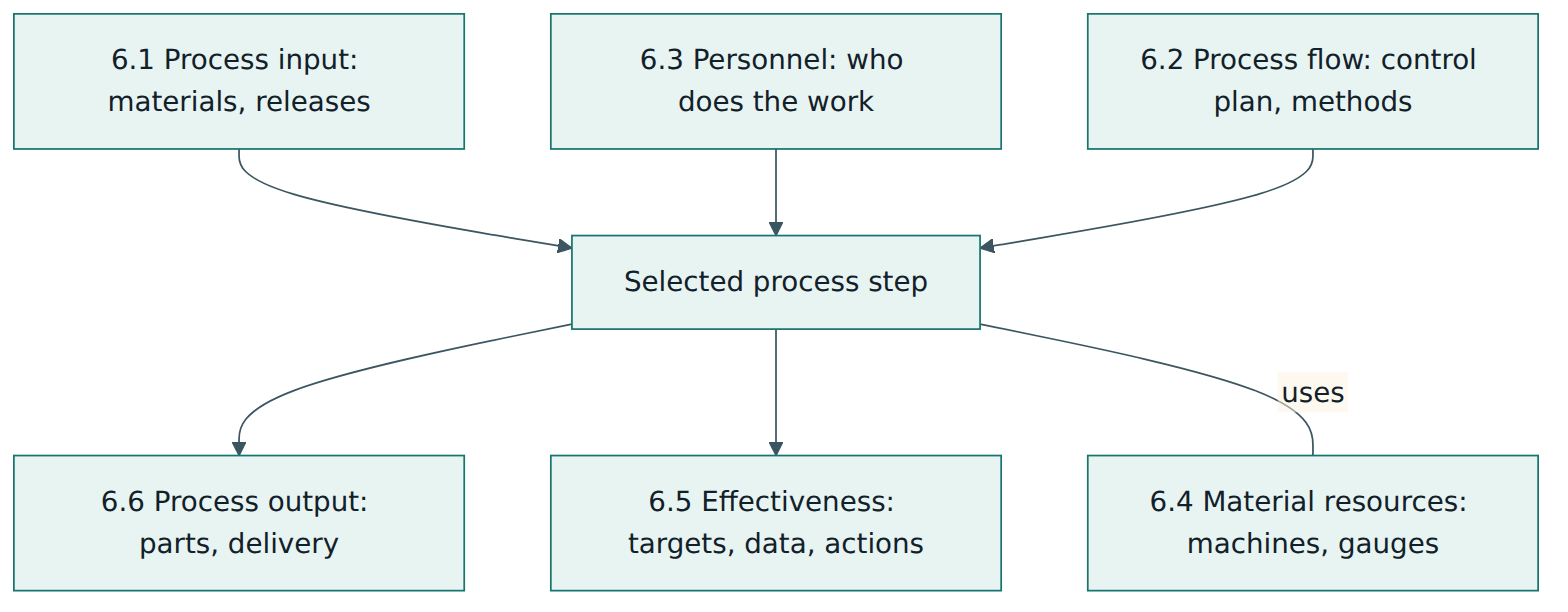
P6 is the largest element and the heart of most audits of running plants. Instead of evaluating "production" as one block, the auditor selects the relevant process steps and evaluates each of them with the full set of P6 questions. The questions are grouped into six sub-elements that follow the turtle model:
- 6.1 Process input: are the right materials available in the right quantity, properly stored, identified and released, and are changes during series production tracked?
- 6.2 Process flow and work content: is the control plan complete and applied, are restarts after interruptions released, are special characteristics controlled, are nonconforming parts segregated, and are mix-ups prevented?
- 6.3 Personnel: are operators qualified, do they know their responsibilities and authority for quality, and are enough people available?
- 6.4 Material resources: can the equipment and tools achieve the requirements, are they maintained, are gauges and test equipment capable, and are workplaces and storage suitable?
- 6.5 Effectiveness and efficiency: are targets set, are quality and process data recorded and analysed, are causes of deviations found and corrective actions checked for effect, and are processes and products audited?
- 6.6 Process output: are quantities matched to demand, are finished parts stored and packed correctly, are records kept, and are customer requirements met at delivery?
The 2016 edition added a seventh evaluation, EU7, that rated transport and parts handling separately from questions spread across the sub-elements. The 2023 edition removed that separate evaluation; handling and logistics topics are still covered by the relevant questions, for example on input and output.
Star questions
Some questions are marked with an asterisk because a failure there has a direct impact on the customer. Typical topics are the control of special characteristics, the handling of nonconforming parts, the capability of equipment and gauges, change control and the analysis of customer complaints. The 2023 edition redefined some of the star questions, so a question that carried the star in 2016 may not carry it now, and the reverse; always check the marking in the edition you are using. Star questions are scored on the same scale as all other questions, but low scores on them trigger downgrading rules (Lesson 5).
Minimum requirements and examples
Each question in the catalogue comes with minimum requirements and with examples. The minimum requirements describe what must be fulfilled for the question to be considered met; the examples give typical evidence and situations to look at. Auditors must not turn the examples into a checklist of mandatory items, and they must not ignore the minimum requirements either. Judging whether evidence meets the intent of a question, in the context of that product and process, is the core skill of a VDA 6.3 auditor.
Lesson 4 – How a VDA 6.3 audit works in practice
Triggers and audit planning
Process audits rarely happen at random. Typical triggers include:
- selecting a new supplier or a new production location for a new part (potential analysis);
- checking a development project at defined milestones before launch (P2 to P4);
- routine audits of series production as part of an annual audit programme (P5 to P7);
- quality problems such as repeated complaints, line stops at the customer or field failures;
- major changes such as relocating production, introducing a new technology or changing a key sub-supplier;
- internal process audits required by the organisation's own quality system.
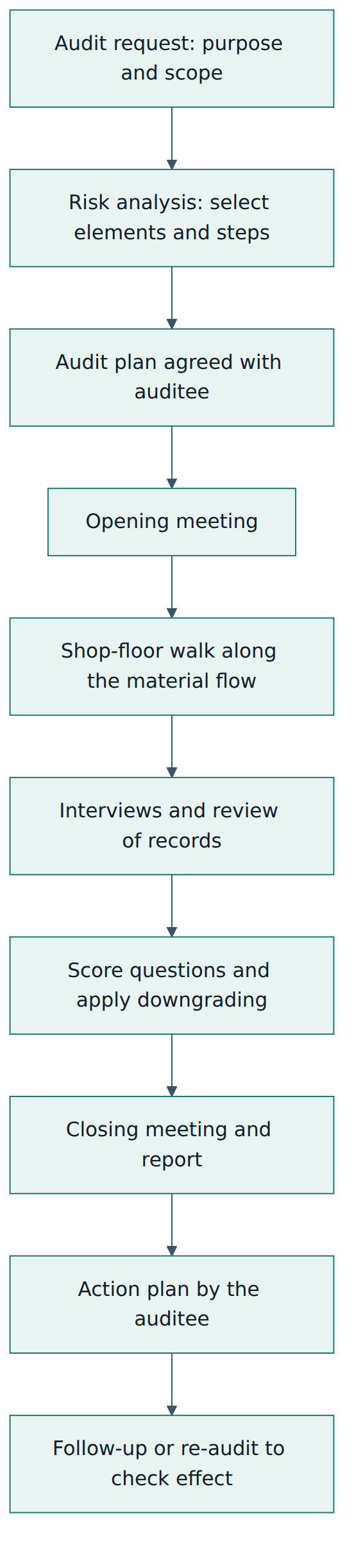
The client of the audit, for example the customer's purchasing or quality department, defines the purpose and scope: which elements, which product group, which process steps, and which location. Because the 2023 edition no longer repeats a generic audit procedure, auditors follow the principles of ISO 19011 for programme management, audit planning, conduct and follow-up, and use VDA 6.3 for the content and evaluation.
Risk analysis and preparation
Good preparation separates a useful audit from a tour. Before arriving, the auditor gathers information such as the process flow chart, the control plan, the process FMEA, recent quality performance (ppm rates, complaints, delivery performance), open actions from earlier audits, and any customer-specific requirements. With this information the auditor performs a risk analysis to decide which process steps to evaluate in P6 and which topics need special attention. A step that handles a safety-relevant special characteristic, that has produced complaints, or that uses a new technology, should be selected. Simple steps with no history of problems may be left out if time is short.
The auditor then prepares an audit plan with the timing, the areas to visit and the people to interview, and agrees it with the audited organisation.
On site
The audit begins with a short opening meeting to confirm scope, schedule and contacts. For a production audit the auditor then usually walks the process in the direction of the material flow: from goods receipt and incoming inspection, through each selected process step, to final inspection, packing and shipping. At each step the auditor observes the work, talks to operators and team leaders, and samples evidence: Is the current revision of the work instruction at the station? Does the operator know what to do when a gauge shows a part out of tolerance? Are the reaction plans in the control plan being followed? Where are blocked parts kept and who releases them?
Interviews cover the remaining elements. For P2 to P4 the auditor reviews project plans, feasibility studies, FMEAs, test reports and approval records. For P5 the auditor checks how sub-suppliers are selected, approved, monitored and developed. For P7 the auditor looks at complaint records, problem-solving reports and customer scorecards.
Throughout, the auditor records findings with concrete evidence: where, what was seen, which requirement it relates to. A finding such as "work instruction at station 40 showed revision C; the released revision is D" is useful. A finding such as "documentation weak" is not.
Remote and hybrid audits
Since the pandemic years, many audits have been partly remote. VDA QMC first published a recommendation for remote VDA 6.3 audits in February 2021, and the 2023 edition added notes on remote audits to the volume. The recommendation chooses between an on-site, a hybrid (part remote, part on site) and a fully remote audit according to risk and influencing factors: product criticality such as safety-relevant special characteristics, unknown processes or locations, poor performance indicators and low product or process maturity all point towards being on site. It also states that a remote audit cannot replace a complete process audit of P2 to P7. Development elements P2 to P4 suit remote evaluation best, parts of P5 and P7 can be covered remotely, and only some P6 questions are suitable, depending on risk. Shop-floor topics such as storage conditions, the separation of rejected parts or the state of equipment are hard to judge through a camera. A potential analysis can be carried out remotely only to a limited extent, because seeing the actual site is a large part of its purpose.
Scoring, closing meeting and report
After the evidence is collected, the auditor scores each evaluated question, calculates the degrees of fulfilment and applies the downgrading rules (Lesson 5). The results and the main findings are presented in a closing meeting so that the audited organisation hears them before leaving the room and can clarify misunderstandings. The written report states the scope, the scores per question, the degrees of fulfilment, the classification, the findings and any downgrading that was applied.
Action plan and follow-up
Every question that does not reach full marks is an improvement opportunity, and every significant finding needs an action. The audited organisation creates an action plan with root causes, corrective actions, responsible persons and deadlines; the audit client agrees the deadlines. Good action plans address causes, not symptoms: if an operator did not know the reaction plan, the action is not only to retrain that operator but to find out why the training system let it happen. The client then checks that the actions were implemented and effective, through evidence review or a re-audit. A C rating usually leads to escalation in the customer's supplier management process, for example restrictions on new business until a re-audit shows improvement; the exact consequences are set by each customer, not by VDA 6.3.
Lesson 5 – Scoring, classification and auditor qualification
The 10-8-6-4-0 scale
Each evaluated question receives one of five scores. Intermediate values do not exist.
| Points | Meaning (paraphrased) |
|---|---|
| 10 | Requirements fully met |
| 8 | Requirements largely met; only minor deviations |
| 6 | Requirements partly met; more significant deviations |
| 4 | Requirements inadequately met; major deviations |
| 0 | Requirements not met |
The scale is deliberately asymmetric: there is no 2. The jump from 4 to 0 marks the difference between a process that works badly and one where the requirement is not fulfilled at all. Questions that genuinely do not apply, for example development questions at a build-to-print supplier, are marked as not evaluated and do not enter the calculation. At least two-thirds of the questions of each audited element, sub-element or process step must be evaluated. According to a VDA QMC sanctioned interpretation for the 2023 edition, an element that misses this two-thirds rule is left out of the overall result, no degree of fulfilment is shown for it and the downgrading rules are not applied to it; when several process steps are audited, the rule is applied to all questions of a sub-element across the steps together.
Degrees of fulfilment
From the scores the auditor calculates percentages at several levels:
- for each process element P2 to P7 (written EP2 to EP7): points achieved in that element divided by the points possible for the evaluated questions;
- for each selected process step in P6 (written E1, E2, and so on): the same calculation over the P6 questions for that step;
- for each P6 sub-element across all steps (written EU1 to EU6);
- overall (EG): all points achieved divided by all points possible across the evaluated questions of the audit.
Suppose an audit has 58 evaluated questions, so 580 points are possible, and the supplier achieves 510 points. The overall degree of fulfilment is 510 divided by 580, or about 88 %. When a supplier makes several product groups, the overall result can also be expressed per product group, so that a strong product group does not hide a weak one.
From percentage to classification
| Overall degree of fulfilment | Classification | Meaning |
|---|---|---|
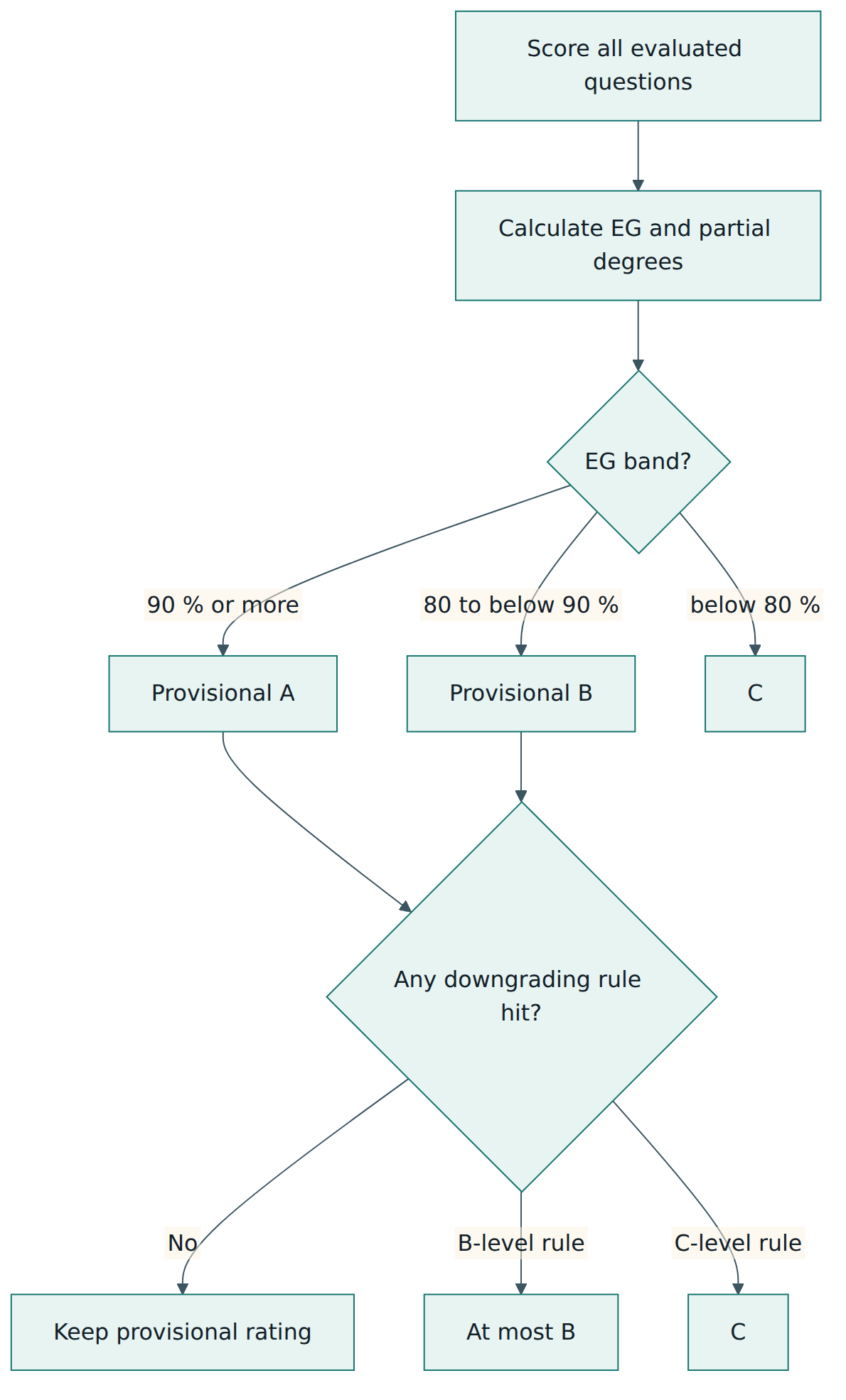
| 90 % or more | A | Quality capable |
| 80 % to below 90 % | B | Conditionally quality capable |
| below 80 % | C | Not quality capable |
Downgrading rules
The percentage band is only the starting point. VDA 6.3 then applies downgrading rules, so that a serious weakness in one place cannot be averaged away. Downgrading became mandatory with the 2010 edition, and the 2023 edition kept the rules of the 2016 edition. In outline they work like this:
- A result is lowered to at most B when any evaluated element (EP2 to EP7), any P6 process step or any P6 sub-element falls below 80 %, when any star question scores 4, or when any other question scores 0.
- A result is lowered to C when any evaluated element or any P6 process step falls below 70 %, or when any star question scores 0.
Downgrading only ever lowers a rating. An audit with an overall 93 % but one process step at 76 % is classified B, not A. An audit with an overall 86 % but a star question scored 0 is classified C. Several rules can apply at once; the strictest one decides. Always apply the downgrading table in your own copy of the volume, because the precise wording and conditions there are authoritative.
Evaluating a potential analysis
The potential analysis is evaluated differently because it judges what an organisation could do, not what it is already doing for this product. It uses a selection of questions taken from P2 to P7 (the 2023 edition reallocated some of them) and rates them with a traffic-light scheme of green, yellow and red rather than with points. The overall outcome feeds the customer's decision on whether the candidate can be nominated for the business, often with conditions or follow-up actions if the result is not fully green. A potential analysis result is never mixed into the A/B/C classification of a process audit.
Who may perform VDA 6.3 audits
VDA 6.3 does not certify organisations. There is no accredited certification body that issues a "VDA 6.3 certificate" for a plant, and an audit result is a rating owned by the audit client, not a certificate. What can be certified is the auditor. VDA QMC offers a qualification path for the "Certified Process Auditor VDA 6.3". In its current form for the 2023 edition, the candidate completes the VDA 6.3:2023 process auditor qualification training and then sits an examination day. Admission is checked by application review; VDA QMC lists prerequisites such as a three-day auditor course based on ISO 19011, proof of knowledge of the Automotive Core Tools, and at least five years of full-time professional experience, preferably in automotive manufacturing, including at least two years in quality-related work. The examination is an audit simulation followed by the formulation and justification of findings and an interview, rather than a written test.
Passing leads to a registered certificate valid for five years. To extend it, an auditor must show continued audit practice; for the next extension VDA QMC asks for ten audits with at least twenty audit days, mostly on site. Auditors who held a 2016-edition certificate could move to the 2023 edition through an upgrade training and an extension application. Many customers additionally require their suppliers' internal auditors or their own supplier auditors to hold this qualification, or an equivalent internal one, and to have product and process knowledge in the technology being audited.
Lesson 6 – Worked example: a series production audit at a tier-2 supplier
The situation
Kessler Kunststofftechnik (a fictional company) is a tier-2 supplier with 350 employees. It makes plastic housings for parking sensors: the housings are injection moulded, painted in body colour and fitted with a seal and a metal clip before being shipped to a tier-1 electronics supplier, which assembles the sensors and delivers them to two carmakers. Over the last six months the tier-1 customer has received three complaints about paint defects and one about a missing clip. The customer's supplier quality engineer, a certified VDA 6.3 process auditor, announces a process audit of series production.
Step 1 – Scope and risk analysis
The audit request states the purpose (evaluate the capability of series production after complaints), the product group (painted sensor housings) and the elements: P5, P6 and P7. Development elements are out of scope because the product is in series production and the design belongs to the customer.
Before the visit the auditor reviews the process flow chart, the control plan, the process FMEA, the complaint reports and the eight-discipline problem-solving reports Kessler submitted. The risk analysis selects three P6 process steps: injection moulding (dimensional characteristics affecting fit in the bumper), painting (where the complaints came from) and clip assembly (missing-clip complaint, and the clip retention force is marked as a special characteristic). Packing is not selected as a separate step, but outgoing goods will be covered under the output questions.
Step 2 – On site
Two auditors spend a day and a half at the plant. Key observations:
- Moulding: machine parameters are monitored and recorded, first-off parts are released after mould changes, and gauge studies for the critical dimensions are current. Operators can explain the reaction plan. Minor deviation: one mould's preventive maintenance was two weeks overdue.
- Painting: paint viscosity and booth temperature are checked, but the control plan's requirement to check film thickness every two hours is not consistently recorded on the night shift. Parts rejected at visual inspection are placed in a red box, but the box is not locked and is next to the good-parts conveyor. Defect data are collected but not analysed by type, so the root cause of the dust inclusions behind the complaints has not been found.
- Clip assembly: a camera checks clip presence, but the system can be bypassed with a key switch, and there is no record of when the bypass was used. The retention force test, required for every hundredth part, is performed and recorded. The corrective action from the missing-clip complaint was retraining; the bypass was not identified as a cause.
- P5: paint and clip suppliers are approved, but the customer's requirement for annual requalification testing has not been passed down to the paint supplier.
- P7: complaints are answered on time and an eight-discipline report exists for each one, but effectiveness checks are missing for two of them.
Step 3 – Scoring and calculation
The auditors score each question. A few examples:
- The question on implementing the control plan, evaluated for the painting step: film thickness checks not consistently done on one shift is a significant deviation, scored 6.
- The star question on controlling nonconforming parts, for the painting step: rejected parts are segregated, but the unlocked box next to the good-parts flow creates a real mix-up risk. The auditors judge this a major deviation and score it 4.
- The question on analysing causes and checking corrective actions, for the clip assembly step: the actions taken after the missing-clip complaint did not address the bypass, scored 4.
- Most moulding questions score 10 or 8.
The results are: EP5 84 %, EP7 82 %, and in P6 the moulding step at 91 %, the painting step at 76 % and the clip assembly step at 83 %, giving EP6 of 83 %. The overall degree of fulfilment EG over all evaluated questions is 83 %, which places Kessler in the B band.
Step 4 – Downgrading check
The auditors now check the downgrading rules. No element and no process step is below 70 %, and no star question scored 0, so no rule forces a C. Several B-level rules are hit: the painting step is below 80 %, and a star question scored 4. Since the result is already B, it stays B. Had Kessler achieved an overall 91 %, these same findings would still have pulled the rating down to B. Had the nonconforming-parts question been scored 0, for example because rejected parts were found mixed into a shipping box, the result would have become C.
Step 5 – Closing meeting, report and action plan
In the closing meeting the auditors present the B classification, the reasons for it and the main findings. Kessler's quality manager asks whether the overdue maintenance affected the score; the auditor explains that it lowered one moulding question to 8, which had a small effect, while the painting and clip findings drive the result.
Within the deadline set by the customer, Kessler submits an action plan:
- Painting: automatic film thickness logging with an alarm if a check is missed; a lockable reject container moved away from the good-parts flow; defect data collected by defect type and a structured problem-solving workshop on dust inclusions, leading to improved booth filtration.
- Clip assembly: the bypass key switch removed and replaced by a documented, supervisor-released bypass procedure with automatic logging; the process FMEA updated to include bypass misuse as a failure cause.
- P5: requalification testing added to the paint supplier's quality agreement.
- P7: effectiveness checks scheduled and recorded for every closed complaint.
- Maintenance: the overdue mould maintenance completed and the planning rule corrected.
Step 6 – Follow-up
Four months later the auditor returns for a focused re-audit of the painting and clip assembly steps. Film thickness records are complete, the reject container is locked and moved, the bypass log shows two supervised uses with justification, and the dust-inclusion rate has fallen sharply. The re-audit scores lift the painting step above 85 % and remove the star question finding. The customer updates Kessler's status. Kessler's own internal auditors add the same steps to their annual VDA 6.3 programme, so that drift is caught internally before the customer finds it.
What the example teaches
The audit did not just produce a score. It linked complaints to process weaknesses that the supplier's own problem solving had missed, showed why a reasonable average could not hide a weak step, and produced actions that changed the process rather than the paperwork.
Lesson 7 – Relationship to other standards and frameworks
VDA 6.3 sits in a family of automotive quality standards and methods. Knowing the neighbours avoids confusion about who requires what.
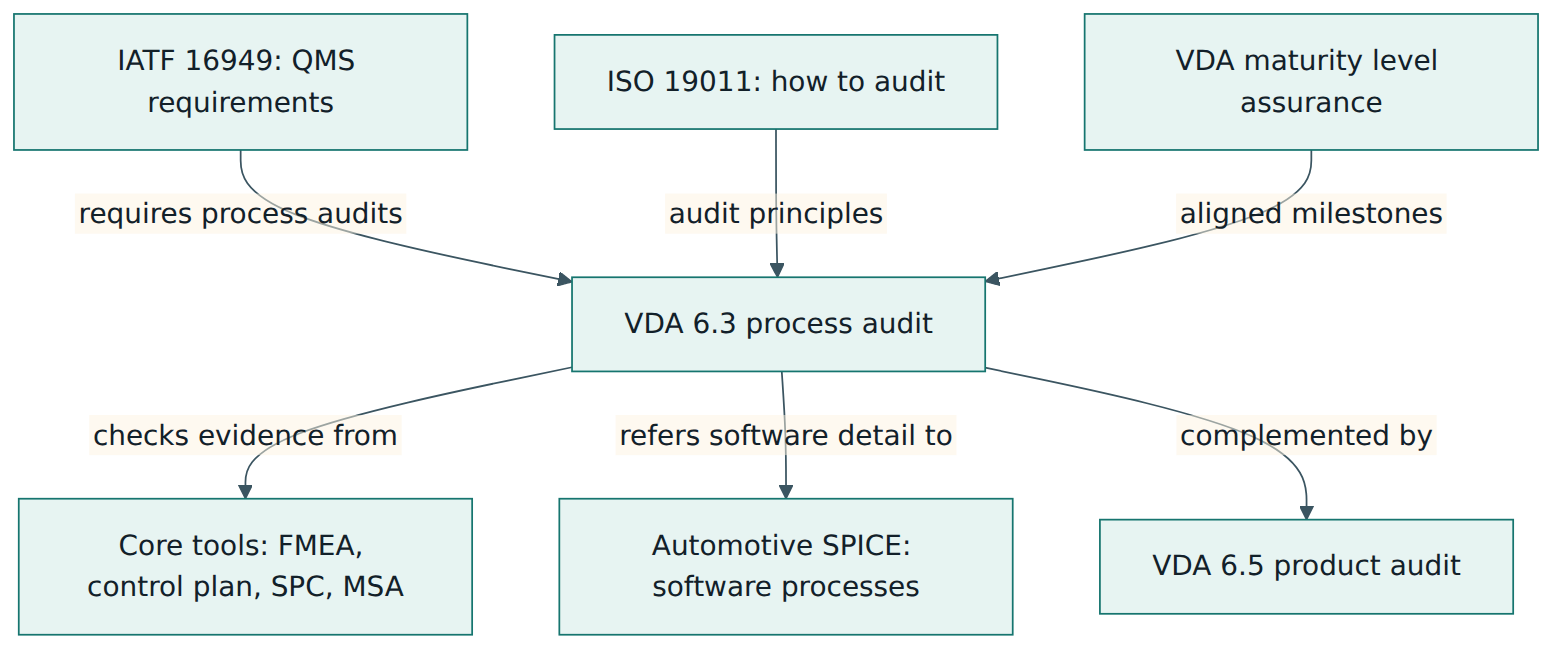
| Standard or method | What it is | Relationship to VDA 6.3 |
|---|---|---|
| IATF 16949 | Automotive quality management system requirements, certified by accredited certification bodies | Requires internal manufacturing process audits; customers often specify VDA 6.3 as the method. A plant can be IATF 16949 certified and still score C in a process audit. |
| ISO 19011 | Guidelines for auditing management systems: principles, programme management, conducting audits, auditor competence | Provides the general audit process that the 2023 edition no longer repeats; the VDA QMC exam requires a course based on it. |
| VDA 6.1 | VDA questionnaire for quality management system audits | System audit view, broad across the organisation; VDA 6.3 is the deep process view. |
| VDA 6.5 | VDA method for product audits | Checks finished products against specifications; complements process audit findings with product evidence. |
| Automotive SPICE | Process assessment model for software and system development, with capability levels | VDA 6.3 includes software aspects at a general level and points to Automotive SPICE for detailed evaluation of software development. |
| VDA maturity level assurance for new parts | Method to track the maturity of new parts across defined milestones in a project | The 2023 edition was aligned with it, so development-phase audits (P2 to P4) and maturity milestones use consistent expectations. |
| Automotive Core Tools (APQP, FMEA, control plan, SPC, MSA, PPAP) | Methods for quality planning, risk analysis, process control, measurement and part approval | Their outputs are the evidence VDA 6.3 auditors examine; core tools knowledge is a prerequisite for VDA 6.3 auditor certification. |
Common confusions
- VDA 6.3 versus IATF 16949 certification. IATF 16949 certification states that a quality management system meets the requirements, based on audits by accredited certification bodies. VDA 6.3 gives a customer or the organisation itself a detailed view of how well chosen processes perform. Neither replaces the other.
- VDA 6.3 versus Automotive SPICE. Both evaluate processes, but Automotive SPICE rates capability levels of software and system development processes in depth, while VDA 6.3 covers the whole product life cycle with a lighter touch on software and a strong focus on manufacturing.
- VDA 6.3 versus TISAX. TISAX is an information security assessment and exchange mechanism in the automotive industry, also linked to the VDA, but it concerns information security, not process quality.
Common pitfalls and best practices
Common pitfalls:
- Treating the audit as a document review. Records alone cannot show whether the process works; skipping the shop floor produces scores that do not match reality.
- Selecting process steps by convenience rather than risk. Auditing the clean, automated steps while the manual rework area is left out gives a misleading picture.
- Using the examples in the catalogue as a mandatory checklist, or ignoring the minimum requirements. Both lead to inconsistent scoring between auditors.
- Reporting only the percentage and forgetting the downgrading rules, which can turn an apparent A into a B or C.
- Writing vague findings without evidence, which the auditee cannot act on and may rightly dispute.
- Answering findings with retraining and new paperwork only, without finding the root cause, so the same weakness returns at the next audit.
- Comparing 2016-edition scores directly with 2023-edition scores when judging a supplier's trend.
Best practices:
- Start every audit with a documented risk analysis using complaints, FMEA, process data and changes, and explain the choice of process steps in the report.
- Walk the process along the material flow and talk to the people doing the work; check that what you are told matches what you see and what the records show.
- Record each finding with location, evidence and the related requirement, and score it consistently with the scale descriptions.
- Check star-question topics such as special characteristics, nonconforming parts and change control with extra care, because they drive downgrading.
- Run internal VDA 6.3 audits with qualified auditors who know the technology, and treat their findings as seriously as customer findings.
- Require action plans that state root causes, and verify the effect of actions with data or a re-audit, not just completion dates.
- Use the same edition, catalogue and forms across all internal and supplier audits so that results are comparable.
- Keep auditors calibrated: joint audits, reviews of each other's scoring and regular refresher training reduce differences between auditors.
Summary and key takeaways
- VDA 6.3 is the VDA QMC process audit method; the current edition is the 4th revised edition of January 2023, and its results are not directly comparable with the 2016 edition.
- It evaluates how well specific processes work in practice, which makes it different from a system audit such as IATF 16949 and from a product audit.
- Seven process elements cover the life cycle: P1 potential analysis before award, P2 to P4 for development, and P5 to P7 for series production.
- Production (P6) is evaluated per selected process step with six turtle-model sub-elements, chosen on the basis of risk.
- Each question scores 10, 8, 6, 4 or 0; degrees of fulfilment are calculated per element, step, sub-element and overall, and the overall result is classified A, B or C at the 90 % and 80 % thresholds.
- Downgrading rules ensure that a weak element, a weak process step or a failed star question lowers the classification regardless of the average.
- Organisations are not certified to VDA 6.3; auditors can be certified by VDA QMC, with a certificate valid for five years and renewed through audit practice.
- The real value lies in risk-based audit planning, evidence from the shop floor and action plans that remove root causes.
Reflection questions
- Think of a production line you know. Which three process steps would you select for a P6 evaluation, and what risk information would justify your choice?
- A supplier shows a strong overall percentage but has one weak process step. How would you explain to its management why the classification is lower than the percentage suggests?
- Which questions or topics in your own organisation would you expect to be most difficult to evaluate in a remote audit, and how would you obtain reliable evidence for them?
- Your internal process audits always end with an A, yet customers keep complaining. What might be wrong with the way the audits are planned, performed or scored?
- For a new supplier making a part with embedded software, how would you divide the evaluation between VDA 6.3 and Automotive SPICE, and what would you expect each to tell you?
Further reading and official sources
- VDA Volume 6 Part 3, Process Audit, Edition 2023 – VDA QMC webshop
- VDA 6.3:2023 Process Auditor – Examination – VDA QMC
- VDA 6.3 – Extension of the Qualification Certified Process Auditor – VDA QMC
- Sanctioned Interpretations and FAQs, VDA 6.3:2023 (German) – VDA QMC
- Recommendation for carrying out remote audits, VDA 6.3 (2021) – VDA QMC
- Changes to VDA 6.3:2023 – DQS
- ISO 19011 Guidelines for auditing management systems – ISO
- IATF 16949 and the automotive certification scheme – International Automotive Task Force
Original tutorial by xOps School (DevOpsSchool Private Limited), written from public sources about VDA 6.3. Not affiliated with or endorsed by the standard's owner; standard names are trademarks of their owners. Buy the official standard from its publisher for the authoritative text.