
ISO/IEC/IEEE 730 – Tutorial (about 60 minutes)
- View
IEEE 730, often listed as ISO/IEC/IEEE 730, is the standard that sets out how a software project should establish, plan and carry out software quality assurance (SQA): the work that gives everyone involved justified confidence that the project's processes and products are fit for purpose. Quality leads, QA engineers, project managers, developers, suppliers and the organisations that buy software use it to agree what assurance will be done, by whom, with what independence and with what evidence. After this tutorial you will be able to explain what SQA is and is not, describe the three areas of SQA activity, write the outline of a software quality assurance plan and apply the standard to a modern agile or DevOps project.
Course overview
Edition and status: the current edition is IEEE 730-2026, IEEE Standard for Software Quality Assurance Processes, developed by the IEEE Computer Society's Software and Systems Engineering Standards Committee. It was approved by the IEEE SA Standards Board on 2026-02-12, published on 2026-08-21 and is listed by IEEE as an active standard. It supersedes IEEE 730-2014, which IEEE now lists as inactive-reserved. Although the standard is frequently called "ISO/IEC/IEEE 730" (as in our course list), we found no joint ISO/IEC adoption of it in the ISO catalogue: it is published by IEEE alone and is harmonised with the joint standards ISO/IEC/IEEE 12207:2017 (software life cycle processes) and ISO/IEC/IEEE 15289:2019 (content of life cycle information items), as well as IEEE 2675-2021 (DevOps) and ISO/IEC 5055:2021 (automated source code quality measures). The detailed activity framework in Lessons 3 and 4 follows the publicly documented 2014 edition; the 2026 revision keeps the same process-based approach while broadening the scope, so check clause numbers and activity names in the copy you hold. Note also that ISO/IEC/IEEE 12207 was itself revised in 2026 (ISO/IEC/IEEE 12207:2026); IEEE 730-2026 is harmonised with the 2017 edition, so expect small differences in process wording when you map the two. Verified 2026-10-29 against the IEEE SA entries for 730-2026 and 730-2014.
Who it is for: QA engineers and quality managers who must set up or audit an SQA function, project and delivery managers who must approve a quality plan, developers and testers who want to understand why assurance asks for what it asks, suppliers whose contracts mention IEEE 730, and buyers who need to judge a supplier's quality approach.
Prerequisites: none. A basic idea of how software is built (requirements, design, code, test, release) is enough. Every term is explained when it first appears.
How to use this tutorial: read the seven lessons in order (about 45 minutes), study the four diagrams, then use the remaining time on the reflection questions before you take the 25-question knowledge check.
Learning objectives:
- You will be able to explain the purpose of IEEE 730, its history and how the 2026 edition relates to earlier editions.
- You will be able to define software quality assurance and distinguish it from testing, quality control and verification and validation.
- You will be able to describe the three SQA activity areas (process implementation, product assurance and process assurance) and the kinds of activity in each.
- You will be able to outline the contents of a software quality assurance plan and tailor it to the risk and life cycle of a real project.
- You will be able to explain organisational objectivity, non-conformance handling and SQA records, and how they produce evidence.
- You will be able to explain how conformance with IEEE 730 is demonstrated, and why there is no certificate for the standard itself.
- You will be able to position IEEE 730 next to ISO/IEC/IEEE 12207, ISO 9001, IEEE 1012, ISO/IEC/IEEE 29119 and CMMI.
Lesson 1 – Origins, purpose and scope
Why a standard for quality assurance?
Every organisation that builds software says it cares about quality. In practice, "quality" can mean anything from "it passed the tests" to "the customer did not complain this week". Without an agreed approach, two things tend to happen. First, quality work is squeezed to the end of the project, where the only tool left is testing, and testing at the end is the most expensive place to discover a wrong requirement or a weak design. Second, nobody can show a customer, a regulator or their own management why they should trust the result. The confidence is based on hope, not on evidence.
Software quality assurance exists to replace hope with evidence. It asks two simple questions throughout the life cycle: are we doing the work the way we said we would, and is the work producing what was asked for? IEEE 730 turns those two questions into a defined set of processes, activities and tasks that a project can plan, execute and show to others.
A long history
IEEE 730 first appeared in 1979 and is often described as the first software engineering standard published by the IEEE. For most of its life it was titled Software Quality Assurance Plans: the editions up to and including 2002 focused on what a quality plan document should contain. The 2014 edition changed the title to Software Quality Assurance Processes and was a substantial rewrite rather than an incremental revision. The emphasis moved from writing a plan to running a set of assurance processes, with the plan as one of their outputs. According to its IEEE abstract, the 2014 edition was harmonised with ISO/IEC/IEEE 12207:2008 and ISO/IEC/IEEE 15289:2011.
The 2026 edition updates that alignment to ISO/IEC/IEEE 12207:2017 and ISO/IEC/IEEE 15289:2019 and adds alignment with IEEE 2675-2021, the IEEE standard for DevOps, and ISO/IEC 5055:2021, which defines automated measures of source code quality. According to its published abstract, its scope covers initiating, planning, controlling, executing, monitoring, evaluating, improving and validating the SQA processes, both before and after software goes into production, with explicit attention to continuous improvement and to stakeholder needs such as security, privacy and resilience. The abstract also notes that it is meant to support organisational quality efforts such as ISO 9001 and ISO/IEC/IEEE 90003 and that it does not replace industry-specific standards.
Scope and purpose in plain words
- It applies to software development and maintenance projects, whatever their size, domain or life cycle model (waterfall, iterative, agile, DevOps).
- It sets out requirements for the SQA processes of such a project. It is normative: it uses "shall" for what a conforming project must do, and it supplies informative guidance to help.
- Its aim is a uniform, minimum acceptable set of SQA processes, so that a buyer and a supplier, or two teams in the same company, share one understanding of what "we do quality assurance" means.
- It is about the project. Organisation-wide quality management is the domain of ISO 9001; IEEE 730 is how quality assurance is carried out inside each software project that such a system governs.
What SQA is not
Many misunderstandings come from treating SQA as one familiar activity. The standard's community is clear that SQA is not simply testing, not just reviews or audits, not something done only at the end, not a purely reactive function, not a gate or a police force, and not necessarily a department called "QA". Testing, reviews and audits are sources of evidence that SQA uses; the gate mentality turns the quality function into an adversary; and the work can be performed by people in many roles provided they have the necessary objectivity. This view shapes everything else in the standard.
Lesson 2 – Key concepts and vocabulary
IEEE 730 uses vocabulary shared with the ISO/IEC/IEEE systems and software engineering standards (the vocabulary standard for that family is ISO/IEC/IEEE 24765). The definitions below are paraphrased to help you learn; your copy of the standard holds the authoritative wording.
- Software quality assurance (SQA) – a set of activities that define and assess whether software processes are adequate, so as to give evidence for a justified statement of confidence that those processes will produce software products that conform to their established requirements.
- Established requirements – the requirements a product or process must meet, taken from the contract, the product requirements, applicable regulations, standards and the project's own plans. Assurance is always judged against something written down and agreed.
- Product assurance – the part of SQA that checks whether the plans, products and documentation conform to their established requirements and will be acceptable to the acquirer.
- Process assurance – the part of SQA that checks whether the life cycle processes, environments and subcontractor processes actually used conform to the defined processes and plans, and whether they are effective.
- Software quality assurance plan (SQAP) – the project-specific document (or set of information items) that records how SQA will be carried out: activities, responsibilities, schedule, resources, standards, tools, measures and records.
- Conformance and non-conformance – conformance means meeting a specified requirement; a non-conformance is a failure to meet one, whether found in a product, a plan or the way a process was performed. Raising and tracking non-conformances is a core SQA output.
- Acceptability – the degree of confidence that the delivered product and documentation will be accepted by the acquirer. A product can conform to every written requirement and still be unacceptable if the requirements missed what the customer needs.
- Organisational objectivity (independence) – the freedom and authority of the people doing SQA to evaluate work objectively and verify that problems are resolved. It is usually discussed in three dimensions, technical, managerial and financial, the same three used for independent V&V in IEEE 1012.
- SQA records – the evidence produced by SQA activities: evaluation reports, audit results, measurements, non-conformance reports and their resolution. Records are what turn assurance into something others can verify.
- Product risk and software integrity level – a judgement of how much harm a software failure could cause. Higher risk or a higher integrity level justifies more rigorous and more independent assurance.
- Assurance case – a structured argument, supported by evidence, that a system meets a stated claim such as "the payout service is safe to release". SQA records are a major source of such evidence.
- Corrective and preventive action (CAPA) – corrective action removes the cause of a detected non-conformance so that it does not happen again; preventive action removes the cause of a potential one. Both rely on root cause analysis.
- Tailoring – adapting the generic SQA processes to the needs of a specific project, documenting what was changed and why.
- Acquirer and supplier – the party that obtains software (customer, product owner, internal sponsor) and the party that provides it. Many SQA activities exist to protect the acquirer's interests.
SQA versus neighbouring activities
Three terms are often confused with SQA. Quality control examines specific products to find defects, for example by testing a build or inspecting a design. Verification and validation (V&V) are engineering processes: verification checks that a work product meets its specification, validation checks that the product fulfils its intended use. SQA sits one level above: it assures that appropriate control and V&V activities are planned, actually performed as planned, and effective. A useful mental model: testers find defects in the product, while SQA asks whether the way the project tests, reviews, builds and releases is good enough to trust the result, and checks the evidence.
A second key idea is that quality is built in, not inspected in. SQA activities begin at project start, when contracts and plans are written, because a missing requirement or an unrealistic plan is cheaper to fix on paper than in production. The 2026 scope extends the same thinking past delivery: monitoring and evaluating quality continues after the software is in operation.
Lesson 3 – Structure of the standard
In the 2014 edition, as in other IEEE process standards, the document begins with an overview (scope, purpose, how to read it), normative references, definitions and a clause of key concepts, followed by the normative clause that specifies the SQA processes, and then a set of informative annexes. The heart of the standard is the process clause, organised around the three activity areas below.
The three activity areas
The 2014 edition organised the SQA process into three activity areas containing sixteen activities in total. Each activity has tasks expressed as requirements, and the standard describes the outcomes they are expected to produce. The grouping is the easiest way to remember what the standard asks for.
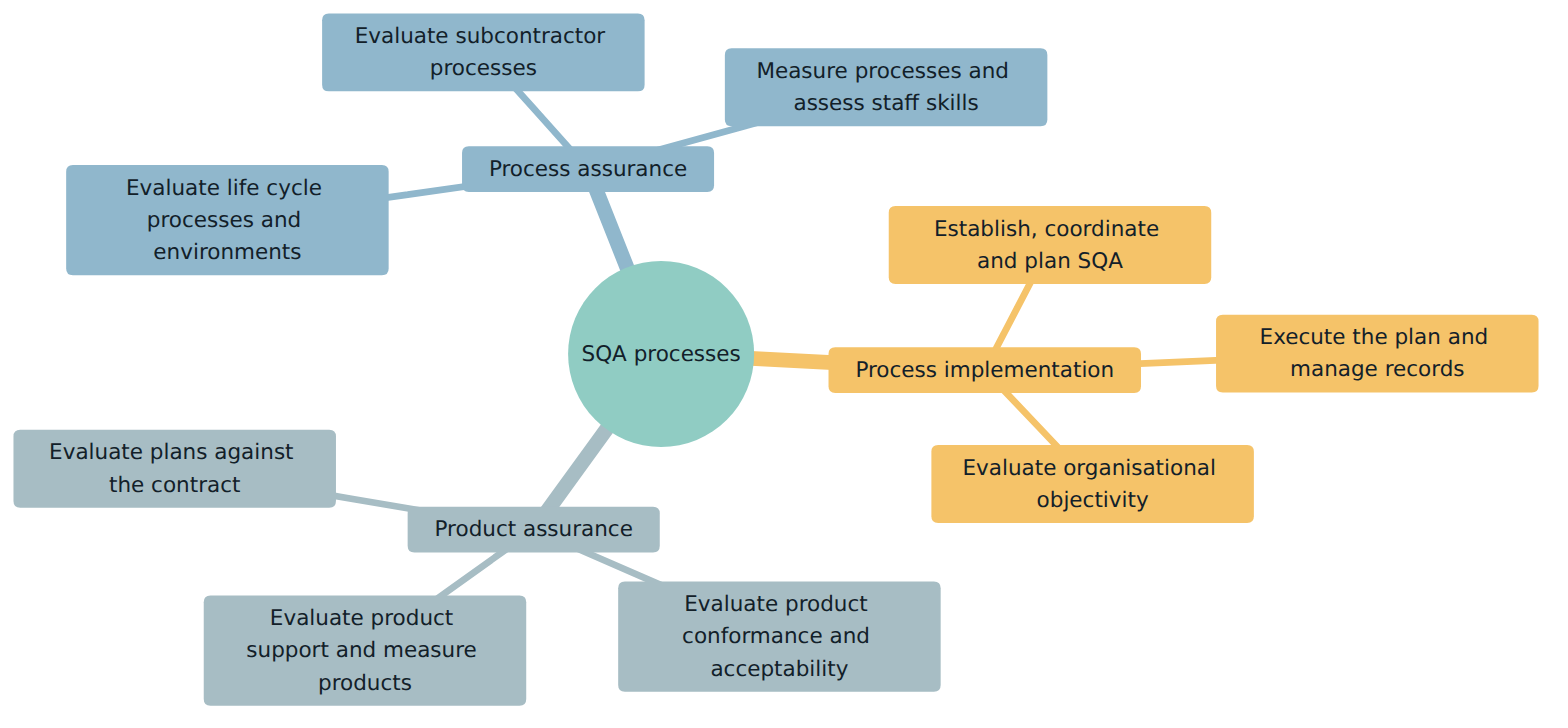
Area 1 – SQA process implementation. This is where SQA is set up and run. It has six activities: establish the SQA processes for the project; coordinate them with related processes (verification, validation, reviews, audits, project planning, technical and agreement processes); plan the SQA activities and document the result in the SQAP; execute the plan, revising it when the project changes and raising non-conformances; manage SQA records; and evaluate whether the people doing SQA have sufficient organisational objectivity and authority.
Area 2 – Product assurance. Five activities check the things the project produces: evaluate plans for conformance with the contract, standards and regulations, and for consistency with each other; evaluate products and documentation for conformance with their allocated requirements; evaluate products for acceptability to the acquirer before delivery; evaluate whether the arrangements for supporting the product after delivery conform to what was agreed; and measure products, checking that the measures represent quality accurately and objectively.
Area 3 – Process assurance. Five activities check how the work is done: evaluate the life cycle processes and their execution for conformance with plans and contract; evaluate the development and test environments; evaluate subcontractor processes against the requirements flowed down to them; measure processes, checking that the measures support effective management; and assess whether staff, including SQA staff, have the knowledge and skills their roles demand and whether training plans are effective.
The SQA plan outline
The standard gives guidance on what an SQAP should contain and, consistent with ISO/IEC/IEEE 15289, treats it as an information item whose content matters more than its format. A typical outline based on the 2014 guidance covers:
- purpose and scope of the plan, definitions and reference documents;
- an overview of SQA on the project: organisation and independence, product risk, tools, the standards, practices and conventions to be applied, and the effort, resources and schedule;
- the product assurance and process assurance activities, with their outcomes and tasks as tailored for the project;
- additional considerations such as contract review, quality measurement, handling waivers and deviations, repetition of tasks after changes, communication with stakeholders and the non-conformance process;
- SQA records: how they are identified, collected, filed, maintained, protected and eventually disposed of.
The informative annexes
The 2014 edition carried an unusually rich set of informative annexes, which many practitioners find as useful as the normative text. They included mappings to related standards such as ISO/IEC/IEEE 12207, a comparison with the 2002 plan outline, guidance for creating an SQAP, industry-specific guidance, SQA in agile development, SQA for very small entities using ISO/IEC 29110, software tool validation, assessing product risk with integrity levels and assurance cases, and corrective and preventive action with root cause analysis. The 2026 edition is roughly 97 pages long; consult its table of contents for the current annex list rather than assuming it is identical.
What the 2026 revision changes in emphasis
Without reproducing the new text, the published scope signals four shifts that you should expect to see when you read it:
- Beyond delivery. SQA is expected to continue into operation, for example by evaluating production incidents and monitoring data as quality evidence.
- Continuous improvement. Monitoring, evaluating and improving the SQA processes themselves becomes an explicit part of the scope.
- Broader quality needs. Stakeholder requirements for security, privacy and resilience are named, not only functional correctness.
- Modern delivery. Alignment with IEEE 2675 brings DevOps pipelines, and alignment with ISO/IEC 5055 brings automated code quality measures, into the assurance picture.
Lesson 4 – How it works in practice
The SQA life cycle on a project
The activities in Figure 1 are not a checklist to complete once. They run as a cycle for the whole project, and on a long project or a product with continuous delivery they repeat every release. Figure 2 shows the typical flow.
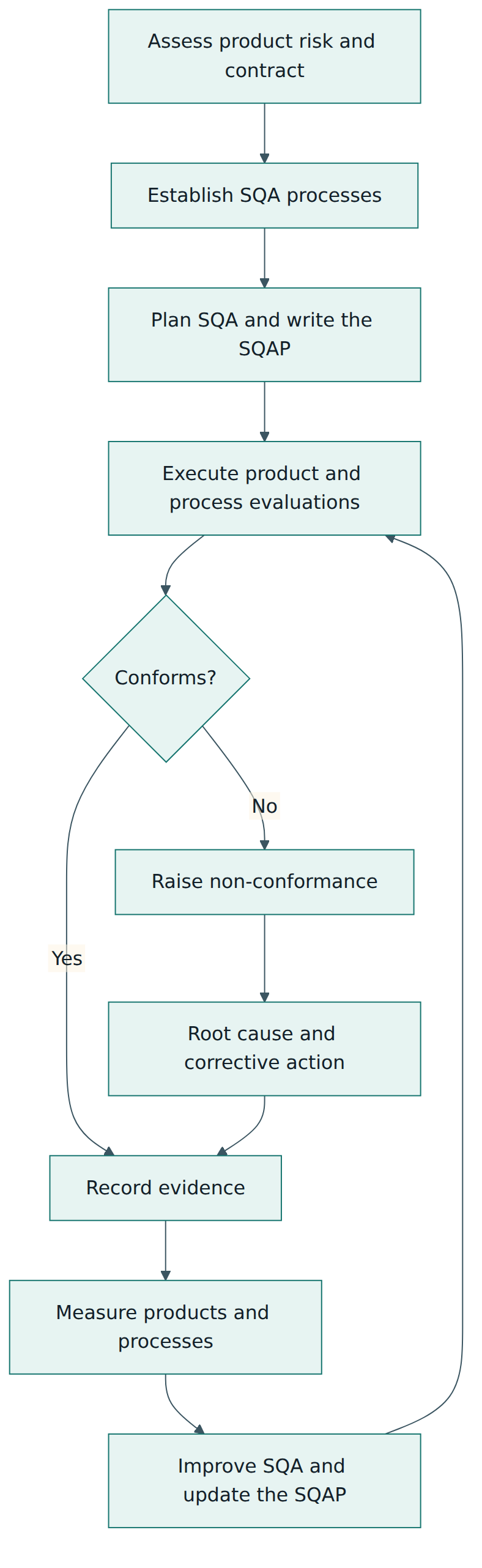
Step 1 – Start from risk and the agreement
Assurance effort is never uniform. A marketing website and an infusion-pump controller need very different levels of rigour. The first input to SQA planning is therefore the product risk: what harm could failure cause to people, money, data, reputation or compliance? Where a project uses software integrity levels (as defined, for example, in IEEE 1012 for V&V), the integrity level drives how much evaluation is planned and how independent the evaluators must be. The second input is the agreement with the acquirer, whether a formal contract or, in agile work, the product backlog and the definition of done. SQA reads the agreement early to see which plans, products and standards are required and whether the requirements themselves are adequate.
Step 2 – Establish and coordinate
Next, SQA defines how it will work on this project and connects itself to the other processes. If the project already has peer reviews, a test strategy, configuration management and a release process, SQA does not duplicate them; it plans to use their outputs as evidence and to check that they are performed. Coordination also avoids a common failure: two groups each assuming the other is checking something.
Step 3 – Plan: write the SQAP
Planning tailors the generic processes. A small internal tool might have a two-page SQAP embedded in the project plan; a regulated medical product will have a controlled document with traceable evaluation schedules. Either way the plan answers: which products and processes will be evaluated, when, by whom, against which criteria, with which tools, what measures will be collected, how non-conformances are handled and escalated, and which records will be kept. Tailoring decisions and the reasons for them are written down, so an auditor can see a deliberate choice rather than an omission.
Step 4 – Execute evaluations
Evaluations are the visible work of SQA. Product evaluations look at plans, requirements, designs, code, test results, user documentation and release packages. Process evaluations look at whether the team followed its defined process: were the reviews held, did the pipeline run the required checks, was the test environment configured as planned, did the subcontractor follow the flowed-down requirements? Typical techniques include document and work-product reviews, process audits, sampling of records, walkthroughs of pipeline configurations and interviews.
Step 5 – Handle non-conformances
When an evaluation finds a gap, SQA raises a non-conformance. This is not a punishment; it is a record that something does not match its requirement and needs a decision. Figure 3 shows a typical life of a non-conformance.
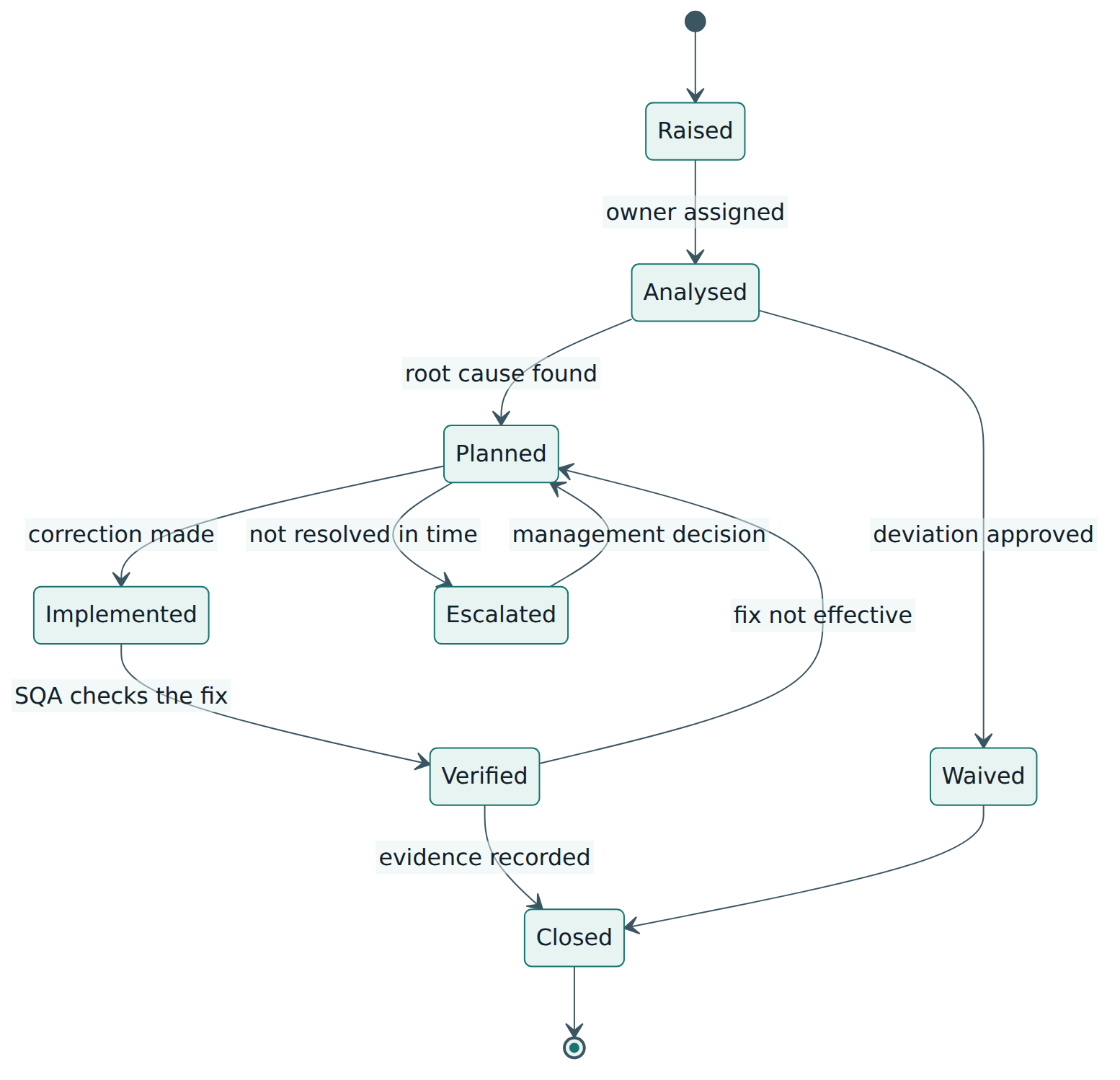
Three details matter. First, the person who raised the issue, or another objective party, verifies that the fix worked; closing on the developer's word alone defeats the purpose. Second, if a requirement will deliberately not be met, the route is a documented waiver or deviation approved by someone with the authority to accept the risk, not silent closure. Third, unresolved issues are escalated through a path defined in the SQAP, which is why the reporting line of SQA (its managerial independence) matters.
Step 6 – Keep records
Records are created as work happens, kept where project staff and management can see them, protected from unauthorised change and retained for an agreed period. They demonstrate that work followed the plans and the contract, support problem solving and improvement, and are the raw material for any audit or assurance case. In a modern toolchain many records are produced automatically: pipeline logs, code review approvals, static analysis reports, test reports. SQA's job is to make sure the right records exist, are trustworthy and can be found.
Step 7 – Measure and improve
Measures turn evaluations into trends. Product measures might include defect density, escaped defects found in production, or code quality findings using ISO/IEC 5055 measures. Process measures might include review coverage, the share of changes that passed every required pipeline check, or the time to close non-conformances. SQA checks that measures are accurate, objective and actually used for decisions, then improves both the project processes and its own SQA approach. In the 2026 view this cycle continues after release.
Roles and objectivity
Who performs SQA? The standard does not require a separate QA department. It requires that whoever performs SQA has enough objectivity and authority. Objectivity is usually examined along three dimensions:
- Technical independence – the evaluator did not build the product being evaluated.
- Managerial independence – the evaluator does not report to the person responsible for delivering the product or managing the project, so findings cannot be suppressed by schedule pressure.
- Financial independence – the SQA budget is not controlled by the people whose work is evaluated, so assurance cannot be quietly cut when money is short.
The level of independence is scaled to risk. A low-risk internal project may be well served by a peer from another team; a safety-related product may need an SQA function reporting to a quality director outside the delivery chain. The SQAP states what was chosen, and the standard asks SQA itself to evaluate whether that objectivity is real in practice.
SQA in agile and DevOps teams
The 2014 annex on agile development already explained how the standard fits iterative work, and the 2026 alignment with IEEE 2675 extends this to DevOps. In practice:
- The product backlog and its acceptance criteria play the role of the agreement against which products are evaluated.
- Product assurance criteria are expressed in the definition of done, so they are applied every sprint rather than at the end.
- Non-conformances become backlog items, prioritised and resolved in normal sprints, with SQA verifying closure.
- Acceptability is evaluated continuously through reviews and demonstrations with the product owner, not only before final delivery.
- Many process evaluations move into the pipeline: required checks, branch protections and automatic evidence capture. SQA then audits the pipeline definition and samples its records instead of inspecting every change by hand.
Lesson 5 – Assessment, certification and compliance
There is no IEEE 730 certificate
Unlike ISO 9001 or ISO/IEC 27001, IEEE 730 has no accredited certification scheme. No body issues an "IEEE 730 certified" certificate to an organisation, and IEEE does not certify individual practitioners against it. Be cautious of anyone who offers such a certificate as if it were official. What exists instead is conformance: a project, or an organisation for its projects, can claim that its SQA processes conform to the standard, and others can check that claim.
How conformance is demonstrated
In IEEE process standards, a conformance claim generally means showing that the mandatory provisions (the "shall" statements) are met for the project, and that any tailoring is documented and justified. Read the conformance clause of the edition you hold for its exact wording. The evidence is mostly the SQAP plus the SQA records it describes: evaluation reports, audit results, non-conformance logs with verified closures, measurement data and evidence of objectivity. A sensible claim is specific: "Project X conforms to IEEE 730-2026 as tailored in SQAP version 3", not "we are IEEE 730 compliant".
Who checks
- First party: the organisation's own internal audit or quality function audits projects against the SQAP and the standard.
- Second party: the acquirer audits the supplier. This is the most common use of IEEE 730 in contracts: the buyer requires conformance and then reviews the SQAP and samples the records.
- Third party: an independent assessor engaged by either side, for example when a regulator expects independent evidence or when an acquirer lacks in-house expertise.
How IEEE 730 feeds other assessments
Because the standard is mapped to widely used frameworks, its evidence is reused in assessments that do have formal schemes:
- ISO 9001 certification of a software organisation, interpreted through ISO/IEC/IEEE 90003, looks for planned quality activities, monitoring and corrective action; IEEE 730 records provide this at project level.
- CMMI appraisals examine process and product quality assurance practices; IEEE 730 gives a concrete process design for them.
- Process assessments based on ISO/IEC 330xx (the successor of ISO/IEC 15504, SPICE) rate the capability of a quality assurance process; IEEE 730 records are natural evidence for such a rating.
- Regulated domains such as medical devices, aerospace or rail have their own software standards; IEEE 730 does not replace them, but a well-run SQA process supplies much of the evidence their assessors ask for.
What a good audit of SQA looks for
An experienced auditor will not stop at "is there an SQAP?". They check that the plan reflects the product risk, that evaluations were actually performed on schedule, that non-conformances were raised (a project with none is suspicious), that closures were verified, that independence is real in the reporting line and budget, that measures are used for decisions, and that SQA itself improved over time.
Lesson 6 – Worked example
The situation
Kestrel Payments is a mid-sized fintech company with about 120 engineers. A regional bank has contracted Kestrel to build a merchant payout service: an API and back-office application that calculates what each merchant is owed and sends payment instructions to the bank. The contract requires the supplier's SQA processes to conform to IEEE 730-2026, requires a security and privacy review before go-live and gives the bank the right to audit. Kestrel works in two-week Scrum sprints with a CI/CD pipeline and outsources the merchant mobile app to a smaller partner studio. Priya is appointed SQA lead for the project.
Step 1 – Read the agreement and assess risk
Priya starts with the contract, not the code. She lists the plans the bank expects (project plan, test plan, security plan, release and support plan) and the standards it names. She finds that the contract says payouts must be "accurate" but gives no tolerance or reconciliation requirement, so she raises the gap with the project manager and the bank's product owner; they agree a daily reconciliation requirement with zero unexplained differences. This is product assurance on a plan, done before a line of code exists. Her risk assessment rates the payout calculation and the payment-instruction interface as high risk (direct financial loss and regulatory exposure) and the reporting screens as medium.
Step 2 – Decide independence
Priya reports to Kestrel's Head of Quality, not to the delivery director, and her budget sits in the quality department: managerial and financial independence. For technical independence, she is not a member of the development team. For the high-risk payout engine, she arranges for an engineer from another product line to review the calculation design. She records these choices and the reasons in the SQAP.
Step 3 – Write a tailored SQAP
The SQAP is twelve pages and lives in the project wiki under version control. Its key decisions:
- Product assurance: every user story meets a definition of done that includes peer review, automated tests and updated API documentation; payout-engine changes also need a second reviewer and a reconciliation test against reference data.
- Process assurance: monthly process audits sampling five merged changes for evidence of review, passing pipeline checks and traceability to a backlog item; a quarterly audit of the partner studio's process.
- Environments: SQA evaluates the test environment once per release to confirm it uses masked data and the same configuration as production.
- Measures: escaped defects per release, reconciliation differences, review coverage, ISO/IEC 5055-based static analysis findings for reliability and security, and the age of open non-conformances.
- Non-conformances: logged as backlog items with a "QA-NC" label; resolution within two sprints or escalation to the Head of Quality and the bank's product owner.
- Records: pipeline logs, review approvals, audit reports and NC history retained for seven years, matching the contract's records clause.
- Tailoring: no separate formal design document for medium-risk screens; justification is that design is captured in reviewed stories and diagrams, and the risk is low.
Step 4 – Execute during the sprints
In sprint 4, Priya's monthly audit samples five merged changes. Four show complete evidence. One payout-engine change was merged with a single reviewer because the second reviewer was on leave and the branch rule had been temporarily relaxed. Priya raises a non-conformance against the process, not against the developer. Root cause analysis shows that anyone with repository admin rights could relax the rule without a record. The corrective action restores the rule, limits who can change it and adds an automated alert when protections change; the preventive action applies the same control to the other two high-risk repositories. Priya verifies the fix in the next sprint and closes the non-conformance with evidence.
Step 5 – Assure the subcontractor
The quarterly audit of the partner studio finds that its test plan does not cover the accessibility requirement flowed down from the bank. Priya raises a non-conformance against the subcontractor process. The studio adds accessibility checks to its pipeline, and the next audit confirms them.
Step 6 – Measure, evaluate acceptability and release
Before go-live, Priya evaluates acceptability. Every requirement traces to passing tests, but the bank's operations team has never used the back-office reconciliation screen. She arranges a structured trial with them; they find the exception report confusing, and the team fixes it before release. Conformance alone would not have caught this. Her release report summarises measures, open non-conformances (two low-risk, with approved deviations) and the security and privacy review results.
Step 7 – After go-live
Because the 2026 scope continues past production, the SQAP includes operational assurance: SQA reviews the monthly incident and reconciliation reports, checks that incidents produce root cause analysis and corrective actions, and evaluates whether the support arrangements match the contract. Three months after launch, Priya also reviews the SQA process itself and shortens the audit sample for low-risk repositories while increasing it for the payout engine.
Step 8 – The bank's audit
Six months in, the bank audits Kestrel. The auditor reviews the SQAP, samples records, checks the non-conformance log (finding issues raised, analysed and verifiably closed reassures them more than an empty log would) and confirms Priya's reporting line. The result is not a certificate but an audit report confirming that the project's SQA conforms to IEEE 730-2026 as tailored.
Lesson 7 – Relationship to other standards and frameworks
IEEE 730 sits in a family of standards. Knowing the neighbours helps you avoid duplication and explain to auditors how your evidence fits together. Figure 4 shows the main relationships.
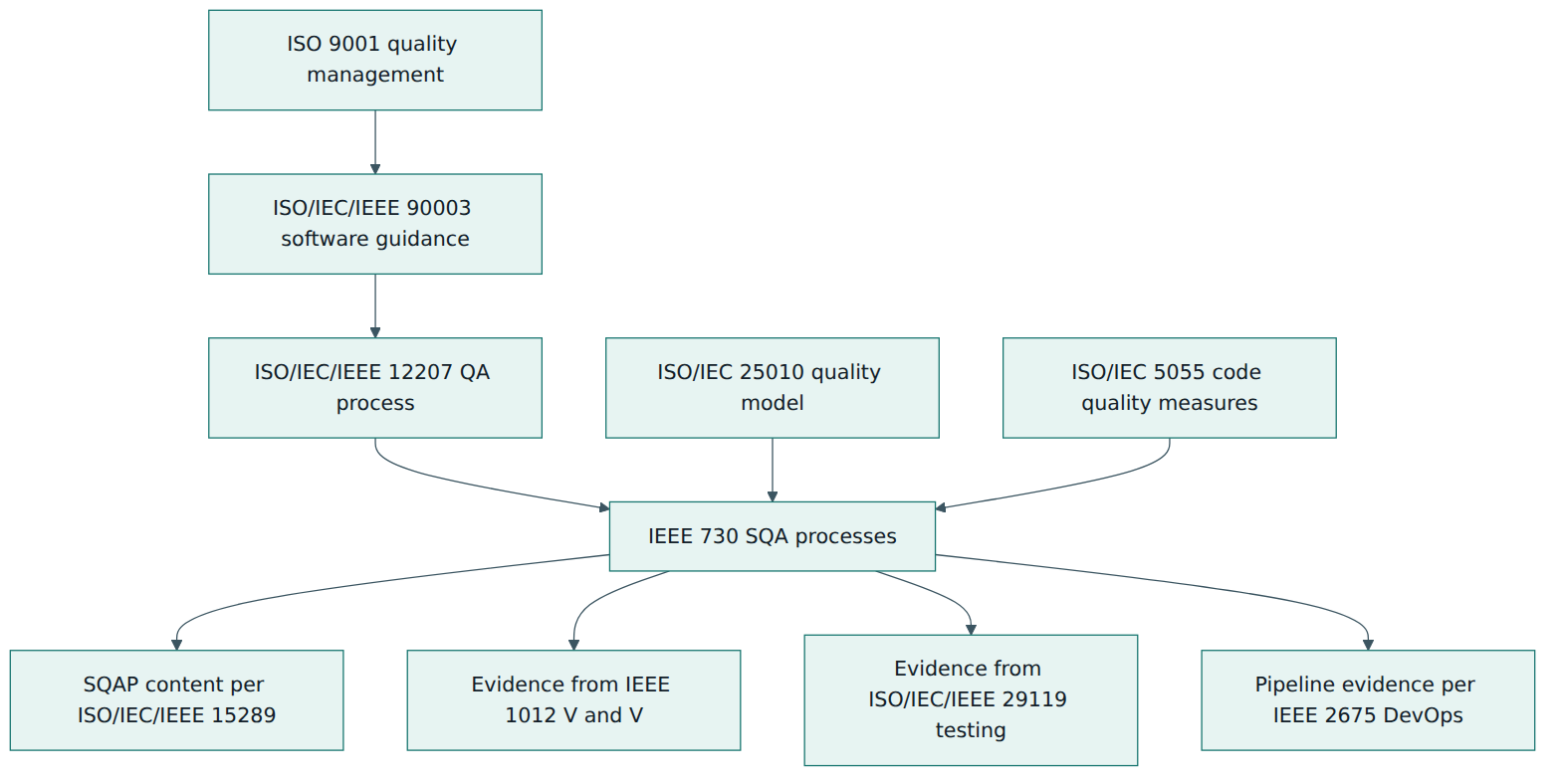
Read Figure 4 from the top. An organisation's quality management system (ISO 9001, interpreted for software by ISO/IEC/IEEE 90003) requires planned quality activities. ISO/IEC/IEEE 12207 names a quality assurance process among the life cycle processes but describes it only briefly. IEEE 730 provides the detailed requirements for that process, and ISO/IEC/IEEE 15289 tells you what information the resulting plans and reports should contain. Below IEEE 730 are the engineering practices whose outputs SQA assures and uses as evidence. On the side, the quality model and code measures supply the definitions of quality characteristics and the automated measures that SQA can use.
| Standard or framework | What it covers | How it relates to IEEE 730 |
|---|---|---|
| ISO/IEC/IEEE 12207 (2017 edition, revised in 2026) | Software life cycle processes, including a quality assurance process | IEEE 730 expands the QA process into detailed activities and tasks; IEEE 730-2026 is aligned to the 2017 edition |
| ISO 9001 and ISO/IEC/IEEE 90003 | Organisation-wide quality management system and its application to software | Certifiable at organisation level; IEEE 730 delivers the project-level assurance evidence a QMS expects |
| IEEE 1012 | System, software and hardware verification and validation, with integrity levels | V&V checks products against specifications and intended use; SQA plans and assures that V&V is done and effective |
| ISO/IEC/IEEE 29119 series | Software testing concepts, processes, documentation and techniques | Testing is a major evidence source; SQA evaluates test plans, environments and execution against the defined test process |
| CMMI | Capability and maturity model with practices for process and product quality assurance | Describes what good QA practice achieves; IEEE 730 offers one concrete way to design that process |
| ISO/IEC 29110 | Life cycle profiles for very small entities | Lighter-weight processes; the 2014 edition explained how to scale SQA for very small organisations |
| IEEE 2675-2021 (also ISO/IEC/IEEE 32675) | DevOps: building, packaging and deploying reliable, secure systems | The 2026 edition is aligned to it; pipeline controls and records become SQA evidence |
| ISO/IEC 25010:2023 | Product quality model (characteristics such as reliability, security, maintainability) | Supplies the vocabulary for which quality characteristics the requirements and measures should address |
Two practical consequences follow. First, if your organisation already holds ISO 9001 certification, IEEE 730 does not compete with it; it is a detailed way of running the project-level part. Second, if your teams already follow ISO/IEC/IEEE 29119 for testing or IEEE 1012 for V&V, do not create parallel SQA checks of the same products. Plan SQA to rely on those processes' outputs and to assure that they are performed and effective.
Common pitfalls and best practices
Pitfalls
- Equating SQA with testing. A project that only tests at the end has quality control, not assurance. Plans, requirements, environments, suppliers and the process itself go unchecked.
- Shelfware plans. An SQAP copied from a template, approved once and never revised gives an illusion of control. Auditors quickly see that records do not match the plan.
- Independence on paper only. The SQA lead "reports to quality" but in practice takes daily direction from the project manager, or the SQA budget is cut by the delivery team when deadlines slip.
- Policing instead of partnering. Treating non-conformances as blame makes teams hide problems. The result is an empty issue log and a false sense of quality.
- Closing issues without verification. Accepting "fixed" from the person who made the change, without objective evidence, defeats the non-conformance process.
- Uniform rigour. Applying the same heavy assurance to every component wastes effort on low-risk parts and spreads thin attention over high-risk ones.
- Stopping at delivery. Ignoring production incidents and operational data as quality evidence, which the 2026 scope explicitly brings in.
- Claiming certification. Advertising "IEEE 730 certified" misleads customers; only conformance claims, checked by audit, exist.
Best practices
- Start SQA at contract and planning time. Evaluating the agreement and the plans finds the cheapest defects of all.
- Scale to risk and write the reasons down. Use product risk or integrity levels to decide rigour and independence, and record tailoring decisions in the SQAP.
- Reuse existing evidence. Draw on reviews, tests, pipeline logs and static analysis rather than duplicating them; assure that they happen and are trustworthy.
- Build assurance into the workflow. Put product criteria in the definition of done and process controls in the pipeline, then audit by sampling.
- Treat non-conformances as learning. Analyse root causes, fix the system rather than the person, and add preventive actions where the same weakness exists elsewhere.
- Use a small set of meaningful measures. Choose measures that drive decisions, such as escaped defects and time to close non-conformances, and review them regularly.
- Evaluate acceptability, not just conformance. Involve real users and the acquirer before release to catch needs the written requirements missed.
- Improve SQA itself. Review the effectiveness of the SQA process at intervals and adjust sampling, timing and focus.
Summary and key takeaways
- IEEE 730-2026 is the current IEEE standard for software quality assurance processes; it supersedes the 2014 edition and is harmonised with ISO/IEC/IEEE 12207:2017 and 15289:2019, but it is not a joint ISO/IEC standard.
- SQA provides evidence-based confidence that processes and products are adequate; it is broader than testing and begins at contract and planning time.
- The standard organises SQA into process implementation, product assurance and process assurance.
- The SQAP is the tailored, living plan that records what will be evaluated, by whom, when, how issues are handled and which records are kept.
- Objectivity has technical, managerial and financial dimensions, scaled to product risk.
- Non-conformances are raised, analysed for root cause, corrected, verified and recorded; waivers need authorised approval.
- There is no IEEE 730 certificate: conformance is claimed and checked by first-, second- or third-party audit, and its evidence supports ISO 9001, CMMI and process assessments.
- The 2026 edition extends SQA past go-live and into DevOps pipelines, continuous improvement and security, privacy and resilience needs.
Reflection questions
- Think of a project you know. Which of its quality activities were assurance and which were control, and what important evidence was missing?
- How would you set the level of technical, managerial and financial independence for SQA on a low-risk internal tool compared with a payment or safety-related system?
- Draft the headings of an SQAP for your current project. Which parts of the generic process would you tailor out, and how would you justify each decision?
- Your team deploys several times a day. Which process assurance checks would you move into the pipeline, and what would SQA still need to audit by hand?
- A customer asks whether your company is "IEEE 730 certified". How would you answer, and what evidence would you offer instead?
Further reading and official sources
- IEEE 730-2026 – IEEE Standard for Software Quality Assurance Processes – IEEE Standards Association
- IEEE 730-2014 – IEEE Standard for Software Quality Assurance Processes (superseded) – IEEE Standards Association
- ISO/IEC/IEEE 12207:2026 – Software life cycle processes – ISO
- ISO/IEC/IEEE 15289:2019 – Content of life cycle information items (documentation) – ISO
- IEEE 2675-2021 – IEEE Standard for DevOps – IEEE Standards Association
- SWEBOK Guide – Software Engineering Body of Knowledge (Software Quality knowledge area) – IEEE Computer Society
Original tutorial by xOps School (DevOpsSchool Private Limited), written from public sources about ISO/IEC/IEEE 730. Not affiliated with or endorsed by the standard's owner; standard names are trademarks of their owners. Buy the official standard from its publisher for the authoritative text.