
AS9100 / IAQG 9100 – Tutorial (about 60 minutes)
- View
AS9100, known internationally as IAQG 9100, is the quality management system standard of the aviation, space and defence industry. It takes the complete text of ISO 9001 and adds requirements that matter when a faulty part can bring down an aircraft or end a space mission: product safety, configuration management, counterfeit parts prevention, key characteristics, first article inspection and tight control of the supply chain. Quality engineers, production and supplier-quality staff, design engineers, buyers and internal auditors at aerospace manufacturers and their suppliers use it every day. After this tutorial you will be able to explain what the standard requires and why, read its clause structure, see how it shapes daily work in a shop or design office, and understand how certification works.
Course overview
Edition and status: the current edition is 9100 Revision D, published in 2016 by the International Aerospace Quality Group (IAQG). The same technical content appears under three regional names: AS9100D, issued by SAE International in September 2016 for the Americas; EN 9100:2018, published by ASD-STAN for Europe; and JIS Q 9100:2016 in Japan. Revision D is built on ISO 9001:2015 and contains its full text plus the aerospace additions. The IAQG is revising the standard, and the next edition will carry a new single global designation, IA9100 ("International Aerospace"). The IAQG's key-change summary of November 2023 planned publication for 2026, and NASA's Office of Safety and Mission Assurance reported in April 2024 an estimate of the fourth quarter of 2026, a delay linked to ISO's decision to revise ISO 9001 itself (ISO 9001:2026 has since been published). The scope of IA9100 has also been narrowed along the way: certification-body updates from 2025 report that the IAQG would first issue IA9100 as a limited-change revision still based on ISO 9001:2015, with a fuller revision aligned to the new ISO 9001 to follow, and a single transition period whose length was not yet final. As of 2026-10-29 we found no announcement that IA9100 has been published and no confirmed transition deadline, so AS9100D remains the edition against which organisations are certified. This course teaches Revision D and points out the changes the IAQG has signalled for IA9100. Verified 2026-10-29 against the SAE International AS9100D catalogue entry, the IAQG IA9100 Key Change Summary (November 2023), the NASA OSMA status article (April 2024) and a certification body's revision tracker (last updated May 2026); the IAQG website itself could not be retrieved, so check it for the latest publication and transition news.
Who it is for: engineers, technicians, quality and supplier-quality staff, production supervisors, buyers, programme managers and new internal auditors who join an aerospace or defence organisation, or who must prepare a company that already holds ISO 9001 for its first AS9100 audit.
Prerequisites: none. A basic idea of what a quality management system is helps, and the tutorial explains the ISO 9001 foundations it relies on.
Learning objectives. After this tutorial you will be able to:
- Explain why the aerospace industry created a common quality standard and how AS9100, EN 9100 and JIS Q 9100 relate to each other and to ISO 9001.
- Define the core vocabulary, including critical items, key characteristics, special requirements, counterfeit parts, product safety and first article inspection.
- Describe the clause structure of the standard and name the most important aerospace additions in clauses 7 to 10.
- Apply operational risk management, configuration management and nonconforming-output controls to realistic situations.
- Describe how certification works: the IAQG scheme, accredited certification bodies, authenticated auditors, the 9101 audit method and the OASIS database.
- Distinguish 9100 from its sister standards 9110 and 9120 and from related standards such as 9102, 9145 and IATF 16949.
- Recognise common implementation pitfalls and the practices that make the system effective rather than a paper exercise.
Lesson 1 – Origins, purpose and scope
Why aerospace needed its own standard
Aviation, space and defence products share three properties that make quality unusually demanding. First, the consequences of failure are severe: a cracked turbine disc or a mis-wired flight control computer can kill people. Second, the products are complex and long-lived: an airliner contains millions of parts from thousands of suppliers and may stay in service for decades, so a part made today must still be traceable and supportable twenty or thirty years later. Third, the industry is heavily regulated: aviation authorities approve designs and production organisations, and defence customers impose their own contract requirements.
Before the 1990s, quality expectations were set mainly by each customer. Military buyers in the United States used specifications such as MIL-Q-9858A, and every large prime contractor sent suppliers its own quality manual. A supplier serving five aircraft makers could face five different rule sets and five separate audits a year, each checking much the same things. When ISO 9001 appeared, large aerospace companies began to require it from suppliers, but they soon found it too generic. It said nothing about key characteristics, first article inspection, traceability of serial-numbered parts or the special processes, such as heat treatment and welding, on which flight safety depends.
The answer was to agree on one set of aerospace requirements on top of ISO 9001. In the Americas, companies combined ISO 9001 with flow-down requirements from a major airframe maker's supplier standard and published AS9000 in 1997. Aerospace companies from the Americas, Europe and Asia-Pacific then founded the International Aerospace Quality Group (IAQG) in 1998 under the umbrella of SAE International, and the first global 9100 followed in 1999 with European concurrence. Revisions came in 2001 (aligned with ISO 9001:2000), 2004 (a structural update), 2009 (Revision C, which added risk management, configuration management, project management and stronger supplier controls) and 2016 (Revision D, aligned with ISO 9001:2015 and adding product safety, counterfeit parts prevention, awareness and human factors). In 2013 the IAQG became an independent international not-for-profit association based in Brussels.
The purpose in one sentence
The 9100 standard exists so that customers, regulators and suppliers across the world can rely on one harmonised set of quality management requirements for aerospace, reducing duplicate audits while raising the level of defect prevention, safety and on-time delivery in the whole supply chain. The standard pursues continual improvement with an emphasis on preventing defects rather than detecting them after the fact.
Who it applies to
The standard is written for organisations that design, develop or produce aviation, space and defence products and services. That includes original equipment manufacturers (OEMs) of aircraft, engines, satellites and missiles; their tier-one system suppliers; and the long chain of machine shops, forging houses, composite fabricators, electronics assemblers and software developers beneath them. It also covers organisations that provide post-delivery support, such as maintenance, spare parts or materials, for their own products. Dedicated maintenance, repair and overhaul organisations normally use the sister standard 9110, and distributors and stockists that do not make anything use 9120. Lesson 7 compares them.
The standard is voluntary in the legal sense: no law requires a company to be certified. In practice, most large aerospace and defence buyers make certification a condition of becoming or remaining an approved supplier, and they write it into purchase orders and supplier quality agreements. For many small manufacturers, the certificate is the entry ticket to the industry.
What the standard is not
AS9100 does not replace airworthiness regulation. A production organisation approved by an aviation authority must still meet that authority's rules, and AS9100 certification is a separate, private scheme. Nor is it a product specification: it does not tell you how thick a bracket must be or which alloy to use. It specifies how the management system must work so that the product specifications set by the customer and the regulator are met reliably.
Lesson 2 – Key concepts and vocabulary
AS9100 uses the vocabulary of ISO 9000 and ISO 9001 and adds a handful of aerospace terms in its own clause 3. Learning these terms first makes the rest of the standard easy to read. The definitions below are paraphrased in plain language.
- Quality management system (QMS) – the set of interacting processes, responsibilities, resources and documented information an organisation uses to deliver conforming products and services and to improve. AS9100 specifies requirements for an aerospace QMS.
- IAQG – the International Aerospace Quality Group, the global association of aviation, space and defence companies that writes the 9100 series and runs the certification scheme. It works through three regional sectors: the Americas (AAQG), Europe (EAQG) and Asia-Pacific (APAQG).
- Critical items – anything in a product or its production, whether a function, part, piece of software, characteristic or process, that strongly affects safety, performance, form, fit, function, producibility or service life, and so needs specific management actions.
- Key characteristic – a feature of a material, process or part where variation strongly affects how the product fits, works, performs, lasts or can be produced, so the variation itself must be actively controlled. A bore diameter on a landing-gear part is a typical example.
- Special requirements – requirements identified by the customer or the organisation as carrying high risk of not being met, for example demanding performance targets, new technology or very tight tolerances. They feed into operational risk management.
- Product safety – the condition in which a product can do the job it was designed for without posing an unacceptable risk of injuring people or damaging property.
- Counterfeit part – a fake or altered part, such as a copy, an imitation or a used part sold as new, that someone deliberately passes off as the genuine article from the original or an authorised manufacturer. A suspect counterfeit part is one where there is objective doubt about authenticity that has not yet been resolved.
- Configuration management – the coordinated activity that identifies and controls a product's physical and functional attributes, and the documents that describe them, throughout its life cycle, so that what is built, delivered and maintained always matches its approved definition.
- First article inspection (FAI) – a planned check, measured and recorded in full, showing that the real manufacturing set-up (the tools, machines, programs and methods intended for series work) turns out a part meeting every requirement of the design. The detailed method is defined in the companion standard 9102.
- Special process – a process whose result cannot be fully verified by later inspection or testing without destroying the product, such as heat treatment, welding, plating, bonding or non-destructive testing. Because defects may only show in service, the process itself must be validated and controlled.
- Foreign object debris (FOD) – any object, such as a lost tool, a rivet stem or a metal chip, that should not be in or near the product and could damage it. AS9100 expects prevention, detection and removal of foreign objects.
- External provider – any supplier outside the organisation that provides a process, product or service, including subcontractors for special processes and customer-designated sources.
- On-time delivery (OTD) – the share of deliveries made on the date agreed with the customer. AS9100 asks organisations to measure it together with product conformity as core indicators of customer satisfaction.
- Human factors – the influence of people's capabilities and limitations (fatigue, workload, communication, environment) on performance. AS9100 asks organisations to consider them when investigating the causes of nonconformities.
- Documented information – the ISO term for information that must be controlled and maintained (procedures, plans) or retained as evidence (records).
Risk in two senses
Two kinds of risk run through the standard. ISO 9001's clause 6.1 asks for risk-based thinking about the management system as a whole: what could stop the QMS from achieving its intended results, and which opportunities could improve it. AS9100 adds operational risk management in clause 8.1.1: a defined process for identifying, assessing, mitigating and accepting risks to the delivery of products and services, such as a new alloy that is hard to machine or a supplier that is the single source of a critical forging. Keeping the two levels apart helps when you read the standard.
Additions in bold
One practical point about the document: AS9100D reproduces the whole of ISO 9001:2015, and the aerospace additions are printed in bold italic text. When people say "the aerospace requirements", they usually mean those additions. Reading only the bold text, however, misses the point, because every ISO 9001 requirement still applies in full.
Lesson 3 – Structure of the standard
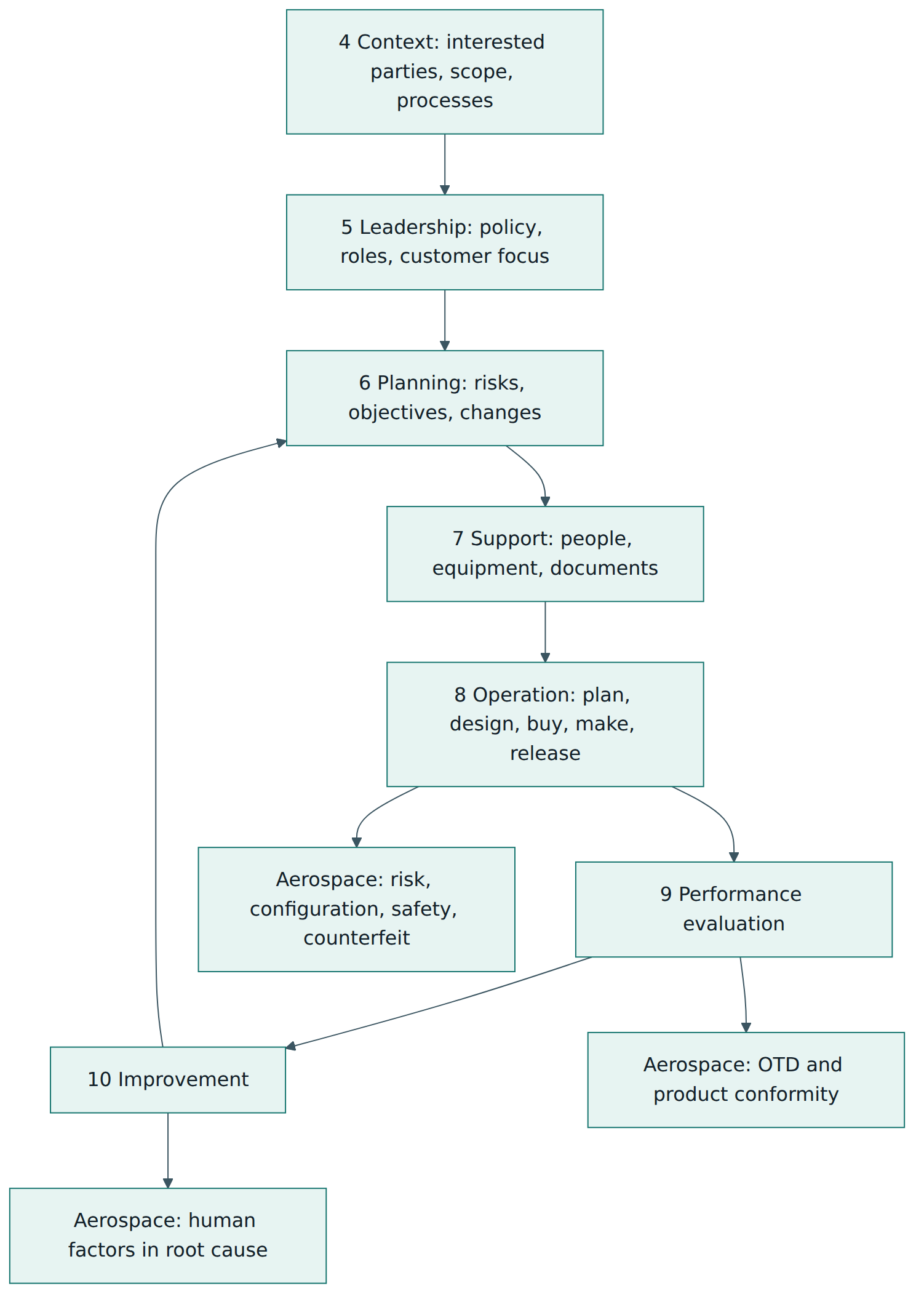
Because it contains ISO 9001:2015, AS9100D follows the ISO high-level structure, now called the Harmonized Structure, shared by ISO 14001, ISO 45001, ISO/IEC 27001 and other management system standards. Clauses 0 to 3 are introductory, and clauses 4 to 10 contain the requirements. The aerospace additions sit inside the same clause numbers, usually as extra sub-clauses or extra list items.
Clauses 1 to 3 – scope, references, definitions
Clause 1 sets the scope described in Lesson 1. Clause 2 makes ISO 9000:2015 (fundamentals and vocabulary) a normative reference. Clause 3 adds the aerospace definitions: counterfeit part, critical items, key characteristic, product safety and special requirements.
Clause 4 – Context of the organisation
As in ISO 9001, the organisation determines its internal and external issues, its interested parties and their requirements, the scope of its QMS and the processes it needs. AS9100 adds that customer and applicable statutory and regulatory QMS requirements must be considered, and that the organisation's documented information must include a general description of relevant interested parties, the scope, a description of the processes and their interactions, and the assignment of responsibilities and authorities. In practice, many aerospace organisations keep a quality manual for this purpose even though ISO 9001 no longer demands one.
Clause 5 – Leadership
Top management must take accountability for the QMS, set the quality policy and objectives and promote the process approach. AS9100 adds to customer focus that product and service conformity and on-time delivery performance are measured, and that action is taken when planned results are not, or will not be, achieved. It also keeps a requirement, dropped from ISO 9001, for a named management representative with responsibility and authority for the QMS, including the freedom to resolve quality management issues.
Clause 6 – Planning
Clause 6 is largely ISO 9001 text: actions to address risks and opportunities, quality objectives and planning of changes. It points forward to the operational risk management process in clause 8.1.1, which is where the aerospace-specific risk work happens.
Clause 7 – Support
Support covers resources, competence, awareness, communication and documented information. Important aerospace additions include:
- A register of monitoring and measuring equipment and a defined calibration or verification process that states equipment type, unique identification, location, frequency, method and acceptance criteria, with a recall process when equipment is found out of calibration (7.1.5.2).
- Awareness: people must understand their contribution to product or service conformity, their contribution to product safety and the importance of ethical behaviour (7.3).
- Protection of documented information, including electronic data, against loss, unauthorised change, corruption and physical damage (7.5.3).
Clause 8 – Operation
Clause 8 is where most aerospace content lives. Operational planning (8.1) must consider product and personal safety, the identification of critical items and key characteristics, the resources needed to support the product in use, and the planning and control of temporary or permanent transfer of work, for example from one site to another or to a supplier. Four new sub-clauses follow: operational risk management (8.1.1), configuration management (8.1.2), product safety (8.1.3) and prevention of counterfeit parts (8.1.4). Requirements review (8.2) includes special requirements and risks. Design and development (8.3) adds division of the work into distinct activities, verification and validation testing with test plans and results, and design outputs that identify key characteristics and critical items. Control of externally provided processes, products and services (8.4) is strengthened considerably, as Lesson 4 shows. Production (8.5) adds controls for equipment, tools and software programs, validation and control of special processes, production process verification such as first article inspection, foreign object prevention, traceability, preservation and post-delivery support. Release (8.6) and control of nonconforming outputs (8.7) close the clause.
Clause 9 – Performance evaluation
Clause 9 covers monitoring, measurement and analysis; customer satisfaction; internal audit; and management review. AS9100 names the customer satisfaction information to evaluate: product conformity, on-time delivery performance, customer complaints and corrective action requests. Where results show a problem, the organisation must develop and carry out improvement plans and check their effectiveness. AS9100 also adds on-time delivery performance to the topics that management review must consider.
Clause 10 – Improvement
Nonconformity and corrective action (10.2) gain several aerospace points: root-cause analysis must consider human factors where relevant; corrective action must be flowed down to an external provider when that provider caused the problem; and specific actions must be taken when timely and effective corrective action is not achieved.
Lesson 4 – How it works in practice
A standard is only useful if it changes what people do. This lesson walks through the aerospace requirements that most visibly shape daily work: risk, configuration, safety, counterfeit prevention, suppliers, production controls and nonconforming product.
Operational risk management
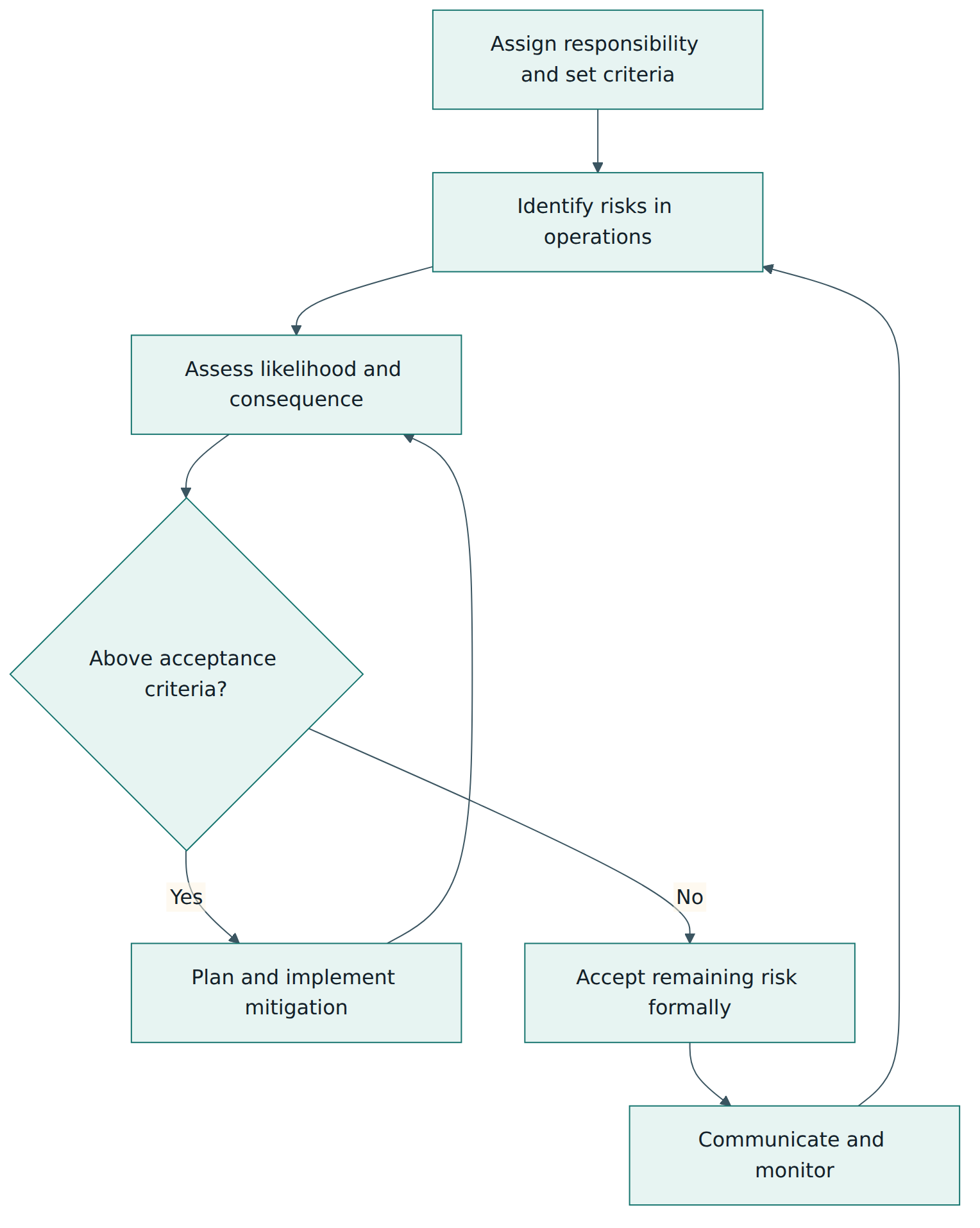
Clause 8.1.1 asks for a defined process to manage risks to achieving the applicable requirements. The organisation assigns responsibility for risk management, defines criteria for assessing risk (typically likelihood and consequence) and for deciding when a risk is acceptable, identifies and assesses risks throughout operations, plans and carries out mitigating actions where risk exceeds the acceptance criteria, and formally accepts the risks that remain after mitigation. Risks are communicated to the people who need to know them. A typical artefact is a risk register reviewed at contract review, design reviews and production readiness reviews.
Configuration management
An aircraft part may exist in several approved versions at the same time, and each serial number must be built to the right one. Configuration management (8.1.2) makes sure that the organisation knows which drawing revision, specification and software version applies to each product, that changes are evaluated and approved before they are implemented, and that the documents always describe the product as actually built. The usual practices are configuration identification (part numbers and revision levels), change control (a change board that assesses impact on form, fit, function, safety and certification), status accounting (records of which configuration was delivered to whom) and configuration audits. The organisation's process must fit the size of the business and the complexity of the product; a small machine shop that builds to customer drawings may do most of this through controlled drawing revisions and travellers.
Product safety
Clause 8.1.3 asks for planned and controlled processes to assure product safety over the whole product life cycle. The standard's guidance mentions hazard assessment and risk management, management of safety-critical items, analysis and reporting of events that affect safety, and communication and training. At a supplier this often means flagging safety-critical part numbers on drawings and travellers, giving operators of those parts specific training, and having a route for reporting events to the customer. The IAQG's 2023 key-change summary for IA9100 proposes turning these guidance items into requirements, with links to safety management systems.
Prevention of counterfeit parts
Counterfeit electronic components, fasteners and raw materials are a real risk, especially for parts that are out of production. Clause 8.1.4 asks for a process to prevent counterfeit or suspect counterfeit parts from being used or delivered. The standard suggests elements such as training staff to recognise counterfeits, monitoring parts obsolescence, buying from original or authorised manufacturers and distributors, maintaining traceability to the original manufacturer, verification and test methods, monitoring reports of counterfeits from external sources such as government and industry alert systems, and quarantining and reporting suspect or detected parts. A detected counterfeit must never go back into the supply chain, not even to the supplier who sold it. IA9100 is expected to turn these considerations into firm requirements.
Managing external providers
Aerospace products are mostly built from purchased parts and processes, so clause 8.4 is one of the most heavily audited. The organisation remains responsible for the conformity of everything it buys, including from sources the customer has designated. Practical consequences include:
- A register of external providers with their approval status (for example approved, conditional or disapproved) and the scope of approval, such as product type or process.
- Periodic review of each provider's performance, including product conformity and on-time delivery, with defined actions when providers do not meet requirements.
- Risk-based verification of purchased items, which may include receiving inspection, source inspection at the supplier, and review of test reports. When test reports for raw material are used as acceptance evidence, the organisation must have a way to evaluate the data and, where risk warrants, to check the reports by independent testing.
- Flow-down of requirements in the purchase order: applicable drawings and specifications, special requirements, critical items and key characteristics, test and inspection needs, requirements for first article inspection, the right of access for the organisation, its customer and regulators to the supplier's facilities and records, counterfeit prevention, notification of nonconforming product and changes, and the need for the supplier to pass these requirements to its own sub-tier suppliers.
Production controls
Clause 8.5 turns the shop floor into a controlled environment. Work instructions and travellers (route cards) give operators what they need and record that every operation and inspection was completed as planned. Tools, jigs and numerical-control programs are validated before use and controlled in storage and use (8.5.1.1). Special processes such as heat treatment, plating or welding are validated and kept under control through qualified equipment, qualified people and approved process parameters (8.5.1.2); many customers additionally require accreditation of such processes through the industry programme Nadcap. A production process verification (8.5.1.3), usually a first article inspection to 9102, confirms that a new part, or a part after a change of process, location or tooling, can be made to every design requirement. Foreign object prevention, identification and traceability through serial or lot numbers, control of acceptance stamps and electronic signatures, and preservation (including shelf-life and handling of sensitive parts) complete the picture. Post-delivery activities (8.5.5) cover in-service data, technical documentation, repairs and handling problems found after delivery.
Nonconforming outputs
Clause 8.7 makes the handling of nonconforming product very explicit, because a wrong decision here can put a defective part on an aircraft.
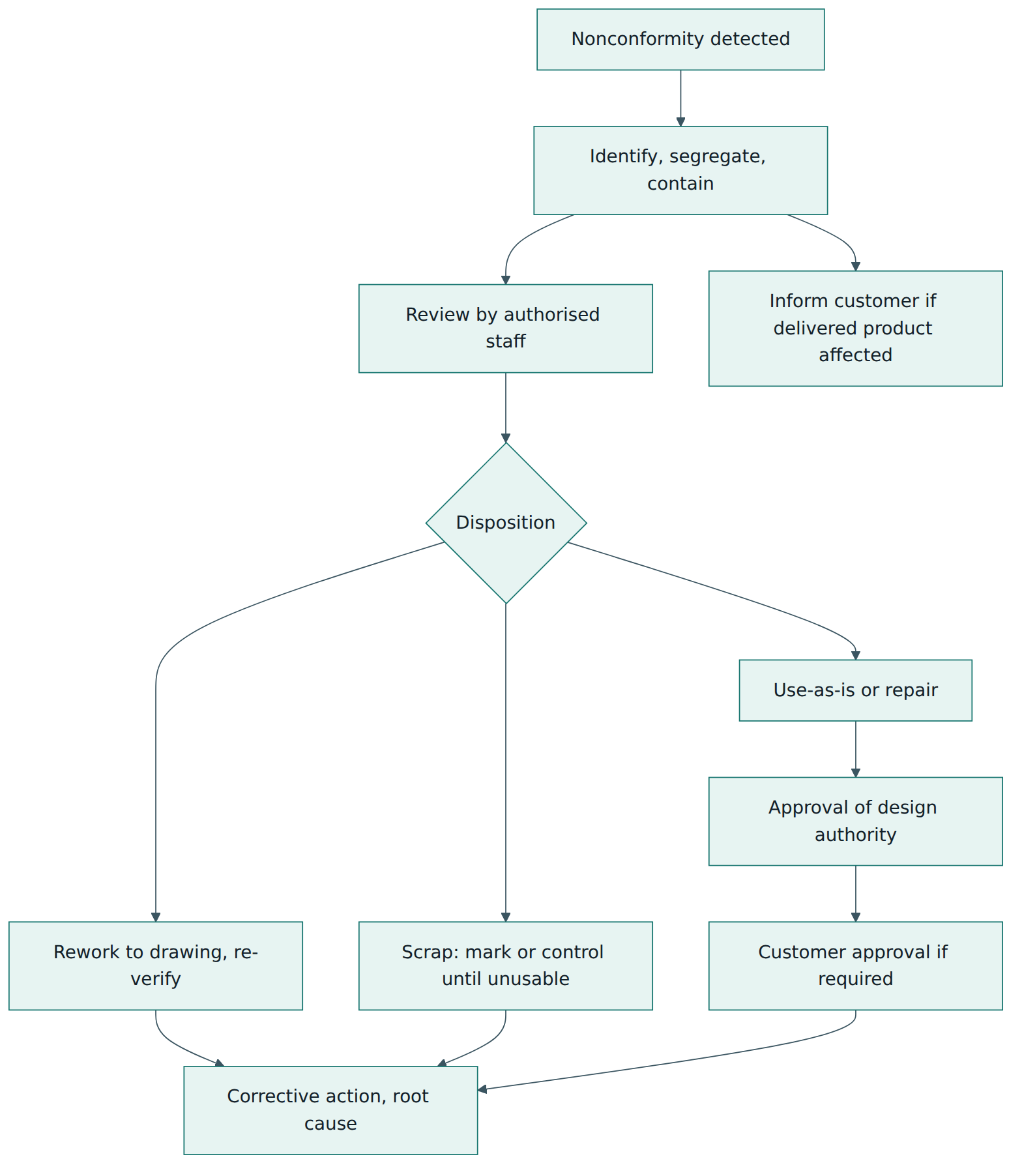
The process defines who may review and who may decide dispositions. Use-as-is and repair dispositions may only be accepted after approval by an authorised representative of the organisation responsible for the design, and by the customer where the contract requires it. Rework brings the part back to the drawing and must be followed by re-inspection. Scrapped product must be conspicuously and permanently marked, or kept under positive control, until it is physically made unusable, so that it cannot find its way back into service. The organisation must also inform affected parties, including customers and external providers, when delivered product may be nonconforming.
Roles and artefacts
Typical roles are the management representative or quality director, quality engineers who own processes such as FAI and nonconformance handling, inspectors with controlled acceptance stamps, a configuration or change board, supplier-quality engineers, internal auditors and process owners for each QMS process. Typical artefacts include the quality manual and process map, risk register, external provider register, calibration register, travellers, FAI reports, nonconformance reports, corrective action records, internal audit reports and management review minutes.
Lesson 5 – Assessment, certification and compliance
A sector-controlled scheme
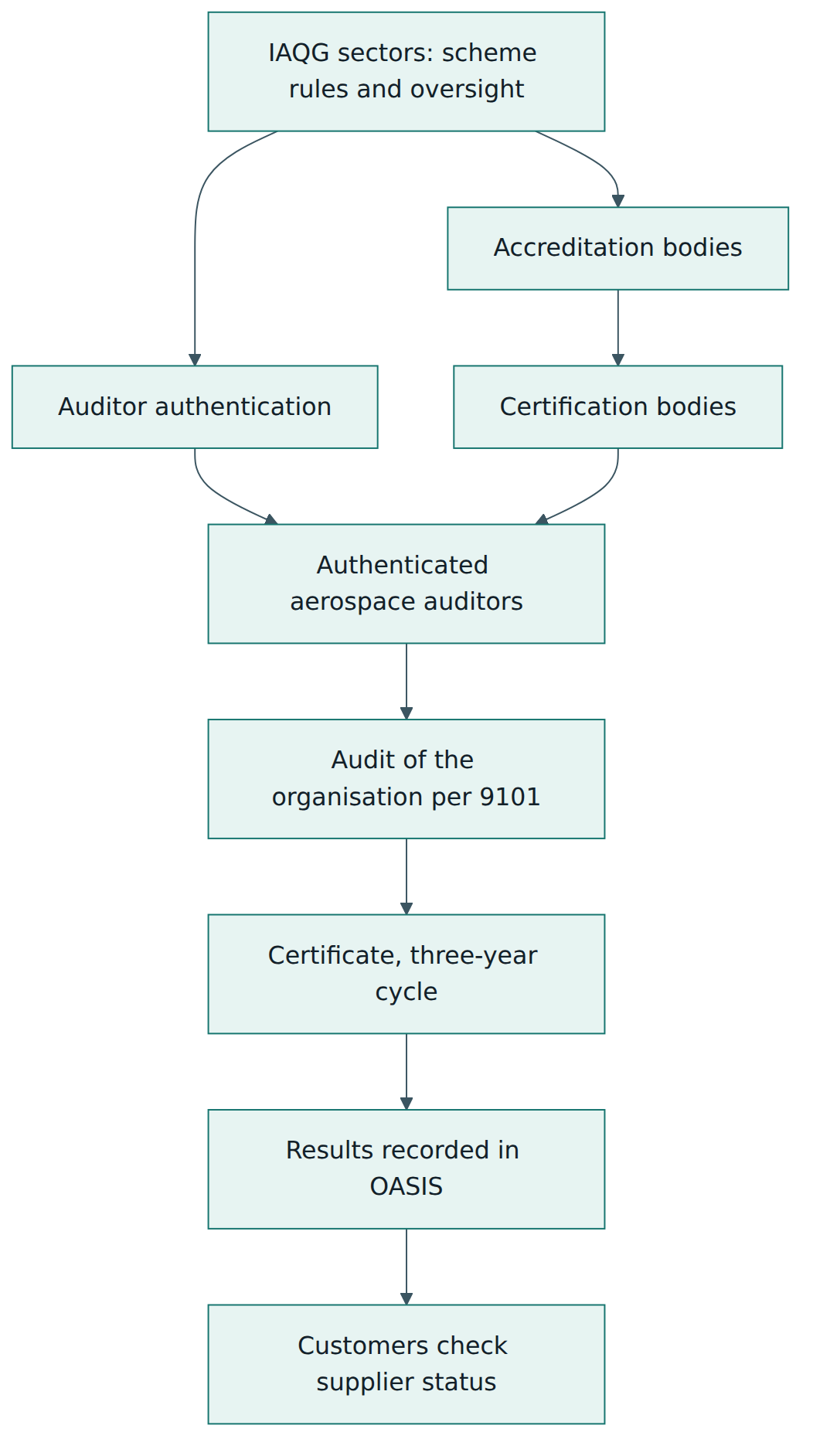
Ordinary ISO 9001 certification is run by certification bodies under general accreditation rules. AS9100 certification is different: it runs under the Industry Controlled Other Party (ICOP) scheme, which the aerospace industry itself governs through the IAQG. The idea is that the customers who rely on certificates also set and police the rules for issuing them. The scheme rests on three groups of standards:
- 9104/1 sets the requirements for aerospace QMS certification programmes: how certification bodies operate, audit duration, certificate content and the certification cycle.
- 9104/2 covers oversight of the scheme, including how the IAQG sectors monitor accreditation bodies and certification bodies.
- 9104/3 defines the competence, training and authentication of aerospace auditors.
The audit itself is carried out according to 9101, the companion standard for QMS audit requirements. It requires auditors to assess the effectiveness of processes, not just the existence of documents, and prescribes the audit records and forms they produce.
The certification process
An organisation chooses a certification body that is accredited for aerospace by a recognised accreditation body and listed in the IAQG's system. The initial audit is normally performed in two stages. Stage 1 reviews the organisation's readiness: scope, documented information, process map, internal audit and management review, and the planning of stage 2. Stage 2 is the full evaluation of the implementation and effectiveness of the QMS on site, following the 9101 method. Auditors trace processes from customer requirements through to delivery and look at performance data such as on-time delivery and product conformity.
Findings are graded as major or minor nonconformities. A major nonconformity typically signals a missing or broken process or a risk that nonconforming product reaches the customer; a minor one is an isolated lapse. The organisation must analyse root causes and submit corrective actions, and the certification body must accept them before a certificate is issued or maintained. The certificate is valid for a three-year cycle with surveillance audits at least once a year and a recertification audit before expiry. Multi-site organisations and organisations with design responsibility have specific rules for how sites and functions are sampled.
Audit records and OASIS
The 9101 method produces structured records. A Process Effectiveness Assessment Report (PEAR) documents how well each audited process achieves its planned results. An objective evidence record lists what the auditor examined, and nonconformity reports document findings. Together with the audit report, these are entered into OASIS, the Online Aerospace Supplier Information System run by the IAQG. OASIS holds the certificates of all organisations certified in the scheme and the certification bodies and auditors involved. Customers can look up a supplier's certification status, and the supplier can grant them access to detailed audit results. Because purchasing departments check OASIS, a certificate that is not listed there is of little value in aerospace.
Auditors and internal audit
Third-party auditors must be authenticated aerospace auditors who meet the 9104/3 competence requirements, including aerospace experience and training. Internally, the organisation runs its own audit programme (clause 9.2), and many companies train internal auditors in the 9101 process approach so that internal audits look for effectiveness the same way the certification body will. Customers may still perform their own second-party audits, for example of special processes or of product, but the shared certificate is meant to remove most duplicate QMS audits.
What certification does and does not prove
A certificate shows that, at the time of audit, an independent, authenticated auditor found the QMS in conformity with 9100 and effective on the sampled evidence. It does not approve a design, it is not a regulatory production approval, and it does not guarantee that every part is good. Customers continue to monitor supplier performance; poor delivery or quality can lead a customer to raise concerns that trigger additional certification body activity, including special audits.
Lesson 6 – Worked example
To see how the pieces fit, follow a fictional company, Northfield Precision, through its first year with AS9100.
The starting point
Northfield is a 120-person machining company that makes titanium brackets and aluminium hydraulic manifolds. It has held ISO 9001 for ten years, mainly for industrial customers. An engine manufacturer offers a contract for a family of engine mounting brackets, on condition that Northfield becomes AS9100 certified within twelve months. The managing director appoints the quality manager, Ana, as management representative and sponsor of the project.
Step 1 – Gap analysis and scope
Ana's team compares the existing ISO 9001 system clause by clause with the bold aerospace additions. The biggest gaps are operational risk management, configuration management, counterfeit parts prevention, first article inspection, foreign object prevention, the external provider register and the measurement of on-time delivery. They define the scope as the design-to-print manufacture of machined parts at one site; Northfield has no design responsibility, so design and development (8.3) is documented as not applicable, with the reason stated. They update the process map and the description of interested parties, adding the engine maker, the aviation authority that oversees the engine maker and Northfield's own special-process subcontractors.
Step 2 – Risk register and contract review
At contract review, the team identifies special requirements in the engine maker's drawings: a tight true-position tolerance on mounting holes, flagged as a key characteristic, and a requirement for shot peening that only approved processors may perform. The risk register records three main risks: a new five-axis machining process, a single approved shot-peening subcontractor, and the long lead time of titanium bar. For each, the team scores likelihood and consequence against defined criteria. Mitigations include a process capability study on the new machine, qualifying a second peening source, and a safety stock of bar. The residual risks are reviewed and accepted by the managing director, and the register is reviewed monthly.
Step 3 – Configuration and production planning
Every bracket part number now has a controlled drawing revision linked to its traveller, its machining program version and its inspection plan. A change board meets weekly; when the engine maker issues a drawing change, the board checks the effect on programs, fixtures and stock in progress, and nothing changes on the shop floor until the board approves it. Numerical-control programs are validated on a first part before release and stored in a protected library. The key characteristic on the mounting holes receives statistical process control, as the customer's flow-down requires.
Step 4 – Suppliers and counterfeit prevention
Purchasing builds an external provider register: titanium bar from two mills via an authorised distributor, shot peening and non-destructive testing from Nadcap-accredited processors, and calibration from an accredited laboratory. Each entry shows approval status and scope. Purchase orders now carry a standard set of flow-down clauses, including right of access, counterfeit prevention, notification of nonconformities and changes, and the requirement to pass the clauses to sub-tier suppliers. For raw material, receiving inspection checks mill test reports against the specification, and a sample is sent for independent chemical and mechanical testing once a year per supplier. Fasteners are bought only from the original manufacturer or its authorised distributors, and staff in purchasing and stores receive counterfeit awareness training.
Step 5 – First article inspection
The first production bracket from the new machine undergoes a full FAI following 9102: every drawing characteristic is measured and recorded, material and special-process certifications are verified, and the report is submitted to the engine maker. One hole is out of tolerance; the FAI is recorded as incomplete, the program is corrected, and a partial FAI is repeated for the affected characteristics. Only then does series production begin.
Step 6 – A nonconformity on the floor
Three months later an inspector finds a bracket with a tooling mark deeper than allowed. The part is tagged and moved to the quarantine cage. The review board considers a repair, but Northfield has no design authority, so the request goes to the engine maker's engineering department, which rejects it. The part is scrapped, cut in half and recorded. Root-cause analysis shows that a worn insert was not replaced because the operator was covering two machines during a night shift. The corrective action addresses both the tool life limit and the human factor, by changing the staffing plan for that shift. The effectiveness of the action is checked at the next internal audit.
Step 7 – Measuring what matters
Northfield starts reporting on-time delivery against the customer's agreed dates, not internal dates, and product conformity as returned parts per million. When on-time delivery falls below target for two months because of late peening returns, an improvement plan with the subcontractor is opened and the second source is brought into use. Management review now looks at these figures, the risk register and supplier performance every quarter.
Step 8 – Certification
After a full cycle of internal audits trained on the 9101 approach and one management review, Northfield invites an accredited certification body. The stage 1 audit finds the documentation ready but asks for clearer criteria for risk acceptance. The stage 2 audit lasts several days on site, following the bracket from contract review to dispatch. The auditor raises one minor nonconformity: two gauges in the inspection room are missing from the calibration register. Northfield traces the cause to gauges bought directly by a cell leader, adds a receiving check for measuring equipment, and submits the corrective action. The certificate is issued and appears in OASIS, where the engine maker's supplier-quality team confirms it before placing the first series order.
The example shows a pattern that holds for most implementations: the work is not writing procedures, but making risk, configuration, supplier control and evidence of conformity part of how the company runs every day.
Lesson 7 – Relationship to other standards and frameworks
The 9100 standard sits at the centre of a family of aerospace documents and beside other sector QMS standards that follow the same idea. The family has three requirement standards for different kinds of organisation and many supporting standards that describe methods in detail.
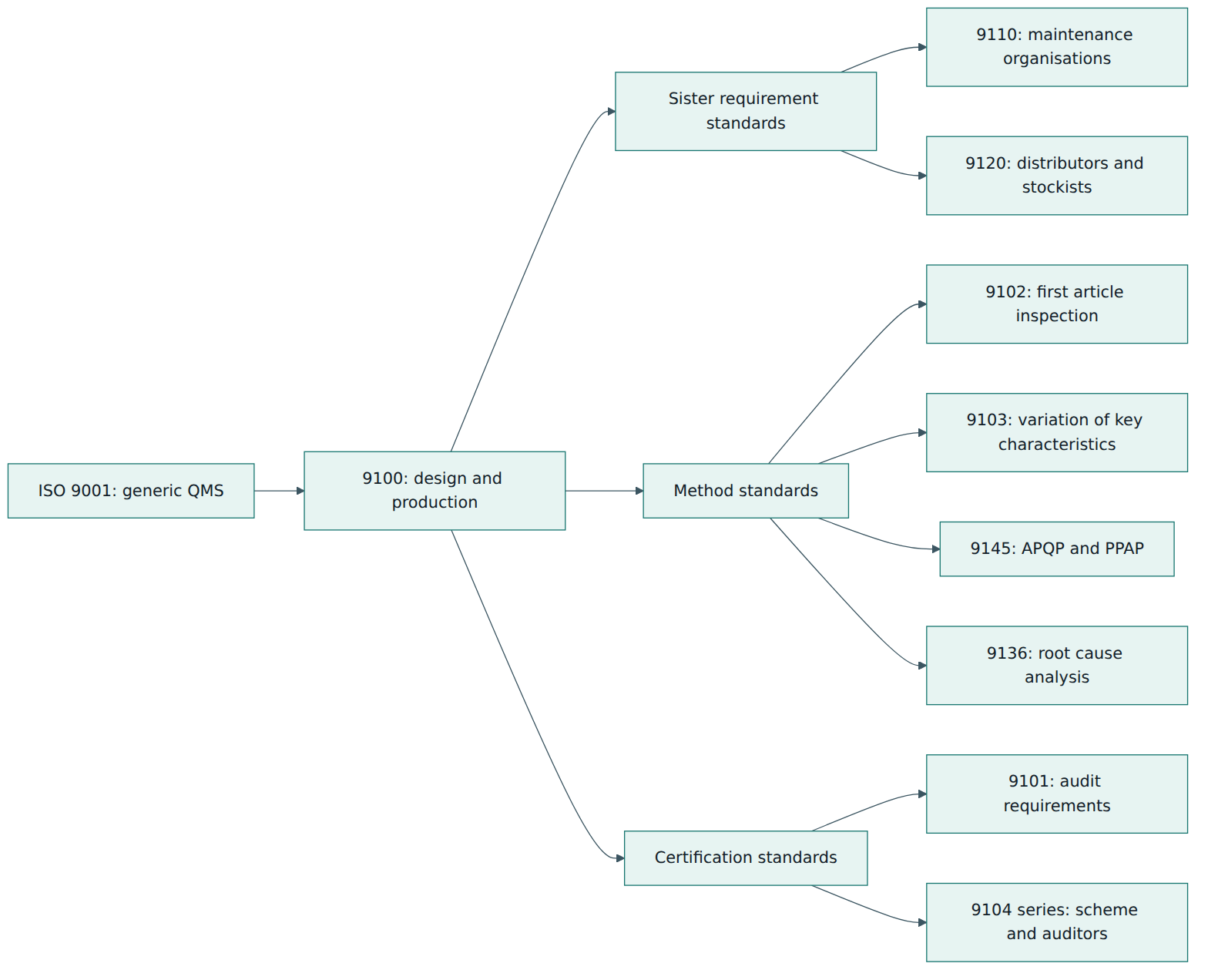
| Standard or framework | What it covers | Relationship to 9100 |
|---|---|---|
| ISO 9001 | Generic QMS requirements for any organisation | The base. AS9100D contains the full ISO 9001:2015 text; a later 9100 revision is planned to adopt the new ISO 9001:2026 (see the edition note in the course overview). |
| 9110 (AS9110, EN 9110) | QMS requirements for aviation maintenance organisations | Sister standard with additions for maintenance, such as airworthiness release and human factors in maintenance; used instead of 9100 by repair and overhaul shops. |
| 9120 (AS9120, EN 9120) | QMS requirements for aerospace distributors and stockists | Sister standard for companies that buy, store, split and resell parts and materials without changing them; strong on traceability and counterfeit prevention. |
| 9102 | First article inspection method and forms | Defines how to perform the production process verification that 9100 requires. |
| 9145 | Advanced product quality planning and production part approval | Describes a structured way to plan new products and prove production readiness; the IAQG plans stronger links to it in IA9100. |
| 9101 and the 9104 series | Audit method and certification scheme rules | Govern how 9100 certification audits are carried out and how bodies and auditors are controlled. |
| IATF 16949 | Automotive QMS requirements | A parallel sector standard built on ISO 9001 in the same way; shares ideas such as special characteristics (close to aerospace key characteristics), production part approval and supplier development. |
| ISO 13485 | QMS requirements for medical devices | Another sector QMS standard with a regulatory focus; companies serving both sectors often hold both certificates. |
| DO-178C and DO-254 | Development assurance for airborne software and electronic hardware | Product-level guidance used for certification of airborne systems; complements the organisation-level QMS that 9100 describes. |
Regional names, one standard
Because the IAQG works through three sectors, each 9100-series document has historically been published by a regional body: SAE International as AS (Aerospace Standard), ASD-STAN as EN (European Norm) and the Japanese Standards Association as JIS Q. The content is technically equivalent, which is why certificates are recognised worldwide. To end the duplication, the IAQG decided that its standards will move to a single "IA" (International Aerospace) designation as each one is revised, which simplifies change control and translation. That is why the next edition of 9100 will be called IA9100.
Where the revision is heading
The IAQG's published key-change summary lists themes for IA9100 that show where expectations are moving: expanded product safety with links to safety management systems; information security, including cyber security, and data protection as a new support requirement; quality culture and ethical behaviour; links to advanced product quality planning; stronger counterfeit parts prevention; sub-tier supplier controls; and foreign object prevention in operational planning. Several items that are notes or guidance in Revision D, notably in product safety and counterfeit prevention, are expected to become requirements. These are signals rather than final text, and later updates suggest that some themes may wait for the fuller revision aligned with ISO 9001:2026, but an organisation working towards them now will find the transition easier.
Common pitfalls and best practices
Pitfalls
- Bolting aerospace onto ISO 9001 on paper only. Writing new procedures for each bold clause without changing how work is done produces a system that passes stage 1 and fails stage 2, because 9101 auditors test effectiveness.
- Measuring on-time delivery against internal dates. Reporting delivery against a promised or re-planned date hides real lateness; the customer measures against the agreed date and will see a different picture.
- Treating repair and use-as-is as internal decisions. A supplier without design authority that approves its own repair disposition puts unapproved hardware into the product and breaks a basic aerospace rule.
- Weak flow-down. Purchase orders that omit key characteristics, special-process approvals, right of access or counterfeit requirements leave the organisation responsible for risks it never passed on.
- Scrap that is not made unusable. Rejected parts left in an open bin can be mistaken for good stock or recovered later; scrap must be marked permanently or controlled until destroyed.
- Root cause stops at "operator error". Blaming individuals without considering human factors such as workload, training or unclear instructions leads to repeat nonconformities.
- Static risk registers. A register written for the audit and never reviewed again does not meet the intent of operational risk management.
Best practices
- Start from a process map, not the clause list. Map how the company actually wins work, buys, makes and delivers, then show where each requirement is met.
- Make data visible. Display on-time delivery, product conformity, escapes and supplier performance where teams can see them, and review them in management review.
- Integrate risk with daily reviews. Update the risk register at contract review, before first article inspection and when changes are planned, so it guides decisions.
- Treat suppliers as part of the system. Rate them by risk and performance, visit special-process sources, and develop weak suppliers instead of only inspecting their parts.
- Train for awareness, not just procedure. Help every employee understand how their work affects product safety and conformity and why ethical reporting of problems matters.
- Audit like the certification body. Train internal auditors in the process-effectiveness approach of 9101 and follow real products and records rather than checklists.
- Prepare early for IA9100. Strengthen product safety, counterfeit prevention, information security and quality culture now, since the IAQG has signalled that these areas will be tightened.
Summary and key takeaways
- 9100 is the aviation, space and defence QMS standard written by the IAQG; AS9100, EN 9100 and JIS Q 9100 are regional names for the same content.
- Revision D (2016) contains the full ISO 9001:2015 text plus aerospace additions; the next edition will be called IA9100, and as of 2026-10-29 Revision D is still the edition used for certification.
- Key aerospace concepts are critical items, key characteristics, special requirements, product safety, counterfeit parts, configuration management and first article inspection.
- Clause 8 carries most additions: operational risk management, configuration management, product safety, counterfeit prevention, external provider control, special processes, FAI and strict nonconforming-output rules.
- On-time delivery and product conformity are mandatory measures of customer satisfaction, and root-cause analysis must consider human factors.
- Certification runs under an industry-controlled scheme: accredited certification bodies, authenticated auditors, the 9101 audit method and results published in OASIS.
- 9110 serves maintenance organisations and 9120 serves distributors, while standards such as 9102, 9103 and 9145 describe methods that support 9100.
- The system only works when risk, configuration, supplier control and evidence are part of daily operations rather than documents written for the auditor.
Reflection questions
- Think of a product or part you know well. Which of its features would you treat as key characteristics, and how would you control their variation?
- Your organisation buys a part that is out of production from a broker. Which steps from this tutorial would you apply before using it, and why?
- How would you explain to a new production supervisor why a repair disposition needs approval from outside the factory?
- Which indicators would you show in a monthly management review for an aerospace supplier, and what action would you expect if one of them deteriorates?
- Looking at the themes signalled for IA9100, which one would need the most work in an organisation you know, and how would you begin?
Further reading and official sources
- International Aerospace Quality Group (IAQG) – IAQG
- AS9100D Quality Management Systems – Requirements for Aviation, Space, and Defense Organizations – SAE International
- IA9100 Key Change Summary (November 2023) – IAQG
- Status of the development of IA9100 – NASA Office of Safety and Mission Assurance
- Aerospace standard revision updates (IA9100 tracker) – Amtivo (certification body)
- OASIS – Online Aerospace Supplier Information System – IAQG
- ASD-STAN (publisher of EN 9100) – ASD-STAN
- ISO 9001 Quality management systems – ISO
Original tutorial by xOps School (DevOpsSchool Private Limited), written from public sources about AS9100 / IAQG 9100. Not affiliated with or endorsed by the standard's owner; standard names are trademarks of their owners. Buy the official standard from its publisher for the authoritative text.