
EFQM Model – Tutorial (about 60 minutes)
- View
The EFQM Model is a management framework, maintained by the European Foundation for Quality Management (EFQM), that helps any organisation – a manufacturer, a hospital, a police force, a university, a software company or a charity – look at itself as one connected system: why it exists and where it is heading, how it turns that direction into everyday work, and what results it actually achieves for the people who depend on it. It is used for self-assessment, for planning improvement and transformation, and as the basis for external recognition. After this tutorial you will be able to explain the logic of the model, name its seven criteria, use the RADAR tool to judge an approach or a set of results, run a first self-assessment, and explain how EFQM recognition works and how the model relates to ISO 9001, ISO 9004 and the Baldrige framework.
Course overview
Edition and status: The current edition is The EFQM Model 2025, published by EFQM (a not-for-profit foundation based in Brussels; the publication is copyright 2024). It was released in 2024, five years after the 2020 edition was launched, and replaced The EFQM Model 2020; national partner organisations have since published translations. It is a refresh rather than a redesign: the three-part structure (Direction, Execution, Results), the seven criteria and the RADAR scoring logic were kept, while the content of the criterion parts, the results guidance and the RADAR matrices were updated. The EFQM Model is not an ISO standard and there is no "EFQM certification" in the sense of a certificate of conformity; instead EFQM and its accredited partners award recognition levels (star ratings) after an external assessment. On the verification date EFQM's own pages showed no newer edition and no announced replacement. Verified 2026-10-29 against EFQM's model and assessment pages and the EFQM Model 2025 publication.
Who it is for: managers and team leads, quality and operational-excellence professionals, strategy and planning staff, engineers moving into management roles, HR and sustainability people, and anyone who has been asked to join an EFQM self-assessment, prepare an application for recognition, or act as an internal assessor. It is equally useful in the private, public and voluntary sectors and in organisations of any size.
Prerequisites: none. Some experience of working in an organisation helps, because the model constantly asks you to compare what is written down with what really happens. Familiarity with the Plan-Do-Check-Act improvement cycle is useful but not required; it is explained where needed.
Learning objectives. After this tutorial you will be able to:
- Explain why the EFQM Model exists, what problems it helps leaders solve, and why it is described as non-prescriptive.
- Describe the Why–How–What logic of Direction, Execution and Results, and name the seven criteria with their main criterion parts.
- Use the elements and attributes of RADAR to evaluate an approach (criteria 1–5) and a set of results (criteria 6–7), including the two master rules.
- Plan and run a basic self-assessment, from scoping and evidence gathering to consensus scoring and an improvement plan.
- Explain the EFQM assessment pathways and recognition levels, and why recognition is not the same as certification.
- Compare the EFQM Model with ISO 9001, ISO 9004, the Baldrige Excellence Framework and improvement methods such as Lean and Six Sigma.
The tutorial has seven lessons, followed by pitfalls and good practices, a summary, reflection questions and official sources. Plan about one hour, including time to study the four diagrams and to think through the reflection questions.
Lesson 1 – Origins, purpose and scope
Where the model came from
At the end of the 1980s European industry felt it was losing ground to Japanese and American competitors who had made quality a board-level discipline. Japan had the Deming Prize, and the United States had just created the Malcolm Baldrige National Quality Award. In 1988–1989 the chief executives of a group of leading European companies set up the European Foundation for Quality Management to promote a similar approach in Europe. The Foundation published its first model in the early 1990s, and the first European Quality Award was presented in 1992. Over the following decades the model was revised several times. For many years it was known as the EFQM Excellence Model, with five "enabler" criteria (what an organisation does) and four "results" criteria (what it achieves), each half worth 500 points.
In 2019 EFQM launched a substantially redesigned model, The EFQM Model 2020. It dropped the word "excellence" from the title, reduced the nine criteria to seven, and reorganised everything around three simple questions about purpose, delivery and achievement. It also put far more weight on the organisation's ecosystem, on transformation and on creating sustainable value for stakeholders rather than only on internal process control. The 2025 edition keeps this design and refreshes the content to reflect what EFQM observed in assessments during the pandemic years, supply-chain disruption, inflation, hybrid working and the arrival of artificial intelligence.
What problem it solves
Most organisations already have plenty of management tools: a strategy document, budgets, a quality management system, a risk register, engagement surveys, perhaps a Lean programme. What they often lack is a way to see whether all these pieces fit together. A strategy can promise customer intimacy while the culture rewards cost cutting; a quality system can be certified while customers drift away; an improvement programme can generate hundreds of projects that do not move any strategic result. The EFQM Model gives leaders a single, holistic lens to test the coherence of the whole system: does the purpose drive the strategy, does the strategy shape how stakeholders are engaged and value is created, and do the results show that it is working – and will keep working?
EFQM calls this cause-and-effect connection the red thread. An assessor following the red thread starts from a stated purpose or strategic priority, traces it through the approaches that are supposed to deliver it, and checks whether the expected results appear. Where the thread breaks, there is an opportunity for improvement.
Non-prescriptive by design
The model does not tell you which methods to use. It does not require a particular strategy process, quality system, organisational structure or improvement method. It describes what organisations that sustain high performance tend to do and achieve, and leaves the choice of how to an organisation's leaders. A start-up, a government ministry and a multinational can all use it, because it asks about the soundness, deployment and effectiveness of whatever they have chosen, not about compliance with a fixed list of requirements. This is the biggest single difference between a management model like EFQM and a requirements standard like ISO 9001.
Typical uses
EFQM describes many ways the model is used in practice. The most common are:
- Understanding organisational maturity through a self-assessment that produces strengths, gaps and, optionally, a score.
- Designing and steering transformation programmes by describing the "as is" and the "to be" state in the language of the criteria.
- Preparing for an external assessment and recognition.
- Benchmarking with other users of the same model, which provides a common vocabulary across sectors and countries.
- Building sustainability plans and reports, and checking how well sustainability is embedded in strategy and operations.
- Assessing the capability of suppliers, partners or funding recipients.
- Supporting mergers, acquisitions and the start-up of new businesses by giving a structured view of what matters.
The scope is the whole organisation, or a clearly defined part of it such as a division, a site or a shared-service centre. The model is not limited to quality in the narrow sense of product conformity; it covers leadership, strategy, culture, people, customers, partners, society, operations, technology, data, finance and sustainability.
The values behind it
The 2025 edition states openly that it rests on a set of European values, expressed in documents such as the EU Charter of Fundamental Rights and the European Convention on Human Rights, and that the United Nations Sustainable Development Goals (SDGs) helped shape it. EFQM expects users to act in the spirit of these values whether or not their local law requires it. Beneath the changing content, three ideas remain constant: the primacy of the customer, a long-term view that takes all key stakeholders into account, and an understanding of cause and effect between why an organisation acts, how it acts and what it achieves.
Lesson 2 – Key concepts and vocabulary
The model uses everyday words in specific ways. These definitions are paraphrased; the official glossary in the EFQM publication gives the authoritative wording.
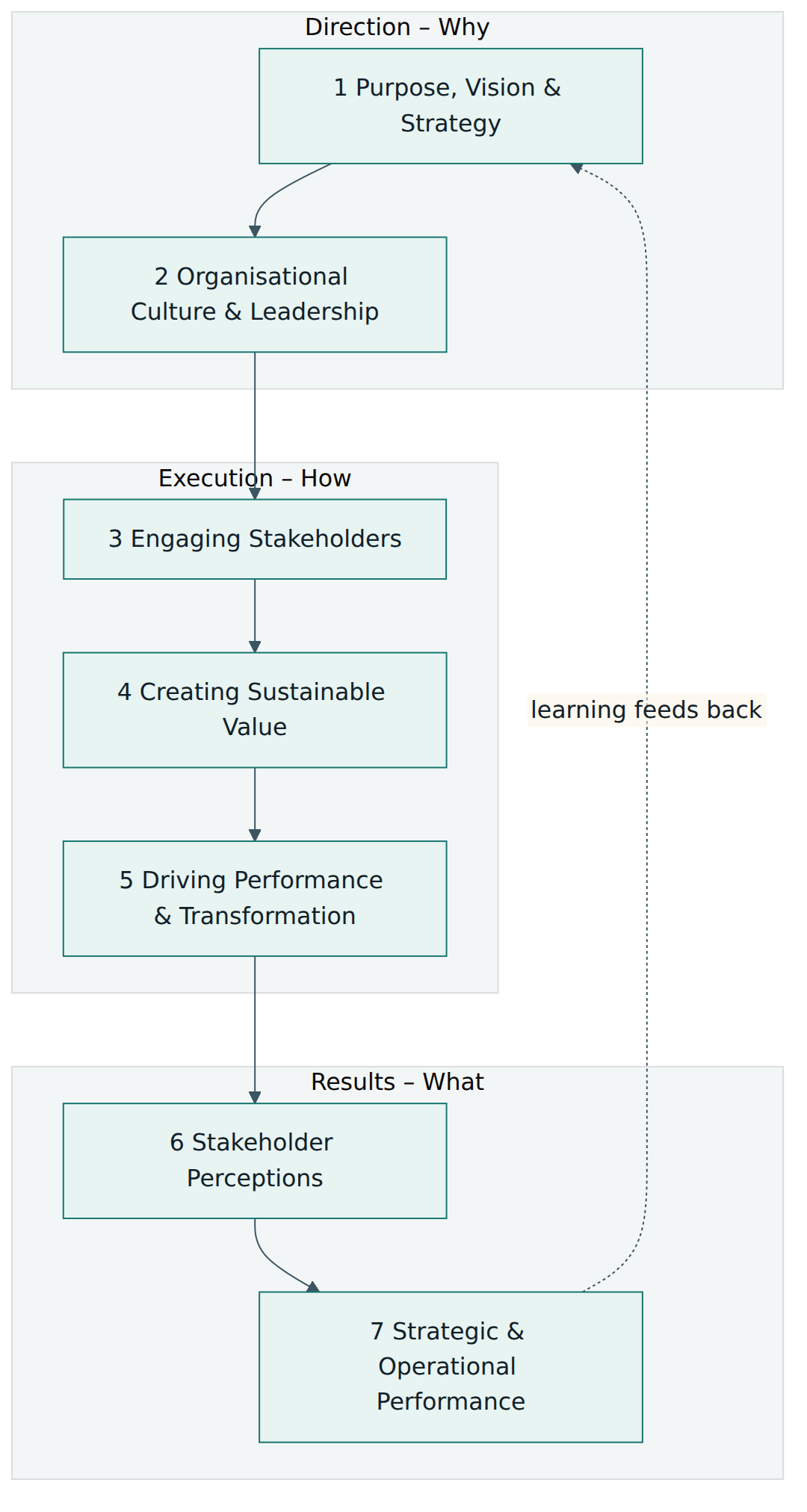
- Direction – the first part of the model, answering "why": the organisation's purpose, vision, strategy, culture and leadership (criteria 1 and 2).
- Execution – the second part, answering "how": engaging stakeholders, creating sustainable value, and driving performance and transformation (criteria 3, 4 and 5).
- Results – the third part, answering "what": what stakeholders perceive and what strategic and operational performance has been achieved, together with predictions of future results (criteria 6 and 7).
- Criterion and criterion part – a criterion is one of the seven main building blocks; each is divided into criterion parts (for example 1.1 to 1.5) that describe in more detail what an organisation achieving sustainable performance typically does. EFQM's assessment pages count 29 criterion parts in total.
- Purpose – the fundamental reason the organisation exists and the positive impact it intends to have; some organisations use a mission statement in addition to, or instead of, a purpose.
- Vision – what the organisation is trying to achieve in the long term; a guide for choosing current and future courses of action.
- Strategy – how the organisation intends to fulfil its purpose and move toward its vision over a period, derived from analysis of its ecosystem, capabilities and stakeholder needs.
- Ecosystem – the wider, interdependent environment in which the organisation operates: competitors, partners, regulators, communities, technology and economic trends, many of which it cannot control.
- Key stakeholder – a person, group or organisation with a direct interest in the organisation and its performance. The model groups them into five categories: customers, people, business and governing stakeholders, society, and partners and suppliers.
- Sustainable value – value that secures the organisation's long-term viability and continuing high performance; in the 2025 edition it must be delivered while treating environmental and social sustainability as a primary focus.
- Approach – the overall way something is made to happen: the processes, structured actions, principles and policies an organisation uses to achieve an aim.
- RADAR – EFQM's diagnostic and scoring logic: determine the Results you need, plan an Approach, Deploy it, then Assess and Refine it.
- Attribute – a specific quality that RADAR examines inside an element, such as whether an approach is sound or whether results show positive trends.
- Red thread – the cause-and-effect line connecting purpose and strategy to the approaches that deliver them and to the results they produce.
- Megatrends – global developments, such as digital transformation, climate change or demographic change, that any organisation should understand if it wants to remain relevant.
- Predictive measures – leading indicators that give confidence about future performance, as distinct from lagging results that report what has already happened.
- Self-assessment – a structured review of the organisation against the model carried out by its own people, producing strengths, opportunities for improvement and, if wanted, a score.
- Recognition – the external acknowledgement (a star rating) awarded by EFQM or an accredited partner after independent assessors have assessed the organisation.
Two further terms are worth separating. A strength is something the evidence shows the organisation does or achieves well against a criterion part; an opportunity for improvement (often shortened to OFI or AFI, area for improvement) is a gap the evidence reveals. Every good assessment produces both, because the main output of the model is learning, not a number.
Lesson 3 – Structure of the EFQM Model 2025
Three questions
The whole structure flows from three questions. Why does this organisation exist, what purpose does it fulfil and why has it chosen this strategy? That is Direction. How does it intend to deliver on its purpose and strategy? That is Execution. What has it actually achieved so far, and what does it intend to achieve tomorrow? That is Results. Direction and Execution together describe what an organisation does; Results describe the outcomes. Results then feed back into Direction, because what the organisation learns from its results should reshape its purpose, strategy and culture.
Direction: criteria 1 and 2
Criterion 1 – Purpose, Vision and Strategy asks how the organisation sets an inspiring purpose and an aspirational vision, and how it builds a strategy that delivers them. Its five criterion parts cover: defining purpose and vision (1.1); understanding the ecosystem, the organisation's own capabilities and its major challenges (1.2); identifying and understanding the needs of key stakeholders (1.3); developing and adapting strategy, including strategic risk and resource allocation (1.4); and designing and implementing a performance management and governance system that drives execution (1.5). The 2025 edition puts more emphasis on analysing the ecosystem, prioritising stakeholders, adapting strategy quickly when the environment changes, and integrating sustainability requirements and regulation into governance.
Criterion 2 – Organisational Culture and Leadership treats leadership as a set of behaviours visible at every level, not as a job title. Its four parts cover: steering the culture and nurturing core values (2.1); creating the conditions for realising change (2.2); enabling creativity and innovation (2.3); and uniting and engaging key stakeholders behind the purpose, vision and strategy (2.4). The 2025 refresh reinforces leaders' commitment to purpose, role modelling of culture and values, removing barriers to change, and new ways of working such as remote and hybrid work. It also introduces "positive impact" alongside purpose, replacing the earlier "force for good" wording.
Execution: criteria 3, 4 and 5
Criterion 3 – Engaging Stakeholders has one criterion part for each of the five key stakeholder groups: customers (3.1, building sustainable relationships); people (3.2, attracting, engaging, developing and retaining them); business and governing stakeholders such as owners, boards, funders or regulators (3.3, securing and sustaining their support); society (3.4, contributing to development, well-being and prosperity); and partners and suppliers (3.5, building relationships and ensuring support for creating sustainable value). Because no organisation can satisfy every group all the time, the model asks how it balances their competing interests so that no single group dominates.
Criterion 4 – Creating Sustainable Value follows the value an organisation offers its customers through four parts: defining the value and how it is created (4.1); communicating and selling it (4.2); delivering it, which includes managing the supply chain so that customer demand can be met (4.3); and defining and implementing the overall experience across the customer journey (4.4).
Criterion 5 – Driving Performance and Transformation recognises that an organisation must deliver today while preparing for tomorrow. Its five parts cover: driving performance, including process, project and risk management (5.1); transforming the organisation for the future (5.2); driving innovation and technology (5.3); leveraging data-driven insights and knowledge (5.4); and managing assets and resources (5.5). New in 2025 are explicit references to business continuity planning and future-foresight programmes for anticipating disruption (criterion part 5.1), and a stronger idea of technology leadership – the ability to use technologies such as AI to reach strategic goals and create value.
Results: criteria 6 and 7
Criterion 6 – Stakeholder Perceptions mirrors criterion 3. It has five parts, one per stakeholder group (6.1 customers to 6.5 partners and suppliers), and concerns what stakeholders think and feel about the organisation. Perception data can come from surveys, focus groups, ratings, social media, complaints and compliments, external recognition, investor reports and, increasingly, analytics such as sentiment analysis.
Criterion 7 – Strategic and Operational Performance concerns what the organisation has actually achieved. Strategic performance is the outcome of executing strategic initiatives, usually tracked through a small number of key indicators; operational performance is the outcome of day-to-day processes. The 2025 edition asks organisations to segment their results clearly between the two and suggests four result categories in which both can be measured: fulfilment of stakeholder expectations and their contribution; economics and financials; performance and transformation; and sustainability. It also expects predictive measures – leading indicators that give confidence about the future – alongside the lagging ones.
Points and weightings
When an organisation is scored, it is scored out of 1,000 points. The split is uneven and worth remembering, because it shows where EFQM places weight. Direction carries 200 points, Execution 400 and Results 400.
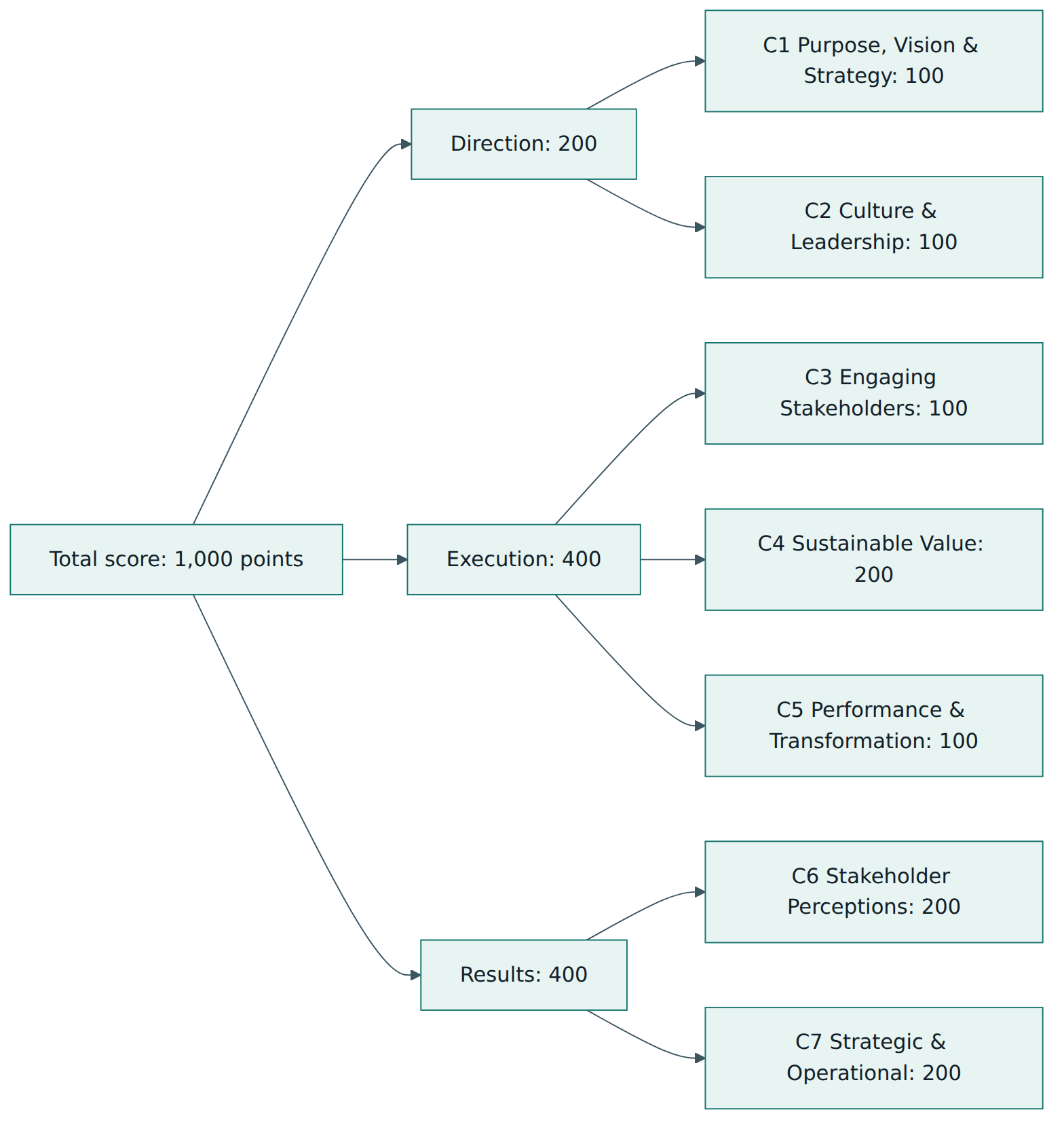
Inside a criterion, the points are normally split evenly between the criterion parts: each of the five parts of criterion 1 is worth 20 of its 100 points, and each of the four parts of criterion 4 is worth 50 of its 200 points. Criteria 3 and 6 are the exception. Because the importance of stakeholder groups differs between, say, a hospital and a bank, the organisation chooses its own weighting for the five groups, within rules: no group may be weighted below 10 % or above 40 % of the criterion's points, and weights move in 5 % steps. Whatever weighting it chooses for criterion 3 must be mirrored in criterion 6, so that the way it engages a group and that group's perceptions carry the same importance.
What changed from the 2020 edition
For people who learned the 2020 model, the main differences in 2025 are: sustainable performance improvement placed at the centre of the model and a clearer distinction between sustainable value (long-term viability) and sustainability (environmental and social responsibility); reinforced leadership content; new workforce, resilience and foresight topics; technology leadership; the four result categories and clearer strategic/operational segmentation in criterion 7; and two RADAR matrices instead of three. The RADAR structure, its scoring logic and its master rules stayed the same.
Lesson 4 – How it works in practice: RADAR and self-assessment
The RADAR logic
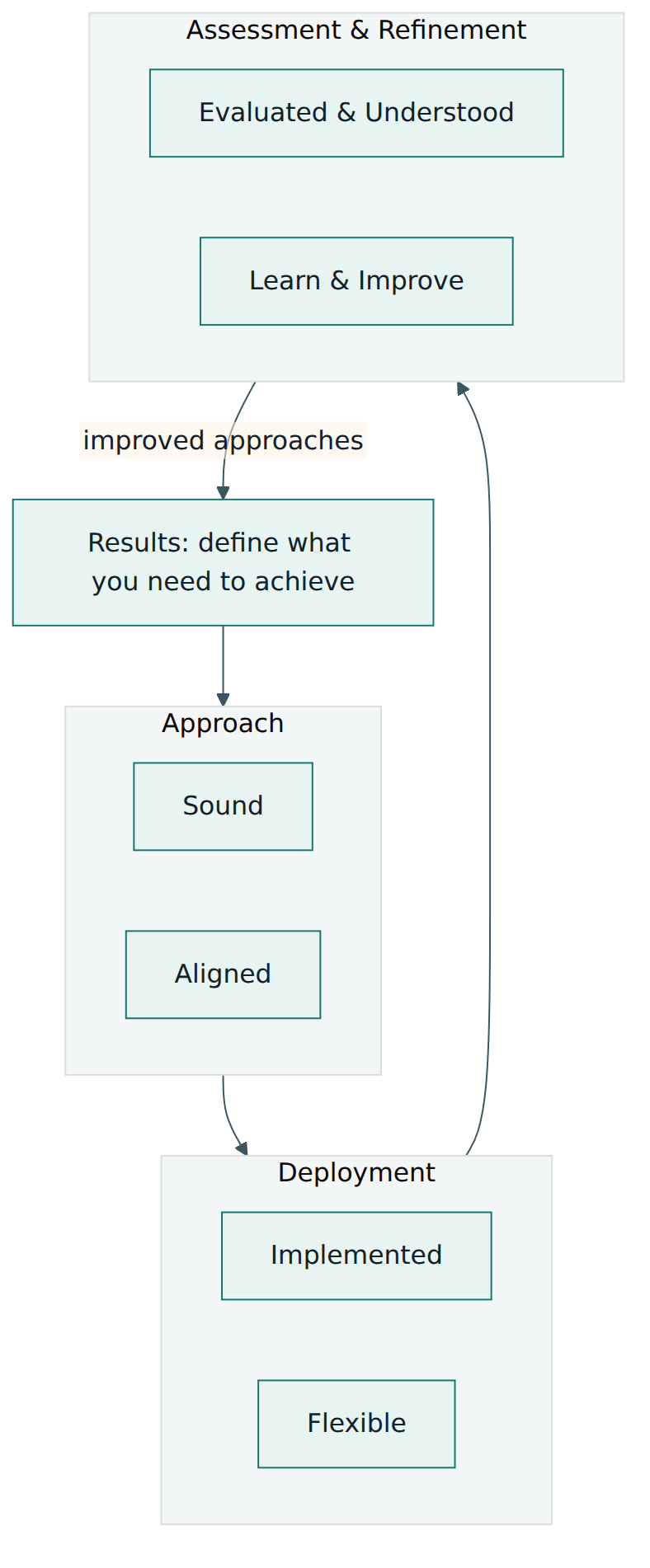
The model tells you what to look at; RADAR tells you how to judge it. At its highest level RADAR says an organisation needs to: determine the Results it aims to achieve as part of its strategy; have an Approach that will deliver those results now and in the future; Deploy the approach appropriately; and Assess and Refine the deployed approach so that it learns and improves. Readers who know Plan-Do-Check-Act will recognise the cycle, but RADAR starts from the intended results rather than from the plan, which forces the question "what is this approach for?" before anything else.
RADAR for Direction and Execution (criteria 1–5)
For each criterion part in criteria 1 to 5, assessors look at the approaches the organisation uses and rate six attributes, grouped in three elements:
- Approach – Sound: there is a clear rationale for the approach, it responds to key stakeholder needs, it is appropriately described and it is designed to be fit for the future.
- Approach – Aligned: it supports the purpose, vision and strategy and is integrated with related approaches.
- Deployment – Implemented: it is actually used, consistently and in good time, wherever it is relevant.
- Deployment – Flexible: the way it is deployed allows adaptation when circumstances change.
- Assessment and Refinement – Evaluated and Understood: internal and external feedback on its effectiveness and efficiency is collected, understood and shared.
- Assessment and Refinement – Learn and Improve: those insights are used to generate creative, improved and innovative approaches and deployment.
Each attribute is rated on a scale from 0 % to 100 % in 10 % steps, from "inability to achieve" through "limited ability", "ability", "comprehensive ability" to "outstanding ability". The assessors then agree an overall percentage for the criterion part, which converts into points. The master rule for criteria 1–5 is that the overall score may not be higher than the score for Sound. The logic is simple: a well-deployed, frequently reviewed approach that has no clear rationale is still a weak approach, so soundness caps everything else.
RADAR for Results (criteria 6 and 7)
Results are judged with a second matrix and six different attributes:
- Relevance and Usability – Scope and Relevance: a coherent set of results linked to stakeholder expectations and to strategic and operational performance has been identified and is reviewed over time.
- Relevance and Usability – Usability: the data are timely, reliable, accurate and segmented enough to give meaningful insight.
- Performance – Trends: results show positive trends or sustained strong performance over an appropriate period.
- Performance – Targets: ambitious, strategy-based targets are set and consistently achieved.
- Performance – Comparisons: meaningful external comparisons are made and are favourable.
- Performance – Future Confidence: there is good reason, based on cause-and-effect understanding, analytics and performance patterns, to expect the results to be sustained.
The master rule for results is that the overall score for a criterion part in criterion 6, or for criterion 7, may not exceed the score for Scope and Relevance. Impressive trends in an indicator nobody needs do not prove much; the organisation must first show it measures the right things.
Running a self-assessment
Self-assessment is the most common way to use the model, and it does not require any external body. A typical cycle looks like this:
- Agree the purpose and scope. Leaders decide why they are assessing (a maturity baseline, preparing for recognition, testing a new strategy) and which part of the organisation is in scope.
- Choose the method. Options range from a questionnaire or workshop, through a matrix-style review, to a full written or evidence-based document. Light methods suit a first cycle; deeper methods suit organisations preparing for external assessment.
- Form and train the team. A cross-functional team, including people from the front line and not only managers, learns the model and RADAR. Many organisations use staff trained as EFQM assessors.
- Gather evidence. For each criterion part, the team collects descriptions of approaches, proof of deployment, review records and results data, and tests them through interviews and observation.
- Assess individually, then reach consensus. Team members first form their own view of strengths, opportunities for improvement and, if scoring, percentages; then they meet to agree a shared position, which reduces individual bias.
- Prioritise. Not every gap matters equally. The team, with leaders, chooses the few opportunities most closely linked to strategy and stakeholder needs.
- Plan and integrate. Chosen improvements get owners, resources and deadlines and are built into the normal strategy and performance management cycle (criterion 1.5).
- Review and repeat. After a cycle, often a year, the organisation reassesses to see whether the gaps have closed and the results improved.
Scoring is optional in a self-assessment. EFQM notes that many organisations value a number because it allows comparison over time and with others, but the strengths and improvement opportunities are what drive change. Scoring is mandatory only when an organisation applies for external recognition.
Roles and artefacts
Typical roles are an executive sponsor (often the chief executive), a coordinator or "excellence lead", criterion owners who collect evidence for each criterion, the assessment team, and – for recognition – an external team of independent assessors. Typical artefacts are a scoping note, an evidence map per criterion part, the RADAR scoring sheets, a feedback report listing strengths and opportunities, and an improvement plan linked to the strategy. EFQM also offers a digital platform, AssessBase, with diagnostic questionnaires of increasing depth, but the model can be applied with ordinary tools.
Lesson 5 – Assessment, recognition and "certification"
Recognition, not certification
An ISO 9001 certificate states that an organisation conforms to a set of requirements. The EFQM Model has no requirements to conform to, so there is nothing to certify in that sense. What EFQM offers instead is recognition: an external judgement of how mature the organisation's management system and results are, expressed as a score and a star rating. Recognition is delivered by EFQM itself and by accredited partner organisations in many countries, which run assessments in local languages. If someone tells you their company is "EFQM certified", they usually mean it holds an EFQM recognition level.
Assessment pathways
On the verification date EFQM described two assessment pathways:
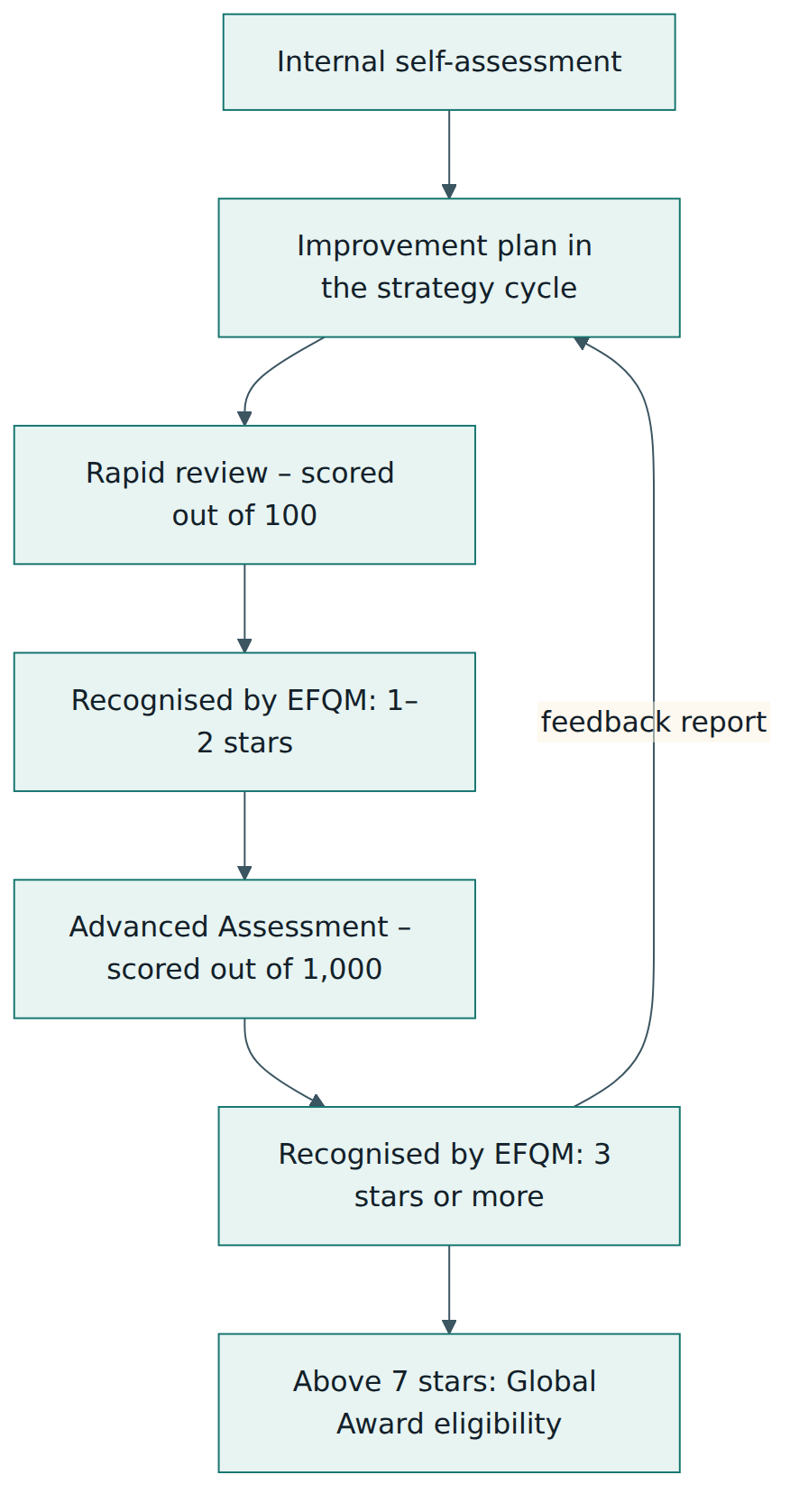
- Rapid review – a short assessment, completed within about a week, against a condensed version of the model. It includes a diagnostic workshop, interviews with the leadership team and focus groups, is scored out of 100, and can lead to recognition at one or two stars. It is designed as the first step on the recognition ladder.
- Advanced Assessment – a comprehensive assessment against the full model at criterion-part level, scored out of 1,000 points, taking roughly four to six months. The organisation prepares a submission document in advance, and a team of independent, internationally trained assessors visits to interview people, observe work and test evidence. The outcome is recognition at three stars or above.
Star levels are based on the assessment score. EFQM describes ratings above seven stars as world-leading performance, and organisations at that level become eligible for the EFQM Global Award, the Foundation's highest recognition, presented at an international event. Recognised organisations are listed publicly with their rating and year. Exact score bands, fees and validity periods are set in EFQM's and its partners' scheme documents and can change, so check the current scheme before planning an application.
How an external assessment works
In an Advanced Assessment the assessor team first studies the submission and forms initial hypotheses about strengths and gaps. During the site visit they test those hypotheses: they follow the red thread from purpose and strategy to approaches and results, talk with people at every level, and look for evidence that approaches are really deployed and reviewed. Each assessor scores independently using the RADAR matrices, then the team reaches consensus on the score and writes a feedback report. The report is often the most valuable output, because it gives an outside view of the organisation's strengths and its most important opportunities for improvement.
Reading a score
Scores on the 1,000-point scale are deliberately demanding. A score of 500 does not mean "half good"; in EFQM's own scoring analysis of assessments made with the 2020 model, organisations around 300 points show good performance, around 500 points excellent performance, and 700 or more world-leading performance. EFQM also observes a typical maturity pattern: organisations at the foundation stage concentrate on customers and on delivering their product or service; as they mature, they integrate purpose, vision and strategy and focus on innovation; the strongest manage transformation and are fit for the future. Treat these as orientation, not as targets to chase.
Assessor competence
EFQM trains and certifies assessors through its training pathway and partners. Many organisations send their own staff to assessor training, both to strengthen internal self-assessment and because acting as an assessor in another organisation is an excellent learning experience. There is no formal personal certificate required to run an internal self-assessment, but trained people produce more consistent results.
Lesson 6 – Worked example: a regional water utility
The following example is fictional but realistic. Riverside Water is a publicly owned utility with about 900 employees that supplies drinking water and treats wastewater for a region of 1.2 million people. It holds ISO 9001 and ISO 14001 certificates, has a five-year strategy and runs a small Lean team. The new chief executive feels that the organisation is busy and well documented but not improving the things customers and the regulator care about. She decides to use the EFQM Model.
Step 1 – Scope and purpose
The executive board agrees that the first cycle will cover the whole utility and that its aim is a maturity baseline, not an award. They will score, to have a reference point, but they tell staff clearly that the score is a learning tool and that nobody will be judged by it. They plan a Rapid review by an EFQM partner in the following year if the internal cycle goes well.
Step 2 – Team and training
A team of twelve is formed: two directors, the quality manager, an operations supervisor, a field engineer, a customer-contact team leader, an HR partner, a finance analyst, the sustainability lead, an IT architect and two people from the treatment plants. Two of them attend EFQM assessor training; the rest receive two days of internal training on the model and RADAR. Each criterion gets an owner who collects evidence.
Step 3 – Stakeholder weighting
Before scoring criteria 3 and 6, the team proposes weights for the five stakeholder groups and the board approves them. Customers (households and businesses) and the regulator dominate the utility's world, so customers get 30 %, business and governing stakeholders (the owning municipalities and the regulator) 25 %, people 20 %, society 15 % and partners and suppliers 10 %. Every weight is within the 10–40 % band, moves in 5 % steps and sums to 100 %, and the same weights are used for criterion 6.
Step 4 – Gathering evidence and following the red thread
The team picks one strategic priority – "reduce water lost through leaks by a quarter within five years" – and follows it through the model. In criterion 1 they find the target in the strategy, based on a sound analysis of ageing pipes, climate-driven drought risk and regulatory pressure. In criterion 2 they find leaders talk about the target often, but front-line crews say they are measured on the number of jobs completed, not on leakage reduced. In criterion 5 they find a well-designed asset management approach, but it is only used in two of the five districts. In criterion 7 the leakage indicator has improved slightly in those two districts and not at all elsewhere, and there is no comparison with other utilities. The red thread breaks at culture and at deployment.
Step 5 – RADAR scoring of one criterion part
For criterion part 5.5 (managing assets and resources) the team rates the attributes as follows and agrees an overall score:
| Element | Attribute | Evidence summary | Rating |
|---|---|---|---|
| Approach | Sound | Risk-based asset plan with clear rationale; benchmarked method | 60 % |
| Approach | Aligned | Linked to the leakage priority and the budget process | 60 % |
| Deployment | Implemented | Used in two of five districts only | 30 % |
| Deployment | Flexible | Plans updated after the drought, but slowly | 40 % |
| Assessment & Refinement | Evaluated & Understood | Annual review exists; no customer or crew feedback used | 30 % |
| Assessment & Refinement | Learn & Improve | One improvement made in three years | 20 % |
| Overall | Agreed score | Team consensus; capped by the Sound rating | 40 % |
The agreed overall score of 40 % is below the 60 % for Sound, so the master rule is respected; it reflects the weak deployment and learning. Had the team been tempted to give 70 % overall because the approach looked so impressive on paper, the master rule would have stopped them.
For the leakage results in criterion 7, the Scope and Relevance attribute is reasonable – leakage is clearly linked to strategy and regulator expectations – but Usability is weak because data are only segmented by district for two districts, Trends are flat, there are no Comparisons and Future Confidence is low. The team agrees a modest score and records that the utility cannot yet predict whether it will reach its five-year target.
Step 6 – Consensus and the overall profile
After scoring all criterion parts individually, the team spends two days in consensus meetings. Their profile shows relatively strong criterion 1 and criterion 4 (the utility understands its environment and delivers a reliable product) and weaker criterion 2, criterion 5 deployment and criterion 7. The total is a little above 300 points – a respectable first baseline. More useful than the number are the 40 strengths and 55 opportunities for improvement in the feedback report.
Step 7 – Prioritising and acting
The board chooses four priorities: change crew performance measures so that they reward leakage reduction (criteria 2 and 5); roll out the asset approach in the remaining three districts with a simplified version for small networks (criterion 5); build a benchmark with three peer utilities (criterion 7); and start a quarterly customer perception pulse alongside the regulator's annual survey (criterion 6). Each priority gets an owner, budget and milestones in the strategy dashboard (criterion 1.5).
Step 8 – The next cycle
Twelve months later the team reassesses. Leakage in the three new districts is starting to fall, crews describe the new measures as fairer, and the benchmark shows the utility is mid-table – an uncomfortable but useful fact. The utility applies for a Rapid review and receives a two-star recognition, with a feedback report that confirms the main improvement themes and points to two that the internal team had missed: partnership management with contractors (criterion 3.5) and the use of data from smart meters (criterion 5.4). The model has become part of how Riverside Water manages, not a separate project.
Lesson 7 – Relationship to other standards and frameworks
The EFQM Model is often used alongside management system standards and improvement methods. It does not replace them; it provides the overall frame in which they sit. The table compares it with the frameworks people most often ask about.
| Framework | Owner and type | Main purpose | How it relates to the EFQM Model |
|---|---|---|---|
| ISO 9001 | ISO; requirements standard for quality management systems | Demonstrate that an organisation consistently meets customer and regulatory requirements; certifiable | Provides a solid process foundation that supports many EFQM criterion parts, especially in criteria 4 and 5. EFQM asks broader questions about purpose, culture, ecosystem and results maturity. |
| ISO 9004 | ISO; guidance standard for sustained success | Help organisations go beyond ISO 9001 toward long-term success, with a self-assessment tool | Shares the excellence and maturity philosophy; not certifiable. EFQM adds a scoring scheme, external recognition and a wide user community. |
| Baldrige Excellence Framework | U.S. Baldrige Program and Foundation; excellence framework | Assess and improve the whole organisation; basis for the U.S. national award | Closest relative. Both are non-prescriptive, holistic, scored and linked to awards. Baldrige uses its own categories and evaluation factors (ADLI and LeTCI) where EFQM uses criteria and RADAR. |
| Lean and Six Sigma | No single owner; improvement methods | Remove waste, reduce variation and improve processes | Tools that an organisation may choose as approaches, typically assessed in criterion 5. EFQM judges how well they are chosen, deployed and linked to strategy. |
| ISO 14001 and sustainability reporting frameworks | ISO and reporting bodies; environmental system and disclosure standards | Manage environmental aspects; disclose sustainability performance | Feed evidence into criteria 1, 3.4 and the sustainability result category in criterion 7. EFQM asks whether sustainability is integrated into strategy and value creation. |
| Balanced Scorecard | Kaplan and Norton concept; strategy management tool | Translate strategy into objectives and measures across perspectives | A possible approach for criterion 1.5 and for structuring results in criterion 7. |
Using EFQM with ISO management systems
Organisations that already hold ISO certificates often find that the EFQM Model helps them get more value from those systems. The certificates show that processes are defined and controlled; the EFQM assessment asks whether those processes are the right ones for the strategy, whether they are improving, and whether stakeholders notice. A common pattern is to keep the ISO audits for assurance and use EFQM self-assessment every year or two for strategic learning.
EFQM and Baldrige
If you already know Baldrige, the translation is straightforward: both frameworks ask what an organisation does and how well, both separate how you work from what you achieve, and both use scoring and consensus. The differences are in emphasis and vocabulary. EFQM organises around Direction, Execution and Results, makes stakeholder weighting explicit, and places strong emphasis on the ecosystem, transformation and the SDGs; Baldrige starts from the Organizational Profile and uses its own evaluation factors. Organisations operating on several continents sometimes use one framework internally and the other for recognition in a specific country.
Common pitfalls and best practices
Common pitfalls
- Chasing the score. Treating the number as the goal leads to polished submissions and little real change; the strengths and opportunities are what matter.
- Describing intentions instead of practice. Assessors look for deployed approaches and real evidence; policies that are not used score low on deployment.
- Delegating the model to the quality department. The model is about how the whole organisation is led, so it fails without visible leadership ownership.
- Ignoring the master rules. Giving high overall scores to approaches without a sound rationale, or to results that are not relevant, inflates the profile and hides the real gaps.
- Too many improvement actions. Trying to fix every opportunity at once overloads the organisation; a few strategic priorities deliver more.
- Treating the assessment as a one-off project. Without integration into the strategy and performance management cycle, momentum fades after the report.
- Measuring only lagging results. Without predictive measures and comparisons, the organisation cannot show confidence that results will last.
Best practices
- Start with why. Agree the purpose of the assessment and communicate that it is a learning exercise.
- Follow the red thread. Trace a few strategic priorities from direction to execution to results instead of checking criteria in isolation.
- Use diverse teams. Include front-line staff and different functions so that evidence reflects reality, and train at least some team members as assessors.
- Assess individually, then agree. Independent first views followed by consensus reduce bias and make the scoring defensible.
- Prioritise ruthlessly. Choose the few opportunities most linked to strategy and stakeholder needs, and give them owners and resources.
- Embed the cycle. Put improvement priorities into the normal planning and review rhythm and reassess regularly.
- Get an outside view. A Rapid review or Advanced Assessment, or benchmarking with peers, calibrates internal judgement.
Summary and key takeaways
- The EFQM Model is a non-prescriptive, holistic management framework maintained by EFQM; the current edition is The EFQM Model 2025, a refresh of the 2020 design.
- Its logic follows three questions: why (Direction: criteria 1–2), how (Execution: criteria 3–5) and what (Results: criteria 6–7), connected by the red thread of cause and effect.
- The seven criteria are Purpose, Vision and Strategy; Organisational Culture and Leadership; Engaging Stakeholders; Creating Sustainable Value; Driving Performance and Transformation; Stakeholder Perceptions; and Strategic and Operational Performance.
- RADAR (Results, Approach, Deployment, Assessment and Refinement) is used to judge approaches and results, with Sound and Scope and Relevance acting as master attributes that cap the overall score.
- Scores run to 1,000 points (Direction 200, Execution 400, Results 400); stakeholder weightings in criterion 3 are chosen by the organisation within 10–40 % and mirrored in criterion 6.
- Self-assessment is the core use; scoring is optional except for external recognition.
- There is no certification of conformity; EFQM and its partners award star-rated recognition through Rapid and Advanced pathways, with the Global Award for world-leading organisations.
- The model complements ISO 9001, ISO 9004, Lean, Six Sigma and sustainability frameworks and is closely related to the Baldrige framework.
Reflection questions
- Pick one strategic priority in your own organisation and follow its red thread through Direction, Execution and Results. Where does the thread look strongest, and where might it break?
- How would you weight the five stakeholder groups for criterion 3 and criterion 6 in your organisation, and how would you justify those weights to your board?
- Choose an approach you know well, such as onboarding new staff or handling complaints. How would you rate it on each RADAR attribute, and which attribute would cap its score?
- Which of your current results indicators are lagging, and what predictive measures could give you confidence about future performance?
- If your organisation already holds ISO certificates, what questions would an EFQM assessment ask that your ISO audits do not, and what would you expect to learn from them?
Further reading and official sources
- The EFQM Model – EFQM
- Assessment pathways and recognition – EFQM
- The EFQM Model 2025 (publication, distributed by a Swiss partner) – EFQM / ITQM
- The EFQM Excellence Model explained – AFNOR
- ISO 9004:2018 Quality of an organization – Guidance to achieve sustained success – ISO
- Baldrige Performance Excellence Program – NIST
Original tutorial by xOps School (DevOpsSchool Private Limited), written from public sources about EFQM Model. Not affiliated with or endorsed by the standard's owner; standard names are trademarks of their owners. Buy the official standard from its publisher for the authoritative text.