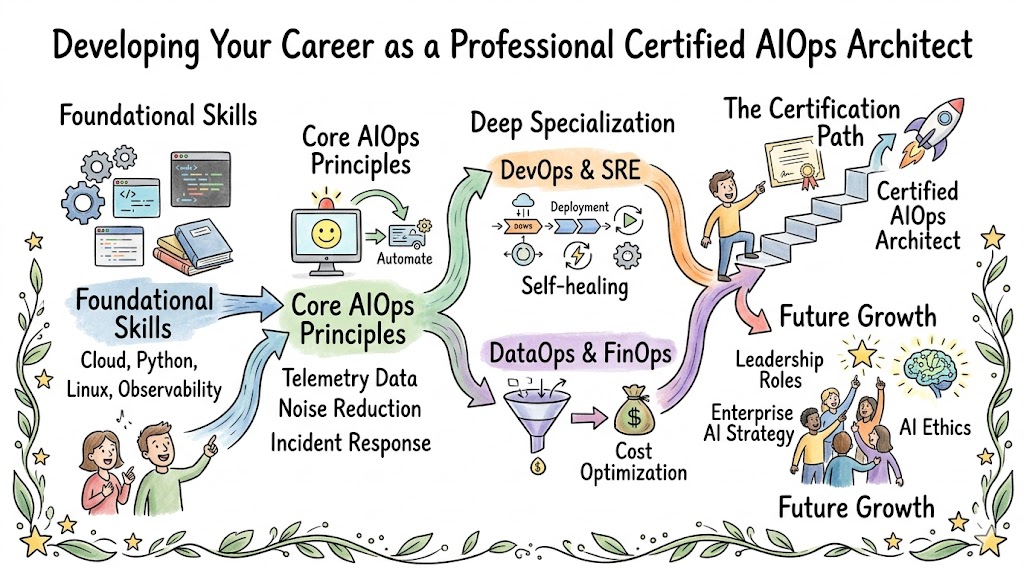
The modern landscape of digital operations demands a shift from manual intervention to automated intelligence. This guide explores the Certified AIOps Architect program, a specialized track designed for engineers who want to master the intersection of artificial intelligence and IT operations. As cloud-native environments become increasingly complex, traditional monitoring fails to keep pace with the sheer volume of telemetry data. By integrating machine learning and data science into the SRE and DevOps lifecycle, professionals can predict failures before they impact users. This comprehensive roadmap helps technical leaders and individual contributors at AIOpsSchool decide how to effectively integrate algorithmic intelligence into their existing platform engineering workflows for long-term career stability.
What is the Certified AIOps Architect?
The Certified AIOps Architect represents a professional standard for individuals capable of designing and implementing intelligent operational frameworks. It exists to bridge the gap between theoretical data science and the practical, high-stakes world of production systems management. Rather than focusing solely on academic model building, this designation emphasizes the deployment of scalable AI solutions that solve real-world infrastructure problems. It aligns perfectly with modern enterprise practices where reducing Mean Time to Resolution (MTTR) is a critical business KPI. Professionals learn to handle massive datasets and transform them into actionable insights for automated remediation.
Who Should Pursue Certified AIOps Architect?
This certification serves a wide range of technical roles, specifically benefiting SREs, DevOps engineers, and cloud architects who manage distributed systems. It is equally relevant for data engineers who want to specialize in operational telemetry rather than business analytics. In the global market, including the rapidly expanding tech hubs in India, there is a massive demand for architects who can navigate complex microservices architectures. Beginners with a strong foundation in Linux and Python can use this to differentiate themselves, while senior managers find it useful for steering digital transformation initiatives within their organizations.
Why Certified AIOps Architect is Valuable in the Future and Beyond
The longevity of an engineering career today depends on the ability to manage scale without proportional increases in headcount. As enterprise adoption of multi-cloud environments grows, the demand for AIOps skills will continue to outpace supply because automated intelligence is the only viable way to manage modern complexity. This certification helps professionals stay relevant even as specific CI/CD or monitoring tools change, focusing instead on the underlying logic of algorithmic operations. Investing time in this track offers a high return by positioning the architect at the forefront of the next major shift in infrastructure management.
Certified AIOps Architect Certification Overview
The program is delivered via the official course page and hosted on the AIOpsSchool platform. It follows a practical assessment approach that values hands-on capability over rote memorization of definitions. The ownership of the curriculum lies with industry practitioners who ensure the content stays updated with the latest advancements in neural networks and anomaly detection. Structurally, the certification focuses on the end-to-end lifecycle of an AIOps project, from data ingestion and noise reduction to automated incident response. This ensures that the architect can deliver tangible value to any production environment immediately after completion.
Certified AIOps Architect Certification Tracks & Levels
The certification is organized into foundation, professional, and advanced levels to accommodate different stages of career progression. The foundation level introduces core concepts of data patterns and basic automation, while the professional tier dives deep into model deployment and integration with existing toolchains. Advanced tracks allow for specializations in areas like FinOps-driven AI or security-focused MLOps. These levels align with typical career moves, helping a junior engineer transition into a senior role or an architect move into a principal or leadership position with a clear validation of their technical expertise.
Complete Certified AIOps Architect Certification Table
| Track | Level | Who it’s for | Prerequisites | Skills Covered | Recommended Order |
| Core AIOps | Foundation | Associate Engineers | Basic Linux/Python | Data Patterns, Observability | 1 |
| Engineering | Professional | SREs / DevOps | 2 Years Experience | Model Training, API Ops | 2 |
| Architecture | Advanced | Senior Architects | 5 Years Experience | System Design, Strategy | 3 |
| Specialized | Expert | Principal Leads | Advanced Math | Custom Neural Nets | 4 |
Detailed Guide for Each Certified AIOps Architect Certification
Certified AIOps Architect – Foundation Level
What it is
This level validates a fundamental understanding of how artificial intelligence applies to IT operations. It confirms that the candidate knows the difference between traditional monitoring and AI-driven observability.
Who should take it
Junior DevOps engineers, recent graduates, or manual QA testers looking to move into automated operations roles should start here.
Skills you’ll gain
- Identification of operational data types
- Understanding of noise reduction techniques
- Basic knowledge of predictive alerting
- Familiarity with AIOps terminology
Real-world projects you should be able to do
- Configure a basic anomaly detection dashboard
- Clean and format system logs for AI ingestion
Preparation plan
- 7-14 Days: Focus on core definitions and the AIOps manifest.
- 30 Days: Complete all lab exercises regarding data visualization.
- 60 Days: Review case studies on enterprise AIOps implementation.
Common mistakes
- Ignoring the importance of high-quality data.
- Confusing standard automation with AI-driven logic.
Best next certification after this
- Same-track: Professional AIOps Engineer
- Cross-track: Cloud Associate
- Leadership: ITIL Foundation
Certified AIOps Architect – Professional Level
What it is
This certification validates the ability to implement and manage AIOps tools in a production environment. It focuses on the integration of machine learning models into existing DevOps pipelines.
Who should take it
SREs and Platform Engineers with at least two years of experience who are responsible for maintaining system uptime and performance.
Skills you’ll gain
- Deployment of ML models for root cause analysis
- Integration of AI tools with Slack/Jira for ChatOps
- Managing automated remediation workflows
- Performance tuning of AIOps platforms
Real-world projects you should be able to do
- Build an automated incident response system using AI triggers
- Implement a noise suppression layer for a global monitoring stack
Preparation plan
- 7-14 Days: Deep dive into API integrations and data schemas.
- 30 Days: Practice building custom dashboards and alert logic.
- 60 Days: Run simulated outages to test AI-driven remediation.
Common mistakes
- Over-reliance on “black box” AI without understanding the logic.
- Failing to account for model drift over time.
Best next certification after this
- Same-track: Advanced AIOps Architect
- Cross-track: MLOps Professional
- Leadership: Technical Lead Certification
Certified AIOps Architect – Advanced Level
What it is
The advanced level focuses on the strategic design of global AIOps frameworks. It confirms the candidate’s ability to lead large-scale digital transformation projects using AI.
Who should take it
Senior Architects and Principal Engineers who need to design resilient, self-healing infrastructures for large enterprises.
Skills you’ll gain
- Designing multi-tenant AIOps architectures
- Cost-benefit analysis of AI operations
- Compliance and security in AI systems
- Mentoring teams on AIOps adoption
Real-world projects you should be able to do
- Design a self-healing cloud infrastructure for a fintech application
- Create a long-term AIOps roadmap for a Fortune 500 company
Preparation plan
- 7-14 Days: Review enterprise architecture patterns.
- 30 Days: Focus on the financial and business impact of AIOps.
- 60 Days: Draft a full-scale implementation proposal for a complex system.
Common mistakes
- Focusing too much on technology and not enough on organizational culture.
- Underestimating the complexity of legacy system integration.
Best next certification after this
- Same-track: Expert Research Fellow
- Cross-track: FinOps Certified Professional
- Leadership: Engineering Manager Track
Choose Your Learning Path
DevOps Path
The DevOps path focuses on integrating AI into the Continuous Integration and Continuous Deployment (CI/CD) cycle. Engineers learn to use AI for predictive build failure analysis and automated testing optimization. This path ensures that the speed of delivery does not compromise the stability of the production environment. It is ideal for those who want to build “smart” pipelines that adapt to code changes automatically.
DevSecOps Path
In this path, the focus shifts to using AI for proactive threat detection and vulnerability management. Architects learn to deploy models that identify unusual patterns in access logs or network traffic that might indicate a breach. By applying AIOps to security, professionals can automate the quarantine of compromised assets. This path is essential for those operating in highly regulated industries like banking or healthcare.
SRE Path
The SRE path is deeply rooted in maintaining reliability through algorithmic noise reduction and incident correlation. Professionals focus on using AI to manage Service Level Objectives (SLOs) and Error Budgets more effectively. This involves building systems that can automatically perform “toil” tasks based on intelligent triggers. It is the most common path for those managing large-scale distributed systems.
AIOps Path
The pure AIOps path is dedicated to mastering the data science side of IT operations. This includes deep dives into different types of machine learning models like clustering, regression, and neural networks specifically for time-series data. Architects on this path become experts in the platforms that aggregate and analyze operational telemetry. They often serve as the bridge between the data science team and the infrastructure team.
MLOps Path
MLOps focuses on the operationalization of machine learning models themselves, ensuring they are deployed, monitored, and retrained efficiently. This path teaches how to treat ML models like software code, utilizing version control and automated testing. It is a vital path as more companies move AI models into production environments. Practitioners ensure that the AI driving the operations is itself stable and reliable.
DataOps Path
DataOps focuses on the health and flow of the data pipelines that feed the AIOps engines. Without clean, consistent data, the AI models cannot provide accurate insights, making this a foundational path. Architects learn to automate data quality checks and manage data governance at scale. This path is perfect for engineers who enjoy the “plumbing” aspect of large-scale information systems.
FinOps Path
The FinOps path applies AIOps to cloud cost management and financial accountability. Architects use AI to predict cloud spend, identify wasteful resources, and automate scaling to optimize costs. This ensures that the organization gets the most value out of its cloud investment without manual oversight. It is an increasingly popular path as cloud bills become a major line item for enterprises.
Role → Recommended Certified AIOps Architect Certifications
| Role | Recommended Certifications |
| DevOps Engineer | Foundation + Professional (DevOps Track) |
| SRE | Professional + Advanced (SRE Track) |
| Platform Engineer | Professional (Core AIOps) |
| Cloud Engineer | Foundation + FinOps Specialized |
| Security Engineer | Professional (DevSecOps Track) |
| Data Engineer | Professional (DataOps Track) |
| FinOps Practitioner | FinOps Specialized Track |
| Engineering Manager | Foundation + Advanced Architecture |
Next Certifications to Take After Certified AIOps Architect
Same Track Progression
After achieving the architect level, professionals should look toward deep specialization in specific AI subsets. This might include exploring Deep Learning for specialized hardware monitoring or Natural Language Processing for improved ChatOps interfaces. Staying within the track allows for becoming a recognized subject matter expert who can handle the most complex operational challenges an enterprise might face.
Cross-Track Expansion
Broadening your skills often involves moving into adjacent areas like MLOps or FinOps. For instance, an AIOps architect might pursue a FinOps certification to better understand how intelligent operations can directly reduce cloud expenditures. This cross-pollination of skills makes an engineer more versatile and valuable to organizations that need leaders who understand the intersection of technology, security, and finance.
Leadership & Management Track
For those looking to move away from individual contribution, the next step involves management certifications or executive leadership programs. The goal is to use the technical knowledge gained from the architect level to lead entire departments through digital transformation. Understanding the technical nuances of AI allows a manager to set realistic goals and build high-performing teams that are ready for the future of automated operations.
Training & Certification Support Providers for Certified AIOps Architect
DevOpsSchool
This provider offers extensive resources for those looking to integrate DevOps practices with intelligent automation. Their curriculum focuses on the practical application of tools in a real-world setting, providing students with the hands-on experience necessary to excel in modern engineering roles. They emphasize the importance of continuous learning and provide community support to help professionals stay updated with the latest industry trends.
Cotocus
This organization specializes in high-end technical training for corporate teams and individual professionals. They provide specialized tracks that cover various aspects of the digital operations lifecycle, ensuring a well-rounded educational experience. Their instructors are often industry veterans who bring a wealth of practical knowledge to the classroom, making the complex concepts of AIOps more accessible.
Scmgalaxy
This platform is a hub for software configuration management and DevOps enthusiasts. They offer a variety of tutorials and certification paths that help engineers master the art of delivery and operations. Their focus on the community allows for a collaborative learning environment where students can share insights and solve problems together.
BestDevOps
As the name suggests, this provider focuses on delivering top-tier education in the DevOps space. They have expanded their offerings to include AI-driven operations, recognizing the shift in the industry toward automation. Their programs are designed to be intensive and outcome-oriented, ensuring that graduates are ready to hit the ground running in their professional careers.
devsecopsschool.com
This site is dedicated to the intersection of development, security, and operations. They provide specialized training on how to use AI and machine learning to bolster security postures. Their courses are essential for anyone looking to specialize in the DevSecOps path, offering deep dives into automated threat detection and compliance.
sreschool.com
This provider focuses specifically on Site Reliability Engineering, teaching the principles of high availability and system resilience. They integrate AIOps into their SRE curriculum to show how AI can help manage complex distributed systems. Their training is highly practical, focusing on the tools and techniques used by SRE teams at leading tech companies.
aiopsschool.com
The primary destination for AIOps-specific certification and training. They offer a comprehensive suite of courses that cover everything from foundational concepts to advanced architectural design. Their curriculum is widely recognized as the industry standard for professionals looking to validate their skills in intelligent operations.
dataopsschool.com
This school focuses on the critical role of data in the operational lifecycle. They teach engineers how to build and manage the data pipelines that power AIOps engines. Their courses cover data quality, governance, and automated pipeline management, ensuring that the foundation of any AI initiative is solid.
finopsschool.com
This provider is the go-to resource for learning about cloud financial management. They show how AI can be used to optimize cloud spending and improve financial accountability within technical teams. Their training is essential for anyone looking to bridge the gap between engineering and finance.
Frequently Asked Questions (General)
- How difficult is the Certified AIOps Architect exam?
The difficulty is moderate to high, as it requires a strong understanding of both IT operations and basic machine learning concepts. - What is the typical time commitment for preparation?
Most professionals spend between 30 and 60 days preparing, depending on their existing experience with Python and monitoring tools. - Are there any mandatory prerequisites?
While there are no strict blockers, a basic understanding of Linux, networking, and at least one programming language like Python is highly recommended. - What is the ROI of this certification?
Professionals often see a significant increase in salary and job opportunities, as AIOps is one of the fastest-growing fields in tech. - Should I take the foundation level if I am an experienced engineer?
Yes, the foundation level ensures you understand the specific terminology and logic used in AIOps, which differs from traditional SRE work. - How often do I need to recertify?
Certifications generally remain valid for two years, after which you may need to take an update exam to stay current. - Is the exam proctored online or in-person?
The assessment is typically conducted online through a secure, proctored platform for global accessibility. - Does this certification cover specific tools?
It focuses on architectural principles and logic, which are applicable across various tools like Splunk, Datadog, or ELK. - Can this help me move into a data science role?
It provides a strong foundation in operational data, which can serve as a stepping stone toward a full data science career. - Is there a community for certified professionals?
Yes, most providers offer access to exclusive forums and networking groups for those who have completed the certification. - How does this compare to a standard DevOps certification?
This is more specialized, focusing specifically on the application of AI, whereas DevOps is more general in scope. - Is it recognized globally?
Yes, the curriculum is designed based on global industry standards, making it relevant in any geographic market.
FAQs on Certified AIOps Architect
- What specific AI models are covered in the curriculum?
The course covers a variety of models including K-means for clustering, linear regression for forecasting, and random forests for classification of incidents. - Does the architect level require coding skills?
Yes, a working knowledge of Python is necessary for the professional and advanced levels to handle data manipulation and API integrations. - How does this certification address multi-cloud environments?
The architectural principles taught are cloud-agnostic, focusing on how to aggregate data from AWS, Azure, and Google Cloud into a unified AI engine. - Is there a focus on Open Source AIOps tools?
The curriculum introduces several open-source frameworks for data collection and model deployment to provide a comprehensive view of the ecosystem. - How is the practical assessment structured?
Candidates are often given a sandbox environment with a simulated outage and must use AI logic to identify the root cause. - Does the course cover the ethics of AI in operations?
Yes, the advanced level includes modules on bias in AI and ensuring that automated remediation does not cause unintended system damage. - Can I skip levels if I have prior experience?
It is generally recommended to follow the sequence, but experienced candidates may challenge the foundation level to move directly to professional. - What kind of support is available during the course?
Students usually have access to lab environments, recorded lectures, and live Q&A sessions with industry mentors to clarify complex topics.
Final Thoughts: Is Certified AIOps Architect Worth It?
Infrastructure is moving toward a state where human oversight alone is insufficient. If you are looking to future-proof your career, mastering the ability to design and manage intelligent systems is a logical step. The Certified AIOps Architect program provides a structured, recognized way to gain these skills without getting lost in academic theory that doesn’t apply to production environments.