
ITIL – Tutorial (about 60 minutes)
- View
ITIL is the world's most widely used body of guidance for managing technology-enabled products and services: how an organisation decides what to offer, builds and runs it, supports the people who use it and keeps improving it. It is used by IT departments, managed service providers, software vendors, service desks and, more and more, by HR, facilities and other teams that also deliver services to colleagues. After this tutorial you will be able to explain the ITIL Value System, the guiding principles, the four dimensions, the product and service lifecycle and the main practices, and you will know how people get certified and how organisations actually adopt ITIL.
Course overview
Edition and status: The current edition is ITIL (Version 5), owned and published by PeopleCert, which acquired ITIL's previous owner Axelos in 2021. PeopleCert announced Version 5 in January 2026 and made the ITIL Foundation (Version 5) qualification available in February 2026; the other core publications and the advanced modules (Product, Service, Experience, Strategy, Transformation, three Practice Manager modules and an AI Governance extension) are being released in phases during 2026, and updated practice guides are planned for the second half of 2026. ITIL 4, published in 2019, still runs in parallel; PeopleCert's ITIL FAQ states that all ITIL 4 certification modules are planned to be retired on 31 December 2027. ITIL is a proprietary framework of guidance, not a formal standard, and organisations cannot be certified against it. Verified 2026-10-29. Because Version 5 deliberately keeps most ITIL 4 concepts, this tutorial teaches Version 5 and points out where the familiar ITIL 4 terms still appear in the documents you will meet at work.
Who it is for: service desk analysts, operations and platform engineers, developers who carry a pager, product owners, service and delivery managers, quality, risk and audit people, and anyone who has been told "we follow ITIL here" and wants to know what that means. It also suits people who learned ITIL v3 years ago and want to catch up.
Prerequisites: none. Some everyday experience of using or supporting an IT service (raising a ticket, waiting for a fix, being asked to approve a change) will help you connect the ideas to real work.
How to use this tutorial: read the seven lessons in order (about 45 minutes), study the five diagrams, then spend the remaining time on the reflection questions before you take the 25-question knowledge check.
Learning objectives:
- You will be able to explain why ITIL exists, who owns it and how it evolved from the 1980s guidance to Version 5.
- You will be able to define the core vocabulary: value co-creation, product, service, outcome, utility, warranty, value stream and practice.
- You will be able to describe the ITIL Value System, the seven guiding principles and the four dimensions of product and service management.
- You will be able to walk through the eight activities of the product and service lifecycle and show how practices support them.
- You will be able to apply the continual improvement model to a real service problem.
- You will be able to explain the certification scheme for individuals and why organisations use ISO/IEC 20000-1, not ITIL, for certification.
- You will be able to position ITIL next to ISO/IEC 20000-1, COBIT, DevOps, site reliability engineering and agile methods.
Lesson 1 – Origins, purpose and scope
Why service management became a discipline
Most organisations do not want technology for its own sake. A hospital wants patient records available at 3 a.m., a retailer wants its checkout to work during a sale, a bank wants payments to clear. The technology behind these outcomes is complex, shared and constantly changing, and it is delivered by many teams and suppliers. Without some agreed way of working, the same failures repeat: nobody knows who owns a broken system, changes collide, users wait days for simple requests, and the business cannot tell whether IT spending is worth it. Service management is the set of organisational capabilities for turning technology and people into services that consumers actually value. ITIL is a collection of good practice for doing that well.
A short history
ITIL started in the late 1980s, when the UK government's Central Computer and Telecommunications Agency (CCTA) collected the practices of well-run IT operations into a library of books, hence the name "Information Technology Infrastructure Library". The early books were many and narrow. Version 2 (around 2000–2001) condensed the guidance and made the "service support" and "service delivery" processes such as incident, problem, change and service level management famous. ITIL v3 (2007, refreshed as the 2011 edition) reorganised everything around a service lifecycle of strategy, design, transition, operation and continual service improvement.
Ownership moved over time. Axelos, a joint venture of the UK Cabinet Office and Capita, took over ITIL in 2013 and published ITIL 4 in 2019. ITIL 4 was a major rethink: it replaced the rigid process lifecycle with a flexible service value system, introduced guiding principles, renamed processes as "practices" and embraced agile, DevOps and Lean ideas. PeopleCert bought Axelos in 2021 and in 2026 released ITIL (Version 5), which keeps the ITIL 4 core but widens the scope again.
What Version 5 is for
PeopleCert describes Version 5 as guidance for digital product and service management. Three themes stand out. First, it treats products and services as two sides of one lifecycle, because most organisations now both build digital products and run them as services. Second, it is designed for AI-enabled work: it adds guidance on where AI can help in each activity and how to govern its use responsibly. Third, it puts more weight on experience – how customers, users and employees actually feel when they use a service – rather than on whether a process was followed.
What ITIL is not
ITIL is not a standard with "shall" requirements, not a tool, and not a set of processes you install. It is guidance that you adapt. The ITIL books repeatedly tell readers to start from their own context and adopt what helps. This is why two organisations can both "use ITIL" and look very different. Its scope is also not limited to IT: the same ideas are used for enterprise service management, where HR, legal or facilities teams handle requests and incidents using the same principles and often the same tools.
Lesson 2 – Key concepts and vocabulary
ITIL gives everyday words precise meanings. Learning them first prevents most misunderstandings, because people from development, operations and the business often use the same word for different things. The definitions below are paraphrased from ITIL usage.
- Value – the perceived benefits, usefulness and importance of something. Value is judged by the stakeholder, not declared by the provider.
- Value co-creation – the idea that value is created jointly by the provider and the consumer through their interaction. A video-conferencing service only produces value when people actually hold good meetings with it.
- Organisation – a person or group with its own functions, responsibilities and relationships to achieve objectives. It can be a whole company or a single team.
- Service provider and service consumer – the roles in a service relationship. The same organisation is usually a provider for some services and a consumer of others.
- Customer, user and sponsor – three consumer roles. The customer defines requirements and owns the outcomes, the user actually uses the service, and the sponsor authorises the budget. In a small firm one person may hold all three; in a large one they are often different people with different expectations.
- Product – a configuration of an organisation's resources designed to offer value to a consumer, for example a mobile banking app together with the platform, data and people behind it.
- Service – a way of enabling value co-creation by facilitating the outcomes consumers want, without them having to manage specific costs and risks themselves. Email "as a service" means you get the outcome (messages sent and received) without running mail servers.
- Service offering – a formal description of what is offered to a target group, which can combine goods, access to resources and service actions such as support.
- Output and outcome – an output is something produced by an activity (a report, a password reset); an outcome is the result a stakeholder cares about (a manager makes a better decision, an employee gets back to work).
- Utility and warranty – utility is what the service does (fitness for purpose); warranty is how well it does it, in terms of availability, capacity, security and continuity (fitness for use). A payroll service with perfect features but frequent outages has utility without warranty.
- Value stream – the series of steps an organisation actually performs to create and deliver a product or service to a consumer, such as "from hiring decision to a new employee being fully equipped".
- Process – a set of interrelated activities that turn inputs into outputs according to a design. A process is how work is meant to be done; a value stream is the end-to-end flow as it really happens.
- Practice – a set of organisational resources (people, information, tools, partners and processes) designed for doing work or achieving an objective, such as incident management or change enablement.
- Incident, problem and known error – an incident is an unplanned interruption or quality reduction of a service; a problem is a cause, or potential cause, of one or more incidents; a known error is a problem that has been analysed but not yet resolved, often with a documented workaround.
- Change – adding, modifying or removing anything that could directly or indirectly affect services. Low-risk, pre-authorised, repeatable changes are called standard changes.
- Configuration item (CI) – any component that must be managed to deliver a service, such as a server, a software release, a contract or a document.
Two of these ideas deserve emphasis. First, value is co-created, so a provider cannot make a service valuable alone: it must understand how consumers use it and help them succeed. Second, ITIL insists on balancing outcomes against costs and risks; the Version 5 Foundation syllabus also weighs experience and sustainability. A service that delivers outcomes but imposes surprise costs or risks on the consumer is not good value, even if every ticket was closed on time.
Lesson 3 – Structure of the framework
ITIL (Version 5) is built from a small number of building blocks that fit together. If you understand these, you can navigate any ITIL publication.
The ITIL Value System
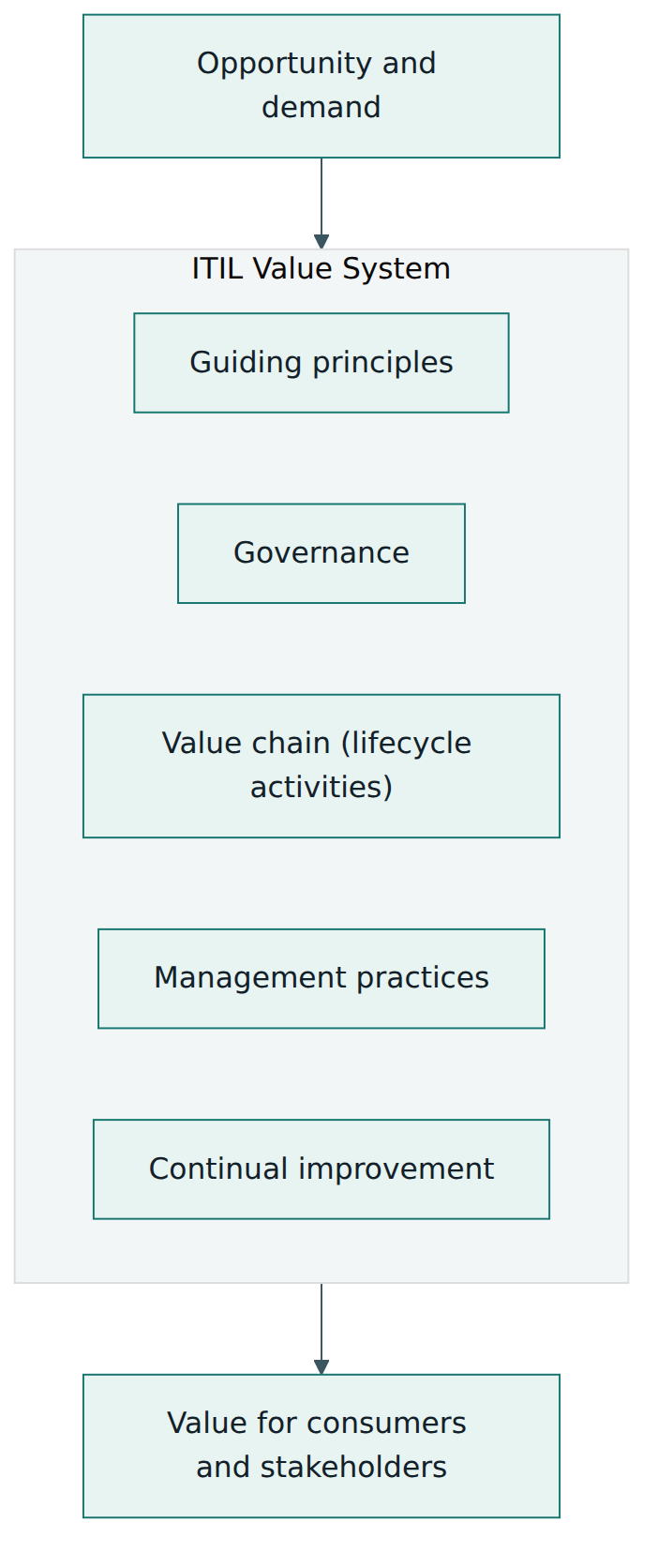
The ITIL Value System (called the service value system in ITIL 4) describes how all the parts of an organisation work together to turn demand and opportunities into value. Opportunities are chances to add value or improve; demand is the need or desire for products and services. Inside the system sit five components: the guiding principles, governance, the value chain activities, the management practices, and continual improvement. In Version 5 the value chain is made up of the eight activities of the product and service lifecycle (Lesson 4), which replace the six value chain activities of ITIL 4. The value system's job is to remove silos: instead of each department optimising its own process, everything is aligned to the flow of value.
The seven guiding principles
The guiding principles are recommendations that help in almost any situation, whatever the size or type of organisation. They carried over unchanged in name from ITIL 4, with Version 5 adding advice on how they apply when AI is used. In short:
- Focus on value – everything the organisation does should link, directly or indirectly, to value for stakeholders. Know who the consumer is and what they care about.
- Start where you are – before building something new, look at what already exists and works. Measure the current state directly rather than relying on reports or opinions.
- Progress iteratively with feedback – break large improvements into small steps, deliver each one, and use feedback to adjust the next.
- Collaborate and promote visibility – involve the right people early, share information openly and make work and its problems visible so decisions are based on facts.
- Think and work holistically – no service or team works in isolation; consider the whole system, including all four dimensions and the end-to-end flow.
- Keep it simple and practical – use the minimum number of steps needed; if a step, form or approval adds no value, remove it.
- Optimise and automate – first make work as effective and lean as possible, then automate it. Automating a bad process only produces bad results faster.
The principles interact. "Start where you are" and "keep it simple" stop teams from designing an ideal process on paper; "progress iteratively" and "collaborate" make change acceptable to the people who must live with it. None of them is applied alone.
Governance
Governance is how an organisation is directed and controlled. In ITIL terms, the governing body (for example a board) evaluates the situation, sets direction through strategy and policies, and monitors performance. Governance does not do service management itself, but it decides what "good" means, approves the risk appetite and holds management to account. This is where ITIL connects to COBIT and to ISO governance standards.
The four dimensions
To avoid focusing only on processes or only on tools, ITIL asks every product, service and practice to be considered from four dimensions. They apply to the whole value system.
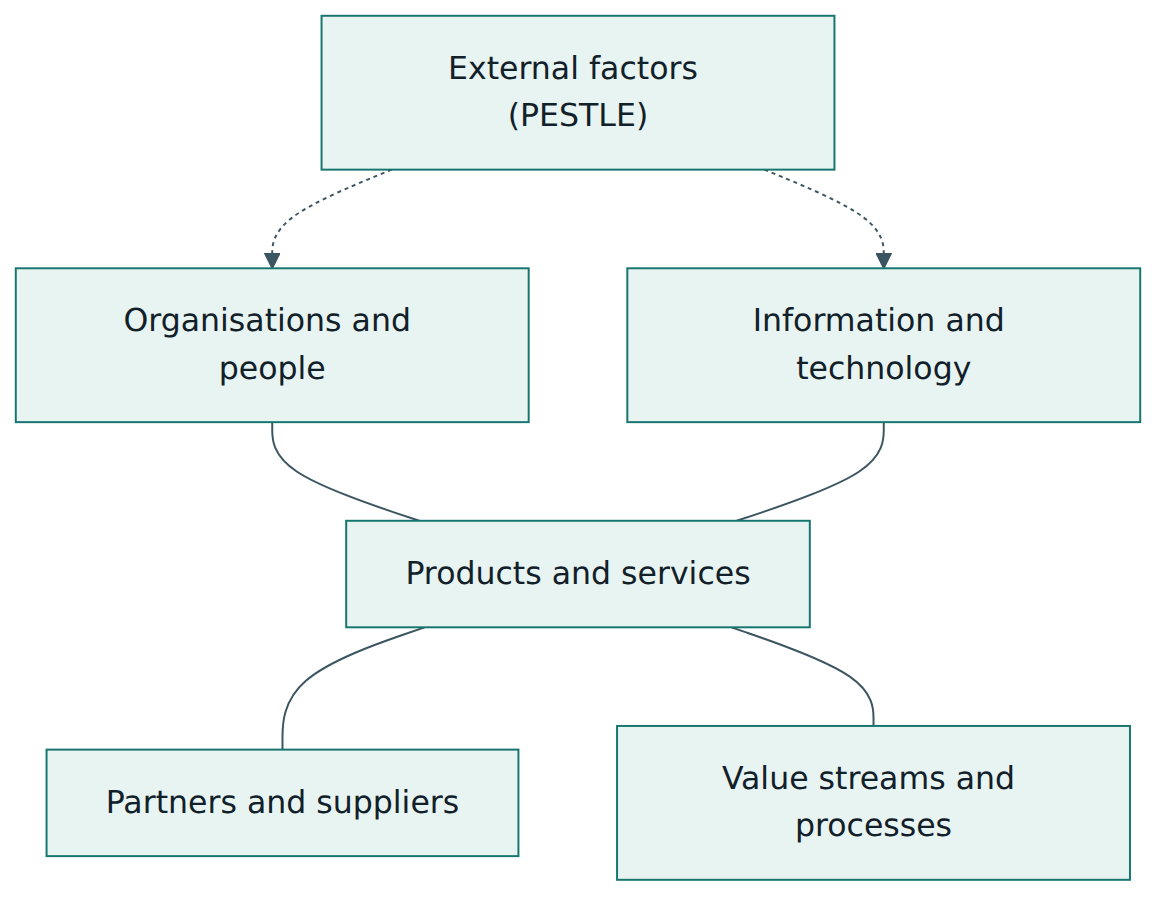
- Organisations and people – structures, roles, skills, culture and leadership.
- Information and technology – the information and knowledge needed, and the technologies (including AI) that support work and services. Version 5 introduces its AI capability model under this dimension.
- Partners and suppliers – the other organisations involved in designing, building, delivering and supporting services, and the contracts and relationships with them.
- Value streams and processes – how the parts of the organisation work together, in what sequence, to create value.
The dimensions are surrounded by external factors, often summarised with the PESTLE mnemonic: political, economic, social, technological, legal and environmental. A new data-protection law, for example, changes all four dimensions at once.
Practices and publications
ITIL describes 34 management practices. ITIL 4 grouped them into general management, service management and technical management practices; Version 5 keeps 34 practices, recategorising some of them, and regroups them into two families, general management practices and product and service management practices. The guidance is published as a Foundation book, core books on Product, Service, Experience, Strategy and Transformation, guidance on AI governance and a set of practice guides. Lesson 4 shows how these pieces are used together.
Lesson 4 – How it works in practice
The product and service lifecycle
The biggest structural change in Version 5 is the product and service lifecycle model. ITIL 4 described six value chain activities: plan, improve, engage, design and transition, obtain or build, and deliver and support. Version 5 replaces them with eight value chain activities, together called the product and service lifecycle, that cover the whole life of a digital product and the services built on it. Any value stream can be described as a sequence of some or all of them, and an activity can be revisited many times.
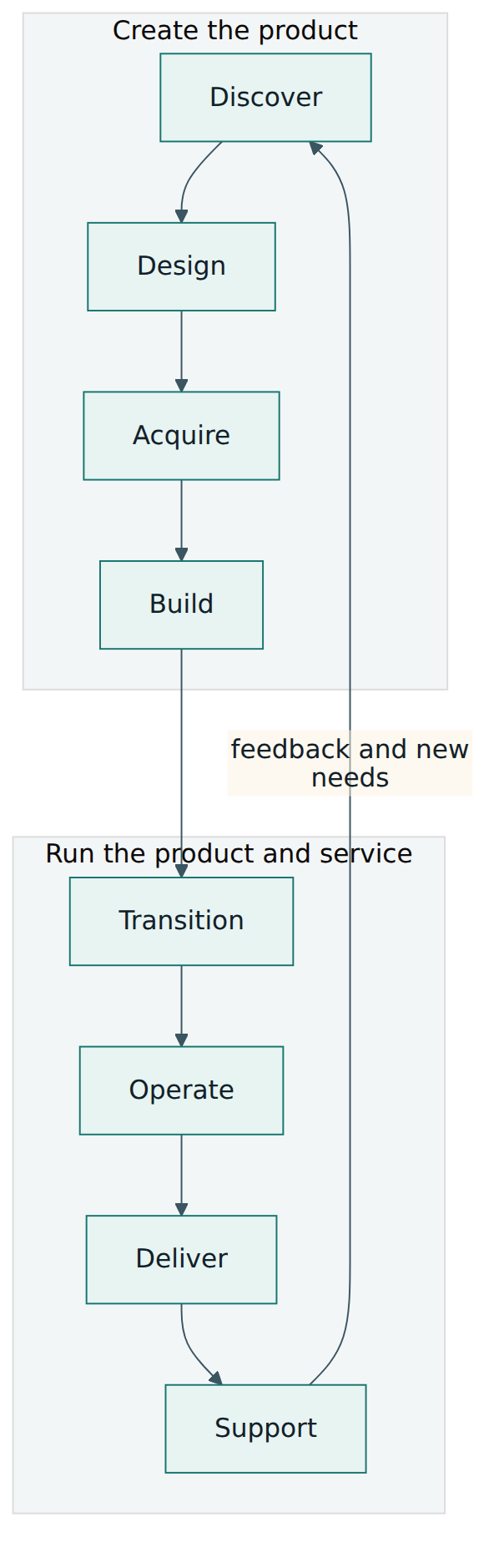
- Discover – understand needs and opportunities, aligned with strategy and consumer demand, and decide what is worth pursuing.
- Design – shape the solution, including its user experience and how it will be operated, secured and supported.
- Acquire – obtain or allocate the resources, components and supplier services needed.
- Build – develop, integrate, configure and test the solution.
- Transition – move new or changed products into live use safely.
- Operate – run and monitor the technology so it meets agreed performance and reliability.
- Deliver – provide the service to consumers as agreed, including onboarding users and fulfilling requests.
- Support – help users and restore normal service when something goes wrong.
Improvement and engagement with stakeholders did not disappear: improvement is a permanent component of the value system, and engagement happens wherever a value stream touches consumers. The point of the lifecycle is to describe what must happen; value streams describe in what order it happens for a specific consumer need; practices provide the capabilities used along the way.
Value streams in practice
Organisations usually map a handful of important value streams rather than everything. Typical examples are "restore a disrupted service", "fulfil a user request", "deliver a new feature" and "onboard a new customer". Version 5 distinguishes core value streams, which deliver value to external consumers, from enabling value streams, which are internal flows such as onboarding a new supplier. Mapping a value stream means listing its steps, which lifecycle activities they belong to, which practices and teams contribute, where work waits, and how long each step really takes. Waiting time is usually far larger than working time, which is why mapping is so revealing.
Key practices you will meet first
You do not need all 34 practices on day one. Most organisations start with a core set that supports the support, deliver and transition activities:
- Service desk – the single point of contact that captures demand for incident resolution and service requests and communicates with users.
- Incident management – minimises the negative impact of incidents by restoring normal service as quickly as possible. Speed of restoration matters more than finding the root cause.
- Problem management – reduces the likelihood and impact of incidents by identifying causes, managing workarounds and known errors, and driving permanent fixes.
- Service request management – handles predefined, user-initiated requests such as access, equipment or information, ideally through a self-service catalogue and automation.
- Change enablement – maximises the number of successful changes by assessing risk, authorising changes and managing the change schedule. ITIL 4 renamed it from "change management" to stress enabling rather than blocking change.
- Service level management – sets clear, business-based targets for service performance and checks them using both metrics and feedback from consumers.
- Monitoring and event management, service configuration management, release management and deployment management – the technical backbone that makes the others reliable.
- Relationship management, supplier management, information security management and continual improvement – general management practices that every service relies on.
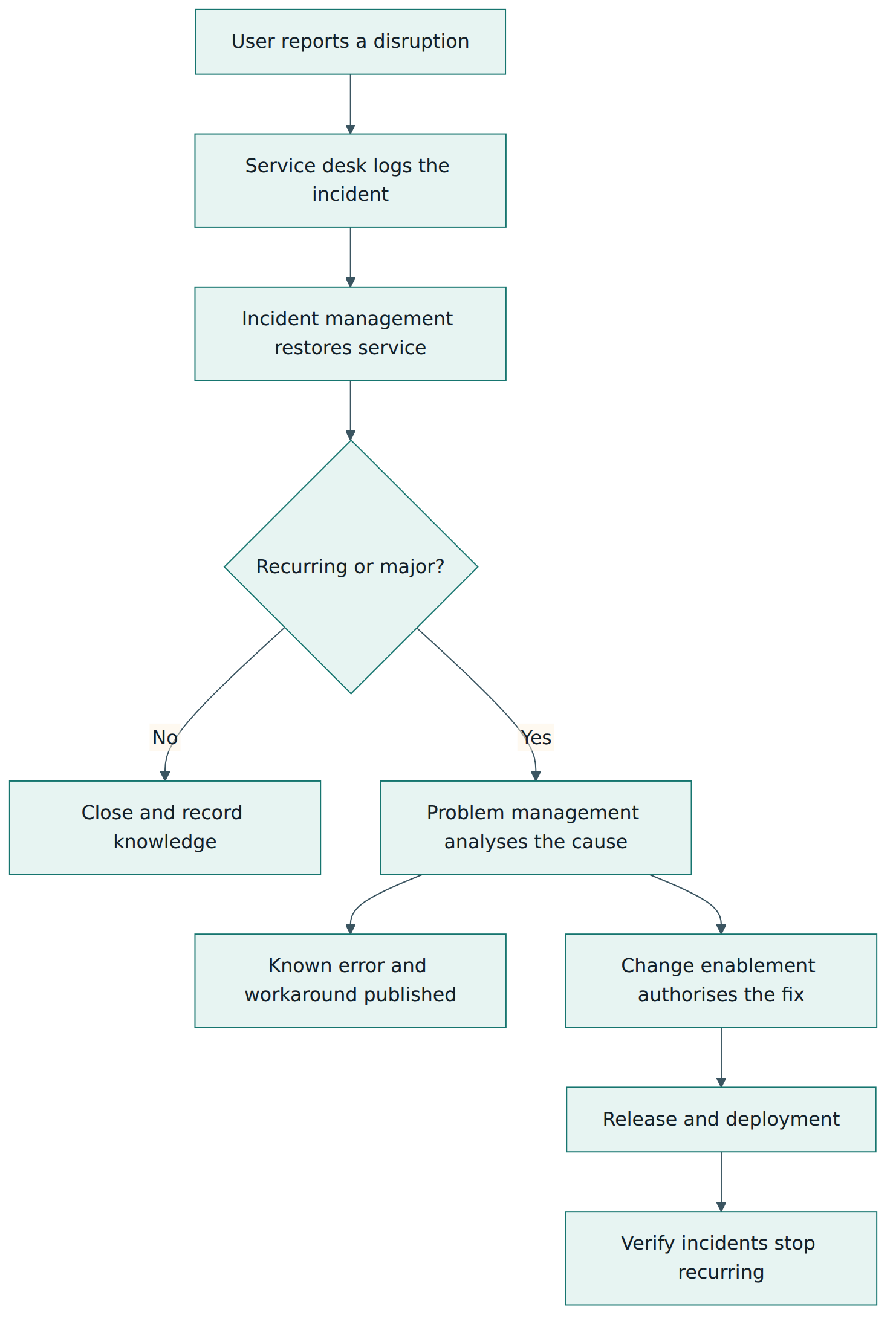
Practices interact constantly. A burst of incidents with the same symptom triggers problem management; the problem's permanent fix becomes a change; the change goes through release and deployment; and knowledge management captures the workaround so the service desk can help users while the fix is pending.
Change authority and risk
A common misunderstanding is that ITIL requires every change to go to a weekly change advisory board. It does not. ITIL asks that each type of change has an appropriate change authority. Standard changes are pre-authorised and can be fully automated; normal changes are assessed by an authority that matches their risk, which may be a peer review in a deployment pipeline; emergency changes are expedited with as little delay as possible. Organisations that practise continuous delivery often authorise most changes through automated tests and policy checks in the pipeline, which is entirely consistent with ITIL.
The continual improvement model
Continual improvement is both a practice and a component of the value system. ITIL offers a simple step-by-step model, familiar from ITIL 4, that can be used for anything from a small fix to an organisation-wide change:
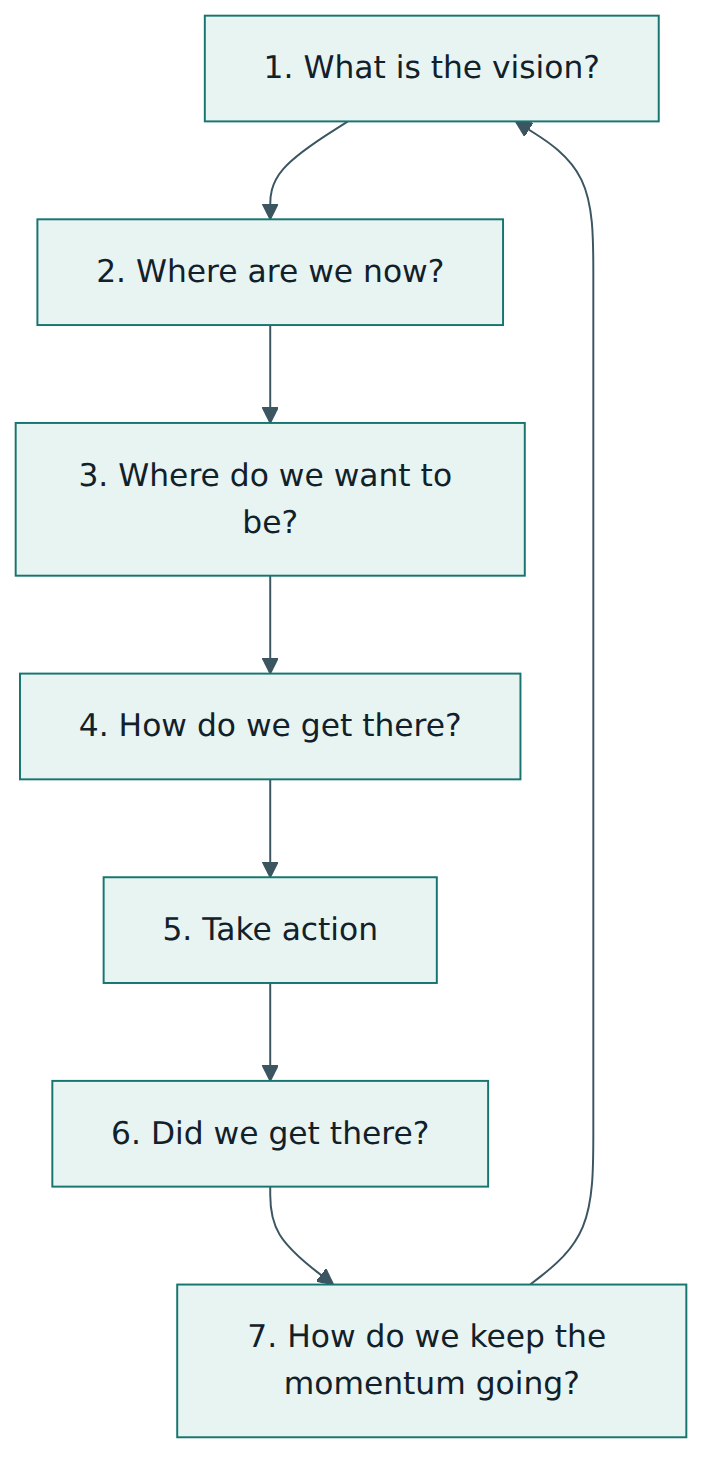
Steps 2 and 6 are the ones most often skipped: without a measured baseline you cannot prove anything improved. Improvement ideas are kept in a continual improvement register so they can be prioritised and tracked rather than forgotten.
Roles and artefacts
ITIL does not prescribe an organisation chart, but certain roles appear almost everywhere: service owners accountable for a service end to end, practice owners accountable for how a practice works across teams, product owners or managers for digital products, service desk agents, incident managers for major incidents, and change authorities. Typical artefacts include a service catalogue, service level agreements and other agreements, a configuration management system, a knowledge base, a change schedule, problem and known error records, and an improvement register. Tools help, but the guidance is tool-neutral.
Implementation steps
A sensible adoption sequence follows the guiding principles. Agree the outcomes leadership wants and the services that matter most. Assess where you are now, ideally by observing real work. Choose two or three value streams with visible pain, map them and improve them iteratively. Define a few practices properly – owners, policies, simple workflows, measures – rather than all 34 superficially. Train people, starting with a shared vocabulary such as the Foundation level. Measure outcomes and experience, not just activity counts, and feed the results into the next improvement cycle.
Lesson 5 – Assessment, certification and compliance
Certification of individuals
ITIL certification applies to people, not organisations. PeopleCert runs the examinations, either through online proctoring or through accredited training organisations. The Version 5 scheme is organised as follows.
- ITIL Foundation (Version 5) – the entry qualification. According to PeopleCert's exam page it is a closed-book, 40-question multiple-choice exam of 60 minutes with a pass mark of 65 %. Holders of ITIL 4 Foundation can take a shorter Foundation Bridge instead of repeating the whole course; PeopleCert plans to retire the bridge at the end of 2027.
- Practice Manager – Foundation, one of three practice-focused modules (Monitor, Support and Fulfil; Plan, Implement and Control; Collaborate, Assure and Improve) and the Transformation module.
- Managing Professional – Foundation plus the Product, Service, Experience and Transformation modules.
- Strategic Leader – Foundation plus Strategy and Transformation.
- Master – awarded to those who hold all three of the designations above.
Transformation is a shared core module taken once and counted towards every designation. The AI Governance module is an extension that stands alone. PeopleCert describes most advanced exams as open-book, reflecting a shift from memorising definitions to applying the guidance. Version 5 certificates carry a three-year renewal date and can be renewed by collecting continuing professional development points, by passing another certification in the scheme, or by retaking the exam. Exam formats and prices change, so always check PeopleCert's current pages before planning.
Choosing a path
For most people Foundation is enough to work confidently in an ITIL environment: it builds the shared vocabulary and the overall model. Engineers and team leads who own a specific area, such as the service desk or change and release, gain most from a Practice Manager module covering the practices they run. Product and service managers who are responsible for end-to-end delivery fit the Managing Professional path, while senior leaders who set direction and drive transformation fit Strategic Leader. A qualification proves knowledge of the guidance; it does not prove that someone can apply it, so organisations should combine training with real improvement work, coaching and review of results.
Why there is no "ITIL-certified organisation"
Because ITIL is guidance rather than a set of auditable requirements, no accredited body certifies a company as "ITIL compliant". Claims such as "we are an ITIL-certified company" usually mean that staff hold ITIL qualifications. An organisation that wants independent certification of its service management uses ISO/IEC 20000-1, the international standard for service management systems. Its requirements are written in the ISO management-system style, and ITIL guidance is a common way of meeting many of them. Accredited certification bodies audit against the standard, issue a certificate for a defined scope and return for surveillance audits.
Assessing ITIL adoption
Organisations still need to know how well they apply ITIL. Common approaches are:
- Maturity and capability assessments – rating how well each important practice is defined, performed and improved, and how well the value system as a whole works. During the ITIL 4 era Axelos published an ITIL maturity model for this purpose; many consultancies offer similar assessments.
- Value stream reviews – measuring flow (lead time, waiting time, rework) and value realised (outcomes, experience) for selected value streams.
- Experience measures – user satisfaction, employee experience and customer effort, which reveal problems that green operational metrics hide.
- Internal audit – checking that policies such as change authorisation or access management are followed, often to support ISO/IEC 20000-1, ISO/IEC 27001 or regulatory obligations.
Whatever method is used, the assessment should start from business outcomes and lead to an improvement plan, not just a score.
Lesson 6 – Worked example
Harbourline Logistics (a fictional company) has 1,800 employees, a customer-facing shipment-tracking app, a warehouse management system and an internal IT team of 90 people plus two outsourcing partners. The chief operating officer complains that the tracking app "falls over every peak season", warehouse staff wait three days for scanner replacements, and nobody can say whether the IT budget is well spent. A new head of digital services, Priya, is asked to fix this "using ITIL".
Step 1 – Focus on value and start where you are
Priya resists the temptation to buy a new tool or rewrite every process. She interviews the operations director (customer role for the warehouse services), floor supervisors and drivers (users) and the finance director (sponsor). They agree three outcomes: reliable tracking for customers during peaks, warehouse workers productive within one hour of a scanner fault, and transparent cost per service. She then gathers real data: six months of tickets, the change calendar, outage reports and a one-day observation at the service desk.
Step 2 – Map two value streams
The team maps "restore a disrupted service" and "fulfil a warehouse equipment request" using the lifecycle activities. The equipment stream reveals that a scanner request passes through four queues, waits for manager approval that is never refused, and sits with the outsourcing partner for two days because the contract does not define a delivery time. Actual work time is under an hour. The restoration stream shows that tracking-app incidents are fixed by restarting servers, so the same incident repeats dozens of times.
Step 3 – Improve iteratively across the four dimensions
- Value streams and processes: scanner replacement becomes a standard service request in the catalogue with no manager approval, and spare scanners are kept at each site.
- Partners and suppliers: supplier management renegotiates the outsourcing contract with a next-morning delivery target and shared reporting.
- Information and technology: monitoring and event management add alerts on queue length in the tracking app, and the service desk tool links incidents to configuration items.
- Organisations and people: a service owner is named for the tracking service, and the service desk agents receive Foundation training so everyone uses the same terms.
Step 4 – Prevent, not only restore
Problem management groups the repeated tracking incidents into one problem. Analysis shows a database connection pool sized for normal traffic. A known error record with the restart workaround is published so the desk can act quickly, and a permanent fix is raised as a normal change. Because the risk is moderate, the change authority is the platform lead plus the service owner, not the monthly board. The fix is released before the next peak.
Step 5 – Agree and measure service levels
Service level management replaces the old target "95 % of tickets closed in eight hours" with measures the business recognises: tracking availability during peak hours, the time until a warehouse worker is productive again, and a short satisfaction survey after each request. The first report shows that ticket targets had been green for months while users were unhappy – the classic "watermelon" effect, green outside and red inside.
Step 6 – Check, then keep the momentum
After one quarter the team returns to the improvement model's sixth question. Scanner downtime has dropped from three days to under four hours, the tracking app survives the peak, and the finance director receives cost per service for the first time. New ideas, such as automating access requests and using AI to suggest knowledge articles to agents, go into the improvement register for the next cycle. Priya did not "implement ITIL"; she used ITIL to improve the outcomes that mattered, which is exactly what the framework intends.
Lesson 7 – Relationship to other standards and frameworks
ITIL rarely stands alone. Understanding its neighbours helps you avoid duplicated effort and explain how frameworks fit together.
| Framework | Owner | What it is | Relationship to ITIL |
|---|---|---|---|
| ISO/IEC 20000-1 | ISO and IEC | International standard of requirements for a service management system; organisations can be certified. | Defines what must be in place; ITIL offers detailed guidance on how. Many organisations use ITIL to meet ISO/IEC 20000-1 and then get certified. |
| COBIT | ISACA | Framework for the governance and management of enterprise information and technology. | Covers governance, control objectives and assurance more deeply; ITIL is richer on day-to-day service practices. They are often used together, with COBIT setting governance and ITIL guiding delivery. |
| ISO/IEC 27001 | ISO and IEC | Requirements for an information security management system. | ITIL's information security management practice and change, access and incident practices support many ISMS controls; ISO/IEC 27001 is the certifiable security standard. |
| DevOps and site reliability engineering | Communities and industry practice | Cultural and technical approaches for fast, reliable software delivery and operations (automation, pipelines, error budgets). | Compatible: ITIL's lifecycle and practices describe what must be managed, while DevOps and SRE offer techniques for doing it quickly and safely. |
| Agile methods such as Scrum | Scrum Guide authors and others | Iterative frameworks for developing products in short cycles with frequent feedback. | Fit naturally within the discover, design and build activities; ITIL's principle "progress iteratively with feedback" reflects the same thinking. |
| Lean | Industry practice | Method for maximising value by removing waste and improving flow. | ITIL's value stream mapping and its "keep it simple" and "optimise and automate" principles draw heavily on Lean thinking. |
Version 5 compared with ITIL 4
Because many organisations built their processes, tools and job descriptions on ITIL 4, it helps to know exactly what moved. PeopleCert presents Version 5 as an evolution rather than a revolution, and the differences are easy to list:
- The service value system is now called the ITIL Value System, and its scope widens from IT service management to digital products and services, including enterprise services outside IT.
- The six ITIL 4 value chain activities are replaced by the eight activities of the product and service lifecycle; plan and improve are no longer separate chain activities, and improvement stays a permanent component of the value system.
- The seven guiding principles and the four dimensions remain, now described as dimensions of product and service management.
- The 34 practices remain, with some recategorised, and are regrouped into two families instead of three.
- Experience (customer, user and employee) and AI, including an AI capability model and AI governance guidance, are new emphases.
- The certification scheme is simpler, with a shared Transformation module and more open-book exams.
In practice this means existing ITIL 4 processes do not need to be thrown away. Most organisations can map their current value chain diagrams to the new lifecycle, keep their practice definitions, and add product, experience and AI considerations over time.
A useful way to remember the relationships: governance frameworks such as COBIT tell the board how to direct and control technology; standards such as ISO/IEC 20000-1 and ISO/IEC 27001 define requirements that can be audited; ITIL is detailed operating guidance for creating, delivering and supporting products and services; agile, Lean, DevOps and SRE provide ways of working that make that guidance fast and reliable. They complement rather than compete with each other.
Common pitfalls and best practices
Pitfalls:
- Treating ITIL as a rulebook. Copying every practice description word for word produces heavy bureaucracy. ITIL is meant to be adapted to context.
- Starting with the tool. Buying an ITSM platform and configuring its default workflows before agreeing outcomes simply automates the current confusion.
- Measuring activity instead of outcomes. Ticket counts and closure times can look perfect while users are unhappy (the watermelon effect).
- Using change control to block delivery. Sending every change to one weekly board slows teams down without reducing risk; it pushes people to bypass the process.
- Restoring without preventing. Fixing the same incident repeatedly without problem management wastes effort and erodes trust.
- Running ITIL as a one-off project. Improvement stalls once the consultants leave if there is no improvement register, ownership or measurement.
- Training without application. Certifying many people while nothing changes in daily work creates cynicism.
Best practices:
- Begin with value streams that hurt. Map two or three, fix the biggest delays, and show results within weeks.
- Name owners. Every important service and practice needs a clearly accountable owner.
- Match change authority to risk. Use standard changes and automated pipeline checks for routine work; reserve human review for genuinely risky changes.
- Measure experience as well as performance. Combine operational metrics with short user and employee feedback.
- Apply all four dimensions. Check people, information and technology, suppliers and workflows for every improvement.
- Keep improvement continuous. Maintain a visible improvement register and review it regularly with stakeholders.
- Govern AI deliberately. When adding AI to service work, define who is accountable for its output, how quality is checked and how risks are managed.
Summary and key takeaways
- ITIL is proprietary good-practice guidance, now owned by PeopleCert; the current edition is ITIL (Version 5), released in phases during 2026, with ITIL 4 certifications planned to retire at the end of 2027.
- Value is co-created by providers and consumers, and good services balance outcomes against costs and risks.
- The ITIL Value System combines guiding principles, governance, the value chain activities (the product and service lifecycle), management practices and continual improvement.
- The seven guiding principles, from "focus on value" to "optimise and automate", help in almost any decision.
- Every product and service must be managed across four dimensions: organisations and people, information and technology, partners and suppliers, and value streams and processes.
- Eight lifecycle activities – discover, design, acquire, build, transition, operate, deliver and support – replace the six ITIL 4 value chain activities, and 34 practices provide the capabilities.
- Individuals are certified in ITIL; organisations seeking certification use ISO/IEC 20000-1.
- ITIL works best alongside COBIT, ISO standards, agile, Lean, DevOps and SRE, adapted to the organisation's context.
Reflection questions
- Pick a service you use at work. Who plays the customer, user and sponsor roles, and do they define value in the same way?
- Choose one value stream in your organisation and estimate how much of its total lead time is waiting rather than working. Which guiding principle would you apply first, and why?
- Describe a service you know that has good utility but weak warranty, or the reverse. What would you change, and in which of the four dimensions?
- How would you design change authorities for a team that deploys many times a day while still managing risk for critical systems?
- Your manager wants the company to become "ITIL certified" to win a tender. What would you advise, and what evidence would actually reassure the customer?
Further reading and official sources
- ITIL (Version 5) explained – PeopleCert
- ITIL frequently asked questions (scheme, transition, ITIL 4 retirement) – PeopleCert
- ITIL Foundation (Version 5) certification – PeopleCert
- ITIL certifications overview – PeopleCert
- ITIL (Version 5): a value stream perspective – PeopleCert Community
- ISO/IEC 20000-1 – Service management system requirements – ISO
- Inside ITIL 5: the AI-native guidance unpacked – EasyVista
Original tutorial by xOps School (DevOpsSchool Private Limited), written from public sources about ITIL. Not affiliated with or endorsed by the standard's owner; standard names are trademarks of their owners. Buy the official standard from its publisher for the authoritative text.