
ISO 9004 – Tutorial (about 60 minutes)
- View
ISO 9004 is the international guidance standard that helps an organisation move beyond "passing the ISO 9001 audit" towards long-term, sustained success. It is used by leaders, quality and improvement professionals, and strategy and operations teams who already run a management system and want to know how good their organisation really is and where to improve next. After this tutorial you will be able to explain what ISO 9004 means by the quality of an organisation, walk through its structure, run a simple maturity self-assessment and turn the results into a practical improvement plan.
Course overview
Edition and status: The current edition is ISO 9004:2018, Quality management — Quality of an organization — Guidance to achieve sustained success, the fourth edition, published in April 2018 by ISO technical committee ISO/TC 176, subcommittee SC 2 (Quality systems). It is a guidance document, not a set of requirements, and it is not intended for certification. It was adopted unchanged in Europe as EN ISO 9004:2018 (in the UK as BS EN ISO 9004:2018, listed as current). It was written alongside the 2015 editions of ISO 9000 and ISO 9001. Its five-year systematic review ran in 2023 and the edition was confirmed (ISO stage 90.93, "confirmed", as shown in the Swiss national catalogue), so no revision project is under way. ISO 9001 has since been revised (ISO 9001:2026, published September 2026) and a 2026 edition of ISO 9000 has also appeared, but ISO/TC 176/SC 2 still lists ISO 9004:2018 as its published edition and no newer edition has been released. Verified 2026-10-29 on the ISO/TC 176/SC 2 committee site, the SNV catalogue and the BSI catalogue. Check the ISO catalogue entry for any later revision before you rely on a specific edition.
Who this is for: managers and team leads, quality and continual-improvement professionals, internal auditors, strategy, operations and transformation staff, and engineers or product people who have been asked to "help the organisation mature". It is especially useful if your organisation is already certified to ISO 9001 and you are wondering what to do once the certificate is on the wall.
Prerequisites: none. A basic idea of what a quality management system is helps, but every term is explained when it first appears.
By the end of this tutorial:
- You will be able to explain the purpose of ISO 9004, what it means by "quality of an organization" and "sustained success", and why it is guidance rather than a certifiable standard.
- You will be able to describe the structure of ISO 9004:2018, from context and identity through leadership, processes, resources, performance evaluation and improvement.
- You will be able to explain how organisational identity (mission, vision, values and culture) and relevant interested parties shape strategy and objectives.
- You will be able to run a self-assessment with the five-level maturity scale in Annex A and interpret the results.
- You will be able to turn self-assessment results into prioritised, measurable improvement actions.
- You will be able to compare ISO 9004 with ISO 9001, ISO 9000, ISO 19011 and excellence models such as EFQM and Baldrige.
- You will be able to recognise common mistakes when organisations try to use ISO 9004 and how to avoid them.
Lesson 1 – Origins, purpose and scope
The problem ISO 9004 addresses
Picture a company that has held an ISO 9001 certificate for ten years. Its audits go smoothly, its procedures are tidy and its nonconformities are closed on time. Yet its market share is slipping, good people are leaving, a key supplier nearly failed last year and a new competitor is winning customers with a digital service the company never thought of. Nothing in the certificate is wrong. The certificate simply answers a narrower question: does the organisation have a management system that reliably meets customer and legal requirements? It does not answer the bigger question: is this organisation well run, and will it still be thriving in ten years?
ISO 9004 was written for that bigger question. It offers guidance for leaders on how to strengthen the whole organisation so that it keeps meeting the needs and expectations of everyone it depends on, not just its customers, over the long term. In ISO's language, it helps an organisation improve its quality as an organisation and achieve sustained success.
Requirements versus guidance
Most people meet ISO through standards that contain requirements, written with the word "shall". An auditor can check whether a requirement is met, which is what makes certification possible. ISO 9004 is different. It is written as guidance, using "should" for recommendations and "can" or "may" for possibilities. It describes good practice and asks you to judge how far your organisation has got, rather than setting a pass mark. That is why there is no ISO 9004 certificate, and why using it well depends on honest self-reflection rather than on producing evidence for an outsider.
This difference changes how you read the document. With ISO 9001 you ask "what must we have?". With ISO 9004 you ask "how mature are we, compared with what good looks like, and which improvement would make the most difference?".
A short history
ISO 9004 has existed almost as long as ISO 9001. The first ISO 9000 series of 1987 included an ISO 9004 document giving general guidance on quality management and quality system elements. When the family was reworked in 2000, ISO 9001 and ISO 9004 were designed as a "consistent pair": ISO 9001 for the requirements, ISO 9004 for performance improvement beyond them, sharing a similar structure. The 2000 edition already contained a short self-assessment annex with five performance maturity levels. The 2009 edition changed direction. It was retitled around managing for the sustained success of an organisation, put much more weight on balancing the needs of all interested parties, and expanded the self-assessment into a fuller tool with maturity levels. The 2018 edition kept the self-assessment idea but reorganised the content around the concepts introduced in ISO 9001:2015, such as the context of the organisation and interested parties, and added a new emphasis on organisational identity: mission, vision, values and culture.
Scope in plain words
ISO 9004 applies to any organisation, of any size, type or sector, public or private, profit-making or not. It is aimed above all at top management, because the topics it covers, such as strategy, culture, resources and innovation, can only be changed by people with the authority to do so. Its central message is that sustained success comes from consistently meeting the needs of relevant interested parties in a balanced way, and that an organisation can deliberately build the capabilities that make this possible. It does not tell you what your strategy should be, which markets to enter or what to produce; it gives you a structured way to examine whether your organisation is equipped to make and carry out those decisions well.
Who uses it and why
Typical users include organisations that have a mature ISO 9001 system and want a next step that is not "more paperwork"; organisations that want a structured self-assessment without committing to an external award programme; leadership teams preparing a strategy refresh who want an independent framework for asking hard questions; and quality professionals who want to talk with executives in terms of performance, resilience and long-term value rather than in terms of procedures. It is also used in education and consulting as a bridge between basic quality management and business excellence models.
Lesson 2 – Key concepts and vocabulary
ISO 9004 builds on the vocabulary of ISO 9000, the standard that defines the fundamental concepts and terms of quality management. The explanations below are written in plain language; they are not the official definitions, which you should read in ISO 9000 itself.
- Quality – in the ISO sense, the degree to which the characteristics of something meet requirements. "Something" can be a product, a service, a process, or a whole organisation.
- Quality of an organization – how well the organisation's own inherent characteristics, such as its leadership, processes, people, knowledge and relationships, enable it to meet the needs and expectations of its customers and other interested parties, so that it can succeed over time. This is the central idea of the 2018 edition.
- Sustained success – success of an organisation over a period of time, not just this quarter. It implies balancing the interests of different parties and being able to adapt as circumstances change.
- Interested party – a person or organisation that can affect, be affected by, or believe itself affected by a decision or activity of the organisation. Customers, employees, owners, suppliers, regulators, communities and partners are common examples. The everyday word is "stakeholder".
- Relevant interested party – an interested party whose needs and expectations matter enough to the organisation's success that it chooses to address them. Deciding who is relevant, and how much, is a leadership judgement.
- Context of the organization – the combination of external and internal issues, such as markets, technology, regulation, climate, competition, culture and capabilities, that affect the organisation's purpose and its ability to achieve its intended results.
- Organizational identity – the set of characteristics that make the organisation what it is: its mission, vision, values and culture. ISO 9004 treats identity as the foundation for policy, strategy and objectives.
- Mission – the organisation's purpose for existing, as expressed by top management: what it does and for whom.
- Vision – what the organisation aspires to become, as expressed by top management: where it wants to be in the future.
- Values – the principles and ways of thinking that guide behaviour and decisions, for example integrity, safety first or customer respect.
- Culture – the beliefs, history, ethics, observed behaviour and attitudes that are actually shared in the organisation. Culture is what people do when nobody is checking, which is why it can support or quietly undermine the stated values.
- Policy and strategy – a policy expresses intentions and direction set by top management; a strategy is the plan for achieving long-term or overall objectives.
- Key performance indicator (KPI) – a measurable value that shows how effectively the organisation, or one of its processes, is achieving an objective. ISO 9004 treats well-chosen indicators as the basis for analysis and decisions.
- Self-assessment – a comprehensive review that the organisation carries out on itself, comparing its practices and results with a reference model, here the maturity descriptions in Annex A of ISO 9004.
- Maturity level – a step on a scale that describes how developed a practice is, from a basic, reactive level to a level considered best practice. ISO 9004 uses five levels.
- Benchmarking – a structured comparison of your practices or results with those of other organisations or other parts of your own organisation, to learn how to improve.
- Organizational knowledge – knowledge specific to the organisation, gained mainly through experience, that it uses to achieve its objectives, from lessons learned to know-how held by experts.
- Improvement, learning and innovation – three related ways of getting better: improvement makes existing things work better, learning builds the capability of people and the organisation, and innovation introduces new or changed things that create or redistribute value.
How the concepts connect
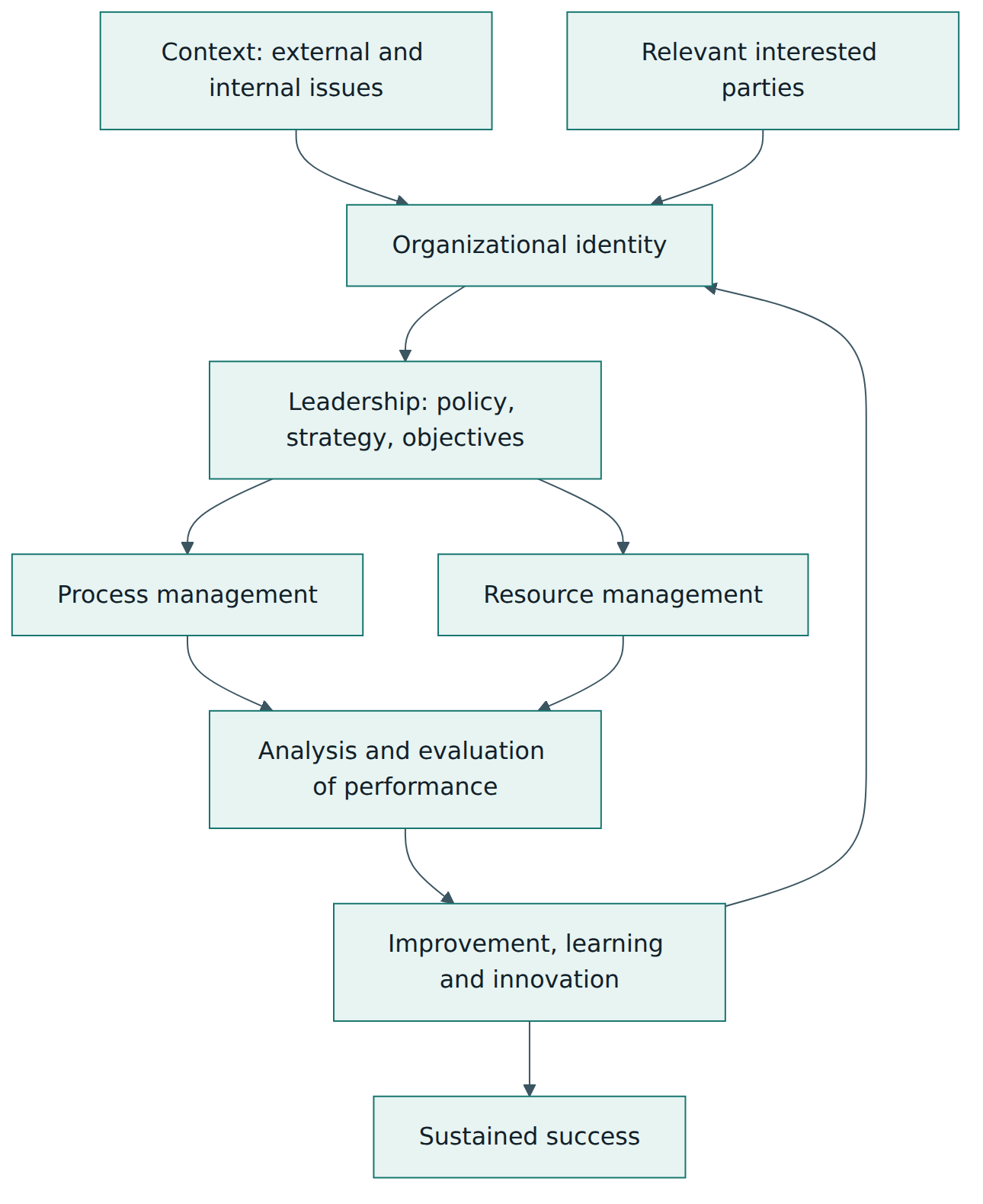
The concepts form a chain of reasoning. The organisation exists in a context and depends on relevant interested parties. Its identity says what it is trying to be. Leadership turns identity into policy, strategy and objectives. Processes and resources deliver them. Analysis and evaluation, including self-assessment, show how well this is working. Improvement, learning and innovation close the loop. The quality of the organisation is the sum of how well all of these work together, and sustained success is the result when they keep working over time.
The quality management principles underneath
ISO 9004:2018 rests on the seven quality management principles set out in ISO 9000:2015: customer focus, leadership, engagement of people, the process approach, improvement, evidence-based decision making and relationship management. In ISO 9001 these principles stay in the background. In ISO 9004 they come to the surface. For example, relationship management becomes concrete guidance on managing partners and suppliers as part of the organisation's resources, and evidence-based decision making becomes guidance on performance indicators, analysis and evaluation.
Lesson 3 – Structure of the standard
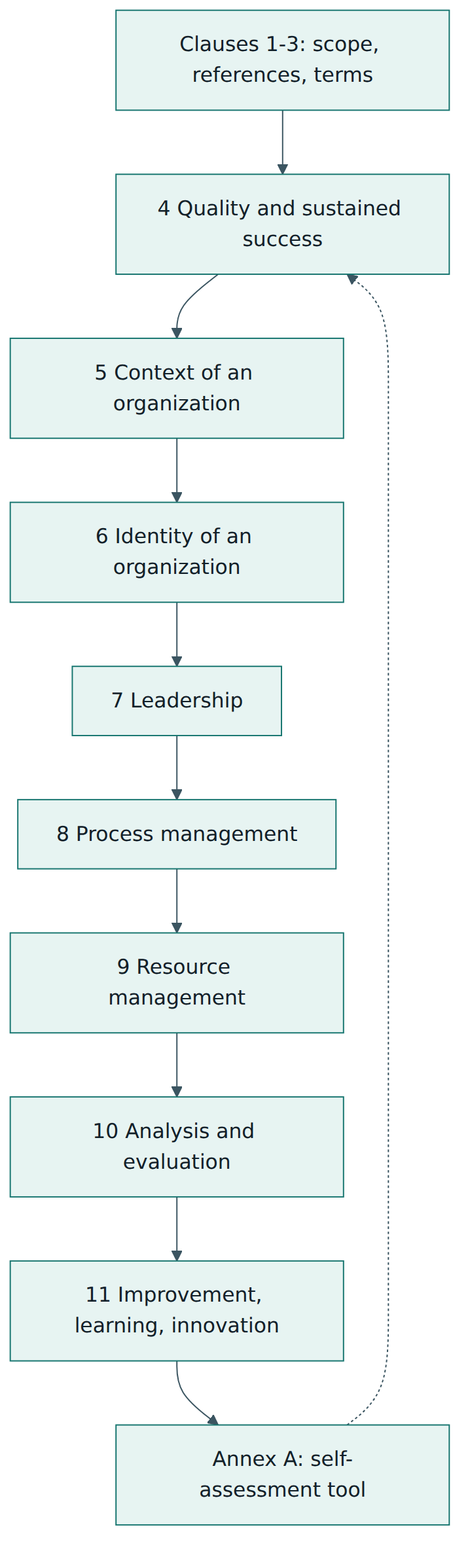
ISO 9004:2018 has eleven main clauses plus an informative annex. The first three are the usual introductory clauses found in most ISO documents; the guidance itself sits in clauses 4 to 11, and the practical self-assessment tool is in Annex A. Note that ISO 9004 does not follow the ten-clause Harmonized Structure that ISO 9001 and other management system standards share. It uses its own sequence, which is closer to the way an executive team thinks about running an organisation.
Introductory clauses
- Clause 1 – Scope: what the document covers and that it gives guidance, not requirements.
- Clause 2 – Normative references: ISO 9000:2015, the vocabulary, is indispensable for applying it.
- Clause 3 – Terms and definitions: points to ISO 9000 for the terms used.
The guidance clauses
Clause 4 – Quality of an organization and sustained success. This clause sets out the central idea. It explains what the quality of an organisation means and how top management can manage for long-term success, for example by looking far enough ahead, balancing the needs of different interested parties, engaging people and building the ability to adapt.
Clause 5 – Context of an organization. This covers understanding the organisation's environment: identifying relevant interested parties and their needs and expectations, and monitoring external and internal issues. It goes further than the equivalent ISO 9001 clause by discussing how to decide which interested parties matter most, how their needs may conflict, and how to keep the picture current as things change.
Clause 6 – Identity of an organization. This is the clause most associated with the 2018 edition. It covers defining and periodically reviewing the mission, vision, values and culture, and making sure they are understood, applied and consistent with each other and with the context.
Clause 7 – Leadership. This deals with how top management establishes policy and strategy, deploys objectives through the organisation, and communicates. The emphasis is on alignment: strategy flows from identity and context, objectives flow from strategy, and communication runs in both directions.
Clause 8 – Process management. This covers determining the processes needed to deliver the strategy, assigning responsibility and authority for them (often called process owners), and managing them as an interacting system rather than as isolated departments.
Clause 9 – Resource management. This is broad. It covers people, organisational knowledge, technology, infrastructure and work environment, externally provided resources such as suppliers and partners, and natural resources. Treating knowledge, technology and natural resources as things to be managed deliberately is one of the ways ISO 9004 goes beyond ISO 9001.
Clause 10 – Analysis and evaluation of an organization's performance. This covers performance indicators, performance analysis, performance evaluation, internal audit, self-assessment and reviews. It is where measurement turns into understanding and decisions.
Clause 11 – Improvement, learning and innovation. This covers continual improvement at all levels, organisational and individual learning, and innovation, including how to judge when innovation is needed and how to manage the risks that come with it.
Annex A – the self-assessment tool
Annex A is informative, meaning it is offered as help rather than as part of the core guidance, but in practice it is the part most organisations use first. It describes, for the topics of the guidance clauses, what practice typically looks like at five levels of maturity, from a basic level to best practice. An organisation reads the descriptions, decides which level best matches its reality, and uses the gaps to plan improvement. Lesson 5 covers how to do this properly.
Reading the structure as a story
A useful way to remember the sequence is as a story a leadership team tells about itself. "Here is what success means for us (clause 4). Here is the world we operate in and who we depend on (clause 5). Here is who we are and what we stand for (clause 6). Here is where we are going and how we will get there (clause 7). Here is how the work gets done (clause 8) and what we need to do it (clause 9). Here is how we know how we are doing (clause 10). Here is how we get better and reinvent ourselves (clause 11)." If any chapter of that story is weak, sustained success is at risk.
Lesson 4 – How it works in practice
Who does what
ISO 9004 does not create new job titles, but its use usually involves a recognisable set of roles:
- Top management sponsors the work, takes part in the self-assessment, owns identity and strategy, and decides on priorities. Without them, ISO 9004 turns into a quality-department exercise with little effect.
- A coordinator or facilitator, often from quality, strategy or a transformation office, plans the work, explains the maturity model, runs workshops and keeps the evidence together.
- Process owners and functional managers contribute knowledge of how things really work, own improvement actions in their areas and report progress.
- Employees across levels provide a reality check. Their view of culture, communication and resources often differs from the view at the top, and that difference is valuable.
- External voices, such as key customers, suppliers or a critical friend from outside, can be invited to challenge the organisation's view of itself.
A typical cycle
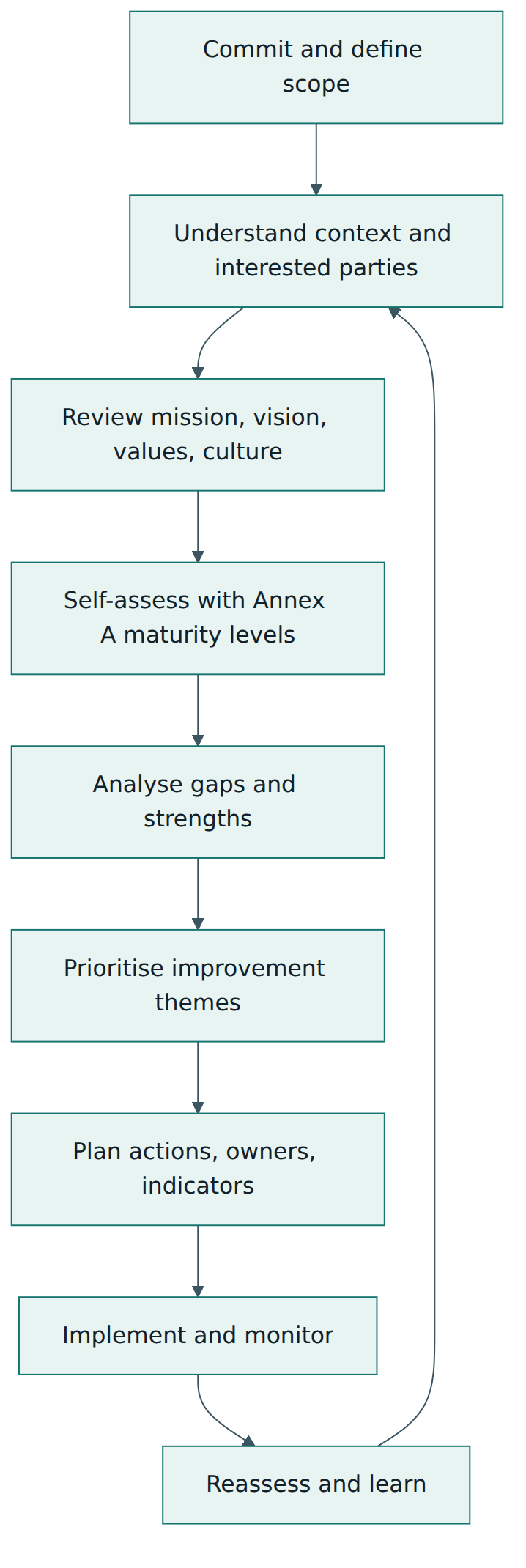
Organisations that use ISO 9004 well treat it as a repeating cycle rather than a one-off project. A common pattern looks like this.
- Commit and scope. Top management agrees why it wants to do this, which part of the organisation is in scope (the whole company, a division or a site), and who will take part. Clear purpose prevents the self-assessment from becoming a box-ticking exercise.
- Understand the context and interested parties. The team lists relevant interested parties, their needs and expectations, and the main external and internal issues. Many organisations already have this from ISO 9001; ISO 9004 encourages going deeper, for example by ranking parties by influence and by the risk of not meeting their needs, and by looking further ahead.
- Review identity. Leaders check whether the mission, vision and values are written down, current, consistent with the context and actually reflected in the culture. A short employee survey or a few focus groups help to test the last point.
- Self-assess. Using the Annex A maturity descriptions, the team rates the organisation topic by topic and records the evidence behind each rating.
- Analyse the gaps. The team looks for patterns: which topics are weakest, which gaps matter most for strategy and for key interested parties, and where strengths can be reused elsewhere.
- Prioritise and plan. A small number of improvement themes is chosen, each with an owner, objectives, indicators and a time frame, and built into normal business planning rather than run as a side project.
- Implement and monitor. Actions are carried out, indicators are tracked and progress is reviewed at regular management meetings.
- Reassess and learn. After a set period, often a year, the organisation repeats the self-assessment, compares the results and asks what it has learned about itself and about the process.
Turning identity into action
One of the most practical ideas in ISO 9004 is that a clear identity should flow down into everyday work. The vision and mission inform the strategy; the strategy is broken into objectives for the organisation, then for functions and processes, and finally into targets that individual teams can influence. This is often called deployment of objectives. Each level should be able to explain how its targets support the level above. When this chain works, people understand why their work matters. When it breaks, you see departments optimising their own numbers at the expense of the whole.
Values and culture need the same attention. A value written on the wall but contradicted by how managers behave does more harm than no value at all. ISO 9004 encourages leaders to check the alignment between stated values and observed behaviour and to act on the difference, for example through how they recognise people, how they react to bad news and how they make trade-offs between short-term results and long-term health.
Managing resources broadly
In practice, clause 9 often reveals the biggest surprises. Organisations that manage money and equipment carefully may have no plan for critical knowledge held by a few long-serving experts, no view of which technologies could disrupt them, or no understanding of their dependence on scarce natural resources such as water or energy. ISO 9004 asks leaders to think about each type of resource in terms of availability, risk and opportunity, and to treat key suppliers and partners as part of the organisation's capability rather than as interchangeable vendors.
Measuring what matters
Clause 10 encourages a small, balanced set of indicators that reflect the organisation's strategy and the needs of its key interested parties. A balanced set usually includes lagging indicators, which show results after the fact (such as customer retention or profit), and leading indicators, which give early warning (such as employee engagement, near misses or the share of revenue from new services). Indicators are then analysed for trends and causes, compared with targets and benchmarks, and reviewed by management so that decisions are based on evidence. Internal audit, self-assessment and management review are three complementary tools here: audit checks whether arrangements are followed and effective, self-assessment measures maturity against a model, and review brings it all together for decisions.
Improvement, learning and innovation in practice
ISO 9004 distinguishes three ways of getting better. Improvement covers the steady stream of small and large changes that make existing products, services and processes work better, using tools such as root-cause analysis and Plan-Do-Check-Act. Learning is about building capability: sharing lessons, developing people and creating an environment where mistakes are discussed openly. Innovation goes further, introducing new or substantially changed products, services, processes or business models. Because innovation carries risk, the guidance encourages organisations to judge when innovation is needed, for example when the context is changing fast, to give it resources, and to manage the risks in a structured way rather than avoiding innovation altogether.
Lesson 5 – Assessment, certification and compliance
No certification, by design
The most important fact about assessment against ISO 9004 is that there is no ISO 9004 certification. The document is guidance and is not intended for certification, regulatory or contractual use. Accredited certification bodies certify against requirement standards such as ISO 9001, not against ISO 9004. If anyone offers you an "ISO 9004 certificate" as if it were equivalent to an accredited ISO 9001 certificate, be sceptical and ask exactly what is being assessed and on what basis.
This is not a weakness. Because nobody is grading you for a certificate, there is less temptation to present a polished picture. The value of ISO 9004 depends on honest self-assessment, and the absence of a pass or fail decision makes honesty easier.
The five-level maturity scale
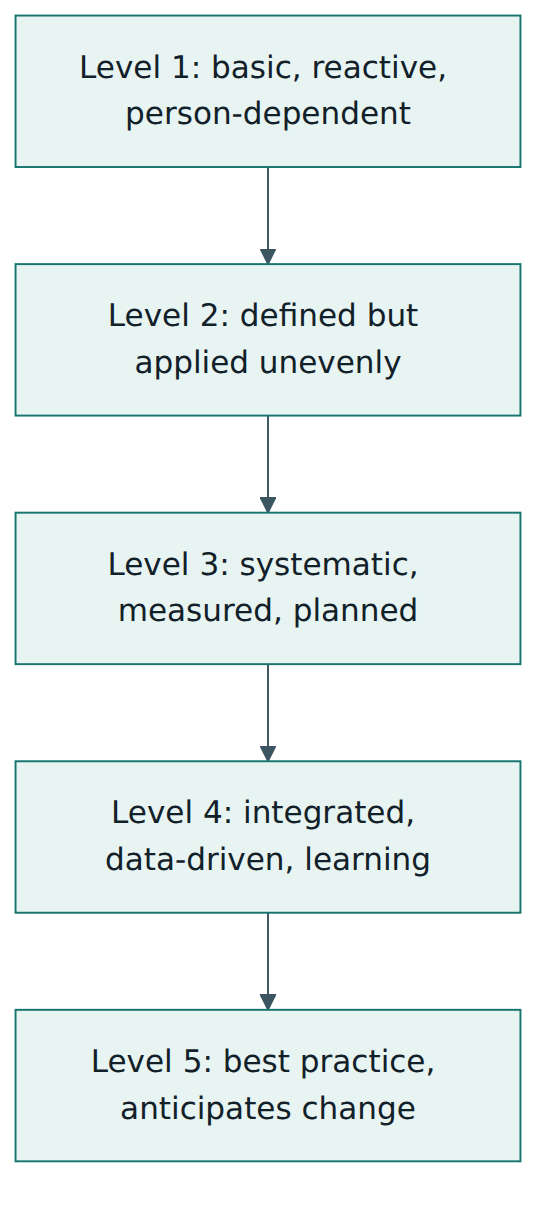
Annex A uses a scale of five maturity levels. Level 1 describes a basic state and level 5 describes what the document regards as best practice; the levels in between describe progressive development. The exact wording differs topic by topic, but the general pattern is easy to recognise:
- Level 1: practice is basic and largely reactive. Things happen because individuals make them happen, and results are inconsistent.
- Level 2: a defined approach exists for the main areas, but it is applied unevenly and improvement is mostly a reaction to problems.
- Level 3: a systematic approach is applied across the organisation, results are measured and improvement is planned.
- Level 4: the approach is integrated, data-driven and continually improved; results are good and the organisation learns from others.
- Level 5: practice is a recognised reference for others, results are sustained over time and the organisation anticipates change rather than reacting to it.
Treat these summaries as a teaching aid: the actual Annex A descriptions are more specific for each topic, and you should use them, in your own licensed copy of the standard, when you rate your organisation.
Running the self-assessment
Annex A can be used at two depths. A quick, high-level pass across the main topics gives leaders a picture of overall maturity in a single workshop. A detailed pass, topic by topic and clause by clause, takes longer but produces a much richer basis for planning. Many organisations start with the high-level pass and go deeper only where the first pass suggests weakness or strategic importance.
Whichever depth you choose, a few rules make the result credible:
- Use evidence, not opinion. For each rating, note the facts behind it: data, documents, examples, survey results. A rating that nobody can explain is not useful.
- Involve several perspectives. Ask different levels and functions to rate independently and then discuss the differences. A wide spread of ratings is a finding in itself.
- Rate the reality, not the intention. A plan that has not been carried out yet does not raise the maturity level.
- Do not average away the story. An overall average hides the most useful information. The profile, showing which topics are strong and which are weak, is what guides action.
- Keep the scale stable. Use the same descriptions and approach next time, so that changes in ratings reflect real progress.
How the results are used
A self-assessment is only valuable if it changes decisions. The output should feed directly into strategy and business planning: the weakest topics that matter most for strategy become improvement priorities, with owners and indicators, and progress is reviewed in normal management meetings. Some organisations also present the profile to their governing body or board as an honest picture of organisational health.
External input without certification
Although there is no ISO 9004 certificate, organisations can still bring in outside eyes. Options include an experienced external facilitator who challenges ratings, peer reviews with another organisation, benchmarking studies, and assessment against business excellence models that do have external assessment and award schemes, such as the EFQM Model or the Baldrige Excellence Framework. ISO 9004 sits comfortably alongside these: it shares their aim of long-term organisational performance but remains a self-assessment tool.
Relationship to compliance
Using ISO 9004 does not, by itself, demonstrate compliance with any law, contract or certification scheme. If your customers or regulators require ISO 9001 certification, you still need it. ISO 9004 can, however, strengthen the system behind that certificate, because a more mature organisation tends to have fewer nonconformities, better-informed management reviews and more effective improvement.
Lesson 6 – Worked example
This example is fictional but realistic. It shows how a mid-sized organisation might apply ISO 9004 over roughly eighteen months.
The organisation
Northbank Pumps designs and manufactures industrial water pumps and offers maintenance services. It has about 450 employees on two sites and has been certified to ISO 9001 for twelve years. Audits are uneventful. However, the board is worried: revenue growth has stalled, two large customers have asked about remote monitoring that Northbank cannot offer, staff turnover in engineering has risen, and a single-source supplier of motor windings had a fire that halted production for three weeks. The chief executive asks the quality manager, Priya, to propose "something beyond ISO 9001" that will help the leadership team see the organisation clearly.
Step 1 – Commitment and scope
Priya proposes using ISO 9004 as a self-assessment framework. The leadership team agrees on a purpose (find the three improvement themes that would most improve long-term success), a scope (the whole company), and a timetable (a high-level self-assessment within two months, action plans in the following budget cycle, reassessment after twelve months). The chief executive personally chairs the workshops, which signals that this is a leadership exercise, not a quality-department project.
Step 2 – Context and interested parties
The existing ISO 9001 context analysis lists customers, regulators and suppliers. In the ISO 9004 workshop, the team widens the view. It adds employees, owners (a family trust that values long-term stability), the local communities around both plants, a university that supplies graduate engineers, and technology partners. For each party it records needs and expectations and ranks them by influence on Northbank and by the impact on Northbank if those needs are not met. Two insights emerge: customers increasingly expect data and digital services, not just reliable pumps; and young engineers expect modern tools and visible career paths, which explains part of the turnover.
Step 3 – Identity
Northbank's mission statement, written fifteen years earlier, says it "builds the most reliable pumps in the region". Nobody can find a written vision. A short staff survey shows that people are proud of product reliability but describe the culture as cautious and slow to try new ideas. The leadership team rewrites the mission to focus on keeping customers' water systems running, which naturally includes services and monitoring, drafts a vision of becoming a trusted partner in water-system performance, and adds "learn and try" to its values. It recognises that changing the culture will take far longer than changing the words.
Step 4 – Self-assessment
Fourteen people from different levels and functions rate each topic independently using the Annex A descriptions, then meet to agree a consensus with evidence. A simplified extract of the result:
| Topic | Consensus level | Key evidence |
|---|---|---|
| Context and interested parties | 2 | Analysis existed but was narrow and rarely updated |
| Identity | 1 | Outdated mission, no vision, values not linked to behaviour |
| Leadership, policy and strategy | 2 | Annual budget but no multi-year strategy deployed to teams |
| Process management | 4 | Well-defined, measured manufacturing and service processes |
| People | 2 | Rising turnover; no structured career development for engineers |
| Organizational knowledge | 2 | Critical design know-how held by three senior engineers |
| Technology | 1 | No scanning of emerging technologies such as remote monitoring |
| Externally provided resources | 2 | Single-source critical supplier; relationships purely transactional |
| Analysis and evaluation | 3 | Good operational KPIs, few leading or strategic indicators |
| Improvement, learning, innovation | 2 | Strong corrective action, little structured innovation |
The ratings from the shop floor and from the leadership team differed by two levels on culture and communication. The team treats this gap as a finding: leaders believed communication was good; employees did not.
Step 5 – Prioritisation
Rather than trying to raise every topic, the leadership team asks which gaps matter most for its new vision and for its most important interested parties. It chooses three themes for the first year:
- Strategy and identity: a three-year strategy built on the new mission and vision, with objectives deployed to every department.
- Technology and innovation: a small cross-functional team to develop a remote-monitoring service with a technology partner, with a defined budget and stage gates to manage risk.
- Resilience of knowledge and supply: capture and share critical design knowledge through mentoring and documented design rationale, and qualify a second supplier for motor windings.
Process management, already at level 4, is deliberately left alone apart from normal continual improvement. The team also agrees to fix the communication gap through regular open forums led by the chief executive.
Step 6 – Indicators and monitoring
Each theme gets an owner from the leadership team and two or three indicators. For example: percentage of department objectives explicitly linked to the strategy; number of customers piloting the monitoring service; voluntary turnover among engineers; number of critical components with a qualified second source. Progress is reviewed monthly in the leadership meeting and quarterly in the ISO 9001 management review, so ISO 9004 work is integrated with the existing system instead of running beside it.
Step 7 – Reassessment
Twelve months later the same group repeats the self-assessment. Identity rises to level 2 and technology to level 2; strategy reaches level 3. People and knowledge improve more slowly, as expected. The monitoring service has three paying customers. A second winding supplier is qualified. The team also learns about the process: next time it will involve two key customers in the context workshop and will start the detailed clause-by-clause assessment for the people topic, where the high-level view was not enough to plan effective action.
What the example shows
Northbank did not need a new certificate or a new manual. It used ISO 9004 as a mirror: it widened its view of who it depends on, clarified what it wants to be, measured honestly where it stood, chose a few priorities that mattered and built them into normal management. The certificate it already held stayed in place, and the system behind it became stronger.
Lesson 7 – Relationship to other standards and frameworks
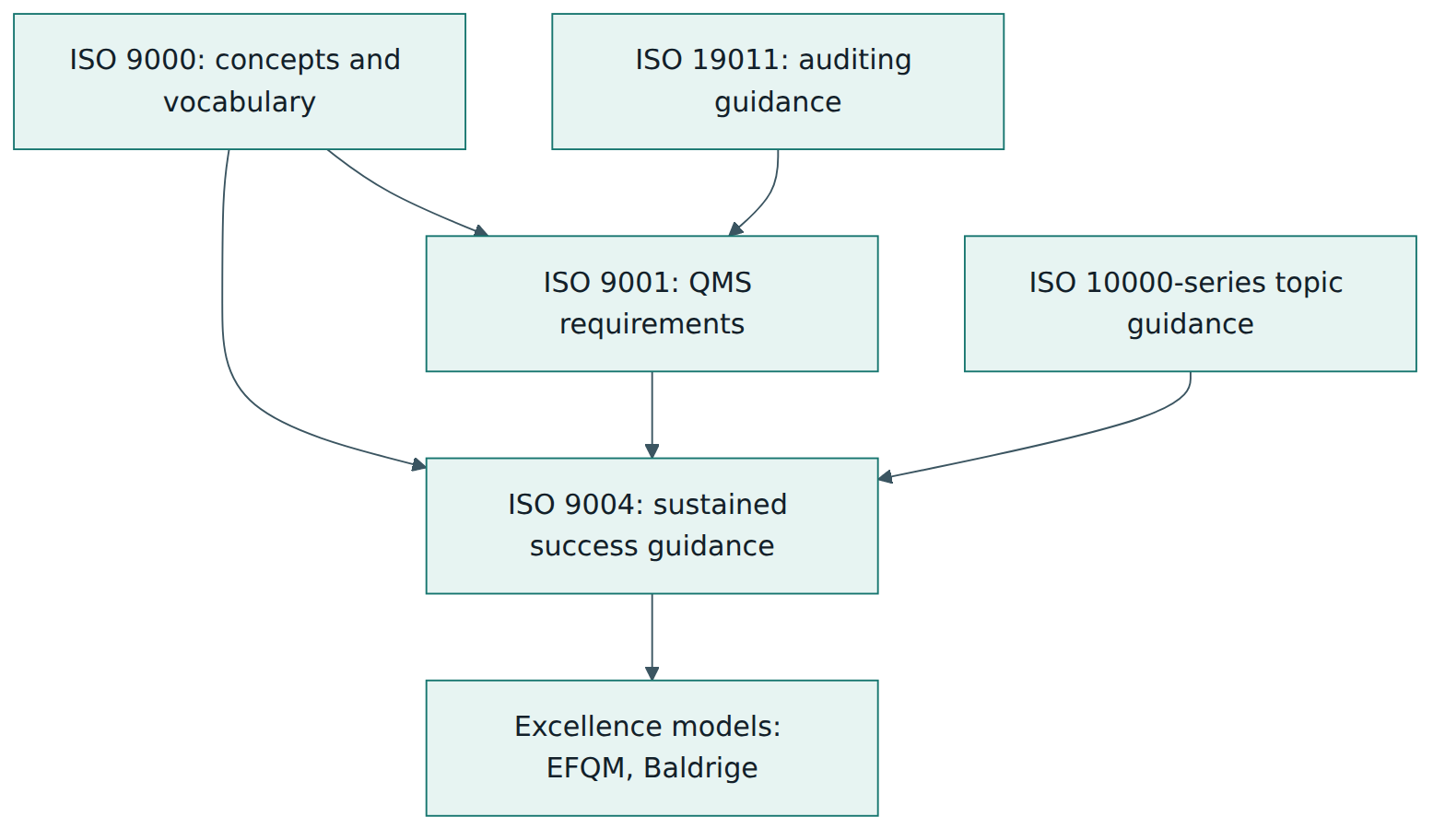
ISO 9004 belongs to the ISO 9000 family maintained by ISO/TC 176, and it is often discussed alongside business excellence models. Understanding the neighbours makes it clearer what ISO 9004 is for.
| Standard or framework | Owner | Type | Main purpose | Relationship to ISO 9004 |
|---|---|---|---|---|
| ISO 9000 | ISO/TC 176 | Fundamentals and vocabulary | Defines quality management concepts, principles and terms | Indispensable reference; ISO 9004 uses its terms and principles |
| ISO 9001 | ISO/TC 176 | Requirements, certifiable | Requirements for a QMS that consistently meets customer and legal requirements | ISO 9004 goes beyond it towards long-term success; most users of ISO 9004 already have ISO 9001 |
| ISO 19011 | ISO | Guidance | Guidelines for auditing management systems | Supports the internal audit part of performance evaluation; audit checks conformity, ISO 9004 self-assessment measures maturity |
| ISO 10000-series guidance (for example on customer satisfaction, people engagement and financial benefits) | ISO/TC 176 | Guidance | Detailed guidance on specific quality topics | Useful deep dives when a self-assessment shows a weak area |
| EFQM Model | EFQM | Excellence model with external assessment and recognition | Framework for organisational transformation and performance | Similar aim and maturity thinking; EFQM offers external assessment and awards, ISO 9004 does not |
| Baldrige Excellence Framework | NIST Baldrige Performance Excellence Program (USA) | Excellence framework with award process | Criteria for performance excellence across leadership, strategy, customers, workforce, operations and results | Comparable scope and spirit; many organisations use ISO 9004 as a stepping stone towards such models |
ISO 9001 and ISO 9004 side by side
The simplest way to remember the pair: ISO 9001 helps you be reliable for your customers; ISO 9004 helps you be successful for the long term for all the parties you depend on. ISO 9001 is about conformity with requirements and is assessed by auditors; ISO 9004 is about maturity and is assessed by the organisation itself. ISO 9001 focuses on the quality of products and services; ISO 9004 focuses on the quality of the organisation that produces them. They are complementary: you do not have to be certified to ISO 9001 to use ISO 9004, but in practice the two work best together, and the ISO 9001 management system gives ISO 9004 a solid base of processes, data and reviews to build on.
The revision of ISO 9001 to its 2026 edition does not change this relationship. Topics that the new ISO 9001 emphasises, such as quality culture and ethical behaviour, are themes that ISO 9004 already explores in its guidance on identity and leadership, which makes ISO 9004 a useful companion for organisations working through the transition.
ISO 9004 and excellence models
ISO 9004, EFQM and Baldrige share the belief that long-term performance comes from leadership, strategy, people, processes, partnerships and learning working together, and that results for all stakeholders matter. They differ in format and use. Excellence models come with their own scoring logic, trained external assessors and recognition schemes; ISO 9004 is a shorter, ISO-style guidance document with a self-assessment annex and no external scheme. Organisations sometimes start with ISO 9004 because it uses the same vocabulary as their ISO 9001 system, and move to an excellence model later if they want external recognition.
Common pitfalls and best practices
Pitfalls
- Treating ISO 9004 as a certification target. Spending effort on chasing a certificate that does not exist, or buying a non-accredited one, misses the point. The value lies in the self-knowledge and the improvements.
- Delegating it entirely to the quality department. Identity, strategy, resources and innovation belong to top management. Without their active involvement, results stay on paper.
- Inflating the ratings. Rating intentions instead of reality, or letting the most senior person set every score, produces a flattering profile and no useful priorities.
- Trying to improve everything at once. A long list of actions across every topic overwhelms the organisation. A few well-chosen themes deliver more.
- Running it as a one-off event. A single self-assessment with no follow-up and no reassessment creates cynicism and wastes the effort.
- Writing values that nobody lives. Updating mission and values statements without changing leadership behaviour, recognition or decision-making leaves the culture unchanged.
- Copying text from the standard into policies. Guidance is meant to be adapted. Reproducing it word for word creates documents that do not reflect the organisation and may breach copyright.
Best practices
- Start with a clear purpose. Decide what decisions the self-assessment should inform, such as the next strategy or budget cycle.
- Combine perspectives. Collect independent ratings from different levels and functions, discuss the differences, and record evidence for each consensus rating.
- Link results to strategy. Prioritise the gaps that matter most for the vision and for key interested parties, not simply the lowest scores.
- Integrate with the existing management system. Feed actions and indicators into management review, objectives and audits rather than creating a parallel system.
- Use a balanced set of indicators. Combine leading and lagging measures that cover customers, people, partners, finances and the wider community.
- Repeat on a regular cycle. Reassess on a fixed rhythm with the same method, so progress and learning are visible.
- Invite outside challenge. Use benchmarking, peer review or an external facilitator to test your view of yourself.
Summary and key takeaways
- ISO 9004:2018 is guidance for achieving sustained success; it is not a requirements standard and there is no certification against it.
- Its central idea is the quality of an organisation: how well its own characteristics enable it to meet the needs and expectations of its relevant interested parties over time.
- The guidance runs from context and interested parties, through identity, leadership, processes and resources, to performance evaluation and improvement, learning and innovation.
- Organisational identity (mission, vision, values and culture) is the foundation for policy, strategy and objectives, and must be lived, not just written.
- Annex A provides a self-assessment tool with five maturity levels; the value comes from honest, evidence-based ratings and the resulting profile.
- Self-assessment results should drive a few prioritised improvement themes, built into normal planning, measured and reassessed regularly.
- ISO 9004 complements ISO 9001 and uses ISO 9000 vocabulary; excellence models such as EFQM and Baldrige share its aims and add external assessment.
Reflection questions
- Think of your own organisation. Which of its interested parties would you rank as most relevant to its long-term success, and which of their needs are currently least well met?
- Write down your organisation's mission, vision and values from memory. Where does the culture you observe day to day support them, and where does it contradict them?
- Pick two topics from ISO 9004, for example organisational knowledge and technology. What maturity level would you give each today, and what evidence would you show to justify that rating?
- If a self-assessment showed a large gap between how senior leaders and front-line staff rate the same topic, how would you investigate and act on that difference?
- Your organisation already holds an ISO 9001 certificate. Make the case to your leadership team, in five sentences, for what ISO 9004 would add and how you would keep it from becoming extra bureaucracy.
Further reading and official sources
- ISO 9004:2018 – Quality management – Quality of an organization – Guidance to achieve sustained success (catalogue entry) – ISO
- ISO/TC 176/SC 2 – Quality systems (committee site, published standards and guidance) – ISO/TC 176/SC 2
- BS EN ISO 9004:2018 – product page and summary – BSI
- ISO 9001 – Quality management systems – Requirements (catalogue entry) – ISO
- Quality management principles (brochure) – ISO
- ISO 9004:2018 – catalogue entry with status and stage – SNV (Swiss Association for Standardization)
- Baldrige Performance Excellence Program – NIST
- The EFQM Model – EFQM
Original tutorial by xOps School (DevOpsSchool Private Limited), written from public sources about ISO 9004. Not affiliated with or endorsed by the standard's owner; standard names are trademarks of their owners. Buy the official standard from its publisher for the authoritative text.